
Early Voting Starts for June Primary
Clip: Season 8 Episode 46 | 14m 38sVideo has Closed Captions
Early voting starts for the June Primary Election.
Early voting starts for the June Primary Election.
Problems playing video? | Closed Captioning Feedback
Problems playing video? | Closed Captioning Feedback
Nevada Week is a local public television program presented by Vegas PBS
Early Voting Starts for June Primary
Clip: Season 8 Episode 46 | 14m 38sVideo has Closed Captions
Early voting starts for the June Primary Election.
Problems playing video? | Closed Captioning Feedback
Where to Watch Nevada Week
Nevada Week is available to stream on pbs.org and the PBS app.
Providing Support for PBS.org
Learn Moreabout PBS online sponsorshipNevada's Primary Election season starts May 23.
Right now, nonpartisan voters make up the largest group of registered voters in the state; and if you're one of them, you will not get to vote in any partisan primary races.
That's because Nevada has a closed primary system, meaning only registered Republicans can vote for Republican candidates, and only registered Democrats can vote for Democratic candidates.
Efforts to change that are underway.
Meanwhile, experts continue analyzing how a recent Supreme Court ruling could impact Nevada elections.
Joining us to explore these issues are former Republican State Senator Warren Hardy; and founder of Vote Nevada, also a CSN History Professor, Sondra Cosgrove.
Welcome back, both of you, to Nevada Week.
Sondra, you believe that nonpartisan voters in Nevada should get to vote in partisan primaries.
Why?
(Sondra Cosgrove) Because they're taxpayers, and taxpayer funds pay for those elections.
And as a woman, I find it ironic that I'm told that it's wrong to force me to produce a marriage license in order to register to vote, but yet it's perfectly okay to say I should have to join a private political organization in order to be able to vote.
-Okay.
But you are referencing something that has not yet passed, the Save America Act.
Okay.
So that's not happening quite yet, but it's a possibility.
Just to clear that up.
Okay.
Warren, what do you think about voting in partisan primaries by nonpartisan voters?
(Warren Hardy) You know, I'm a big-- I've evolved into a big supporter of open primaries for different reasons than Dr.
Cosgrove.
Under closed primaries, we've got the far right that controls those primaries on the Republican side and we've got the far left... So think of it as, I would say, MAGA and Woke.
And those are the folks that get through the primaries into the general elections.
So moderates or people in the center, which the overwhelming majority of the country is either center left or center right, really doesn't have much of a say in general elections.
So I completely support open primaries for a different reason than Dr.
Cosgrove.
-Help our viewers understand the opposition to open primaries, though.
There is a concern that maybe someone who is truly a Democrat could register as a Republican and then get in and try to mess with the primary.
-But that's not an open primary.
So what you're talking about is a semi-open primary, where I could walk in and say I'm going to vote a Democratic ballot or a Republican ballot.
Open primary is everybody's on the same ballot, and you pick one.
So if I, if I was a registered Democrat and I voted for the Republican, well, then I'm voting against the Democrat.
-Hmm.
-Everybody-- So right now in our judicial races, in our mayor races, everybody's on one ballot.
You get to pick one person.
If you don't pick the person that you want, they're not going to win.
-So what you're proposing could potentially end up with, I guess, two Republican candidates in the race for governor in November?
I'm a little confused.
-We get whoever the voters pick.
It doesn't matter about the parties.
The parties do not control our democracy.
They're not in our constitution.
Voters are.
So if voters pick two Republicans, then we get two Republicans.
They might pick two Democrats.
-And would it only be the top two vote getters?
-If we went the way that California does it, we'd be top two.
-Okay.
-I mean, the Democrats are wringing their hands about that very issue right now.
There's five Democratic candidates for governor and two Republicans.
And they're doing the calculus that two Republicans might advance.
So I get it.
Those are-- But those are things that should be dealt with in your party structure, right?
That shouldn't-- We shouldn't build, we shouldn't build our process around that.
I think the reason we've had difficulty in Nevada is that we've had this ranked-choice voting concept, which is very confusing for the public.
I think the first time when it passed, people just said, yeah, open primary, they get to vote whoever I want.
The second time it came around, which was required constitutionally, the opposition was able to confuse the issue by trying to explain ranked-choice voting, which is a very complicated thing, where your first choice and then your second choice.
And it's just-- But it's confusing to the public.
-You need voter education.
-No, 100%.
We need voter education in a lot of ways, but I think that's the reason it's had difficulty--not the concept of open primaries themselves, but the confusion about how they're going to work.
-So that was Question 3, which was on the 2024 ballot.
It did not pass in 2024.
It did pass in 2022.
And that combined open primaries and ranked-choice voting.
How is this potential ballot question you are proposing, because you are proposing to have open primaries on this ballot-- -Actually proposing to say that every voter has to be treated equally in every election that's taxpayer funded.
And then the state can decide what that looks like, because there's many variations of open primary.
But I think a lot of nonpartisans would like to just be able to vote for the person.
If I want to vote for you, I shouldn't be told I can't if I'm an eligible voter.
So that would be everybody just on the same ballot.
-Okay.
And how does that-- -Which is required by the Voting Act of 1965, right?
That's what's required, equal treatment.
-Yes.
-Which we're going to talk about.
But how would this ballot measure differ from Question 3?
-So Question 3 was open primaries, top five candidates move forward to the general election.
And then voters can rank their candidates when they vote in the general.
All we're doing is saying put in the voter bill of rights that's in our constitution that every voter has to be treated, be treated equally in every election that's taxpayer funded.
-So Question 3 had opposition from both Democrats and Republicans.
And that was the combination of primaries and the ranked-choice voting.
Warren, do you expect that what Sondra is proposing will have the same amount of opposition?
-From the internal operations of government and political parties, yes.
There is a perception that each party somehow benefits from the current system.
But they don't matter at the end of the day.
I think to Dr.
Cosgrove's point, if we can do a good job of educating the public about what this really means and, more importantly, what it doesn't mean... And I think talking about it in the context of being constitutional under both the state Fair Voting Act and the federal Act, people will, I think, look at it in a different way.
-So if that does get on the ballot, what is the status of that?
-Still, we're running into a very weird problem when it comes to getting the petition signed.
A lot of the young people who are registered nonpartisans--there are about 55% nonpartisan--when we put the piece of paper in front of them, they're looking at us and saying, I don't want to put my signature and address on a piece of paper when I don't know what you're going to do with it.
So because of a lot of the privacy issues and kind of weird AI stuff we're having, they don't trust.
They get out their phone and they're like, I want to use two-factor authentication.
Don't you have a QR code?
So we're actually thinking about doing another ballot initiative that's statutory to allow for electronic signature in two years.
-Do you think that this is going to get on the ballot this year then, the open primary question?
-I think it's going to be close.
-Okay.
If it does get onto the ballot, it would have to pass in this election and the next general election in order to amend the Nevada Constitution, similar to the voter ID measure that passed in 2024 and is coming back again this year.
Let's move to the Supreme Court ruling on the Voting Rights Act of 1965.
This stems from a case out of Louisiana.
Districting-- The district map was redrawn, and it resulted in the addition of a second majority black district.
So Louisiana has six U.S.
House districts, two of them would have become a majority black district.
The Supreme Court ruled that that redrawn map relied too much on race and violated the constitutional principle of equal protection under the law.
This has led several states to try and redistrict ahead of the midterms.
What impact will this have in Nevada?
Sondra, you start, and then Warren.
-I don't think it's going to have an impact here.
No one has said they're going to sue.
No one has said-- The governor hasn't said, I'm going to call the DOJ in, Department of Justice.
So I don't think it's going to have any impact now.
After the election, we could see something happen.
-What about you?
-Yeah, I agree.
I don't think there's anything short term that's going to change in Nevada.
We're not looking at redistricting for political purposes.
We're not looking at any of those things.
But I think it's going to drive a really serious discussion among academics, among the legal jurists, and hopefully the public about what the original intent of the Voting Rights Act was.
It was to ensure that everybody had equal access.
Nobody was to be discriminated against for any reason, really.
And that sort of evolved into what we now do in gerrymandering and redistricting.
We do it along racial lines.
We do it along socioeconomic lines.
We do it along rural lines-- all these sorts of things.
And I think it's important that as Nevadans we protect the ability to decide how we want our redistricting to be done and do it whenever we want.
That's what the Constitution provides for.
In Nevada, we have a unique, interesting thing that says we can look at community of interest.
So even, even if, you know, depending on how the case law plays out at the federal level, continuing to do party lines the way we do them, I think, has that extra level of protection in Nevada because it specifically says you can look at special interest groups-- or what's the word, not special-- community of interest.
-Such as?
-So it might be people who live in a certain area.
It might be people who share an ethnic background.
It's kind of a very loose definition.
But people who say they're a community of interest in Nevada get the ability to argue that they're a community of interest.
And so the people can be involved in ways in this state that I don't think they're involved in other states.
-Typically redistricting will happen across the country every 10 years after the newest census.
And that's what happened here in Nevada.
Do you expect any attempts at redistricting before the next go-around, before the next census?
-I don't think so.
-Not in Nevada.
-No.
-Why?
-Just because I don't think anybody believes it will have the impact it has in other states.
-Right.
-This has become a political thing by the administration to try to move votes in the midterm.
And is it going to work?
It might.
I mean, if you'd have asked me weeks ago whether this was going to be a typical midterm where the President in power is unpopular, I would've said yes, it's going to be a bloodbath for Republicans.
All of those dynamics still exist.
But with the redistricting and the seats that it has changed, there's a possibility even under that scenario Republicans could hold on to both houses.
-Let me ask you this: How do you redistrict nonpartisans?
When you've got a huge number of nonpartisans and many of them are new voters, how are you supposed to figure out where on the map they go?
-You have to go back to a very fundamental, basic one man, one vote, which I think is what the founders intended.
But you have to, in my opinion, sort of have to go back to that as a starting point to say, We're going to start with one man or woman.
It's always said one man, but one person, one vote.
We're going to go back to that as the basis for making our decisions.
Then we'll tweak these other things as we go.
But it's interesting, because everybody-- because it feels right and it's socially and morally right to make sure during the 1960s that we had black districts and we had inclusion and we had diversity.
But what if you replace race with religion or, you know, income bracket and redistrict based on that?
That wouldn't be acceptable to anybody.
So just like many things in government, in my opinion, we need to go back to the founding and say, What did they mean and what are we supposed to be doing?
The only way to deal with what you're talking about is by going back to this basic fundamental one person, one vote.
-Is that what you are promoting in your fight for the establishment of an independent redistricting commission in the state of Nevada?
-Yes.
-What would that accomplish?
-So what we were proposing-- And it's the Democratic attorneys that sue us to knock it off the ballot every time.
What we were saying is let the majority and minority leaders in both houses of our legislature each pick one person--so we're assuming two Democrats and two Republicans--and then they get to pick three nonpartisans.
So then that way the Republicans and Democrats can't collude, because you would need the three nonpartisans to go along with you, but our legislature exempts itself from the open meeting law.
What we're saying is this commission would take it away from the legislature and be under the open meeting law so we can see what they're doing.
-And see how they are attempting to redistrict the state.
-Yes.
-The attorneys who have fought against your measure, their argument is that what you're proposing does not establish a revenue source to pay for this new entity and that it would be an unfunded mandate, which the Nevada Constitution prohibits.
-Not true.
-So the Nevada Constitution says that if you run a statutory ballot question--you're going to change a law, you're going to create new law--then if it's going to cost money, you have to include a tax.
In 2022 the Nevada Supreme Court reinterpreted that language to say it also meant constitutional amendment, even though ballot questions "enacting constitutional amendment," that language is not in the constitution.
So what we did is we took down the independent redistricting ballot question and we put up a second ballot question to say the Nevada Constitution does not require you to put taxes in the constitution if you run a constitutional ballot question.
-We have run out of time.
Warren Hardy, Sondra Cosgrove, thank you for joining Nevada Week.
-Thank you.
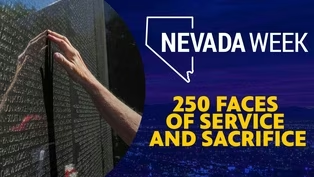
250 Faces of Service and Sacrifice
Video has Closed Captions
Clip: S8 Ep46 | 6m 29s | A Henderson photographer captures portraits of service members for America’s 250th birthday. (6m 29s)
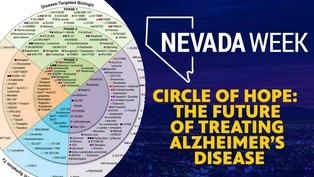
Circle of Hope: The Future of Treating Alzheimer’s Disease
Video has Closed Captions
Clip: S8 Ep46 | 3m 35s | The Circle of Hope offers families and doctors a yearly glimpse into future Alzheimer’s care. (3m 35s)
Providing Support for PBS.org
Learn Moreabout PBS online sponsorship New Episode
- News and Public Affairs

Top journalists deliver compelling original analysis of the hour's headlines.
 New Episode
- News and Public Affairs

FRONTLINE is investigative journalism that questions, explains and changes our world.
 New Episode
 New Episode
 New Episode
 New Episode
 New Episode
 New Episode
 New Episode
 New Episode
Support for PBS provided by:
Nevada Week is a local public television program presented by Vegas PBS