
Eastern Kentucky Flooding: Housing Crisis Grows
Clip: Season 1 Episode 170 | 6m 27sVideo has Closed Captions
How the housing crisis in Eastern Kentucky was made worse by historic flooding
How the housing crisis in Eastern Kentucky was made worse by historic flooding six months ago and what is being done to improve the situation. Originally Aired 1/26/23
Problems playing video? | Closed Captioning Feedback
Problems playing video? | Closed Captioning Feedback
Kentucky Edition is a local public television program presented by KET
Eastern Kentucky Flooding: Housing Crisis Grows
Clip: Season 1 Episode 170 | 6m 27sVideo has Closed Captions
How the housing crisis in Eastern Kentucky was made worse by historic flooding six months ago and what is being done to improve the situation. Originally Aired 1/26/23
Problems playing video? | Closed Captioning Feedback
How to Watch Kentucky Edition
Kentucky Edition is available to stream on pbs.org and the free PBS App, available on iPhone, Apple TV, Android TV, Android smartphones, Amazon Fire TV, Amazon Fire Tablet, Roku, Samsung Smart TV, LG TV, and Vizio.
Providing Support for PBS.org
Learn Moreabout PBS online sponsorshipWe continue our look at Eastern Kentucky's recovery following catastrophic flooding six months ago with thousands of homes destroyed by the flood.
The greatest challenge is finding people a place to live.
But as housing experts in the region will tell you, eastern Kentucky was already dealing with that challenge well before the flood.
Housing Development Alliance, a hazard based nonprofit that builds affordable housing for low income families, says even before the flood, about 40% of people living in the region were inadequately housed.
That includes those who are homeless, doubling up with other families living in substandard housing or spending more than 30% of their income on their house payment or rent.
The organization said the issue can be linked to an appraisal gap and affordability gap.
The appraisal gap is when the cost of building a home exceeds the appraised value.
The affordability gap is the gap between the appraised value of the home and what the buyer can afford.
The Housing Development Alliance is working to build new, affordable homes in the counties hit hardest by the flooding.
The project is funded by a grant from the Foundation for Appalachian Kentucky.
We spoke to both organizations and a flood survivor who's getting one of those new homes.
All say while it's a start, it doesn't begin to meet the need.
We had a housing crisis before the flood.
Having you took a bad situation and made it a lot worse.
When this flood hit, it exacerbated that housing crisis.
The flood didn't didn't discriminate, but the people who can afford it the least were the people who suffered the most.
They were closest to the creek.
They had the least amount of foundational support to withstand the flood.
I can't go back where I lived because the land was completely destroyed.
I lived in a double wide and there was the top, the the back half, the whole probably 50, 60, 70 feet of the land had actually washed out.
It was eroded.
And it just the back half of my house was just standing there in like 30 feet up in the air.
My son and daughter in law live in northern Kentucky, and they came and were able to get to us.
And so we stayed up there until the end of Thanksgiving or Thanksgiving weekend.
And we found a rental embrace it.
It was so hard even for us just to find a rental.
And it was just accidental mentioning to a person that no person.
That's how we found out.
I think one in six families in the hardest hit counties applied for FEMA.
And so it's hard, you know, if you start with a broken housing market and you lose 400 houses that got that literally washed away and another 1800 or 2000 that worsened differently damage and probably need to be replaced.
There's just no place for those people to go.
There's no extra capacity to absorb that.
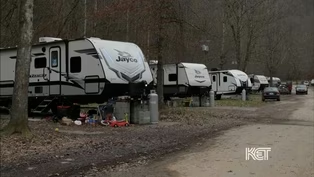
And now as I drive back in areas, there's just every little spot that could possibly have a travel or travel trailer or a small trailer or anything.
They're just stuck everywhere because all the the land that at one time was never flooded.
It's it's just gone.
And and nobody knows what to do.
The need is significantly more with this event because of the lack of insurance.
FEMA says 4% of applicants or that they had had flood insurance.
So 96% of the people who are trying to recover from the flood started with nothing.
The foundation took in 8000 applications for assistance right off the bat, and we mapped out all of the addresses that we had that said they were either fully destroyed or partially destroyed, and that came to about 5000.
We made the first $1 million investment in a movement called Housing Can't Wait.
The foundation was great.
They stepped up really early on and said, Here's some money, get busy.
We've committed to doing at least 20 houses as fast as we can.
A friend Tell me about the Housing Development Alliance that were helping the flood some flood victims.
And so it was a few weeks before we heard anything, but actually that they did say they could help us.
So we are in the process of getting everything together to actually build a new house.
It will be in Perry County and it's it's like maybe 15, less than 20 minutes from where I lived originally.
I'm just thankful to have somewhere to go.
Many do not.
We know that's just a drop in the bucket to the need.
When we talked about long term recovery and talking about building thousands of houses, that's not something that can happen overnight.
But people need housing today.
And so people are living in all sorts of different situations.
We know people who are staying in houses that are not completely repaired.
We've seen people buying mobile homes and bringing them and setting them right back up where they're mobile home washed away.
And it is I think it is desperation.
And that's one of the reasons why we really desperate for the state to fund some of the recovery.
Our legislature didn't put any housing dollars in the first emergency bill, and I think that was wrong.
One of the things we're being told is, well, you're not ready to spend the money.
You haven't even spent all this money.
The problem with that is, in order to be ready to spend the money, you have to know what's coming.
We're going to do ourselves a disservice if we spend all of our philanthropic dollars first and then let the state say, How do I how do I you know, what kind of money do we need?
We need all the things.
So we need to be stacking that philanthropic money in that state.
Money and that federal money with now and with any money that might come later.
We know if we don't have any resources, if we don't know what's coming, we can't even give people hope.
And more than anything right now, our people need hope.
According to Scott McReynolds, around 70% of the families impacted by the flood did not live in a designated flood zone.
He said that presents a challenge when they're trying to help a family determine whether they should rebuild on their property or move somewhere else.
Eastern Kentucky Flooding: Life After The Flood
Video has Closed Captions
Clip: S1 Ep170 | 2m 40s | Displaced survivors from the flooding in Eastern Kentucky find shelter at state parks (2m 40s)

Video has Closed Captions
Clip: S1 Ep170 | 5m 1s | Meet rescue dog Ethan Almighty (5m 1s)
Providing Support for PBS.org
Learn Moreabout PBS online sponsorship
- News and Public Affairs

Top journalists deliver compelling original analysis of the hour's headlines.

- News and Public Affairs

Today's top journalists discuss Washington's current political events and public affairs.











Support for PBS provided by:
Kentucky Edition is a local public television program presented by KET