
Eastside Development Sales Tax
Season 3 Episode 2 | 26m 46sVideo has Closed Captions
The Flatland team examines the projects funded by the development tax for KC's Eastside.
In 2017, voters approved a 1/8 percent sales tax with the goal of spurring economic development in disadvantaged neighborhoods of the city. So far, the Central City Economic Development (CCED) sales tax has awarded over $53 million and funded 39 projects. This month, Flatland in Focus investigates these projects and gages their effectiveness in addressing economic disparities in Kansas City.
Problems playing video? | Closed Captioning Feedback
Problems playing video? | Closed Captioning Feedback
Flatland in Focus is a local public television program presented by Kansas City PBS
Local Support Provided by AARP Kansas City and the Health Forward Foundation
Eastside Development Sales Tax
Season 3 Episode 2 | 26m 46sVideo has Closed Captions
In 2017, voters approved a 1/8 percent sales tax with the goal of spurring economic development in disadvantaged neighborhoods of the city. So far, the Central City Economic Development (CCED) sales tax has awarded over $53 million and funded 39 projects. This month, Flatland in Focus investigates these projects and gages their effectiveness in addressing economic disparities in Kansas City.
Problems playing video? | Closed Captioning Feedback
How to Watch Flatland in Focus
Flatland in Focus is available to stream on pbs.org and the free PBS App, available on iPhone, Apple TV, Android TV, Android smartphones, Amazon Fire TV, Amazon Fire Tablet, Roku, Samsung Smart TV, and Vizio.
More to Explore
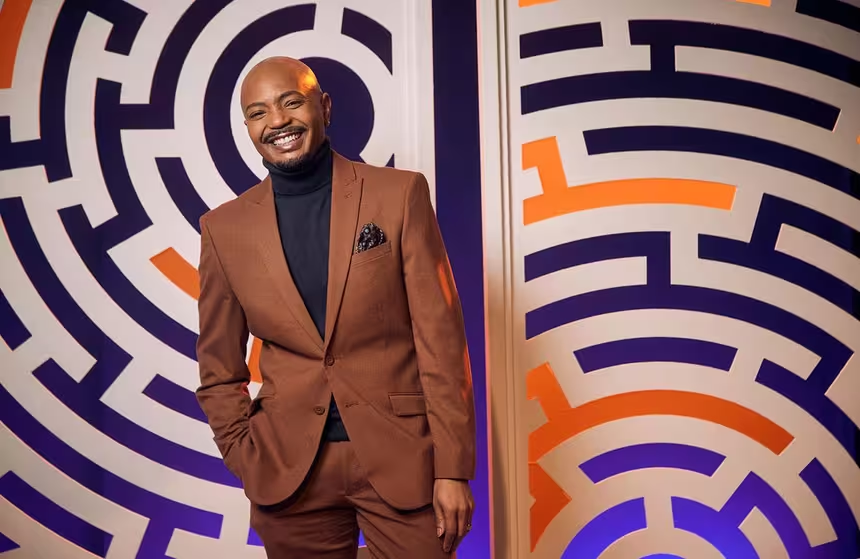
Meet host D. Rashaan Gilmore and read stories related to the topics featured each month on Flatland in Focus.Providing Support for PBS.org
Learn Moreabout PBS online sponsorship- [Narrator] "Flatland in Focus" is brought to you in part through the generous support of AARP, the Health Forward Foundation, and RSM.
- Hi, I'm D. Rashaan Gilmore and welcome to "Flatland in Focus."
Today, we're taking a look at the Central City Economic Development Sales Tax in Kansas City and how the projects that have received those funds thus far are impacting communities in need of investment.
(gentle upbeat music) Since voters approved the 1/8 cent sales tax back in 2017, more than $53 million have been allocated to nearly 40 projects that aim to revitalize the central city.
An area that has historically been disinvested in redlined.
But a recent audit of the program has stirred questions about the effectiveness of the process by which the CCED board has recommended projects to city staff charged with overseeing those contracts.
Community members and developers have raised concerns over how long some projects are taking to get approved and prioritized by the city.
Let's take a look at some of the projects that have been completed so far and hear from board members and community members about whether or not the initiative is helping to transform the central city.
(gentle music) - [Narrator] We say the rising tide floats all boats.
If you're a citizen of the Kansas City, you would want the underserved to be brought up to where we could be a viable city.
It could be a livable community.
It would be a place where everyone would feel safe.
- [Speaker] We got out.
Would you like to pull it?
Okay, pull it.
(kids yelling) (shoes clacking) (group chattering) (gentle music) - My wife started Kiddy Depot in a house.
We'd signed a lease to a 3,000-square-foot building at, which is right up the street here.
Then after five years, rent's more than doubled.
We had to pack up.
So I'm gonna get out here and we're gonna build our own.
And I had no idea how I was gonna do that.
The banks tell you they want 20%, until they understand you're gonna build a multimillion dollar facility in a blighted neighborhood.
Blighted surroundings and household incomes at that time, which were less than $30,000 a year.
Hard sale, we had no debt and were turned down for the loan by six banks.
About that time, I learned of the Central City Economic Development Tax Fund, and we were fortunate enough to be awarded, I think I was the second project awarded in the first round.
We were awarded financing, predicated on receiving the million dollar grant from Kansas City.
That was the caveat that made this development possible.
And without that million dollar grant from the city, we wouldn't be here today.
- CCED, it's a sales tax that was approved by voters in Kansas City that allows for an incentive for economic development and a boundary in what's known as central city, runs from 8th Street to Gregory Paseo to Indiana.
Projects would be scored with a objective scorecard that had like a series of metrics that ranged from number of jobs created to a number of housing units if they were affordable.
If it was a mixed-use project, we would take those things, score the proposals, and then make a series of recommendations based on the, you know, quality of those projects.
It was the city's responsibility to determine which projects are gonna be approved or not approved, and do the whole contracting process and get money out the door.
We were just a recommending body.
I was proud to serve on it 'cause it's so important and this needs to be successful.
The community really needs it.
But, you know, it was really hard.
There was a common complaint from developers and community members as well, that they had a really hard time getting a hold of people at the city or getting responsive, timely answers to things.
Sometimes we ourselves would try and get ahold of city staff to say, "Hey, you know, what's going on?"
Like, I mean, truly rarely get a response.
You know, what made this worse was that this was during COVID, especially in the aftermath where you had this massive inflation on building materials and labor costs and these delays, you know, ended up really threatening the viability of a lot of these projects.
You know, why is it that some of these projects haven't, you know, finished?
It's like, well, the cost increased so much for them that, you know, in some cases it was equal to or greater than the incentive.
It was a job.
I mean, it really was.
They were volunteers and it's supposed to be like any other board or commission.
I mean, these type of calls and these answers and stuff, that should be something that you're talking to like an executive director about, you know, for the program, not me, you would think would be the opposite, where it'd be, you know, the easiest, most seamless process when you're doing it in an area town that needs the most.
But unfortunately, it was the opposite.
- When we in the community got behind this initiative to actually tax ourselves because of the lack of equitable investments east of truce.
What we wanted the city to do was to set up an operation for the CCED with staff in the community outside of the walls of City Hall.
The mayor has turned a deaf ear to those requests and so, you know, it's just an unfortunate situation as we consistently find ourselves in when it comes to investing in our communities with the greatest need that are most highly populated by people of color.
- The mayor appoint people to fill vacancies hasn't been done.
Contracts are still waiting by the wayside to get processed.
There are several people that got approved that they've taken the money back from.
That's not anything that has to do with CCED board or anything.
That's the process and that's where I think people in the community are falling victim to the process.
I think the concept of it was good.
It could have been successful and it still could be.
The Linwood Shopping Center looks great.
It's been redeveloped.
Emmanuel Child Development Center, finally Kelvin Simmons project over on 1900 Vine.
I think those projects have been successful.
- That's your money shot.
- This is one of the largest private development projects in the 18th and Vine area in modern day history.
To do projects of this scale and of this magnitude, CCED alone doesn't do it.
But if you don't have CCED, the conversation doesn't begin with investors and people that might wanna do a project like this.
They want to be able to see that their return on their investment is going to be equal to if not better.
But the reality is, when you're doing projects on the east side, the market still does things that we don't control.
Financial institutions for one, number two, appraisals, number three, the environmental issues that we face.
All of those things take place on the east side.
Not saying that it doesn't happen on the west side, but I can tell you when it comes to return on investment and it comes to evaluations, they're different.
And in some cases we're trying to eradicate blight.
In other communities, you're trying to give an amenity and you're trying to advance a community with some things that are really nice.
There's a difference there.
Is it big enough?
No.
Are we hoping that it would be reauthorized?
Yes, because again, the conversation about development projects like this, don't even start if you don't have a CCED fund.
- You know, it was a pilot program, it was new, it was new to everyone, so it was new to us, it was new to the board, it was new to the city.
But the benchmarks that has been able to achieve far outweighs the lack thereof.
Better than 40% of childcare facilities closed as a result of the pandemic.
What that did, it left the heavy lifting to those that were able to survive.
Childcare is another essential part of our economy.
It creates sustainability for employers.
Employers have second and third-shift employees that otherwise wouldn't have anywhere to leave those children, thus affecting their bottom line and their profit margins.
Access to capital is the reason that our community looks like it does.
I would also challenge 'em in saying, if we don't have this ascent sales tax, they must be happy with what they see here today.
- You know, those are all good projects.
Our vision was for transformative, impactful, development, which means we would not have these little development over here and then a little something over here.
And we told the community, we're gonna take this tax burden and you're gonna see a difference in the quality of your life.
We're gonna see economic development in your community.
We're gonna have affordable housing, we're gonna have retail, we're gonna have recreational spaces and safe places for our children to play and gather.
And we came back that up.
So I won't go to the voters asking for renewal unless something significant changes between now and the time that the tax expires.
- I think that the tax has done a lot of good.
I really do.
I think that there're some of the projects that are, you know, under construction now that have finished are really important, you know, transformational projects in the areas they sit.
But the city's gotta do a lot better with it.
It's one of the few things that exist to make sure that you can get something in the central city that you can't get at 12th and Broadway instead.
- All right, welcome back for the discussion portion of today's program and with me around the table, we have Ken Bacchus, who is the President of Urban Initiatives Group and the Treasurer of the CCED board.
Kelvin Simmons, Co-developer and Co-owner of One Nine Vine Development Project.
Bishop James Tindall, senior of the Urban Summit, President and Founder.
Thank you Dr. Bishop Tindall for being here with us.
And then Dr. Vernon Howard, President of the Southern Christian Leadership Conference of Greater Kansas City.
And I am so privileged to also welcome our only elected official at the table today, Melissa Robinson, 3rd District Councilwoman.
And you know, sort of before we get into today's discussion, we asked for some the city staff to be present.
They were either unavailable or did not get back to us, but we're glad to have you as an elected official to be able to speak on behalf of the city.
And I just wanna do a little bit of a level set if I can, and particularly with Bishop Tindall and Dr. Howard, because you two are both very instrumental in seeing this dream be realized.
And so I just kinda wonder from your perspective, do you feel like the CCED is meeting the intent that you have for it?
- No.
- No.
Okay.
That's a very firm no.
You care to say why or in what ways.
- We had a dream of rebuilding the inner city.
We asked for the tax to have a place, a building within the inner city, a executive director and a staff.
None of those things have happened.
- I think what Bishop is referring to is the ability for us as a community to create something and establish something that is long-term that will be an effective investment tool that will counter the disinvestment, the social subjugation, the economic withdrawal that has taken place within the areas of concern.
And what we see is, without the structural apparatus pieces in place, then what happens is we lose the capacity to be a long-term sustainable viable investment tool for the change of the system and the structure.
And so if we do these things, we are beyond the individual granting of funds for projects that are good.
However, we lose the opportunity to have systemic and structural change because there is no relocation of the apparatus within the urban core, within the inner city where most poor, underemployed, unemployed, struggling, suffering black and brown people live.
- So let's talk about that for just a moment because the CCED is a sales tax that was approved for a 10-year period and we've got about four years left on that.
So that was back in 2017.
And it seems to me that of the $53 million that have been so far raised from these tax revenues that we're talking about 40 projects that have moved through multiple rounds.
I just wonder if you have a take on why that apparatus, the infrastructure to make it really be successful was not, or is not in place.
- It always started with a level of bureaucratic challenges.
Our city staff have never really felt very warm and fuzzy about this idea.
And so it's something that did take the vote of the people to do that.
And there is this culture, this longstanding culture at City Hall that continues to be oppressive to disinvested neighborhoods.
And so that's why it is important to have a standalone entity that their sole responsibility is to look after these disinvested communities and to advance, use this as an investment tool to advance development.
But at the same time, we have to look at, you know, absence of these investments.
When you think about the amazing work that, you know, Kelvin Simmons is doing to bring in mixed-income neighborhoods back to the 18th and Vine area.
So there's been some great things that have happened, but it's been, you know, in spite of the challenges at 414 East 12th Street at City Hall.
- But what is your take, Kelvin, I mean, you've got a project that's moving through the, you know, One Nine Vine project.
I'm just interested to know, do you feel like the... From your side as a developer, that the project that the initiative is meeting with its potential?
- I have to play the hand that was dealt to me and the CCED, I would say that, but for CCED, a project like mine would never go forward.
The conversation wouldn't even start.
Now, in most of these cases, a large project, the size and scope of something, like I have $26 million project.
There are multiple layers of, you know, investments and subsidies.
Would I like to see some things differently?
Yeah, I would.
- Speak to those, tell our audience what those things are that could be improvements to the process.
- So a private developer that's allowed to get additional investment, higher investment and other things like that.
If we could do it all over again, instead of getting a grant, I'd probably have a low interest loan.
- Gotcha.
- Where you've got some entities out there that have low interest loan, like MHDC and things like that, that could be forgivable over a period of time.
I'd probably do that one differently in hindsight.
- Ken Bacchus what are your feelings and your thoughts on how all of this is unfolding?
And of course, you have a very unique role with CCED.
- Well, it is a series of unfortunate.
I think, the city would never wanted it.
The city manager didn't want it.
Mayor James didn't want it.
We actually got it to passed.
But once we got to City Hall, they promised us they would do whatever they could do to make it work.
And that they would provide the staff at no cost against the fund.
- And how is that working out?
Because as that seems to be that the issue, the word that Dr. Howard used was apparatus.
That infrastructure that should be supporting it.
- The people at City Hall that are in housing and community development four, three and a half or four years ago, they're gone.
The folks that are there now have almost no experience in doing these kind of developments and projects.
What we're not pleased with is there's no technical assistance to the community.
There's no place you can walk into and talk to people about how this work.
We've funded several small community-type development projects.
If they had the technical assistance, their project would probably completed.
- It is the grassroots community.
It is poor people, it is marginalized people.
It is people who have been disinvested from, who had the vision and the strength and the power to put together this proposal, take it to the people in spite of the fact that the powers of government denied it- - Denied.
- And didn't want it.
And we forced it to be a reality.
Remember, the red line of disinvestment in our area has been going on for a century or more.
We're talking about decades of disinvestment, of redlining, of not allowing equity of investment in our communities.
It is the city of Kansas City, Missouri's moral obligation and responsibility to ensure that equity of investment happens in our community.
- Okay.
- And it is not happening.
- And so.
- And that is the reason.
And the justification for what the Bishop is saying- - [Rashaan] Well, I wanna go back to Bishop Tindall.
- That has to be independent and it has to be something that our lawyers, our professional people and staff run to ensure that it happens the way it's supposed to.
- Well, and I'm glad for what you said because it raises the question of is this intentional?
I mean, we're talking about $53 million pot of money.
- We've had zero, almost zero support in the management at City Hall to help us.
We've been fighting left and right.
We now have a cadre of support, including Councilwoman Robinson that are assisting us, but is different in some of the alphabet soup groups like EDC, PIA and all of them.
They have a staff and they have an attorney assigned to them that write their ordinances, push it through City Hall, staff attorney we have is an assistant city attorney at City Hall whose main job is certainly not us, but is they're responsible to us, which means we don't really receive the level of support we should.
We need to be physically in the community.
We need to have people hired in the community who know the community and they need to have the qualifications necessary to provide the technical assistance to help people move their projects through.
- It seems to me then that the issue is that we don't have the infrastructure that we need to move contracts through, some of the technical assistance.
I'm just curious to understand why there is this sort of resistance.
- The challenge for me in this conversation though, we're talking about $53 million.
We're talking about taxpayer dollars that are precious.
We're talking about the historic investment in the community.
We're talking about some great projects that have happened that have transformed our community, including a 24-hour daycare center that helped to make sure people could go to work.
And in the backdrop, I'm thinking about a $270 million deck over I 670 that was funded, just like that.
Our community needs more.
We need to be talking about how these projects are transforming the community.
We need to yes.
Be talking about how do we make it better and build capacity in ways that we've never done before.
But there's a lot going on in the city and we need to be focused on what is the trajectory for the 3rd District, What is the trajectory for disinvested parts of our 5th District?
- But let's look at 2005 and let's look at, for instance, Berkeley River Park, right?
2005 you just had a bike trail, nothing else- - Right.
- Right.
2005 you have a port authority.
Port authority is an entity that is one of those economic development- - Quasi-governmental.
- Quasi-governmental.
Yep.
Developers weren't even going down there 'cause you had to clean up a lot of that.
That was down there.
MGE had a lot of storage tanks that were there.
Developers said, "No, we're not gonna deal with that.
That's port authority."
Fast forward today as of probably a month, six weeks ago, port authority issues probably 700, $800 million in revenue bonds for the new Kansas City current development, right?
That's going to transform and change that entire area just in a, you know, few years.
If you really think about it, 2005, 2006 to today, there's going to be almost a billion dollars spent in an area where nothing was there to issue almost $800 million in revenue bonds.
But to only have CCED money coming into to 18th and Vine, that's no apples and apple's comparison.
But when the city really wants to do something and wants to move, you can.
- Well, I think that's the bigger point here.
If there were, you know, a serious interest in making sure that.
It could be supported and could really thrive, and we see.
The promise of CCED.
Realized, well, you put support behind that.
I think that for a lot of folk on the east side, and that's the area of the community that I come from very proudly so, and I know that for many years, there's sort of this collective zeitgeist that many of us share in that feels like, "Was this the moonshot for east side development?"
I think what a lot of people fear is that with the renewal coming up and not seeing things move fast enough, that there won't even be the energy to get the renewal through in just four years.
And of course, campaigning around that has got to start sooner than later.
And so I just, first you, Ken Bacchus and then Councilwoman.
- Today, the commission has recommended $53 million in projects and the council has approved all of those recommendations.
Those recommendations has bought in $480 million of money, private dollars.
That's in addition to the 53 million.
If you take $100 of what we've done today, taxes put in $11.
Private sector has put in $89 to every $11 we put in.
That is almost unheard of in some places.
But are we where we need to be?
No, these are catalytic projects.
They are making a difference in these communities.
They're making some changes, but they're not necessarily as quick as they should be.
We see how to make it happen.
- We want the same deal that the other parts of the city gets.
And that takes, yes, CCED, but it also takes other investments from the city and the private sector.
- Do you think based on where we are today, that if this piece of legislation was back up before the voters, that they would support it again and that we would see this kind of strong support, we saw initially?
- Voters, I believe responded to a moral call as having looked at the history that we have talked about of disinvestment in our community, but it also took the strength and courage of grassroots mobilization.
- [Rashaan] Right.
- And I don't think the name of the Urban Summit has been spoken here in this context, but it should be because we're talking about a nonprofit advocacy group that brought the vision and the energy and the mobilization to the table.
It's time for the city of Kansas City, Missouri to step up and say, "We support this with our mouths."
But also it's time for the commission, which has the power to present to the city council and the city manager and the mayor.
These kinds of structural, capacity building, changes that we are talking about making that Bishop is talking about.
In order to move beyond 2017 to make this systemic and structural, it is easy to say, "It wasn't done."
It's very difficult to say, "Commissioners, why was it not done?"
- We need to make certain that the mayor and the city manager is on board with it as well.
We believe we're moving down that pathway.
As I mentioned some, the 10 projects that were proposed recommended back in March that the council heard in May, three or four of those are already have contracts.
This is just, I mean, as of two weeks ago.
- If you can get four contracts out, how come you can't get an executive director or a building?
- That's not what I'm saying.
- Or staff.
That's crazy.
- No.
What I'm saying.
- It doesn't make sense.
- We have been working on getting independent out in the community offices and staff.
We have never stopped doing that.
We are now actually receiving support inside City Hall for that to happen.
Councilwoman, I think I'm saying that correct.
Now, the administrative part of all of these projects, if it's, even if it's EDC, their projects have to come through council as well through ordinances.
But the difference is, they have the staff and they have the legal people.
We have none of that.
- The community led by the Urban Summit with the help of SCLC, NAACP, Urban League and a host of grassroots organizations, we're advocating for that to be the first thing that happens.
Why?
Because the infrastructure is there to make this long-term and sustainable.
- It sounds like the bridge between where we are and where we wanna be is not quite as long as it might seem.
And to your point, Mr. Bachhus, it seems like a lot of that effort is moving that way.
But I think there's one of, it's one of momentum.
Councilwoman, we will give you the last word and then we'll wrap.
- There is a new city council that's been seated and so to the points earlier, I think that there is more receptivity.
We're very hopeful that we'll be able to turn the tide and that we're also hopeful that the voters of Kansas City will have confidence to understand the importance of this investment and continuing.
- Well, that's where we wrap up today's conversation for this episode of "Flatland in Focus."
You've been hearing from Treasurer of the CCED board, Ken Bacchus.
Co-owner of the One Nine Development Project, Kelvin Simmons.
Bishop James Tindall, Senior President and Founder of the Urban Summit.
And thank you for your leadership on this issue, Bishop Tindall.
And Dr. Vernon Howard, President of the SELC of Greater Kansas City.
3rd District Councilwoman, Melissa Robinson, thank you as also as always for being a guest on the show with us.
And be sure to check out the rest of our reporting on the CCED sales tax at flatlandkc.org.
You can also join us on Instagram at flatland _kc to join our livestream discussion, ask all of your questions on this topic.
We would love to have you.
I'm D. Rashaan Gilmore and this has been "Flatland in Focus."
As always, thank you for the pleasure of your time.
- [Narrator] "Flatland in Focus" is brought to you in part through the generous support of AARP, the Health Forward Foundation, and RSM.
(upbeat music)
Preview: Eastside Development Sales Tax
Preview: S3 Ep2 | 30s | The Flatland team examines the projects funded by the development tax for KC's Eastside. (30s)
Providing Support for PBS.org
Learn Moreabout PBS online sponsorship
- News and Public Affairs

Top journalists deliver compelling original analysis of the hour's headlines.

- News and Public Affairs

FRONTLINE is investigative journalism that questions, explains and changes our world.












Support for PBS provided by:
Flatland in Focus is a local public television program presented by Kansas City PBS
Local Support Provided by AARP Kansas City and the Health Forward Foundation