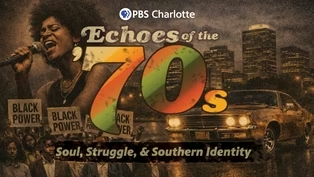
Echoes of the '70s | Soul, Struggle, & Southern Identity
Echoes of the '70s | Soul, Struggle, & Southern Identity
7/9/2026 | 58m 6sVideo has Closed Captions
Explore how the 1970s transformed Charlotte in this new Living History documentary.
Take a trip back to a time when Uptown was a ghost town after five, Eastland Mall was the place to be, and Charlotte was just beginning to dream bigger. Explore the people, places, and pivotal moments that transformed a quiet Southern city into the Charlotte we know today. Don't miss this latest chapter of our Living History Series Echoes of the '70s: Soul Struggle and Southern Identity
Problems playing video? | Closed Captioning Feedback
Problems playing video? | Closed Captioning Feedback
Echoes of the '70s | Soul, Struggle, & Southern Identity is a local public television program presented by PBS Charlotte
Echoes of the '70s | Soul, Struggle, & Southern Identity
Echoes of the '70s | Soul, Struggle, & Southern Identity
7/9/2026 | 58m 6sVideo has Closed Captions
Take a trip back to a time when Uptown was a ghost town after five, Eastland Mall was the place to be, and Charlotte was just beginning to dream bigger. Explore the people, places, and pivotal moments that transformed a quiet Southern city into the Charlotte we know today. Don't miss this latest chapter of our Living History Series Echoes of the '70s: Soul Struggle and Southern Identity
Problems playing video? | Closed Captioning Feedback
Where to Watch Echoes of the '70s | Soul, Struggle, & Southern Identity
Echoes of the '70s | Soul, Struggle, & Southern Identity is available to stream on pbs.org and the PBS app.
Providing Support for PBS.org
Learn Moreabout PBS online sponsorship- [Presenter] This is a production of PBS Charlotte.
(bright music) - [Narrator] The Charlotte you know today didn't exist in the 1970s.
It wasn't a banking powerhouse.
It wasn't one of America's fastest growing cities.
In uptown, it was a ghost town after 5:00.
- In the '70s, I was living in Greensboro.
We looked down on Charlotte.
We thought Charlotte was a secondary city.
- [Narrator] But the federal deregulation of banking and a growing airport changed everything.
- Are you ready?
- [Narrator] From the courtroom to the concert stage, from Vietnam to the final four, from school integration to skyline transformation, this was the decade that changed Charlotte forever.
- [Presenter] Funding for Echoes of the '70s, soul, struggle & Southern Identity, is provided in part by Anne Waters-Dowd, in loving memory of her husband, W. Frank Dowd III.
- [Narrator] Perhaps nothing says that Carolina's more than the official state dance, the Shag, and the beach music that goes along with it.
♪ Just one look ♪ - He said, "Can you sing?"
And I thought, "Can I sing?"
I said, "Yes, I can sing."
- [Narrator] Much like beach music in the Shag, Lynn and David Erdman have had quite the relationship.
- I came to this city with high hopes and they've all been exceeded.
- And we've been singing together ever since.
- [Narrator] In the 1970s, there was no internet, no dating apps, and you couldn't even buy an alcoholic drink in a bar.
Social options were very limited.
- So the opportunities were you needed to meet people at a social place somehow.
- In Charlotte, one option for unmarried guys was the members only Bachelor's Club.
- And it was kind of an old Charlotte group.
And here I was, very much new Charlotte, but I wanted to get to know people who were in Charlotte, so I joined the Bachelor's Club.
- [Narrator] And for the ladies, the Spinsters Club.
- I would say it's kind of a. They're making up something that is fun.
It was the place to be.
- The Spinsters Club.
It's a funny term.
It's an archaic term, it was archaic in 1977 to call an unmarried woman a Spinster, but it was done lightheartedly.
- It was always an event where you invited eligible men that wished to meet other women.
- [Narrator] New members of these esteemed social clubs even got their names printed in the newspaper.
- You figured, okay, well then this is a kind of qualified or okay thing to join.
In other words, its got some respect in the city.
- And the Spinsters would have four or five social events a year.
And they would be at some apartment complex or at Fireman's Hall.
- [Narrator] Lynn and David met at a Charlotte O's baseball game event.
They later married and had two daughters.
- To look back now and our kids think it's hilarious.
Who would ever meet that way?
- [Narrator] As the Erdman's relationship grew, so did the city.
Charlotte in the 1970s looked nothing like it does today, and nothing like it did in the decades that preceded it.
- First half of the 20th century, Charlotte was the center for America's textile manufacturing region from down in South Carolina and Georgia all the way up in Virginia.
Kind of we were the trading city.
But after World War II, that starts to decline.
Textiles move to other parts of the world.
And by 1977 the last big mill closed here.
- [Narrator] Even with the area textile mills closing, Charlotte's population still grew by 30%.
From 241,000 people in 1970 to 315,000 by the end of the decade.
- Charlotte, compared to today, was a small town.
It didn't feel like a small town because it was the largest city in North and South Carolina.
But nationally, it was maybe 40th.
Today we're something like 14th largest city in the United States.
- [Narrator] In 1974, Hugh McColl became president of North Carolina National Bank, which later became Bank of America.
He desperately wanted to make the area a top 25 city.
- To get the people to come here, you had to have something more than we had.
And so I knew what a city was supposed to look like, and ours surely didn't look that way.
It was the most boring damn city I'd ever seen in my whole life.
You couldn't buy a drink.
They had more churches than bars.
It was a remarkably boring town.
- [Narrator] In the 1970s, Harvey Gantt served as a city councilman who worked to create growth that followed the 1966 Odell Master Plan.
- Hugh McColl and I walked up and down Trion Street many a days and talked about what made the Champs-Elysees in Paris great and what does Charlotte have to do to get there?
- There was some development out on Highway 51 at that time, but Pineville was a long way away and Matthews was a long way away.
And Mint Hill was a long way away.
Likewise, Huntersville.
Charlotte was compact.
- [Narrator] Charlotte was a small city.
On par with the likes of Greensboro, Winston-Salem, Columbia, South Carolina, and Richmond, Virginia.
- In the 1970s, I lived in Greensboro.
I worked at the Greensboro Coliseum as an usher.
We looked down at Charlotte.
- The world did not know about Charlotte.
People joked that there was a CH factor, that people confused us with all of the other CH cities.
They were sure that Charlotte was a beautiful colonial port city on the coast of South Carolina, where for some reason, the University of Virginia had been built.
- [Narrator] A few key things happened during the decade that launched Charlotte into a new era of prosperity.
- Wachovia and Winston-Salem used to be the biggest bank in the state.
And so we think of Charlotte being this big bank town, but really it was Winston-Salem had the biggest bank.
And the banks here saw that as competition and were trying to get ahead of them.
- So we had this internal competition within the state on what city was going to explode and move forward.
And part of it was just good luck and good timing.
The other part was damn good leadership.
- [Narrator] Deregulation at the federal level also played a pivotal role.
Opening the door for major bank mergers and interstate banking, which would begin in the early '80s.
- North Carolina actually had some good laws that allowed banks to have multiple branches within the state, which seems kind of weird that you even think about that.
But some states, you had basically one branch per county.
So you never had any bigger banks.
- It wouldn't be till the 1980s that Hugh McColl figured out how to buy a bank outside of Charlotte, Lake City Bank in Florida.
And that's the beginning of interstate banking in the '80s.
- [Narrator] The local banks were in competition, not only with acquisitions and mergers, but in building the city, literally.
- At the time, they were part of the group they called them.
It was Crutchfield and McColl, Rolf Neal at "The Observer."
Other folks who they would get together and decide, "Hey, we need a new bus center in Charlotte.
We need to raise money for Johnson C. Smith.
We need a new hospital."
They would get together and kind of make it happen.
- If the emergence of banks was the catalyst for Charlotte's growth in the 1970s, it was another sector of business playing perhaps an equally vital role.
- The second factor was Duke Power Company.
When Duke Power decided to build three nuclear power plants, not only build them, but design them.
So they hired all these engineers from all the top engineering schools in the nation.
Think of how big of that decision had on Charlotte.
- [Narrator] And the third key element taking Charlotte from Old Milltown to modern day city was a key decision in the '70s to expand Charlotte Douglas Airport.
An airport that didn't have the best reputation following the crash of Eastern Airlines Flight 212 in 1974.
Since the 1930s, the federal government regulated all domestic air travel as a public utility, setting fares, routes, and schedules.
- Used to be you went point to point.
Federal government gave you permission to fly to Greensboro or to fly to Birmingham.
And airlines were greatly limited in what they could do.
- But with mounting talk about lifting those regulations, Charlotte leaders began pitching the idea, not of an airport expansion, but of building an entirely new terminal.
- The first airport bonds failed, even with John Belk as mayor.
The people were in recession, gas prices, long lines at the gas pumps in the early '70s.
Are you kidding?
You want to put money toward an airport?
That's foolish.
- [Narrator] Plans for the new 325,000 square foot terminal were now in motion, and Charlotte gained a huge advantage.
- We expanded the airport before our competing mid-size cities did.
- But what it did was to position us as a hub outside the Northeast, outside of Atlanta.
- [Narrator] All that was left between Charlotte and its future was to get those federal regulations lifted.
- Jimmy Carter came into the White House with the notion of deregulation, and deregulation began with the airlines.
And airlines could fly anywhere they wanted to.
And very quickly, they developed the hub and spoke system.
- [Narrator] In 1979, right as those federal regulations were lifted and new terminal construction underway, Piedmont Airlines left its home base of Winston-Salem and set up shop in Charlotte.
The airport was renamed Charlotte Douglas International.
(plane roars) - And when Piedmont made the decision to move its hub out of Winston-Salem and bring it to Charlotte, then all of a sudden, we had a headquarters.
Eastern was not headquartered in Charlotte.
Piedmont became headquartered here.
and we had direct flights to places that we'd never had before.
- [Narrator] As Charlotte's airport expanded, so did its possibilities.
New flights brought new people, new companies, and new opportunities.
- But it was over a 25 to 30-year period that this happened.
The airport, the banks, and Duke Energy Company.
Without those three things, Charlotte would be a different city today.
(marching music) - [Narrator] Other key things to happen in the 1970s, included the opening of Carowinds Amusement Park in 1973.
The launching of what would become a local food icon, Bojangles, in 1977.
- Bojangles grew up with Charlotte.
And to see the growth has just been tremendous.
- And the arrival of international business machines known to everyone as IBM.
- Late '70s, I think, is when IBM decides it needs a regional headquarters in this part of the world, and it is in Charlotte.
- All of these elements in the '70s led to more people, more jobs, and of course, opportunities.
It all marked the beginning of an economic transformation that would change the region forever.
(upbeat music) While the city's expansive growth hit a new year, not everything was ideal nationwide.
- In addition to the kind of shaky economy, the inflation, the gas lines, we were also in the process of finally admitting that the United States had lost the war in Vietnam.
(guns firing) - [Narrator] Approximately 330,000 service members from the Carolinas served the United States during the Vietnam War.
- And you have your seatbelt on?
- I do.
- [Narrator] David Vipperman of Rock Hill was one of them.
- That's where I went to work.
When I woke up in the day, that was my office.
- [Narrator] His mission on this day?
Enjoy that flying feeling once again.
A far cry from what he was asked to do so many years ago.
- Do I want to accomplish the mission?
Yes.
Am I going to do my best to accomplish the mission I've been assigned?
I'm going to do that if I'm in combat.
- As an Air Force pilot, David flew the biggest, fastest plane of the era, the F4 Phantom.
- None of us took joy in the destruction we brought to each other.
And I know there were missions that I flew that a lot of people surely were hurt.
I find no joy in that.
- It was really stressful because the Vietnam War was the first American war that had ever been televised.
And so it was on TV every night.
- David was one of an estimated 3,000 servicemen who returned to the Charlotte area when the war finally ended.
- Last of the troops and allies are famously evacuated by helicopter.
A lot of those folks come home to Charlotte.
- [Narrator] And it wasn't just American soldiers who came back to the States and to the Carolinas.
- But also a lot of the refugees from the Vietnamese population, people who had helped the United States in the war were not real popular back home.
Charlotte had Catholic refugee services that was a kind of a regional center for relocating refugees.
- [Narrator] In Mooresville, Richard's Coffee Shop, is a gathering place.
Military, museum, and support system dedicated to honoring those that serve.
And also those that didn't make it home.
At Garinger High School in Charlotte, the names of 18 former students killed in Vietnam are etched in a Granite Memorial in front of the school.
Those same 18 names can be found on the Mecklenburg County Vietnam Veterans Memorial.
A 270-foot long carved granite wall in Thompson Park, which honors the 105 county servicemen killed in action.
(bright music) Every generation has a place where childhood starts to loosen its grip.
In 1970s Charlotte, that place had escalators, fountains, food courts, and a thousand storefronts.
Parents saw a place to shop.
Kids saw a place to disappear, and somehow both were right.
- You might not buy anything, you might not shop, you might not eat, you might not do anything.
You just go to hang.
- [Narrator] Before South Park became that kind of place, the drive south felt very different.
- It was all landscape.
They had magnolia trees and big boxwoods.
It was like driving through a park.
- [Narrator] South Park was tied to one of Charlotte's most prominent families.
Cameron Morrison had been North Carolina's governor and senator.
- It was part of Cameron Morrison's farm.
It was part of his dairy farm.
- [Narrator] That land sat south of Charlotte's old retail center.
But Charlotte was spreading out.
Suburbs were filling in, and the stores that defined uptown started looking outward.
- When the Belk family and the Ivy's department store family collaborated to build South Park Mall, that was a revolution.
- [Narrator] For kids nearby, it felt less like history and more like weekends.
- They had a grand opening and everyone in my family went.
I went with my next door neighbor.
We walked over there.
They gave away goldfish in Ziploc bags.
And the key was to try to get it home without it dying.
- [Narrator] Soon, going there did not need a special reason.
- I remember going to that with my parents and, you know, and hanging out and running around and seeing all my friends.
- For kids who could walk there, it changed the map.
- It's like we had arrived.
When I told people I lived near the mall and I could walk there, everyone was jealous.
It was the community for our part of town.
- [Narrator] Working there opened another door.
- To see the mall when it was quiet, closed, and how everything continued as far as maintenance, cleaning.
We thought you were the cool people.
- [Narrator] South Park also had things learned by rumor.
One was tucked inside Sears.
- You could put your fingernails in the elevator, and if you could open the door, it would stop wherever you were.
And the doors would open and you'd see the concrete block shaft.
And everybody knew how to do it because everybody's name was written on the concrete, depending on where you stopped (laughs).
- [Narrator] Not the kind of story developers put in the brochure.
More like mall folklore.
The kind of mischief that made the building feel like it belonged to the kids too.
- Between the escalators, that was the cool place.
You kind of walked a little faster when you got there because you know, you didn't want to get made fun of or something, but the cool people hung out there.
- [Narrator] Those little rules were part of growing up there.
The adults saw stores.
The kids saw territory.
Then Eastland opened in 1975.
South Park had polish.
Eastland had energy.
- It was packed.
And there were so many people there.
Belk's at that time was, was set up in a round.
It was like a round.
And I mean, you could hardly move.
- [Narrator] Cindy Crisp remembers Eastland as the mall that felt built for the younger people.
- It was exciting because it was huge.
It had the Farrell's Restaurant where it would ring the bell.
- [Narrator] Eastland also changed the rhythm of a mall trip.
- They had this new thing called a food court.
You could have any kinds of food you wanted.
You could have pizza, you could have hamburgers.
- They had glamour shots and full restaurants.
- And we got an Orange Julius, which was like big time.
And it even had a Craft salad bar.
- [Narrator] Eastland even turned little fads into events.
- I sold the Pet Rock.
I had a Pet Rock show where I would do the Pet Rock would do tricks and people were lined up at the door - [Narrator] But Eastland's biggest gathering place wasn't a store at all.
- It was hard to get a space to look down because everybody wanted to see.
- [Narrator] For some kids, the rink was something to watch.
For others, it was the reason to go.
- This was the era of Dorothy Hamill.
- [Reporter] A performance without any flaws.
- Being an ice skater was pretty cool.
And even if you fell, being able to get back up and right back to it, that was more what counted because you were pretty tough if you fell and got back up.
- [Narrator] Even if you never laced up skates, Eastland gave you a balcony seat.
- It was fun looking down at everybody too, watching everybody bust.
- Is it called a Zamboni?
When it came, you know, that was like the highlight.
You got to see the Zamboni.
- [Narrator] And at Christmas, the malls became theater.
- My girls still talk about it.
It had things that you didn't see anywhere else, like the Singing Bears.
My youngest daughter would stand there and look at those singing bears for hours if you'd let her.
- [Narrator] In Gastonia, the memory was more personal.
- Gaston Mall was the first place that I was small enough to go sit on Santa's lap.
They would cap the fountain and build Santa's Wonderland with a big huge cushy chair and a gentleman named Charles Elledge.
He was Santa to many, many, many children.
And he would sit there, looked like him, sounded like him to all of us.
- [Narrator] Every mall had its own landmarks.
Different buildings, different rituals.
But by then, every kid understood the language.
You didn't need a plan.
You just needed the mall.
- You didn't have to say anything but let's meet at the mall.
Or let's go to the mall.
And people knew exactly where, and you usually knew where your group met.
- [Narrator] That's what people are really remembering.
Not just the stores, the fountains, food courts, or the ice rink.
They remember a place where childhood gave way a little.
A place safe enough for the parents to let go.
Big enough for kids to disappear for a while.
The malls were built for shopping, but what they gave a generation was really somewhere to go.
(upbeat music) (typewriter clacks) (bright music) (projector whirring) - [Narrator] In the 1970s, America began thinking differently about nature.
Across the country, there was a growing focus on conservation, open space, and the idea that land, water, and air needed protecting.
- I'm learning, Charlotte never really understood the importance of having, like, park, land recreation land.
Unlike other cities, never required developers to, like, set aside land for parks.
So early on, it was basically the generosity of some of our early leading citizens, like Edward Dilworth Latta, engaged the first park, Latta Park.
- There were several other things that happened in the '70s at the federal level that were really important to this kind of movement.
We called it the open space movement.
So the Clean Water Act and the Clean Air Act were all done in the '70s.
- [Narrator] Five years after becoming the fourth campus in the UNC system, UNC Charlotte observed the first Earth Day in April of 1970 with the support of founder and then vice Chancellor for Student Affairs, Bonnie Cone.
This new conservation focus has changed the way communities thought about open spaces.
This was no longer only about playgrounds and ball fields.
It was also about waterways, air quality, and the understanding that growth could erase natural spaces if no one moved to protect them.
- A lot of the early neighborhoods like Dillworth, Myers Park, these were designed by people like John Nolan that were park developers, so they were kind of given these rolling hills kind of thing.
- [Narrator] In the early '70s, Mecklenburg County began what some call one of the most innovative land use plans of the time for an area its size, a system with a broader footprint and vision for acquiring and protecting open spaces.
- In 1974, Mecklenburg County decided that they would develop a park and rec system that had a little bit different focus.
And that focus was to create these large park spaces similar to a state park type feel and to do greenways.
- [Narrator] Among the early voices in that shift, renowned botanist at UNC Charlotte professor, Dr.
James F. Matthews, helped identify natural areas worth protecting.
- The first couple of projects that Mecklenburg County did after they were formed in 1974 was McDowell Park, which is now McDowell Nature Preserve.
- [Narrator] McDowell helped define what that early county model would look like.
A place with room to spread out, a strong connection to nature and the feel of a destination.
- And if you go in there, it has this very state park type vibe.
It has a campground and we have a nature center and we have these big pavilions and you can get out on the water and fish.
- [Narrator] Other projects followed.
Latta Plantation Park.
Now Latta Nature Preserve, became another large county park space.
And by the late 1970s, McAlpine Creek Greenway emerged as Mecklenburg County's first greenway.
Over time, those efforts would grow into something larger.
A park system shaped by two histories coming together.
The city's early neighborhood parks and Mecklenburg County's new push toward larger parks, greenways, and open space.
- Being able to provide a phenomenal park system for our residents is probably the thing that all the employees of Park and Rec try and do because there aren't any great cities that don't have phenomenal parks.
- [Narrator] As Mecklenburg County continues to grow, those early efforts remind us that progress and preservation can go hand in hand.
(gentle music) (bright music) - So this is your grandfather sitting in a meeting with President Jimmy Carter.
- [Narrator] Some legacies are measured in years.
Others are measured by the lives they change.
- Living Black history here in North Carolina.
This is a picture of my son and I, standing beside the statue of my father.
- [Narrator] For Derek Chambers, the son of legendary civil rights attorney Julius Chambers, his is one of courage, conviction, and a commitment to making a difference.
- He was a true champion fighting for justice for all.
My father would take on cases where he would sometimes wouldn't get paid.
He would do it out of the kindness of his heart for his fellow mankind who were in need.
I had one with him and Vernon Jordan.
- [Narrator] Sitting on the couch flipping through old pictures, Derek and his son, Miles, reflect on how Julius' advocacy for African Americans, helped shape our society.
- If it wasn't for the pathway and the movement that they had for civil rights, I said I would've met the people that I met now.
(bright music) - [Narrator] Julius's case that makes them most proud is Swann v. Charlotte Mecklenburg Board of Education.
- It gave the opportunity for all individuals, no matter what background you came from, what side of the city you came from, or us to come together as one.
- [Narrator] He represented the Swans, an African-American couple who wanted their six-year-old son to attend the historically white Seversville Elementary, but were denied by the school board.
Julius filed the initial pleading in 1965.
In 1970, the suit went before the US Supreme Court.
And in 1971, the court decided that the federal courts could use their power to require school districts to integrate.
- One of those remedies can be putting kids on buses so that some of their education, they go to their neighborhood school, some they go to a crosstown school.
- [Narrator] With the ultimate goal of creating more racially balanced schools.
- Charlotte really became a national model for that.
And we saw other cities throughout the south begin to adopt busing campaigns to integrate and desegregate their schools.
- [Narrator] The victory made Julius a household name in the fight for civil rights.
However, the change he fought for, wasn't embraced by everyone.
- We see white residents actively leaving their neighborhoods and fleeing to suburbs that were outside of the city center.
- [Narrator] Historians say suburban growth in Matthews, Huntersville, Mint Hill and Cornelius was already beginning to reshape the region.
But the changes happening weren't driven by just one moment in history.
The aftermath of the Swan case was one piece.
To understand how we got here, we have to go back to the 1960s when the foundation for those changes was first being laid.
- It started with a program called Urban Renewal from the federal government.
(upbeat music) - [Narrator] Which focused on revitalizing cities across the US by demolishing areas that officials said were in poor condition and replacing them with modern structures.
- I think the leaders of the '60s and '70s, were really trying to do what they thought was right.
But in hindsight, they probably did the opposite.
- [Narrator] For white Charlotte leaders, the Brooklyn neighborhood, a longstanding African-American community was at the top of that list.
They were replaced by hotels, government buildings, and offices.
- It was more than a place on the map.
Brooklyn was a city within a city where you had white collar and blue collar persons living beside each other.
Worship, played, lived, and grew up together.
What we have here is a plaque of remembrance.
- [Narrator] Reverend Dr.
Janet Garner Mullen shares what she remembers about growing up in Brooklyn, how much of a tight-knit neighborhood they were, and all the love she felt there.
- To be able to go from house to house and laugh and play in the streets and the smell of nice food coming out of the windows and going to the park and being together as a community.
- [Narrator] She also remembers the devastation that began in 1961 and carried on through the '70s.
When officials destroyed the neighborhood she called home.
- And when we saw these bulldozers and these white people coming over and this man on a bulldozer in a suit smiling as he was tearing down our homes, we as young people, as children, wanted to know why was this happening?
- [Narrator] In the end, over 200 businesses, 13 churches, two schools, and over 1,400 homes were bulldozed, forcing residents to find new places to call home.
For those who settled on the West End, they were uprooted again by interstate construction in the 1970s and 80s.
- And it wasn't just Brooklyn.
There were other pockets of African American residents, the Greenville neighborhood off of Statesville Avenue.
The upshot of that was in the '70s, people who had been displaced from these older Black neighborhoods looked to new areas.
West Boulevard, which had been Black and white, became almost entirely African American.
The Belmont neighborhood near me on the east side, which had been white working class, became almost entirely African American.
In the 1970s, Charlotte was an even more segregated place than it had been 15 years earlier.
- [Narrator] Another part of Charlotte that tells the story of change during this time is Fourth Ward.
By the mid 1970s, this once thriving neighborhood was facing a very different reality with vacant homes, boarded up buildings, and properties that had fallen into disrepair.
But instead of letting history disappear, a group of banks, community leaders, and preservationists saw an opportunity to bring Fourth Ward back to life.
Through low interest loans and restoration efforts, they began saving the neighborhood's historic homes and its story.
Then in 1976, the creation of the Friends of the Fourth Ward helped turn that momentum into a long-term commitment to preservation and revitalization.
Today's Fourth Ward stands as a reminder of what can happen when a community chooses to invest in its past while building for its future.
Where restored Victorian homes now share the block with new housing, restaurants, and modern development.
(gentle music) (bright music) In the 1970s, two presidents came to Charlotte.
Richard Nixon for Billy Graham, and Gerald Ford for the Mecklenburg Declaration of Independence, which celebrated this country's freedom from Britain over a year before our nation did.
Different visits.
Same signal.
Charlotte was starting to matter.
And in the Queen City, politics wasn't just campaigns.
It was faith, business, image, and power.
(crowd cheering) On May 20th, 1975, Freedom Park filled up for President Gerald Ford, where nearly 100,000 people came out.
- I remember they let us out of school.
They bused us there and you had had to bring your lunch.
And I brought a peanut butter sandwich and it was so hot that day.
The peanut butter got all crusty.
- [Narrator] The speech goes in the archive.
The sandwich stays in the memory.
And while kids got sent to see a president, the event wasn't a must see for every adult.
- They didn't take off work, they didn't go.
My mother's not going to waste the day to do that.
- [Narrator] For some, it was a workday.
For others, it felt much bigger.
- It was a big deal to go and to be a part of it all.
And all my friends wanted to be a part because we had this president coming and it was just almost like a social event that season.
You know, to go do that was just the ultimate.
- We welcome to Charlotte, the president of the United States of America.
(audience applauds) - [Narrator] Presidential visits didn't feel routine then.
They felt like the city had been chosen.
- Today presidents come and go.
They show up at the airport, they give a little press conference, and off they go.
When Gerald Ford came he filled the bowl at Freedom Park.
- People were really excited that Mac Deck Day was being acknowledged in advance of the bicentennial.
That was probably more important than the fact that Gerald Ford was the president at the time.
- [Narrator] Not exactly a rally or a concert.
Something quieter and more Charlotte.
- It was like a picnic.
Behavior probably wasn't a lot different from when the symphony would play there.
It was patriotic excitement.
- North Carolina is a showcase of a state that reveres the values of the past while leading the way toward a progressive future.
(audience applauds) - [Narrator] Four years earlier, another president came for a different reason.
As Richard Nixon came to honor Billy Graham.
- To follow Billy Graham is the hardest assignment I've ever had in all those speeches.
(audience applauds) - [Narrator] The public reason was faith, but the political meaning ran deeper.
- Richard Nixon came for a very important visit to connect with the people of North Carolina to show his connections with Billy Graham, recognizing the political power of the Graham family.
- [Narrator] Inside Charlotte Homes, Graham needed no introduction.
- He comes on with those crusades and you weren't allowed to talk because, you know, my grandmother would say, Billy Graham's on now.
- [Narrator] That respect changed the way Nixon's visit landed.
- It was already very controversial.
I would say that Billy Graham was not, which is what was kind of interesting about that.
- [Narrator] Graham gave Charlotte a connection few cities could claim.
- And if all the people of America were like the people of the Piedmont section of the Carolinas, we would have a better nation.
- [Narrator] By the middle of the decade, Charlotte was harder for national politicians to ignore.
- Presidents Nixon and Ford could count electoral votes, and all of a sudden North Carolina was becoming a major player in national politics.
And Charlotte they saw was becoming a major city.
- For Charlotte, the visits felt like pride.
For the presidents, they were strategy.
And between these two ideas stood Mayor John Belk.
- We are proud that President Ford has been here on several occasions.
- [Narrator] Inside the city, politics often move through business names, personal trust, and who had the power to open doors.
That's where Mayor John Belk comes in.
- Even though he had grown up in a very wealthy family, he was really good at being of the people.
- [Narrator] That trust gave him the room.
- He was very much of the old white power structure, but he was a person who would pull other voices in.
Fred Alexander, first Black City Council person in the 20th century, appointed by John Belk.
Ruth Easterling was the first woman.
She was appointed by John Belk.
- [Narrator] He also gave Charlotte a public face.
One that traveled quite well.
- He was probably very welcoming for outsiders.
And any business leaders who came here, he could do the Southern Charm offensive.
- [Narrator] The delivery could sound casual, but the thinking was not.
- He was known for dad jokes.
- For example, if you asked John Belk, why is the airport there?
He'd go, "Because that's where the planes land."
And everyone would just go, "What?"
- Someone said, "Mr.
Belk, have you lived here all your life?"
And he said, "Not yet."
That's John Belk.
- He was almost a caricature of a presence where he'd play this kind of role of plain dumb, and yet he was very smart.
And it had appealed to the common man.
- [Narrator] But becoming a big city meant more than airports and political visits.
It also meant loosening some old rules.
Charlotte, even the night out, came with politics attached.
- This is the Bible Belt.
For a long time, you could not sell a drink of whiskey or bourbon or gin or whatever.
- [Narrator] The workaround was almost ritual.
- If you want a liquor drink, you brought your own bottle and then they charged you for the Coke or whatever and you poured it in.
And they had lockers for the permanent customers to keep your bottle of vodka or bourbon or whatever it might be.
- What it did was to kill the possibilities of nightlife.
- It was a dead city for young people in their 20s.
- [Narrator] In 1978, Mecklenburg County voters approved Liquor by the Drink.
It didn't remake Charlotte overnight, but it loosened the rules.
- When Liquor by the Drink passed in a referendum here, there was on the behalf of musicians and club owners, there was a great rejoicing because it became possible to have an entertainment scene that was not just the church and the country club.
- [Narrator] But decades in, Charlotte was still holding onto the old world, But the city was moving.
Presidents came through.
Billy Graham gave Charlotte reach, and John Belk sold a much bigger future.
Even nightlife started to loosen up.
That day in Freedom Park, Charlotte was celebrating its past.
By the 1970s or about, the future starting to show.
Charlotte was no longer waiting to become something bigger.
Charlotte's 1970s growth is often told through buildings, banks, and neighborhoods, but something was still missing.
Women in the workplace, women in leadership, women visible on every corner of the city's public life.
- As the 1970s dawned in Charlotte, there were no women in elective office, no women on TV news.
There were very few women principals, doctors, ministers.
There were only a few women that were in leadership positions in cultural institutions or as business executives.
- [Narrator] The decade opened new doors for women across Charlotte in business, education, politics, and public life.
For Blandina Mahata Gray, one of those doors opened onto a city bus, a job she already knew how to do.
- I was working at the school, driving the school bus.
Two or three men would come and pick up children from school.
And I'd be out there talking to them, you know?
And they said I should go and drive a city bus.
- [Narrator] Blandina decided to try.
No woman had ever driven a city bus in Charlotte before, and that door did not open right away.
- Went back '75.
One of the supervisor asked me if I was still interested in driving a bus.
I said, "Oh yeah, right."
- [Narrator] Blandina got the job becoming Charlotte's first female city bus driver, a trailblazer behind the wheel.
In many ways, the role fit her like a glove, but making history did not make the work any easier.
The buses were often old, heavy, and hard to handle.
- That's the one I was trained on.
And I think that was about the first day or two I started working.
- [Producer] No power steering?
- Some of them didn't have.
No, you had to use your power.
- [Narrator] And not everyone welcomed a woman in the driver's seat.
Some male supervisors resisted training her, and a few passengers chose not to ride on her bus.
- They might walk away, you know.
I say, "Hey, I ain't got to wait on her bus.
You the one waiting."
- [Narrator] She didn't wait for the job to get easier.
Blandina kept showing up day after day, route after route, making history along the way.
- I feel good to see them doing something that didn't nobody else want to do (chuckles).
(bright music) - [Narrator] Meanwhile, across the Queen City, women gathered, organized, and made equality part of the public conversation.
- Women were part of the biggest debates going on at the time from school desegregation to the Equal Rights Amendment.
- [Narrator] And in education, Title IX promised another kind of access, especially for women who wanted to compete athletically.
Title IX passed in 1972 and promised women equal access to federally funded education, including schools, colleges, and athletic programs.
But on campuses and in gyms, the promise took time to become reality.
- Universities were not implemented.
But now the federal government is saying in 1975 that if universities do not start funding women's athletics, then we're taking away federal funding from the academic end of your institution.
- [Narrator] Judy Wilkins-Rose saw those limits up close.
She lived them as an athlete at then Winthrop College, challenged them as a coach, and later helped change them as athletics director at UNC Charlotte.
- At Winthrop in the 70s, we got $1 in meal money when we traveled.
The university wasn't really funding athletics to the degree that it needed nowhere near.
But there was still this camaraderie.
We never saw it that way.
You know, we were like, "God, this is great.
We're still playing basketball."
(upbeat music) - [Narrator] She remembers being hired at UNC Charlotte to coach basketball.
The opportunity came with a catch.
Women could lead, but they were often expected to carry far more than their male colleagues.
- You will also coach women's tennis.
You'll be over the lifeguards.
But I think what they were trying to do was give me enough jobs to justify paying me the $8,000 that I made that year.
- From breaking barriers behind the wheel to leading from the sidelines, these women prove that equality isn't achieved in a single moment.
It advances one courageous first at a time.
(typewriter clacks) (bright music) - [Narrator] Long before Charlotte had the Hornets or the Panthers, one of the city's biggest sports moments was taking shape on a campus a lot of people still didn't quite know.
- UNC Charlotte was not in the city limits of Charlotte until the 1990s.
- [Narrator] That's one way to say it.
Cedric Maxwell had another.
- You go out on 49 and then you in the country.
- [Narrator] In North Carolina, the basketball map already had its landmarks and Charlotte wasn't one of them yet.
But Melvin Watkins could see the outline.
- You know, they talked about and actually showed me a vision of what the campus was supposed to be.
I guess glorified junior college may be the best way to describe it.
- [Narrator] Cedric Maxwell would one day be drafted by the NBA's Boston Celtics.
But when he first heard from Charlotte, he wasn't thinking about Boston, banners, or anything close.
Truth is, he wasn't even totally sure which Carolina sent the letter.
- Got my recruitment letter from UNC Charlotte and thought I was being recruited by Chapel Hill.
My first recruiting trip and I went to the cafeteria and we had breakfast that morning.
I said, "Can you go back and get some more?"
They said, "Yeah.
All you can eat."
I said, "Where's the paper at so I could sign?"
- [Narrator] Before the rest of the country figured them out, Charlotte had already built something at home.
First in the mineshaft, later at the Coliseum.
- My four years of college.
We never lost a home game when I played.
When Cedric played, we never lost a home game.
Teams that came there, came with a smile, left with a frown.
- [Narrator] By 1976, Charlotte had done enough winning to earn a trip to the NIT.
- [Reporter] From Madison Square Garden in New York City.
- Can you imagine these country bumpkins going to New York City?
Oh man, we thought we had died and gone to heaven.
- [Narrator] They didn't come home with the NIT trophy, but they came home different.
And when they got back, Charlotte was waiting on them.
- There were about five or 6,000 people at the little Charlotte Douglas Airport.
(crowd chanting) And I remember this Black woman coming up to me with a plate of cornbread.
Cornbread, I know you love.
I remember that.
- [Narrator] Before the big sports city image, the 49ers gave Charlotte something to rally around.
- I remember even as a kid tuning in and then they were local heroes.
- The basketball team at the University of North Carolina Charlotte, they're called the Mean Green.
- And it was just the neatest thing that our UNCC was on TV and making it this far.
- [Narrator] The next season, that confidence carried right into the NCAA tournament.
Central Michigan first, followed by Syracuse, and then Michigan.
Number one in the country at the time came in thinking they were just going to keep on moving.
- They were number one.
They weren't number one once we left the building (laughs).
- [Narrator] That one sent Charlotte to the final four.
Against Marquette, the 49ers were one basket away from playing for it all.
One basket from North Carolina.
One basket from forever.
- I was involved in all these plays and the last one is a long pass.
I grabbed the basketball.
I recovered quick enough to get there and block his shot as he tried to dunk it.
The ball was on the rim and he tapped it in while it was essentially goaltending.
- [Reporter] And that doesn't matter whether it fell before the buzzer.
(crowd cheers) It is good.
- [Narrator] It hurt then.
It still hurts now.
But losing that game didn't make the run smaller.
A school some people confused with Chapel Hill made the country learn a different name.
- I don't think anyone felt like they had lost.
I think everyone felt like, wow, they made it to the Final Four.
That's just incredible.
- [Narrator] That's why it lasted.
Not because they won, but because of what Charlotte saw in them.
A school, a city, and a team all trying to prove they belonged.
That team gave Charlotte one kind of roar.
But in the 1970s, the city was fighting its voice in other places too.
In arenas, in clubs, on the radio.
And if basketball gave Charlotte something to cheer for, music gave it something to move to.
Charlotte turned up the volume.
(upbeat music) Rock bands filled the Coliseum.
Festival crowds poured into the speedway.
Singer-songwriters, blues players, gospel groups, and local bands all found stages across the city.
But the Queen City music scene had been building for decades.
- Charlotte was always sort of perceived as a music city, and WBT Radio, you could hear that station from Maine to Cuba.
For decades, that was a mainstay.
Even the Carter family, you know, Johnny Cash married into the Carter.
They moved to Charlotte to have a show on WBT.
Then in the mid 50s, the Charlotte Coliseum was built.
(radio reporter speaking faintly) - [Reporter] Make it the finest structure of its kind in the south.
- And that was one of the largest Coliseums in the United States or in the world.
And so if you had a hit in the '50s or '60s, you were playing the Coliseum.
30 to 40 years of Charlotte being a mainstay in the Southeast for music really gave the '70s the platform to kind of do what it did.
- [Narrator] That platform helped Charlotte carry its musical roots into a louder, more electric era.
Country, gospel, blues, and soul move forward, meeting rock, funk, disco, and the emerging energy of a new decade.
- Everything was an evolution.
So, you know, there's all this mixing of jazz evolving.
There's all this stuff happening with, like, Motown waning and R&B spreading out and taking its different wings.
The rise of funk and disco.
(upbeat music) - You had Southern Rock which is a sort of a mixture between country music and rock music and a little bit of soul thrown in there.
And that's pretty much the South.
- [Narrator] Southern rock may dominate the memory of the decade, but Charlotte radio stations also carried one of the '70s most defining voices.
North Carolina born Roberta Flack.
♪ Killing me softly with his song ♪ ♪ Killing me softly with his song ♪ - Roberta Flack was one of the biggest artists of the '70s as far as being a female vocalist, especially a Black female vocalist.
And her songs rang out all over the place.
People were dancing.
And she is from Black Mountain, North Carolina.
- Really, the whole world set up and take notice of Roberta was when she did "First Time Ever I Saw Your Face" and then "Killing Me Softly."
Both of those were massive hits.
- [Narrator] Geography also worked in Charlotte's favor as a growing music city.
As national acts moved through the Southeast, the city became an easy place for musicians to stop, play, and build an audience.
- Being at the intersection of I-85 and I-77 helped a lot.
There were a lot of acts who were looking for some place to play between Washington and Atlanta.
And Charlotte was the perfect place.
- [Narrator] A perfect place for Charlotte's biggest venues and even smaller rooms carried the sound and spectacle of the decade.
The Coliseum could hold rock, country, soul, gospel, large religious crusades, and even Elvis, the king, returning to the Piedmont again and again.
♪ Oh yeah ♪ - [Narrator] By the '70s, he was the god that people remember him as.
There are bootleg photos from his Charlotte shows in the 1970s with the white suit and the sweat flying off of him.
Charlotte was the hometown in some ways of Billy Graham.
By the '70s, he was the leading evangelist in the world and would come back to Charlotte and, like a rock star, would fill the Charlotte Coliseum.
- I know there's a famous sign that has Elvis, Billy Graham Crusade, and then under that, professional wrestling.
So you get a little bit of Elvis, you get the king, you get a little bit of religion, you get some pro wrestling.
- [Narrator] Outside of the city, the festival there was also reshaping North Carolina.
In 1970, Love Valley, a tiny western themed town north of Statesville, became the site of a rock festival that felt almost unbelievable.
Southern bands, crowds, traffic, police attention, and the sense that the freewheeling spirit of the '60s had entered a different decade.
- The Allmans kind of starting to build out of Macon in the late '60s, and they were touring.
They actually played the Love Valley Festival in 1970.
The Love Valley Festival was kind of the end of the '60s.
Southern rock bands were getting out and playing North Carolina coming through here almost from the start.
- [Narrator] And in August of 1974, that energy roared into Charlotte Motor Speedway.
August Jam began as a concert and became one of the city's largest, loudest, most talked about music moments.
- [Dolph] In the August Jam, they were set up for like 70,000 people.
And it's estimated that 200 to 300,000 people showed up.
Performing, you had the Allman Brothers, you had Emerson Lake and Palmer, you had Marshall Tucker Band, Foghat.
- [Narrator] Just before showtime, traffic had ground to a standstill as hundreds of thousands of concert goers overwhelmed every route into Charlotte Motor Speedway.
With legendary DJ Wolfman Jack still en route by helicopter and the station scheduled MC J Thomas, trapped in the gridlock, the microphone unexpectedly landed in the hands of a young Charlotte radio DJ named Larry Sprinkle.
- Someone called in, no cell phones back then, but the old-fashioned phone said, "Traffic is stopped on Highway 29.
People are walking in."
The general manager said, "Larry, you're up."
And I went, "Okay.
Showtime."
And so I walked out on the stage, and if you can imagine every spot, if the Charlotte Motor Speedway is occupied by somebody, and the sound, when they knew things were started, I mean, it was like the loudest concert crowd multiplied a thousand times.
And so I grabbed the mic and I went, "Are you ready?"
And it just went crazy.
I mean, the sound, you could feel it, and then bam, right into the show.
And that's how it started.
And it wasn't until, let's see, three or four bands later, they said, "Wolf Man is here.
Wolfman Jack."
And he goes, "I'm right here.
I'm the Wolf Man.
I'm ready to rock and roll all night and party every day."
So I introduced him and he did the record show - There is footage you can see on YouTube of Black Oak, Arkansas opening their set, introduced by Wolfman Jack.
And there's some overhead shots that open it.
And you go, "That's a lot of people.
That's a lot of people in one place."
As often happened with a lot of festivals in the 70s, there were a certain amount of people who'd bought tickets in advance and many more who basically showed up the day of, and many crashed the gates.
- [Narrator] But 1974 carried more than the sound of amplifiers at the Speedway.
That same summer, Grandfather Mountain drew crowds to the Blue Ridge for its Singing on the Mountain Gospel Festival.
♪ Tell the world that the savior has come ♪ - Johnny Cash, June Carter Cash, Maybelle Carter, and others brought country and gospel tradition to the mountain.
And offstage, June celebrated her birthday with cake, family, and friends.
But most music across the Piedmont did not happen in front of large crowds.
It happened in rooms, restaurants, bars, clubs, and listening spaces where musicians could experiment and build a local audience.
- What was happening in the '70s almost sometimes dependent on the venue that you went to see.
If you were going to the Coliseum or Park Center or somewhere else like that, you were going to see a louder band.
Maybe a regional, national touring.
If you just wanted to go to a restaurant on Thursday night, you were more likely to see a singer-songwriter.
Any given night on the "Charlotte Observer" or even the "Charlotte News," you could go to the paper and say, "Oh, okay.
I feel like going to this restaurant.
Oh, so-and-so is playing."
- [Narrator] The Double Door Inn, opened in 1973 by the Karres Brothers, quickly became one of the region's essential listening spaces.
- So originally, the musicians would play in what had been the former game room.
Musicians kept coming in, opportunities kept coming in.
Eventually, the Dixie Drags, another notable band in the South during the 70s, wanted to play there, wanted to play two nights.
So they built the stage that became the stage for the Double Door.
And after May 1976, it was all music.
And I don't think Nick and The Double Door ever looked back.
- [Narrator] Even as the Double Door became a signature stop for Black Charlotte, clubs like the Excelsior carried their own history as places for music, community, and culture.
- The Excelsior Club was like the primary Black music club in Charlotte at the time.
Sam Cook and James Brown and Nat King Cole and Will Harrison would've all come through there.
And having that club as a base was a really, really important staple.
- Charlotte in the 1970s was a center for gospel music.
It was a white gospel circuit.
There was a black gospel circuit.
That was the bread and butter of entertainment for a lot of people.
- [Narrator] Charlotte didn't come out of this decade with one sound.
It came out with a music scene that could hold and draw a crowd for all of them.
- It's not necessarily folk or blues or soul or R&B.
It's sort of this Piedmont or this whole North Carolina thing that you can't really put your finger on it.
But it's in the water.
It's just a part of us.
- Suddenly in the 1970s, North Carolina musicians are all over the radio.
And whether maybe it wasn't just one defining event, but it was a series of small events, the story of music in Charlotte in the 1970s isn't one big earthquake.
It's a series of small earthquakes.
The music and art and culture throughout the '70s into the '80s reflected what was happening in the Queen City.
- [Narrator] The Charlotte that entered the 1970s was still searching for its identity.
It was a city of textile mills, quiet streets, and untapped potential.
But over these 10 years, something extraordinary happened.
The skyline climbed.
New industries arrived.
New voices demanded to be heard.
And a city once overlooked began capturing the nation's attention.
- When I walked through the city and see the people in the streets, that what I dreamed of happening is happening.
- [Narrator] Because the greatest legacy of the 1970s wasn't simply the city that was built.
It was the belief that Charlotte could become something greater.
The decade came to an end, but its echoes remain all around us.
- [Presenter] Funding for Echoes of the '70s, Soul, Struggle & Southern Identity" is provided in part by, Anne Waters-Dowd in loving memory of her husband, W. Frank Dowd III.
- I was a low man on the totem pole in 1974.
- I moved in 78 when you take a nap at the corner of Trade and Tryon and not get hit by a car.
- People in Charlotte did not even know where UNC Charlotte was.
- Let's go to the mall.
You might not have any money, but you still went.
- I love the way it's grown.
I think the vibrancy, all of the things we have to offer now.
- I think it was the most misunderstood city in the State of North Carolina.
- Definitely a smaller city where a few people like that could really make a big difference.
(bright music) - [Presenter] A production of PBS Charlotte.
(bright music)
Echoes of the '70s | Soul, Struggle, & Southern Identity Preview
Explore how the 1970s transformed Charlotte in this new Living History documentary. (30s)
Providing Support for PBS.org
Learn Moreabout PBS online sponsorship











Support for PBS provided by:
Echoes of the '70s | Soul, Struggle, & Southern Identity is a local public television program presented by PBS Charlotte