
Economic development - Marion Mayor Mike Absher
4/6/2023 | 26m 38sVideo has Closed Captions
Economic development - Marion Mayor Mike Absher
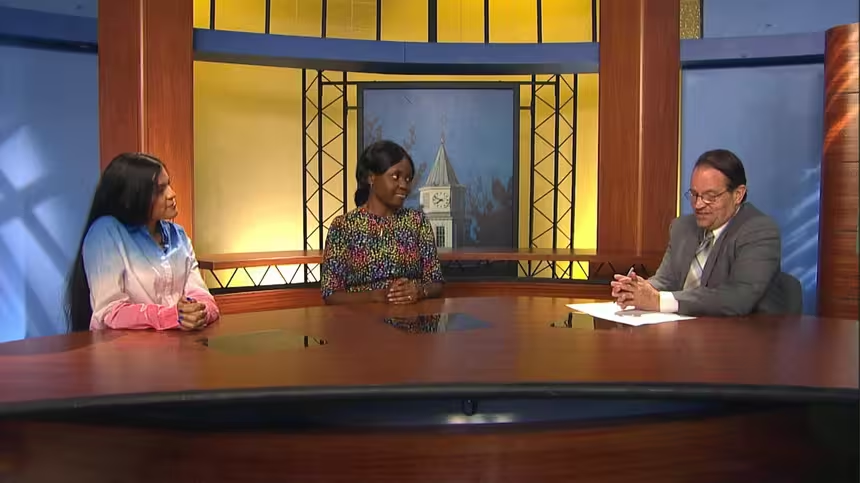
From time to time on the program, we cover issues that don't get a lot of attention in most classrooms...but affect our daily lives, sometimes in profound ways. Economic development is one of those issues. While many places in Illinois have been struggling, Marion is thriving. Fred Martino interviews Marion Mayor Mike Absher.
Problems playing video? | Closed Captioning Feedback
Problems playing video? | Closed Captioning Feedback
Eye on Education is a local public television program presented by WSIU
Economic development - Marion Mayor Mike Absher
4/6/2023 | 26m 38sVideo has Closed Captions
From time to time on the program, we cover issues that don't get a lot of attention in most classrooms...but affect our daily lives, sometimes in profound ways. Economic development is one of those issues. While many places in Illinois have been struggling, Marion is thriving. Fred Martino interviews Marion Mayor Mike Absher.
Problems playing video? | Closed Captioning Feedback
How to Watch Eye on Education
Eye on Education is available to stream on pbs.org and the free PBS App, available on iPhone, Apple TV, Android TV, Android smartphones, Amazon Fire TV, Amazon Fire Tablet, Roku, Samsung Smart TV, and Vizio.
Eye on Education
Eye on Education features interviews with people making a difference in all facets of learning. From Pre-K through higher education, we highlight efforts to prepare students to become the world's future leaders in every discipline.Providing Support for PBS.org
Learn Moreabout PBS online sponsorship(upbeat music) (intense dramatic music) - "Eye on Education".
I'm Fred Martino.
From time to time on the program we cover issues that don't get a lot of attention in most classrooms but affect our daily lives sometimes in profound ways.
Economic development is one of those issues from jobs and recreation to housing and transportation.
It's at the heart of thriving communities.
While many places in Illinois have been struggling, Marion is thriving.
The City notes a second year with a billion dollars in business.
Yes, that is billion with a B.
The city's mayor is a business owner himself with several car dealerships.
We are very pleased to welcome Marion Mayor, Mike Absher, to the program.
Mayor, thank you so much for being here today.
- Thanks for the invitation.
It's great to be back at SIU.
- Well it is good to have you here.
You're an alum and this is something that today is as I mentioned in this introduction that's so important for people to understand.
I'm hoping to learn a lot about economic development in our conversation today.
And I will tell you, I've been interested in this now for two years because I've been able to see you speak at the Marion Chamber Dinner and this year you noted that Marion businesses have exceeded a billion dollars in receipts for a second year in a row.
Give me a sense of of where this places Marion in the state of Illinois.
- Well, there's about 1300 plus or minus municipalities in the state that report municipal sales tax.
And that's where I base that number on.
That's the 1% portion of the sales tax that I think all municipalities get.
And so of that 1300, I think Marion is probably ranked 45th out of 1300 in the state.
But if you look at the 44 above that, so to speak.
You're gonna notice there's just much much larger towns there and really none that are I guess probably the closest one to us is O'Fallon.
They are a little bit bigger than we are but beyond Metro East, you really have to get to Urbana Champaign area.
Springfield is larger and then nearly all the rest of them are collar cities are in the Cook County and Chicago land area.
So as far as deep Southern Illinois if you ranked it that way, we would be very fortunate indeed.
- And some would, just looking at the list you just gave there, would say that that's not really apples to apples competition because they're very close to metro areas like St. Louis or Chicago.
- Yeah.
There's the commonalities among some of those that we do, you would consider peers, I suppose.
As most of them are on an interstate, as you can imagine that is the life blood, I believe of a retail economy anyway.
And so there's some commonalities there but you've gotta travel a little bit to see a town.
- So the interstate helps, of course.
What are the other key reasons in your view for Marian's growth?
- Well, I have to mention the interstate again because I think that is indicative of our success to a large degree.
You've also got Route 13, which I call an entrust state.
It basically runs river to river.
And the crossroads of that, of course, N57 run through Marion.
But we've also got Interstate 24 that terminates just about 10 miles south of Marion.
And then of course interstate 64, about 45 miles north of Marion.
And so that stretch of Interstate 57 is really three interstates, if you think of it that way.
A lot of people don't.
That's also indicative of why we have lots of accidents on that stretch of road, which I'm glad to see that IDOT is improving that road constantly.
So really it's the convergence of all those arteries.
I consider the blood arteries of our economy that help us out so much.
But really beyond just that blessed geography, if you will is years ago, many of our founding fathers of the city and those that were economic developers brought things to town.
Like the Veterans Administration Hospital, for example.
We've kind of lost that in the background to some degree.
It's been there so long.
You forget just what an economic driver in of itself that is.
And along with all the retail that web have.
- Okay.
Well, in addition to the retail, and also government positions like the hospital and others, Marion had incredible news recently attracting a FedEx distribution center.
Tell me about that and how the city landed that project.
- Well, again, I think the distribution Marion is uniquely positioned for distribution of all kinds whether that's rail or road, and soon to be air additionally.
In terms of FedEx, we really landed two distribution facilities in the last couple of years.
One is Reader Link which is a large book distribution center which is in the old Old Circuit City distribution building which was very sparsely populated since Circuit City went out of business.
And so they're gonna be occupying the greatest part of that million plus square feet that's in there.
That was really our first win.
Now FedEx, to go to your question that's an interesting story.
Actually, it got on our radar at the city level because I was eating pizza at a pizza place on the square.
And someone that had knowledge of that kind of bent my ear and said, "Hey I'm hearing this and you guys really ought to reach out to them", which we did.
And interestingly, it didn't get anywhere the first go round but probably six months, nine months later, they called back to Glen Clara.
Our economic development director that had reached out originally.
And it just sort of went from there.
And we helped them try to cite some places and they landed where they obviously built and the rest is history.
- All right.
Well you've been very successful as well in attracting some major chains to the city.
Texas Roadhouse, very busy restaurant site work starting on a new Olive Garden.
Those are just a few of the major restaurant chains.
How does the city work to attract businesses like this?
- Well, in those cases, I think in both of those cases specifically sometimes the the city gets credit for stuff it shouldn't and sometimes it gets the blame for things that it shouldn't too.
But in both of those instances, it's actually the land developers.
That had reached out to those chains and negotiated those things.
And we were involved, so to speak but not necessarily at the beginning stages.
So Olive Garden, for example that latest one really was a function of the landowner at the time that had reached out to them and convinced them to look at that property.
That's a long, for 20 years that's been rumored in Marion and I'm glad to see that it's it's finally coming to fruition.
- So it's very important, I guess, for the city to work closely with land developers.
To encourage them in the work that they're doing.
And as much as possible, I would assume make things as easy as possible.
When they're looking at new projects.
- I think Marion has a unique also reputation and I think it's well deserved is that once those opportunities do come about we very much try not to stand in the way and be helpful.
And whether it's code requirements or whatever it is try to work with them very proactively in making sure that their project goes smoothly and quickly so that they can start business.
- Okay well, another major effort, you've already hinted at this is Veterans Airport.
With a plan to add a new carrier, Contour Airlines.
This is going to be able to bring commercial jet service back to the region and also Chicago flights as well.
Give us a sense of how important this is to really I would assume not only Marion, but really the region.
- Yeah, it absolutely is important to the region.
So a couple years ago, maybe three years ago, the airport did a study.
As part of this process, the last go around when they were choosing an airline to come in with the essential Air Service program EAS, which is a federal program.
And they ultimately ended up choosing Cape Air again.
But that study showed about 700,000 people from the Chicago area that ended up frequenting either Marion or Carbondale.
And I think obviously so much of that is driven by SIU but not simply just the university.
I think it's SIH is another example.
You've got a lot of traveling doctors, a lot of traveling nurses.
And then thirdly and maybe most overlooked is this concept that I'm enamored with, which is natural tourism.
There are some people that are organically finding out the resources we have just south of here namely the Shawnee National Forest and the Garden of the Gods and all of the accoutrements that go along with with those attractions.
I think we've done a pretty poor job regionally as marketing that but I think there's a huge opportunity just for that piece alone.
But if just a percentage of those 700,000 people can hop on that aircraft and you gotta keep in mind this is a completely different class of aircraft than has been available before.
This is a 30 seat regional jet it's about 50 minutes wheels up to wheels down from O'Hare to Marion, and I'm told will cost far south of a hundred dollars one way.
So that's a game changer potentially time will have to tell and see how successfully that is marketed and thus adopted.
But personally, I can see a billboard up in on the Ryan that shows a picture of Camel Rock, for example.
At Garden of the Gods and says "For $55 and 49 minutes you're a world away."
And I think that's a huge opportunity for our entire region.
- Yeah, absolutely.
And of course we should say Contour Airlines is already established in Cape Gerardo and in Paducah.
But not going to Chicago.
So that's another reason why this also may be very attractive to travelers here who want to have a connection in Chicago.
- Yeah We used to send quite a few people too, export them if you will, to Paducah to catch that O'Hara flight for those that I've picked up people in Paducah that we're trying to get here from Chicago.
And I know there's some people that are upset because of the loss of the St. Louis connection.
And like I said, time will have to tell.
But the truth is, is you can get a whole lot more places in the world from Chicago than you can from St. Louis.
And so I think that that connecting hub will be far more impactful as well, even for those that want to export out of here.
But I think we have an import opportunity for tourism and for the university.
And like I said time will tell, but I'm actually pretty excited about it.
- Well we will be watching not far from the airport efforts underway to revitalize a former indoor shopping mall.
Tell me about those plans.
- Well, like a lot of other things on COVID time that has gone painfully slowly it seems to everybody else.
But the truth is there's 330,000 square feet inside of there that needed to be deconstructed and reformatted.
And that's been going on for the last couple of years.
The idea there is for the new owners to turn that into a retail mixed development, including restaurants and entertainment.
The concept is that retail can survive.
But the way I have always thought of it and explain it to folks is that we used to go to malls to shop and we would also eat and entertain while we are there, hence the little kitty rides and things that popped up in those big buildings.
But now the paradigm has really turned upside down.
People want to go eat and entertain themselves.
They will also shop while they're at those kinds of venues.
So the model's been turned upside down and that's exactly what they envision there including restaurants and entertainment.
And we hope to have some pretty big news in the coming weeks on that, but not quite prepared to share that today.
- Okay well one, folks will be watching because of course as you know, this is really something that's happening all over the country, that indoor shopping malls are either declining or going completely empty.
Marion this will be an interesting experiment to see how how successful this will be because unlike some of those shopping malls, Marion was able to maintain the anchor stores like Target and Dillards.
So there's a stronger base, if you will, to see a resurgence.
- And that's one of the reasons why I campaigned four years ago, hard on it and we've worked so hard on it is that at minimum we owe it to those anchors to see that they can thrive, not just survive.
And so, like I said, works underway and there'll be some news about that I feel in the next few weeks.
- Well, the owners of the mall have also brought a new baseball team to town.
Now it has a name the "Thrill Billies", tell me about the importance of sports teams and other efforts to have recreation and tourism grow in the city.
- Well, as I understand it, they're gonna have about 50, if I remember right, home games.
Which is probably a smaller calendar than what the miners had there.
And it's a completely different kind of baseball.
This is a wooden bat collegiate level baseball that I'm told the the level of play is very, very high and competitive.
So that'll be great to see that come in.
But in addition to that they had a rodeo there last year and several other concert events.
That rodeo I think brought in 5,000 people.
And that's exciting to see that.
I've always thought that stadium should and could be far more than just a baseball venue and they're actually turning it into that.
So that'll be exciting to see that all come alive too.
I hope it can be more used more than just the 50 or 60 nights a year for baseball alone.
But we're glad to have baseball back and I'm certainly glad the stadium didn't go dark.
- Well this again is something that we see around the country in different places where as part of an economic development strategy, recreation tourism is really a focus.
I moved here from the southwest and one of the cities near where I lived was El Paso and the city actually knocked down its city hall downtown and relocated it to build a baseball stadium in downtown El Paso.
It's also used for soccer matches as well.
Cause there's a professional soccer team and that brought hotels and more restaurants and you name it.
- Well, sports tourism is something we're looking at very very strongly.
And with the baseball and the owners of the baseball stadium are looking at it very strongly as the baseball stadium is just sort of the pinnacle of several other fields in that area that can drive lots of sports tourism traffic and drive some economic growth too.
So I think you're exactly right.
I think that all communities need to look at that as well.
- All right, well Marion has also been a leader in providing permanent services for area residents.
The hub recreation center looks like the kind of facility seen in much larger cities.
Tell me about the importance of the hub and efforts like that.
- Well, the hub specifically has a really diverse set of offerings.
Everything from swimming to basketball, weightlifting, lots of classes like yoga and kickboxing.
My wife takes both of those at the hub.
And most recently, of course, pickle ball which seems to be taking over the world.
We have some somewhat of a conflict now between basketball players and the pickle ball players that want their quirks laid out.
But what you see there is engagement.
You see our community members engaging there.
And so the importance of having a facility like that not that every town can or maybe even should have that but I feel like those are the kinds of offerings that make residents enamored with their town appreciative of their town.
And it's got a sticky factor.
They want to stay there because there's those kinds of things to be involved in.
So we're very blessed to have that facility and to keep investing in it and its offerings for all of our residents.
- Okay.
People also need, in order to an area to grow and for folks to do well, they need affordable housing.
And some say this is a really major challenge for Illinois.
Marion is unusual in that you do not levy a city property tax.
Tell me about the importance of that.
- Well that was a leg of the stool, so to speak, of a 2020 vision that the council approved obviously right before 2020 when the world fell apart with the pandemic.
But basically because of our sales tax and our sales tax base we're able to fund city services through that.
And that was my argument.
It's a trade off for a little higher sales tax versus no property tax on for city services.
It does put us in a pretty unique spot at that time.
I haven't caught up with the numbers, but we're talking about how many municipalities there were and there's about 1300.
At that time there were only four or five in the state of Illinois that did not levy a property tax.
So that puts us in pretty rare air and it does make our from a property stand tax standpoint it does make us a little bit more competitive than some surrounding communities.
Gives us a little bit of bragging rights I suppose.
But the reality is, that we just didn't need to tax our residents for those services that the sales tax base would cover that.
So, but back to the affordable housing this is a huge issue for all towns.
You're probably gonna ask me a question broad more broadly about property taxes in the state.
And I've got a little bit different view on that one.
Everybody including me, gripes about it.
I'm fortunate enough that I've had business interests in other states and what I've noticed there I did an analysis several years ago.
So where you have lower property taxes, you usually have personal property tax and in some cases you've even got income tax at the city levels.
In Kentucky is a good example of that.
And in Missouri there's a lot of personal property tax on taxes you gotta pay on your car, for example every year over and over.
Same way in Kentucky.
So in my mind, a lot of that stuff balance is out.
It did, at least for my businesses when I looked at it nobody likes the taxes, but it always felt to me like one state or the other, they're gonna get what they need to operate sort of one way or the other.
So we can maybe pile on on the property tax front and I would agree they're too high, but I don't know what the alternative is and that that therein lies the rub so to speak, is what else do they decide to tax on other than property taxes.
But I do think the state's gonna have to address it at some point and figure that out.
I don't have the greatest suggestion in the world.
- Okay, well do you think there are any improvements any ways to make it more simple fairly quickly?
- I think, I don't know about quickly, nothing in government I will tell you that moves very quickly.
- Quickly, right.
- I found that out the hard way.
Part of Illinois's problems or at least the experts have characterized it as having a lot of taxing bodies in the state.
Probably more taxing bodies than any other state per capita.
So I do think there needs to be an effort where it makes sense to reduce those taxing bodies when they provide, when they have overlap of services.
Executing, that on the other hand is hard.
- Not easy.
- It's very, very difficult.
And so, but I think that that has to be looked at in just efficiency of government in general has to be looked at.
- Of course.
So the city is also working to provide more options for rental housing.
I wanted to ask you about that.
Give us a sense of the work and how important that is to economic development.
- Well, so let me express this to you this way and this is maybe the most important thing to leave you with 'cause I think this applies to all communities.
It's one thing to go out and we're gonna get jobs and this that and the other, that's great.
But if the people that work at these companies, don't live in your community economically speaking you're just providing services without getting them spending their sales tax dollars or their paycheck, if you will.
So case in point, Ison, which is our largest manufacturer plus or minus, has about 2000 jobs.
How many zip codes do you think Ison sends its paychecks to or in other words, if Marion is one of those that has people that work there how many other zip codes other than Marion do you think are employed at Ison?
Any idea?
- Goodness.
I bet that's a lot.
80?
- The last number I had 81 more than Marion.
There's 82 at one time anyway recently.
- I was gonna say 20.
- It's shocking, right?
I mean it's shocking.
And my point is, you've gotta have the housing stock whether that's rental or just attainable housing affordable housing, whatever moniker you wanna put on it if you want to retain those paycheck dollars.
And that's hard.
But the fact of the matter is, a lot of people don't like rentals and apartments that come in but the world's changing.
A lot of people don't want to own a home anymore.
My kids, for example, their age, they don't want to own a home.
They want something a little bit more simpler and not have all the maintenance.
So I think it's a mix you gotta have of all of that.
But at least I think we're recognizing what the trends are and we're trying to inspire some developers to build some of the stuff that the market actually needs so that we can retain those paycheck dollars for all those jobs that are located in Marion - And maybe attract in more employers.
- It is absolutely a virtuous cycle that you create with that.
No question about it.
- A few minutes left.
And I also wanted to ask you about something you've touched on in terms of, you've said there was a need to market our state parks for in instance.
Are there other areas where you think there could be more collaboration in southern Illinois to boost economic development?
- Yes, Steve Mitchell, who is the economic director for Carbondale, and I talk about this all the time and I'm so proud of Marion's new relationship with Carbondale.
But the way I expressed it to him the other day is I think all of our towns in terms of the Shawnee National Forest, I think we could be the Gatlinburg, if you will, if you think of it that way which is at the foothills of the Smokey Mountains.
I think all of our towns from Murfreesboro all the way to Shawnee Town.
I think we're all at the foothills of this great natural resource and we do need to be working together each and every day on a common strategy on how to accentuate that so that we all benefit from it.
And Steve and I have had numbers of conversations about it and are working together on several different things and that's exactly what we need to be doing.
- Okay, final question.
You are a business owner yourself, as I mentioned in the introduction, a number of car dealerships in Marion.
Gimme a sense of how this helps you in your job to understand needs and sell the city to others.
- Well, as far as selling the city, good, bad or indifferent.
I've lived all of my life with one short exception in Marion.
And it is easy to sell because I believe in it.
And it's just quite that simple.
My family's done business there for 75 years.
I've been there all 53 years and it's to me, the greatest place on earth.
But it's very helpful to actually conduct business in southern Illinois in order to sell southern Illinois.
It's easy to do business here and you try to convince people of that.
But the truth is, it is easy to do business here and I'm preaching that from the rafters every time I get a chance.
- Well, we appreciate you coming in to talk with us today and learn a little bit more about some of the work being done.
- Appreciate the invitation.
Thank you.
- Thank you for being here.
My guest, Marion Mayor Mike Absher, that is "Eye on Education".
Thanks for being here.
For all of us at WSIU, I'm Fred Martino.
Have a great one.
(intense dramatic music)













Support for PBS provided by:
Eye on Education is a local public television program presented by WSIU