
Edmund Adjapong, Ph.D.; Sarah Adelman; Robert C. Garrett
6/17/2023 | 27m 26sVideo has Closed Captions
Edmund Adjapong, Ph.D.; Sarah Adelman; Robert C. Garrett
Edmund Adjapong, Ph.D., Program Director at Seton Hall University, joins Steve for a discussion about the educational significance of hip-hop; Sarah Adelman, Commissioner of NJ Department of Human Services, highlights the need for food assistance and mental health treatment; Robert Garrett, CEO of Hackensack Meridian Health, discusses Project HEAL, a hospital-based violence intervention program.
Problems playing video? | Closed Captioning Feedback
Problems playing video? | Closed Captioning Feedback
Think Tank with Steve Adubato is a local public television program presented by NJ PBS
Edmund Adjapong, Ph.D.; Sarah Adelman; Robert C. Garrett
6/17/2023 | 27m 26sVideo has Closed Captions
Edmund Adjapong, Ph.D., Program Director at Seton Hall University, joins Steve for a discussion about the educational significance of hip-hop; Sarah Adelman, Commissioner of NJ Department of Human Services, highlights the need for food assistance and mental health treatment; Robert Garrett, CEO of Hackensack Meridian Health, discusses Project HEAL, a hospital-based violence intervention program.
Problems playing video? | Closed Captioning Feedback
How to Watch Think Tank with Steve Adubato
Think Tank with Steve Adubato is available to stream on pbs.org and the free PBS App, available on iPhone, Apple TV, Android TV, Android smartphones, Amazon Fire TV, Amazon Fire Tablet, Roku, Samsung Smart TV, and Vizio.
Providing Support for PBS.org
Learn Moreabout PBS online sponsorship- [Narrator] Funding for this edition of Think Tank with Steve Adubato has been provided by The Turrell Fund, supporting Reimagine Childcare.
The New Jersey Education Association.
The Healthcare Foundation of New Jersey.
The Port Authority of New York and New Jersey.
Moving the region through air, land, rail, and sea.
Choose New Jersey.
Horizon Blue Cross Blue Shield of New Jersey.
Here when you need us most.
The Adler Aphasia Center.
New Jersey Sharing Network.
And by Robert Wood Johnson Foundation.
Working for a more a healthier, more equitable New Jersey.
Promotional support provided by Meadowlands Media.
A print and digital business news network.
And by NJBIZ.
Providing business news for New Jersey for more than 30 years, online, in print, and in person.
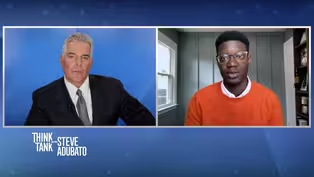
[MOTIVATIONAL MUSIC] - We're now joined by Dr. Edmund Adjapong, who is Program Director for Secondary Education at Seton Hall University, one of our higher ed partners.
Good to see you, Doctor.
- Thanks for having me, Steve.
- So, tell us exactly what hip hop education is.
By the way, hip hop, I was just told by Usame, our producer, 50 years, celebrating 50 years hip.
How do we mark that?
- Yeah, you know, hip hop is a beautiful culture, and genre of music that emerged from the Bronx in 1970s and we're currently, this whole year, we're celebrating this 50 year of the culture.
There are a lot of activities and events that are happening, all across the country, all across the globe, and particularly here in the Bronx, New York.
Where we're celebrating this phenomenal culture, that's really emerged from, you know, young folks and youth from black immigrant communities, just trying to make sense of their communities, and having opportunities to share their experiences with the world.
- So hip hop education means what?
- Well, you know, hip hop education is the merging of hip hop culture, with an educational context and spaces.
You know, when we think about traditional teaching and learning, and traditional educational spaces, we, you know, we recognize that, you know, education is, can often be Eurocentric and align to Eurocentric values, and oftentimes really not incorporate, you know, values of other folks, right?
So when we think about hip hop and education, particularly within my work and my research, I'm thinking about how do we leverage the different creative elements of hip hop.
Which include at the MC, the B-boy the graffiti artists, the DJ, and knowledge itself, and how can we leverage those elements, in supporting young people in learning, and engaging, and developing their identities.
As it relates to whatever content, they're trying to engage in.
- So again, I struggled with science all the whole time, it doesn't matter, but STEM, science, technology, education, math.
- Yeah.
- So, it's so interesting only 34% of black students complete STEM degrees compared to 58% of white students.
So when it comes to hip hop education, pedagogy if you will, It's, I think you told our producers that break dancing can be used to teach different states of matter.
Huh, I didn't understand it the first time.
I might be able to understand it now.
Please help us, Professor.
- Yeah, you know, when we think about hip hop, you know, a lot of us see hip hop as a genre of music, which it is, right?
But I want folks to recognize that hip hop is a very nuanced and beautiful culture.
So when we talk about break dancing in particular, like you know, we see hip hop dances, and hip hop dancers maybe at concerts, at events.
But when we think about break dancing, and bringing these elements into the classroom, it's really about taking the framework, and the philosophy of these elements.
So break dancing really aligns to kinesthetic learning, right?
And recognizing that young people in schools, they have diverse needs, learning needs, right?
So young people might, you know, not want to sit in their seat for the whole day, right?
And they may not learn the best in that way.
So when we wanna leverage break dance in the classroom, You know, one way it could look like in the science classroom, as it relates to my research, is how can we get young people to imagine themselves as the content, right?
Their physical being, their physical bodies themselves, and literally move around the classroom, the space, in reference to that.
So when we think about the different states of matter, we know that we have gas, we have solid, and then we have liquids, right?
We know that solids have a particular composition.
Solid molecules are, you know, they're held tightly.
They don't necessarily take the shape of the container.
They have a rigid structure, shape or form.
And I remember teaching this to my sixth grade students in the Bronx years ago, and they understood the concept, but it was really heady for them, right?
They understood the composition of the molecules, but they didn't really have a deep understanding of the concepts.
- So how'd you bring break dancing into it?
- Well the students weren't actually break dancing, but I was getting them to be kinesthetic learners, right?
Which is in reference to break dancing.
So I said, you know what, you guys all act as molecules.
I want you all to stand behind your seats, and assume that you each student in the classroom is a molecule.
Now, the whole class is a solid, right?
The classroom is a shape of container.
So the students, you know slowly, they understood the composition of solid molecules, and how they interact and engage.
So all the students started to line up on the side of the classroom in a structured shape or form.
And then I asked them, so what do we know about solid molecules?
And what do we know about molecules of matter?
Are they ever stagnant or staying still?
And the student's like, no, they're always moving even if they're in place.
So the students started shaking in their spots and vibrating, right?
So this idea of recognizing that students like to move around, they like to engage, but to break dancers and joining that in reference to how they learn and understand content has been really remarkable, in connection to hip hop and education.
- Where'd your passion for this come from?
I'm curious about how your colleagues - Yeah.
- have reacted to it.
I'll ask that in a second.
Where'd your passion come from for this?
- Ah man, you know, my passion, it comes.
I'm a young person that grew up in the Bronx, New York, the birthplace of hip hop.
And as a child, as a young person, you know, navigating schools, you know, I was marked as a gifted and talented student, but I never saw myself really connecting with the content, within the classes that I navigated as a child.
When I got to high school, I had this teacher who used hip hop as a way to spark our interest in a physics class.
You know, I always loved science, but I just ne never really connected with the content.
I remember being in the high school, in my high school physics class, learning conceptual physics and studying rapper's chains, and talking about, hey the pen.
This can be a pendulum, right?
And doing calculations and learning conceptual physics through hip hop, right?
Through the culture, that I engaged in outside of school.
And that really is what sparked my interest, and what led me to use these practices when I was a teacher in the Bronx.
And what led me to become a researcher in this field.
- So, I'm curious about this, to what degree if at all.
- Yeah.
- Doctor, is race relevant here?
Meaning your experience, the experience of many African American students in urban communities?
Not the same, but there are obviously certain similarities.
For a white kid from the suburb, right?
Whether it's Seton Hall or any other place, typical, I don't even know what typical means.
Do you teach it any differently?
Is it any less relevant?
And how the heck do you do that in a diverse setting?
- Yeah, great question Steve, and I get this question often.
You know, when we think about hip hop, and hip hop music, and hip hop culture.
Like for me in my work, it's really targeted for black and brown students, right?
To support them in developing identities, and fully connected to science content.
But when it comes to teaching various students from different races, it's all the same, right?
When we think about white students, they benefit from this as well.
Hip hop really is anchored in a multimodal way of learning, right?
So we talk about break dancing, and we take the kinesthetic aspect of that, right?
How do we get young people to move around in the classroom, and make sense of the content, while engaging and embodying the content in their physics?
- No different for white kids, black kids.
- Absolutely, no.
- No different.
Relate the same - Relate the same.
When we think about hip hop, you know, white youth are the top consumer of hip hop music, right?
So they're engaging the culture just as similar.
And this is the same as black students, right?
They might be different connections, and different points of entry, but there are similar connections, right?
And the work is not just about hip hop music.
It's really about idea of multimodal learning.
- Wow, and real quick, any pushback from colleagues?
- Not pushback per se, but I would say that my colleagues generally don't necessarily understand it, at face value.
A lot of folks don't understand it at face value, when we talk about bringing hip hop into schools.
You know, I really try to advocate as, you know, we all of our students, regardless of race and background are diverse learners, and have various diverse learning needs.
And when we bring hip hop in these multi-modal ways of learning, we're able to meet our students where they are, right?
Regardless of how they learn, and how they connect to the content.
- Thank you, Professor.
I appreciate it.
Well said, well done.
Important conversation.
We'll make sure we catch up with you again.
Thanks so much.
- Thanks for having me.
- You got it.
Stay with us, we'll be right back.
To watch more Think Tank with Steve Adubato, find us online and follow us on social media.
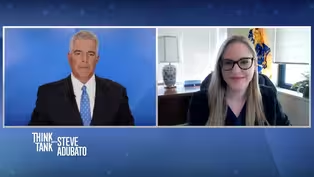
- We are honored to be joined by the Commissioner of the New Jersey Department of Human Services, Sarah Adelman.
Sarah, good to have you with us.
- Hey, Steve, it's good to be with you.
- Commissioner, let me ask you this.
When it comes to federal dollars, I'm gonna jump right into this, because we've had several guests today different areas whether it's child care, education, mental health issues, "Hey, you know, the Feds gave New Jersey so much money as it relates to COVID, they're sitting on that money."
Explain to folks what federal money is in your department and whether those dollars are being expended, and if not, why not?
- It's a great question and an important one, because in our department, Human Services, our programs are supporting New Jerseyans across their lifespan from child care all the way through aging and senior services, and individuals across New Jersey needed services and supports, many for the first time, as a result of the pandemic.
And so all of this federal funding that we were receiving in New Jersey was one of our top priorities to be able to get that out to the folks who most need it.
And that has been a focus of ours over the three-year public health emergency.
At Human Services, we have programs in mental health and addiction services, disability services, food assistance, child care assistance, aging and senior services, disability services.
You know, the list goes on and on.
We're also the state New Jersey Family Care/Medicaid Agency.
We administer Medicaid benefits in New Jersey.
So there are lots of ways that we've been directly delivering benefits to New Jersey households and individuals since the beginning of the emergency.
As an example, New Jersey SNAP, our food assistance benefits program, we have been able to deliver more than $3 billion in additional assistance throughout the public health emergency because of a lot of the federal funds that we received.
The same thing in Medicaid for instance.
We are now serving 30% more individuals who are covered in New Jersey's Medicaid program since before the public health emergency.
So there are lots of ways across all of our programs that we're delivering direct services and benefits to folks.
- So let's do this.
We're gonna put up the website for the New Jersey Department of Human Services.
But I'm curious about this, as it relates to the issue of food insecurity, how much worse is the food insecurity situation because of inflation?
- Well, there were kind of across the board economic impacts to New Jersey households as a result of COVID-19, and food security is definitely one of those areas.
Feeding America estimates that there are about 650,000 food insecure individuals here in New Jersey.
But we definitely saw an increase in the need for assistance benefits throughout the last three years.
Our SNAP enrollment went up about 40% over the course of the public health emergency.
- And to be clear, SNAP is what was previously known to be food stamps.
- That's right.
- It's gone up.
The number of people signing up for SNAP gone up dramatically?
- We had about a 40% increase over the public health emergency.
- Wow.
And the role of your department in that regard?
Be specific so people can understand what you do.
- So in food security, there are a number of ways people can get food assistance in New Jersey.
One of them is SNAP Food Assistance.
When you sign up and receive benefits for SNAP you receive an EBT card that you can use at the grocery store.
- I know in government there are a fair number of acronyms.
What is that card and what does it stand for?
- That's right, it's an electronic benefits card.
It works just like a credit card.
You can use it at the grocery store, it has your SNAP benefits on it, and you can use it directly to purchase groceries.
And one of the things that we did that was really important during COVID was that we also were able to expand access for online grocery shopping and delivery using SNAP cards, as well.
So, here at DHS, you sign up for SNAP, you receive your benefits, and, you know, there are other ways that people can get support too across government.
There are food banks and food pantries.
Some individuals may be eligible for WIC or other assistance benefit programs that also- - I'm sorry, WIC?
- WIC.
- Women, infants and children?
- That's right, and it's administered in the Department of Health here in New Jersey.
There are a variety of ways that individuals can get food assistance benefits here in our state.
- Let's do this, let's talk.
By the way, I am struck by the number of acronyms in government.
But the need for us, those of us in the media, to help people interpret what that means it can be a lot of inside jargon.
Let's talk about child care.
Our initiative Reimagine Child Care, the website will go up right now.
What is the role of the New Jersey Department of Human Services as it relates to helping to provide accessible, affordable, quality child care, particularly for those who are struggling financially?
- Child care is so critical to economic success in our state and across the nation.
And we knew, as a result of COVID, that child care needed to be an area of focus, because a thriving child care system means a stronger economy.
It means more jobs, more inclusive economic growth.
It means better outcomes for our kids, and more support that is so vital to New Jersey families.
And so here at the Department of Human Services we have a program that helps families afford the cost of child care.
- What's it called?
- It's a child care assistance program, and it's for families with lower incomes to help them afford the cost of their child care.
So you can visit our website, it's ChildcareNJ.gov.
- Say it again.
- ChildcareNJ.gov.
- Go ahead.
- And that's where families can go to find out if you're eligible and to sign up for child care assistance benefits.
We pay your child care provider directly to help you with your child care costs.
And this is has been a tremendous area of focus for Governor Murphy and our administration in partnership with the legislature.
We have, since the beginning of Governor Murphy's administration, added over a billion dollars in additional funding through our child care assistance program.
And we've more than doubled our infant and child care rates that we're paying to providers to help expand access to more families and to build a broader network of providers participating in our program.
- The last area I wanna explore is mental health.
Now, mental health is not, issues of mental health they're not dealt with in one state agency.
It's multifaceted and there are a whole range of agencies and not-for-profits and others involved.
What is the role of your department as it relates to helping to increase access to mental health services for those who have a very hard time accessing mental health services?
- We are the state's lead mental health and addiction agency that serves adults.
So as you said, there are different access points across government depending on the individual and what their needs are.
But here at Human Services, we have been really focused on helping build the provider network across New Jersey.
The social services providers that you talked about, the psychiatrists, and psychologists, and clinicians across the state that are available to serve individuals in all of their mental health needs and in addressing their addiction needs.
- So if someone goes on the website, I'm sorry for interrupting, someone goes on the website, it's not you're gonna provide them a mental health professional, but can you direct them to an organization that could help?
- Absolutely, we have a hotline for individuals needing addiction support, it's R-E-A-C-H-N-J.
- R-E-A-C-H-N-J.
- That's right.
And also through our website, folks can access information about mental health providers across the state.
Of course, we always encourage any individuals experiencing thoughts of suicide or suicidal ideation or those concerned about a loved one to call 988.
We also oversee the 988 Lifeline System here in New Jersey and have, since last summer, worked to stand up that system in New Jersey so that there is always someone to call and somewhere to go for individuals who are in need of assistance.
- Commissioner, I wanna thank you for joining us.
We appreciate it.
- Thank you, Steve, good to see you.
- Good to see you.
Stay with us we'’ll be right back.
To watch more Think Tank with Steve Adubato, find us online and follow us on social media.
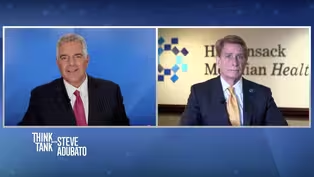
- I wanna welcome Bob Garrett, CEO of Hackensack Meridian Health.
Good to see you, Bob.
- Good to see you too, Steve.
Put it in context, please.
- Yeah, so unfortunately we're seeing significant increases in violence at our hospitals and in schools, in society in general.
The stats are really overwhelming, Steve.
It's really, and I just, I just shake my head when I think about this but gun violence now is the biggest killer of children in the US, which is really staggering.
48,000 people in the US died by gunfire last year.
So we've declared it, along with 50 other health systems across the country, as a public health emergency.
And what we're trying to do is certainly prevent it wherever possible.
- Oh, I'm sorry, Bob, why do you think there's such an uptick?
- Well, I think, I think part of it has to do with the pandemic and the mental health issues that have related, have been a result of that pandemic.
- Right.
- I think that's certainly a major factor, Steve.
But we actually saw the number of violent incidents going up even before the pandemic, so it was going in that direction.
But I think the pandemic certainly exacerbated those trends.
So what we're focused on is prevention and then we're also focused on being able to help victims and their families of gun violence.
So on the prevention side, again, we have signed a pledge along with 50 other health systems across the country.
We're part of a consortium that is being led out of Northwell Health in New York.
And what we're trying to do is find strategies to help prevent gun violence and we think by declaring it a public health emergency, maybe staying out of the politics related to the Second Amendment and guns, but just understanding that whatever your position is on the Second Amendment, this is a public health emergency and we have to, whether you're a gun owner or you're not a gun owner, we have to take steps to try to prevent this senseless killing, particularly of of young people like children and adolescents.
So we're working with these other health systems to find the right strategies, but we also have put in programs that help victims of gun violence as well.
- Bob, sorry for interrupting, we actually, I'm sorry for interrupting, we actually had one of your physician leaders engaged in something called Project Heal.
- Yes.
- What is that and how is it connected to the fight against prevention of violence as a public health issue?
- So Project Heal actually is a program that helps victims of gun violence or their families.
So it's a program that's funded through federal funds as well as state funds.
And we set up Project Heal at Jersey Shore University Medical Center.
We hope to expand it at some of our other sites but what it does is we help those victims by referring them to the right help.
They might need behavioral health types of assistance, they might need social assistance, they might need additional medical assistance.
Also, it's a crisis for their families so we also make referrals for their families.
And I'm happy to say the program just celebrated its two year anniversary and we've already helped over 400 families, which is really, really significant.
And we're hoping that because it's been so successful that we can demonstrate that it's a model that should be replicated not just throughout New Jersey, but throughout the country.
And we're gonna start at Hackensack Meridian by offering it at some of our other hospitals as well.
- It's so interesting.
First I'm gonna disclose a couple things.
One, that I teach in the Hackensack Meridian Health Physician Leadership Academy, and I've gotten to know many of the physicians there, many of whom are involved in dealing with those who are victims of violence.
And also that HMH is a long longtime underwriter of our programming with Bob.
One more quick follow up on this.
When the nursing shortage becomes more pressing, what impact does that have on physicians in what they do and other clinicians on the front lines?
Because it's not just nurses are here, physicians are here, respiratory therapists.
It's... - It is a team sport, you know, between physicians, nurses and other professionals and support personnel.
So if there's a severe shortage in one, it really impacts the job functions of others.
So let me talk a little bit about what we've done for nursing in particular.
Since the beginning of the pandemic, we've invested over $600 million in salaries and benefits for our team members.
And as a result of that, we've been able to hire over 2000 nurses in the past year alone.
So that's encouraging.
But many of those nurses are coming out of school and they need to be trained.
They need to be oriented.
The good news is we have three nursing schools within Hackensack Meridian Health Which serve as a pipeline for jobs throughout our health system.
And, you know, what's even I think more impressive in some ways is we have over 500 affiliations with other schools, not just for nursing, but for other healthcare professionals as well.
So there's a good pipeline.
But in spite of that, it's still you know, it's still been tough because there's been a lot of issues that that have led to nurses and other healthcare professionals leaving the field.
You talked in our previous interview about fiscal challenges, long-term fiscal challenges at HMH and other healthcare systems, hospital systems across the nation face.
A lot of it, much of it COVID related.
But you're also now talking about violence as a public health issue, which only expands upon the demands of hospitals and hospital systems.
Is there a disconnect between A, the need to cut expenses, be more fiscally conservative while you're expanding programs to deal with public health issues like violence?
- There's a tremendous disconnect there.
And our mission is to transform healthcare, it's to improve the health of our communities.
And a public health crisis like gun violence and violence in general is something that's near and dear to our mission.
So we have to, we have to continue to fund programs like that, but that's why we're asking for assistance from our partners, whether it be the state government, the federal government, to fund programs like Project Heal because these are tough times for healthcare networks and for hospitals.
But honestly, as you're pointing out, the demand for these types of services and this type of help is incredible.
There's never been more of a need for it than now.
- And that also includes behavioral health, mental health issues, violence, a whole range of issues.
Bob Garrett is the Chief Executive Officer of Hackensack Meridian Health.
Bob I wanna thank you so much for taking the time to talk with us.
- Thanks for having me, Steve.
- You got it.
I'’m Steve Adubato, we will see you next time.
- [Narrator] Think Tank with Steve Adubato has been a production of the Caucus Educational Corporation.
Funding has been provided by The Turrell Fund, supporting Reimagine Childcare.
The New Jersey Education Association.
The Healthcare Foundation of New Jersey.
The Port Authority of New York and New Jersey.
Choose New Jersey.
Horizon Blue Cross Blue Shield of New Jersey.
The Adler Aphasia Center.
New Jersey Sharing Network.
And by Robert Wood Johnson Foundation.
Promotional support provided by Meadowlands Media.
And by NJBIZ.
- At the Turrell Fund, We know childcare creates transformative early learning experiences for young children, and helps families succeed.
Childcare is essential for the economy, driving financial growth and sustainability across all sectors.
The Turrell Fund envisions a New Jersey in which every infant and toddler has access to high quality, affordable childcare In order to grow, develop and thrive.
Our children are our future.
For more information, visit TurrellFund.org.
The Educational and Cultural Significance of Hip-Hop
Video has Closed Captions
Clip: 6/17/2023 | 9m 26s | The Educational and Cultural Significance of Hip-Hop (9m 26s)
Hackensack Meridian Health CEO Launches Intervention Program
Video has Closed Captions
Clip: 6/17/2023 | 8m 39s | Hackensack Meridian Health CEO Launches Intervention Program (8m 39s)
The Ongoing Need for Childcare and Food Assistance
Video has Closed Captions
Clip: 6/17/2023 | 10m 1s | The Ongoing Need for Childcare and Food Assistance (10m 1s)
Providing Support for PBS.org
Learn Moreabout PBS online sponsorship
- News and Public Affairs

Top journalists deliver compelling original analysis of the hour's headlines.

- News and Public Affairs

FRONTLINE is investigative journalism that questions, explains and changes our world.












Support for PBS provided by:
Think Tank with Steve Adubato is a local public television program presented by NJ PBS