
Is Higher Education Thriving in Utah?
Season 10 Episode 26 | 24m 35sVideo has Closed Captions
We examine if Utah's colleges and universities are adapting quickly enough in our tech-heavy world.
Are Utah's colleges and universities adapting quickly enough in our tech-forward world? Our expert panel examines the pressures facing higher education and how schools are preparing the future workforce while still keeping tuition affordable. Rep. Karen Peterson (R-Clinton), Utah State University President Brad Mortensen and Utah Higher Education Commissioner Geoff Landward join this episode.
Problems playing video? | Closed Captioning Feedback
Problems playing video? | Closed Captioning Feedback
The Hinckley Report is a local public television program presented by PBS Utah
Funding for The Hinckley Report is made possible in part by Cleone Peterson Eccles Endowment Fund, AARP Utah, and Merit Medical.
Is Higher Education Thriving in Utah?
Season 10 Episode 26 | 24m 35sVideo has Closed Captions
Are Utah's colleges and universities adapting quickly enough in our tech-forward world? Our expert panel examines the pressures facing higher education and how schools are preparing the future workforce while still keeping tuition affordable. Rep. Karen Peterson (R-Clinton), Utah State University President Brad Mortensen and Utah Higher Education Commissioner Geoff Landward join this episode.
Problems playing video? | Closed Captioning Feedback
How to Watch The Hinckley Report
The Hinckley Report is available to stream on pbs.org and the free PBS App, available on iPhone, Apple TV, Android TV, Android smartphones, Amazon Fire TV, Amazon Fire Tablet, Roku, Samsung Smart TV, and Vizio.
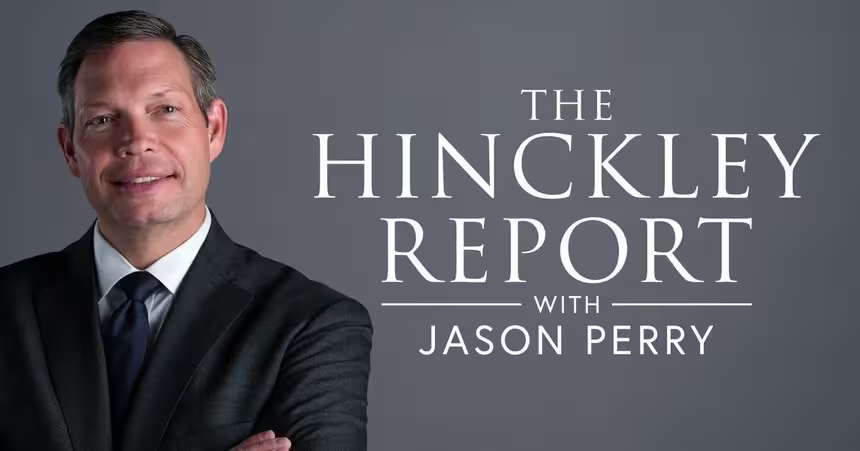
The Hinckley Report
Hosted by Jason Perry, each week’s guests feature Utah’s top journalists, lawmakers and policy experts.Providing Support for PBS.org
Learn Moreabout PBS online sponsorship- [Narrator] On this episode of "The Hinckley Report," our expert panel takes a close look at the state of higher education in Utah.
How are our universities preparing the future workforce while keeping college affordable?
What impact will new technologies have on the classroom, and how are leaders maintaining public trust?
(triumphant music) - [Announcer] Funding for "The Hinckley Report" is made possible in part by The Cleone Peterson Eccles Endowment Fund, and by donations to PBS Utah from viewers like you, thank you.
(triumphant music) - Hello and welcome to "The Hinckley Report."
I'm Jason Perry, Director of the Hinckley Institute of Politics.
Covering the week, we have Geoff Landward, Commissioner of the Utah System of Higher Education, Representative Karen Peterson, a Republican from Clinton, and Vice Rules Chair in The Utah House.
And Brad Mortensen, President of Utah State University.
So glad to have you all on this special episode of "The Hinckley Report."
And I have to say, just having your expertise in this area is just so critical; the one that runs the system, the regulator of the system, and, of course, one of our great presidents of Utah State University.
I wanna talk about the state of higher education in Utah, where it is, where it's been, maybe a little bit about where it's going through your particular vantage points, if that's okay.
And, Commissioner, I wanna start with you for just a minute.
Talk about where you would say we are right now.
Is higher ed successful, is it accomplishing its mission, or are we seeing an inflection point of some sort right now?
Where do we see it evolving?
- The way I think about it is, higher education has made a course correction, and now we're on the right trajectory.
So I think that there's a lot of cause for optimism, I think that we've had some time to have some retrospection in where has higher education been, where did it need to go, and why did we start to see diminishing trust, questions of value?
I think you saw that the politics around higher education became complicated, and it required us to take a look inside and say, "Okay, where have things gone wrong, where have things gone right, and what can we do differently now to make sure that we're rebuilding that trust, that we're on the right trajectory?"
And I feel like we've made that turn, at least in Utah, people are starting to take notice of what we're doing and feeling like this is what higher education needs to be.
So I feel very good about where we're going.
- Okay.
Representative, talk about this from not just your vantage point as a legislator, but you also oversee the Higher Education Appropriations Subcommittee, you are very much involved in all policy direction of higher education.
Talk about kind of your view with what the Commissioner just talked about, particularly, when we've had periods of sort of lack of public trust in institutions generally, but even in higher education.
- Yeah, so this conversation our nation has been having about higher education, of course, has come to Utah, and that makes sense because education's a huge investment just for our taxpayers, for our state, but it's also for the individual students who choose to come to our campuses, and we wanna make sure that we can have value proposition for everyone involved, for those people who are helping pay for the system, and for those students who are taking the time and spending their money to come to our system.
And we need to make sure that we can show demonstrable outcomes, that we can say, "You come here, and we can show you where this gets you.
- Mm-hmm.
President, these outcomes is certainly what our legislatures talked about, but now you're former President of Weber State University, now President of Utah State University, we talk a lot about those outcomes through the entire system.
Talk about your approach to that, having been a President for quite some time.
- Yes.
You know, the whole return on investment conversation I think is really important for higher education, you know, trying to make sure that it's not just affordable on one end, but the students are getting those valuable experience and programs that will lead to the workforce, but then the personalized interaction with faculty and staff to help them to have the confidence and to be successful as they go out.
And that's something I think if we do really well across our higher education system in Utah, I've got to see it at two schools up close now, but working with technical colleges, and I know all of our institutions are really focused on providing that value, we can do more, I think, to tell that story and to make sure that the public and our policy-makers know that that value is front and center for all of us.
- How do we do that from your perspective, 'cause I know you're doing that as Commissioner, but it does seem like this is a moment where we have to prove the case- - Yeah.
- That there is a reason to go and there's a return for doing it.
- Well, people don't question the value of something unless they start to see an evidence that there isn't value, or that there isn't as much value as was being sold in the first place.
I think what we have an obligation to do in public higher education is to think about the question of, "Okay, all of the programs that we're offering, what are the outcomes that the student and the state of Utah is going to get from these, because those are the two investors; you have the students paying tuition, and you have the taxpayers helping subsidize the cost.
So how does the state of Utah benefit from this?
Well, if you lined up 10 students and asked them, "Why are you going to college?
", at least nine out of 10, if not 10 out of 10, are going to say, "Because I want better economic opportunities.
I want better career opportunities."
So we have to start asking the question, "Do our degrees and certificates lead to those opportunities?
And are we giving a workforce that attracts the kind of industries that help our economy grow?"
And I know that there are some that are critical of this notion that it's not all about workforce; and, no, it's not all about workforce, but it is about the benefit of the state, it is about the prosperity of the citizens of the state and those who are graduating and those who are hiring our graduates.
So a very simple question needs to be asked, every time we offer a degree or certificate, every time we start to embark on research, and that is, "How is this going to benefit students, how is this going to benefit the state, and will it provide the opportunities students are looking for?"
If we start to deliver those, and if we start to scrutinize everything we do to make sure that that's what's being delivered, the question about value starts to answer itself.
We don't have to sell it if it truly is valuable.
- But, Geoff, just going to Utah State, and Utah State has been in the news a lot the last year, and we can have the programs line up and other things, but if there are other types of expenditures that look to the public, like, they're out of line, and if we aren't following good policies and protocols, then that undermines the whole system.
So I think we have a real obligation as leaders to make sure that we're being transparent in how we're running our institutions so that we don't... Even when we have lots of data to back us up, if we're giving those anecdotes of, "Wow, I can't believe they spent money on a fancy golf cart," as a hypothetical example, (Karen chuckles) to really destroy that public trust and confidence.
- And to that, I think there's a couple of things, but, you know, we've talked a lot about program outcomes, we've talked about expenditures, and what our public sees happening at our institutions, but then the last piece is, do they see our state reflected in our institutions?
Do they see that these schools are here to serve our communities and that their values are reflected in the institutions in their community.
And that's the other piece that's incredibly important in our state.
You know, I live near Weber State University, and that's our school, right, and so, people want to see professors and the things coming out of the university to feel like, "Yes, that's our school," they're dealing with issues that are happening in our community, they're being responsive to..." You know, I feel great sending my kid to that school.
- Yeah.
Commissioner, this brings up such a very interesting point because your job is to keep the system, which includes the tech colleges, right?
And so, what Representative Peterson was just saying was just so interesting, is how do we get it to feel like a system when the university is closest to the representatives is their number one priority.
So we wanna take care of President Mortensen and Utah State University, but what about Southern part of the state of Utah?
How do you approach that as a Commissioner, because we all have to work through those I guess sometimes tensions, but there's also the opportunities.
- Yeah, it can be a tension.
I mean, look, this is my favorite subject.
- Yes.
(Karen chuckles) - Because what I see is the potential for having 16 public colleges and universities in the state, all competing against each other.
And the question you have to ask yourself is, "Does that give us the best outcomes for the State of Utah?
A system is intended to be an alliance of different types of institutions, all with very specific missions and roles designed strategically to provide access to the kind of higher education that gives students the kind of outcomes we're looking for, that meets the workforce demands of the regions around the state.
If we have institutions that are competing against each other instead of working in partnership with each other, we get decision-making and outcomes that might be good for one institution, but may not be good for the entire State of Utah.
And, ultimately, when you talk about renting a system, the biggest question is, "Is this good for the state as a whole?
Is this good for a system as a whole, not just one institution?"
Sometimes that means we have to make decisions that one institution may not like because it doesn't give them a competitive advantage over another institution, but it is good for the State of Utah.
And that's why having a system gives you the opportunity to look for those opportunities and say, "We're going to build a system where there's collaboration and cohesion among the institutions to deliver for the students, not just for one institution at the expense of others."
- Representative, you've taken this on a little bit- - Yeah, I have.
- This very thing, yes.
- Yes.
- In your role there.
I've seen your spreadsheets as you look through these programs throughout the state.
Talk about through your lens on what the Commissioner was just talking about.
- So as we think about what programs we're offering across our state, we wanna make sure that students have access to those programs.
So we don't want to say, "If you want to do this program, there's only one opportunity in one part of the state, and that's not gonna have access for people in the other part of the state."
But at the same time, within our regions, we also need to be thinking about how our students move between those institutions.
- Yeah.
- So I wanna know that a student in my area can go to Davis Technical College and get to Weber State and know exactly what their path is, that they're not gonna have to repeat courses, that they're not going to have to do things again, that they're not gonna get credit in a way that they thought they were going to and that slows down their progress.
And so, while we're thinking both about a system and how we all work together, we're also thinking, I ran legislation this year to start thinking about this regionally, to think about "How do we create regions within the state where all those institutions are working together?"
You know, when President Mortensen was at Weber, they started thinking about shared services across their region; it not only creates efficiencies, it creates better service.
And so, having those regions work together to create efficiencies and reduce costs for students, but also create clear paths for students so they know where they're going, where they can start, and where they can go, and all the checkpoints along the way that get them better economic opportunities.
- Mm-hmm.
President Mortensen, you have such a unique perspective too because you're now an R1 research university that you're president of, and so, you had a chance to see the system at play in two very distinctly different roles it seems.
Talk about that too, and how you make sure there's alignment, particularly since you have representation in every county in the state of Utah, 'cause that's a very interesting responsibility.
- Yeah, it's been really fun because, you know, my background, I used to work in the system office, and I've heard these conversations about how do we align schools and missions and roles for a long time.
I think this framework that we have now through Karen's bill and the work that Geoff has done, it gives me hope that we can actually talk about some integration across the system, how we partner together, you know, Utah State, when we are serving in rural Utah, we wanna make sure that in some of those places, we're the only option that people have, and we have to be able to meet them with technical programs and then associate's degrees in Eastern Utah.
But then in other areas, we have great partners at Snow College or Southern Utah University, and we can try to think about how to help them have access to graduate programs or bachelor's degrees or things that aren't available in the region.
So this is a really positive conversation, I think it'll be good for all the people of Utah if we can do this right.
- Okay.
Representative, I want to set the stage, if you don't mind.
Last year, the legislature put in place sort of a cut and reallocation plan, where percentage of the budgets were cut through all the system, and a proposal had to be given about what you would do with those.
Talk about the rationale for that, and then, Commissioner, let's talk about how we implemented it.
- Yeah.
- Yeah.
So, you know, two years previous to that, we passed legislation to say, "Let's look at the programs across the state."
And as I started to get that data back, this is spreadsheets you're referencing, and recognize there were literally programs with no students.
And when we think about administrative costs at our institutions and how we've seen an increase in administrative costs, we wanted to think more strategically about how do we shift resources from maybe administration into the classroom.
We have great faculty, we need classes available for our students, so that they can get the classes they need to get through our institutions.
And so, you know, while a lot of people in our country were talking about cutting higher education budgets, every one of our institutions ended up with all of their funding back, but reallocated into a way that helps position them hopefully to respond to their students' needs, to respond to industry needs in their area, and to make sure that they really are focused on the things that are going to get students from A to Z, but that their institution is maybe a little bit more streamlined in getting it there.
- Hmm.
Commissioner.
- Well, I think one of the key points that Karen brought up is critical, and that is, when you look at the outcomes of the first year of this program, we have a net positive increase in investment into instruction, and a net decrease in administrative costs.
I don't think that that can be emphasized enough because what we're talking about here is we took a program and said, "In partnership with the legislature, let's scrutinize all of our offerings and make sure that we are taking a hard look at every program and every administrative cost that we have, and ask that question, 'Is this getting us the best return on investment?'
And if the answer is no, then let's make the hard decision of redeploying those resources to where we are getting a better return on investment."
And so, when you look at our institutions now, we have more money going into instruction, more money going to faculty, but also in programs that were demonstrated by data, verifiable data, that they are very high-performing programs giving a return to the students and to the state.
That means higher education is healthier now than it was a year ago.
That's what leadership gets you, and we appreciated the legislature looking at this saying, "This is an opportunity to continue to invest in higher education rather than deinvest."
I think that's the wrong direction for the country, Utah's not doing that.
I will tell you this: I have had more calls from colleagues around the country asking us, "How did Utah do this, and can we have the model that you had so we can implement it on our states?"
This isn't a demonstration of Utah leading out on something in a time where I think people are flailing a little bit to understand what do we do with higher education?
Utah isn't asking that question, they know what to do.
- Mm-hmm.
President, talk about what you're doing internally as you look at the cut and reallocation plan, but I know this is a conversation that you have regularly on campus, just trying to get not just the system approach, but the overall value itself and how you increase the opportunities for students and decrease the cost, because we talk about costs a lot.
- Right.
You know, it really was a great exercise in hindsight, it was really difficult to go through at the time, But if we can do this right as institutions, we'll be so much better positioned to be successful in the future for our students and to help keep those costs down.
And like Representative Peterson said, many states are just cutting higher education, red states and blue states, they're not giving the schools a chance to reinvest in programs with a lot of demand.
You know, I got to go through this at Weber, and then I got to do it again at Utah State, 'cause they were waiting for the new president to come to review that plan, and we made some tweaks.
But having those conversations in both places, it gave us a chance to reflect as an institution, what are the real needs for our students to be able to prepare for the economy of the future, and what are the roles that we have as an institution.
One thing at Utah State that we did is we put more money into ag programs, into our statewide, you know, serving those rural areas to make sure that those folks have the same access.
And it really will... You know, it's a difficult conversation to have on campus, but it pushed us to have those conversations where maybe inertia sets in a little bit, but we were able to reallocate things and hopefully make it better for the students.
- Okay.
While we're talking about money, Representative, talk for a second about one of your bills that you worked on this year, so sort of an unprecedented investment in research- - Yeah.
- In the State of Utah.
Talk about what's happening right there, and let's see what we're going to see happen through our universities throughout the state.
- This has been a fantastic opportunity.
You know, often when we talk about colleges and universities, we talk about programs and we talk about sports, and we talk about, you know, students and things, but our research that is happening at our institutions, not just our ones, not just Utah State and University of Utah, but also at our regional universities, the applied research happening in our state is incredible.
You think about the first artificial heart, you think about BRCA gene, you think about all this happening at the Space Dynamics Lab; incredible work happening at our institutions, aligned both with industries in our state, like aerospace and defense and life science, but also incredible opportunities for our students to come and to learn and to think critically and to solve real problems and to be able to go out then into the world and continue to do that.
And so, you know, as we've seen kind of the federal landscape change on availability of research dollars, we had a conversation in our state about "Do we care about this?
", because research doesn't happen unless we're intentional about saying we value research and we're going to help research happen in our state.
And so, this year, I ran legislation, and we were able to get funded at $50 million- - Yeah, 50.
- Which is incredible of one time dollars, to start a research fund, to say, "How can our universities use this as seed money, as matching money, to think about, you know, research opportunities they might have?
How can they leverage these dollars to bring in more dollars to our state to help us think through research projects and proposals?
And how can we think about commercialization, how we can think about industry connection?
And, ultimately, how can we help our students experience research and be ready to just go out in the world and solve amazing problems?"
- Yeah, Commissioner, talk about that perspective a little bit too, when we talk about the benefit and ROI for our students, but the societal impacts are significant also in terms of the advancements, et cetera, from all the universities.
- Oh, without question.
This is probably the most baffling part of what we've seen over the last few years around conversations around higher education has been the willing forgetfulness of so many in this conversation about how this country and its leadership in the world so often has been built on the backbone of our world-class higher education system, the breakthroughs and research that we've seen is humankind, the genesis of those often are at the research universities of our American universities itself.
So to shortsightedly cut the investment in that kind of research is puzzling.
And so, I'm grateful that at least in Utah, we still see the value and frankly critical nature of needing to continue to make those investments in research.
It's astonishing that the legislature in a time like this has said, "Not only are we going to continue to invest in higher education, we're going to double, triple, quadruple down, and start doing state-funded research."
This is unprecedented, most states do not do this level of state-funded research.
I'm so grateful to live in a state where they see that value.
- Mm-hmm.
President talk about this as it gets to the Utah State University.
And also, I'd love to have you talk a little bit about the workforce alignment part that sometimes is connected with this research.
Well, yeah, I mean, it's been a real rollercoaster ride for our researchers, the last year, as we've gone through this fear of federal cutbacks, and then just the hope, seriously, that has come about through this legislative initiative to put funding into our research dollars, I mean, we are probably gonna have $500 million worth of research ideas that come out of this just from Utah State because people are so excited and want to bring good ideas forward between the Space Dynamics Lab and programs like ASPIRE that are working to electrify vehicles and charge them in ways while they're driving down the road, working with energy, whether it's nuclear, or whether it's around our distribution systems, whether we can do geothermal stuff without causing earthquakes, I've been part of all of these conversations since the legislation has started to really pick up steam.
And so, that provides the opportunity for that knowledge that will help our economy to grow and be successful, but also it gets our students, undergraduates and graduate students into these programs, so that then they can be prepared to go out and provide the workforce that will actually drive the energy industry, or, you know, help with our efforts around, you know, aerospace and defense, and will really allow Utah to take a leadership role when the other places in the country are cutting back.
- Hmm.
- I wanna talk about sort of the changing landscape of education for just a minute with advances in technology.
I've heard you have to talk about this before people, Commissioner, artificial intelligence, what this is doing?
Do we still need college, like, we maybe do... Talk about this for just a moment because it's really changing the way we're approaching education?
- Yeah, so the question, "Do we still need college?
", the answer is yes.
But then another question is, "But what does college look like?
", and I would say it looks drastically different.
We have an opportunity to fundamentally think differently about how we transfer knowledge from expert to student, how we research, and what that experience looks like.
I don't see a future where we simply have lecture halls with hundreds of students listening to a professor give a lecture on a specific subject.
In fact, I think artificial intelligence is already doing that very well, and in some cases, better.
But you cannot replicate the mentor relationship that a professor can have with a student, you cannot replicate experiential learning that a student can have in a classroom.
And that's what we need to start going into is that human experience in a classroom that is different than just hearing facts given to you by an expert.
And so, I'm excited about what higher education could look like, but we have to embrace it, we have to be ready for it, and we have to be excited about it.
And I think that in Utah, we're getting ready to do that the right way.
- President Mortensen, how are you doing it?
How are you approaching it?
- You know, some young people have concerns that, you know, "Why do I need an education?
How will I even get a job, because AI is just gonna do everything."
And so, we have a real responsibility to help them see their role in an AI-informed world in the future, and we have hundreds of classes that are embedding AI tools and technologies for students to learn how to use it, learn how to use it responsibly and get the most out of it, how they can use it to help build up their own resilience, and then really be prepared for the workforce.
Some specific programs like our Analytics Solution Center at USU, you know, I've been told by industry people and by nonprofits and even the legislature is gonna start using our student consultants to help them with AI projects in their fields.
And so, it's really exciting that we can lead out in some of those areas, but it is going to be very disruptive.
- Yeah.
Maybe in our last 30 seconds, Representative Peterson, we have legislation looking at some of these issues as well.
So the final word on this.
- Well, I was gonna say, well, we've talked a little bit about what's the student experience around AI and how we prepare our students, I also think we need to be thinking about how AI can help our universities as giant organizations with thousands of employees thinking about student advising, thinking about procurement, thinking about all those things that happen on a campus, and how can AI help us do some of those things better to reduce costs?
- Yeah, we'll be watching this one very closely.
I know legislation is looking on the federal side and on the state side.
Thank you so much for the leadership in the State of Utah and for talking about higher education.
And thank you for watching "The Hinckley Report."
This show is also available as a podcast.
Thank you for being with us, we'll see you next week.
- [Announcer] Funding for "The Hinckley Report" is made possible in part by the Cleone Peterson Eccles Endowment Fund, and by donations to PBS Utah from viewers like you, thank you.
(triumphant music) (bright orchestral upbeat music)

- News and Public Affairs

Top journalists deliver compelling original analysis of the hour's headlines.

- News and Public Affairs

FRONTLINE is investigative journalism that questions, explains and changes our world.












Support for PBS provided by:
The Hinckley Report is a local public television program presented by PBS Utah
Funding for The Hinckley Report is made possible in part by Cleone Peterson Eccles Endowment Fund, AARP Utah, and Merit Medical.