
Education is the passport to the future
Season 6 Episode 12 | 26m 48sVideo has Closed Captions
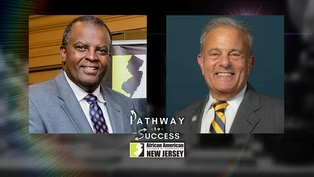
Dr. Michael A. Bernstein, President, TCNJ, talks about his career in education.
Host John E. Harmon, Sr., Founder & CEO of the AACCNJ, talks with Dr. Michael A. Bernstein, President, TCNJ, talks about his career in education and his love of learning and teaching. Pathway to Success highlights the African American business community.
Problems playing video? | Closed Captioning Feedback
Problems playing video? | Closed Captioning Feedback
Pathway to Success is a local public television program presented by NJ PBS
Education is the passport to the future
Season 6 Episode 12 | 26m 48sVideo has Closed Captions
Host John E. Harmon, Sr., Founder & CEO of the AACCNJ, talks with Dr. Michael A. Bernstein, President, TCNJ, talks about his career in education and his love of learning and teaching. Pathway to Success highlights the African American business community.
Problems playing video? | Closed Captioning Feedback
How to Watch Pathway to Success
Pathway to Success is available to stream on pbs.org and the free PBS App, available on iPhone, Apple TV, Android TV, Android smartphones, Amazon Fire TV, Amazon Fire Tablet, Roku, Samsung Smart TV, and Vizio.
Providing Support for PBS.org
Learn Moreabout PBS online sponsorship- Support for this program was provided by Horizon Blue Cross Blue Shield of New Jersey.
- Hello, this is John Harmon, founder President, CEO of the African American Chamber of Commerce of New Jersey.
Welcome to Pathway to Success.
Today's guest is Dr.
Michael, a Bernstein, president of the College of New Jersey, and this is one of the major educational institutions in the Garden state of New Jersey.
And Michael, we're delighted to have you here today on Pathway to Success.
Thank - You, John.
Delighted to be here.
- Just start by just sharing a little bit about your background, where you're from, big family, small family, and then we'll slowly unpack your journey to your arrival at the College of New Jersey.
- I'm a native of New York City, John.
I'm the grandson of immigrants.
Both my parents were college graduates and went on to professional careers.
I have, I have two older sisters.
So a fairly small family, I guess.
- Any influencers in your life that you'd like to share?
- Well, I would start with my parents.
I was blessed with wonderful parents, and they did their best to take care of my sisters and I and teach us good values and set us on good paths.
- Let's talk a little more about some of the ways in which they may have influenced you or made a significant impact in, in, in you being the person that you are today.
- My parents instilled in, in all of us, you know, a deep concern for equity, fairness, decency, and most of all, that we be committed to being good, good neighbors, good citizens, good coworkers.
That was always on their minds.
- So you've attended a number of institutions of higher education on the east coast, west coast, all over the place.
You know, let's kinda unpack that.
- I, I was, I was very fortunate.
My parents encouraged us to go on to college.
I got an excellent college education and then I decided to go on to advanced study.
I wanted to teach at the collegiate level.
And as I finished graduate school, I had an extraordinary opportunity to join the history department at Princeton University.
So my first teaching job was right here in New Jersey.
I spent about five years at Princeton and it was time to move on.
And another great opportunity opened up in California at the University of California San Diego.
I spent 20 years there and learned everything I know, I think about higher education, and then moved on to some other remarkable opportunities in higher education leadership.
- So Tulane is also Tulane University, Stony Brook was another.
Let's talk about Tulane.
So, but while you were there, hurricane Katrina landed on that city and how did that impact the university and, and, and some of the things that you guys may have executed to help the residents in that city?
- I was approached to join Tulane to assist with the rebuild of the university itself.
Tulane is the, the largest employer in Orleans Parish.
Having the opportunity to be part of that team and work to help revitalize and recover the city was an extraordinary experience.
I, I served there almost a decade, and as you say, new Orleans is a, new Orleans is a very special place.
It's a, it's a special cultural, historic and yes, hospitality, capital of America.
So being there was a, was a great privilege and we, we were, we were able to succeed in getting the city back up on its feet.
- I, I'm sure there was some stories, some memorable moments that, that you might want to share with our viewers.
- So many, so many memories and I will always be, you know, deeply connected with New Orleans.
I loved being there and it was a special time to be there.
Probably the first and most powerful impression is when I arrived, people welcomed us with open arms.
I'd be standing on a, on a line in a supermarket and people would come up.
They could tell that I was a newcomer and, and they would ask me what I was doing there.
And I would explain that I had joined the university.
I was, you know, helping to rebuild the place.
They would stick out their hands, they would hug me.
That's the nature of New Orleans.
It's a very, you know, it's a very resilient community.
Takes care of one another.
That's, that's why the city recovered.
- I too had an opportunity to spend time in New Orleans during the time of Katrina, and I was a board member of the National Black Chamber.
And I recall the President Harry offered having some conversations, some very frank conversations with President Bush and, and to your point, the resolve, the, the, the, the desire to, to get the city back on his feet.
So that was my experience.
And so how was that experience advised you today, you know, leaving there, then you had, you came into Stony Brook and then the pandemic hit.
So can you contrast those two kinda situations?
- My experience in, in New Orleans taught me a lot about resilience.
It, it taught me a lot about gratitude and humility.
You know, you don't take things for granted.
Obviously in New Orleans, you know, every day you could see those who were far less fortunate than yourself, and that would both remind you of your place and at the same time, you know, drive you to, to, to try harder because you knew what was at stake, you know, after a major crisis like Hurricane Katrina, people don't squabble over over details.
They get together and, and work hard together.
And that's, that's another powerful memory of New Orleans that people work together across political lines, across social lines, across ethnic lines, because they were determined to, to bring the city back.
And then, yes, I, I finished my, my work in New Orleans and I, I came back north, I came back home to the New York City area, joined Stony Brook, university of the State, university of New York system, and served a couple of years and then the pandemic hit.
So again, I was reminded in that crisis that, you know, that's what we're here for in major institutions.
We're here to serve our communities and sometimes things go badly, and that's when you really have to roll up your sleeves and, and work hard.
And I, you know, I I I say often to my colleagues at the college here in New Jersey, I've said it often in the past, leadership and engagement are all about problem solving.
You know, it's about, it's about helping communities flourish, even in the face of adversity.
- You know, it's easy to stand up in good times, but in adversity they'll find out what you're really made of and, and where your, your passion and your commitments lie.
And to know you today and to have read your story, I, I just think it's impressive.
But notwithstanding all that, you've done all these great universities, you've attended all the accolades that have been extended to you with family and friends, and you've walked across a number of stages.
You've also written six books.
Ta can can you talk about that?
My friend, - I've been, I've been very fortunate throughout my career to have the opportunity to engage as both a teacher and a scholar with my students and on behalf of my students.
And I've had the opportunity to, you know, do historical research and publish books about, about American history.
I find, I find writing books one of the hardest things I've ever done in my life.
You know, it's something you gotta stick with every day and you just gotta keep going.
But the opportunity to make a contribution like that and contribute to learning is, is a blessing in and of itself.
And I, I'll always be grateful that I had the chance to do that.
- Yeah.
So six books.
Let, let's talk about at least a couple of the, the title and why and what was it about?
- My work mostly is focused on the economic history of the United States.
Yes.
During the 20th century.
And my first book was about the Great Depression of the 1930s.
And I think a large reason I was interested in, in writing that book is that's the, that's the period and the crisis in which my parents grew up.
They, they were youngsters during the Great Depression.
And they would share, you know, their memories of, you know, the difficulties, the anxieties and the fear of that period.
And I would, I had the opportunity to talk to a couple of my grandparents as well, who of course lived through that.
And sometimes I've often thought, you know, I wrote that book 'cause I was trying to figure out my parents a little more.
And, and subsequent books I published have continued in that vein, sort of looking at how the American economy has evolved ever since the 1930s into, into the later years of the 20th century.
It's a big - Story.
Economics really opened my eyes to what the world was all about.
How the US eco not only how the US economy worked, but how people were engaged in the economy, how they could potentially leverage the eco, the economy to have a better life.
I remember a class, money and banking and all those pieces start to come together.
And I think about, you know, we talked about the, the people of New Orleans.
And so I think about the people of Trenton, my friends and and peers who may not have been exposed to business and or understanding of economics.
But Mr.
President isn't everything we do, - You know, the health and welfare of communities, it's dependent on a lot of things, but it's especially dependent on people's ability to make, to make a good living, to establish households if they so choose to raise families.
And when communities do not have that foundation, good jobs, committed employers, supportive public services and agencies, it's, it's, it's a tragedy.
And again, I think, you know, reflecting on my parents' experience, my grandparents' experience living through the Great Depression and how that really undermined their confidence in the future.
You know, I learned a great deal about what inspired public policy can achieve when we put our minds to it.
- So let's take a break.
We'll be back in a moment.
- For more information, please visit our website.
- Welcome back to The Pathway to Success.
Dr.
Bernstein, you've been all over the place, but somehow you found your way into the garden state as the, as the President of the College of New Jersey.
And I just want to hear, how did that come to fruition, - John?
I was in California.
I had concluded my work at Stony Brook University on Long Island.
I had returned to California where I had lived for a couple of decades previously.
And, you know, as we say, the phone rang, although in my case it was really, the email went off one day and I was informed that the College of New Jersey was looking for an interim president.
And, you know, I had conversations with representatives of the college.
They asked me to participate in a Zoom meeting with some of the trustees of the college.
And we started, I remember that Zoom meeting.
It was well over an hour.
We talked about the college where, you know, how it was operating, what its future aspirations were.
And I, I found myself becoming increasingly captivated by not only the college itself, which I had always known about, always admired this institution from afar, but that maybe I could be in a position to make a beneficial contribution.
One thing led to another and I was invited to campus to interviews and ultimately was hired A year ago.
The, the board of trustees chose to remove interim from my title, and I'm honored to be serving as the 17th president of the college.
Now - You know what a fascinating story.
Here we are today, going from Trenton State College to the College of New Jersey.
Speak to the, the significance of that change from Trenton State to the College of New Jersey.
And now you are part of the future, your vision.
- It's about 30 years ago now that Harold Eov changed the name of Trenton State.
- Dr.
How OV was a friend of mine, a mentor, a true visionary, a gentleman who set forth on a vision that was somewhat disruptive to the mindset in the trajectory of, I guess the city of Trenton.
- Harold Iik.
Koff and I have talked about that.
Harold's been tremendously supportive.
He remains intensely interested in the fortunes of the college.
And you can see here I'm wearing a pin on my, on the lapel of my jacket that celebrates our dual identity as Trenton State College and the College of New Jersey.
You know, I know that the name change decades ago was controversial in, in parts of the community.
And for some of the alumni, here we are 30 plus years later, everyone knows about the College of New Jersey.
We chose last year to start to celebrate, as I call it, our dual identity.
In fact, independent of what people's opinions are about that name change, our identity is intimately connected with our roots as Trenton State College.
What is the mission?
Our mission is always will be to serve our students by serving our students.
We're serving our state and our region, and even communities farther afield.
I think some 23 states are represented in this year's new incoming class.
And by doing that, we are fulfilling our commitment to the taxpayers of the state who provide crucial support to us and to our mission as, as educators.
And I, I, I just have to say, I'm so proud of our students in the past couple of years in American higher education have been tumultuous, to say the least.
There have been a lot of headwinds, pushing and pulling political, economic, social, cultural.
Our students keep a level head about them.
It's not that they're uninterested in these bigger issues.
They are.
They, they have events and activities to explore those issues.
And they have their own opinions, of course, but they remain focused on the education mission.
That is the essence of, of who we are.
One of the dramatic things that drew me to the colleges, I'm remembering that first conversation I had with some of the trustees was reflecting on this mission, how important it is and how meaningful it is.
And to be part of it is really one of the greatest, if not the greatest honors of, of my career.
- Is there such thing as a typical day for the president of the College of New Jersey?
- Yes and no.
I, you know, on a functional level, my days typically are filled with meetings, right?
I'm, I'm meeting with colleagues who help me with the work of the college.
I'm meeting with committees that are dealing with certain issues.
I'm meeting with alumni or elected officials or community partners.
But at the same time, when I said no, there's always the unexpected.
You come in every day ranging from the good to the bad.
There's the unexpected.
And I have to remind myself, and I encourage my, my colleagues, the vice presidents who work with me in a, in a very important administrative team, you know, be prepared.
Don't assume that you got everything going and it's all fine, because those are the days that are gonna go haywire for all sorts of reasons.
- So you, you, you referenced the students and there's a lot of intangibles in the work that you do, but what brings a smile to your face as it relates to your interaction with the kids?
- When I, when I go across the campus on any given day, if I'm making my way to a meeting or going to an event, and I, I both watch the students in their daily activities and or interact with them, I'm, I'm always impressed by their, their maturity, their engagement, their humility, and the humility is the foundation of their excellence as students, you know, only the humble learn.
I just met, I met with a first year student yesterday, and I asked him about his experience so far, you know, his first month at the college.
And he spoke very positively about this cohesion and support he feels from faculty and staff supporting his success, but also from his peers.
I say this often to my, my own office team, when I'm having a bad day getting cranky, my head's about to explode about something.
If I can just get out and interact with a couple of the students, or even just look out the window from my office and see them going between class i, I, I feel better, - You know, as we look to the future.
Mr.
President, can you talk about your plans for the next three to five years at the College of New Jersey, - John?
You know, our, our, our big focus is to remain, you know, a school that fulfills the dreams and aspirations of, of our, of our students here in New Jersey and in the wider region.
Part of that is to remain committed to innovating and transforming our academic programs so that they remain current and they meet the needs of new generations of students.
Of course, we have to also rigorously manage our finances to make sure that we're, we're utilizing the funds provided by the state responsibly and also generating revenue that enables us to do new things in, in important ways.
- Are there specific things that you all do within the College of New Jersey to ensure that, that, that happens?
- It all starts in the classroom.
The faculty are concerned with their learning fanning out from that.
We have, you know, academic professional staff who provide an array of, as we call them, wraparound services.
These are co-curricular services that, you know, support students through mentoring, counseling, tutoring, other activities.
And of course, all of this comes together in this package that enables students to succeed, reminds them that there's a whole army out there supporting their success.
And then I think perhaps one of the most powerful ingredients, the success of their peers.
When you're part of a community of successful people, it makes it not only more imaginable, but more possible for you to succeed as well.
- One, in terms of the African American Chamber of Commerce of New Jersey, how can we work with you to potentially get more black students to be interested in and compete for slots at, at the College of New Jersey?
That's the first question.
And the second, as a former EOF student, let's talk a little bit about the importance of that type of programming on the campus and also the potential adverse impact with federal cuts to programs like that.
- Our concern about affordability and accessibility, you know, is also framed around a number of programs that support students, both financially and in terms of programming to ensure that they will succeed, that they can come to college, and that they will succeed.
So the Educational Opportunity Fund is a, a very, very important program in support of students who need financial support and also programming support.
Most of them first generation college bound students to ensure that they have the opportunity to come to college and that they'll succeed when they come.
The funding for EOF, as we call it, has been stable over the past few years.
There've been some, some cuts, but it's been generally stable that, which is great, but the challenge is costs just go up.
So it's hard to keep pace when the funding stays flat and also the need increases.
There are more and more students who need the support looking federally, you know, the recent budget bill in, in the United States Congress, you know, threatens to destabilize some finances here in our state.
So we worry about the potential impact of that on EOFI.
I will say the, the college is absolutely committed to EOF.
We provide more than the amount of funds expected in matching with EOF commitments.
That's a, that's a point of pride for us and also a point of mission for us.
But, you know, resources are always a challenge.
So we have to pay close attention to maintaining that kind of support.
I also, I think it's very important that community members always convey the message, both parents themselves, but even the wider community, remind our students, and here I'm speaking of students in high school who are thinking about college.
You can make this work.
It may seem like an impossible mountain to climb, expensive, hard to get in.
How do I do this?
There are people there in your own families, in your high schools here at the College of New Jersey or any other institution you're looking at who want to help you and can make this possible for you one step at a time.
Don't, as the old saying goes, don't look at the top of the mountain.
Just look in front of your feet.
Put one foot in front of the other, you will get to the top of the mountain.
That's what we're there to help you do.
- You know, that was a powerful statement and it brought mind Nelson Mandela who said, it's difficult in the beginning.
It seems difficult in the beginning until it's done.
And, and that's what you say to the students who inspire them.
And, but the other point you made, sometimes we get so carnival on the cost, we don't look at the benefits, the outcomes.
Well, I can tell you this, my friend, it's been an honor and privilege to have this conversation with you today on Pathway to Success.
- Thank you so much, John.
It's been a, it's been a great pleasure to talk with you - Until the next time on your Pathway to Success.
This is John Harmon, founder, president, and CEO of the African American Chamber of Commerce in New Jersey.
Thank you for tuning in today.
Education is the key to a better life.
You know, it doesn't matter if you go to two year, four year school or trade school.
It's making the best of the opportunity.
There's tremendous opportunities throughout the economy of New Jersey and the United States, but education is a, is a key component of that.
You know, I often talk about being one of seven kids from Trenton.
Trenton is a city of working class individuals.
As I was coming up, we went to work every day to provide a life for their family.
And so finally graduated from college.
That was something that I did not believe was possible, but one day I did.
So as we had the conversation today with the president of the College of New Jersey, he represents education every day to thousands of students on the campus of the College of New Jersey.
So my word to you today, no matter if you are young, you are old or you are, you're disadvantaged, you are military vet education is still a critical component of having a better life.
So pursue it with everything you got.
Yeah, it could be expensive, but the benefits they're in outweigh severely the cost.
So I encourage you to embrace education as a transformer in your life.
Thank you.
- Support for this program was provided by Horizon Blue Cross Blue Shield of New Jersey.
Education is the passport to the future
Video has Closed Captions
Preview: S6 Ep12 | 48s | Dr. Michael A. Bernstein, President, TCNJ, talks about his career in education. (48s)
Providing Support for PBS.org
Learn Moreabout PBS online sponsorship
- News and Public Affairs

Top journalists deliver compelling original analysis of the hour's headlines.

- News and Public Affairs

FRONTLINE is investigative journalism that questions, explains and changes our world.












Support for PBS provided by:
Pathway to Success is a local public television program presented by NJ PBS