
Education: School Plans
Clip: Season 2 Episode 45 | 10m 13sVideo has Closed Captions
Dr. Robert Shaner, Michael DeVault, Dr. Alesia Flye, & Mark Greathead are interviewed.
Christy McDonald interviews Dr. Robert Shaner, Superintendent, Rochester Community School District, Michael DeVault, Superintendent, Macomb ISD, Dr. Alesia Flye, Chief Academic Officer, Macomb ISD, and Mark Greathead, Superintendent, Woodhaven-Brownstown School District, on the options for returning to the classroom in the fall.
Problems playing video? | Closed Captioning Feedback
Problems playing video? | Closed Captioning Feedback
One Detroit is a local public television program presented by Detroit PBS
Education: School Plans
Clip: Season 2 Episode 45 | 10m 13sVideo has Closed Captions
Christy McDonald interviews Dr. Robert Shaner, Superintendent, Rochester Community School District, Michael DeVault, Superintendent, Macomb ISD, Dr. Alesia Flye, Chief Academic Officer, Macomb ISD, and Mark Greathead, Superintendent, Woodhaven-Brownstown School District, on the options for returning to the classroom in the fall.
Problems playing video? | Closed Captioning Feedback
Where to Watch One Detroit
One Detroit is available to stream on pbs.org and the PBS app.
Providing Support for PBS.org
Learn Moreabout PBS online sponsorship(upbeat music) - It's high time in Michigan that we stop looking at public education as an expenditure and start looking at it as an investment.
- Being able to be flexible, being able to pivot so that we're meeting the needs of our of our students is extremely important.
- We need to look at how effective this system we've had.
And I will tell you, it has performed better than we thought but not to the degree of what is acceptable.
- Our teachers have been forced to become facilitators, more facilitators of student learning, and how can they do that in such a way that their time with students, their time in-person with students is that much more valuable?
- They are the conversations being had by school administrators across Southeast Michigan right now as they put together multiple options for the fall.
I spoke with Dr.
Robert Shaner, Superintendent of Rochester Hills Community Schools in Oakland County.
He's also on Governor Whitmer's Return to School Advisory Council.
Mike DeVault, superintendent of Macomb Intermediate School District, along with Dr.
Alesia Flye, Macomb ISD's chief academic officer, and Mark Greathead, superintendent of Woodhaven-Brownstown School District in Wayne County.
What are some of the considerations that you're taking into account when you are starting to make these decisions about what fall will look like for your district?
- Really a couple of things, how to get kids back in school, in as a normal a fashion as we possibly can while keeping them safe, providing for virtual choice if parents choose that and also being able to pivot to a really probably a more sophisticated remote learning platform sometime in the fall, if that becomes necessary.
And that it's extremely, extremely complex.
If you think about, just for instance, let's talk about our transportation system.
If we have to socially distance transportation and put 15 kids on a bus, or 20 kids on a bus.
I put 115 school buses on the road every day and I know there are school districts in the tri-county area that even larger than us, that almost doubles the number of buses and runs that need to put on the road, not to mention the time that it takes and then do those health protocols that we're hearing we might have to execute.
- We're anticipating that some parents may not wanna send their kids back.
So not only do you have to have a regular school plan, but you have to give parents a choice to have something online or distance learning.
If in fact, we have to have, and by the way, we're assuming that thermometers, face masks, and all those things will be on a traditional school model.
And that's very different than any students has ever, ever participated, then you have to look at hybrid systems, two or three or four, we've looked at 14, there may be three or four that are actually doable, and somewhat more better at large districts than with small districts, so we've teased that all out.
We have plan to submit to the governor's office and also in the entire area.
And if in fact, worst case scenario, we could be back to remote where we are now, but we can no longer just have the technology shortfalls and the training that would be used to teachers if it's full remote, and online in the fall.
- What does the appropriate schedule look like?
It certainly can't be one size fits all.
So what works best for our youngest learners versus what works best?
And what can our older students handle and take on?
If we have a blend where we do have the students in-person for at least part of their learning, we need to be very cognizant about prioritizing which materials are best suited for in-person instruction?
Which curriculum is best suited for in-person instruction?
And then what can we do in advance virtually?
- Is it hard, Mark, to look across the board?
Because you already have some districts coming out saying, "Well, this is what we're doing already."
that is so individualized district by district.
And though you can talk, let's get together as Wayne County schools, as Oakland County schools, but really what would work for one district may not work for another?
- No, but I also think there's a lot of value and collective power in working collaboratively the way we have in Wayne County.
And we've taken the approach that we fully recognize, appreciate, and support that each local school district will have decisions to make that are best for their community.
- What are some of the concerns that teachers are having?
- Been serving the community on an ongoing basis throughout this time, and some of our students surveys that the students were out for a week and a recurring theme was how much they miss their friends, their staff.
But I think just in terms of the staff, we hear the wonderings about how their students are doing as they've kept in touch, they know that some of our families have been significantly impacted by this pandemic.
- I think, again, the expectations are gonna be higher.
I think the requirement for us to support our staff and be more focused about what we deliver is gonna be there.
So the things that we're working on, we're going to move to a one-to-one technology environment.
We're making sure that all of our students have connectivity, and we're working very diligently, become more focused on which platforms that our teachers are using and making sure that they have the professional development support that they need.
- There's research out there that indicates, even without a pandemic, you typically do have some summer loss in terms of instruction.
And there's already some documented research that indicates that there will be some instructional loss during this, throughout this global pandemic as well.
And so, part of our plan is assessing where students are, when they're back with us and we typically do that anyway, every district will be getting benchmark assessments, information about their students, and so that they can come up with a differentiated plan to help improve the achievement.
- What does this do to where you believe student achievement is?
And we had to put that on hold for a little bit?
- Absolutely, I believe we need to put it on hold for a little bit.
I don't say that in a cavalier way because it really makes me sad that we would have to put it on hold for a little bit, because what I feel we've been lacking is consistency in our benchmarking, in our measurements of the benchmarks.
We need consistency year over year data, data that's given to us in a timely manner, data that we can quickly act on to improve our instructional practices.
So to use the same benchmarks and the same testing methods in an entirely different learning and teaching environment would provide us with meaningless data.
- What are you hearing out of Lansing right now and the difficulties of trying to plan for a dozen different scenarios and knowing that you're going to need more resource and hearing that possibly you're going to get less?
- I cannot increase our costs and decrease our revenue.
And more importantly, for them to make a comparison to a private business, at this point, I can't even create a forecast.
But many of my colleagues in the private sector forecast almost on a monthly basis and I can't even create a forecast to have any indication of what my profit loss is gonna be, and our profit and loss in student achievement and outcomes for children.
So this is gonna be, it's gonna be a challenge and I hope folks understand it's high time in Michigan that we stop looking at public education as an expenditure and start looking at it as an investment.
- What is your concern about funding for schools?
- The first concern is that potentially could be going in the wrong direction.
Yes, through the School Finance Research Collaborative, we had already identified where school district funding needed to go to make it equitable and meaningful across the board.
Now with the potential of going in the wrong direction with so many increased demands on school districts, so with the type of cuts that have been thrown out there, even without those added expenses, I fear that a good number of school districts wouldn't even be able to open their doors in the fall.
- We have actually met with all of our United States senators and our congressional delegation and their support along with a governor that you can't separate school from opening a community of business.
Moms and dads depend upon us and we have to make up for that time loss, so it's an enormous lift.
- I wanna talk to you a little bit about, I guess, the mental health support for parents and for students and what we really need to take into account.
- we have 130,000 students that we serve in this county and we know that it will have impacted each of them potentially in a different way in terms of the student and the families.
And so yes, we have instructional goals, but our goals of making sure students feel safe and nurtured and supported as they reconnect in the school setting is a priority.
- There's a couple of things that the pandemic has taught us about public education.
First of all, it's taught us that it's a foundation of our communities.
It's someplace that really is the bedrock of the word community.
People go to their public education systems for so many different things outside of education.
Mental health services are gonna be critical.
I think we're way under estimating the trauma that this has had not only on children, but adults.
And the reentry part of it, the anxiety that people are gonna feel coming back into a social setting and thinking about all the different possibilities that might happen.
It is gonna be critically important.
And it's gonna be critically important to approach this holistically.

Celebrating Student Milestones
Video has Closed Captions
Clip: S2 Ep45 | 2m 9s | How Metro Detroit communities are celebrating their graduating seniors during the pandemic (2m 9s)
The Need of Psychologists and Counselors in Schools
Video has Closed Captions
Clip: S2 Ep45 | 7m 55s | Karen Anthony, Mental Health Consultant & Sirrita Darby, Detroit Heals Detroit (7m 55s)
New Plans for the Detroit Public Schools Community District
Video has Closed Captions
Clip: S2 Ep45 | 6m 9s | Dr. Nikolai Vitti, Superintendent, Detroit Public Schools Community District (6m 9s)
Parenting During the Time of COVID-19
Video has Closed Captions
Clip: S2 Ep45 | 7m 4s | Tara Hardy interviews Kathleen Alessandro, Executive Director, Great Start – Detroit Wayne (7m 4s)
Special Needs Education in the Time of COVID-19
Video has Closed Captions
Clip: S2 Ep45 | 4m 38s | Dr. Lanissa Freeman, Special Education Director, Southfield Public Schools is interviewed. (4m 38s)
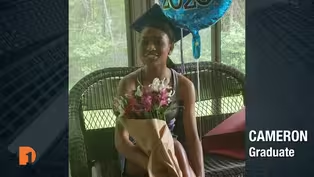
Video has Closed Captions
Clip: S2 Ep45 | 2m 7s | Students share the challenges they've faced and how they hope things will change. (2m 7s)
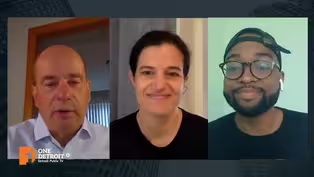
The Uncertainty of Teachers in the Fall
Video has Closed Captions
Clip: S2 Ep45 | 8m 34s | Two teachers give insight on the future of in-classroom teaching and concerns about health (8m 34s)
Providing Support for PBS.org
Learn Moreabout PBS online sponsorship New Episode
- News and Public Affairs

Top journalists deliver compelling original analysis of the hour's headlines.
 New Episode
- News and Public Affairs

Today's top journalists discuss Washington's current political events and public affairs.

 New Episode
 New Episode
 New Episode
 New Episode


 New Episode
 New Episode

Support for PBS provided by:
One Detroit is a local public television program presented by Detroit PBS