Utah Insight
Education’s Digital Divide
Season 2 Episode 11 | 26m 56sVideo has Closed Captions
As education becomes more technology-based, are some students being left behind?
The COVID-19 pandemic ushered in a new era of remote learning in American schools. But experts worry unconnected children from lower-income families will be permanently left behind. From a federal plan that would limit this learning loss, to proposals that would increase access to technology, our panel of education experts discuss the ways to bridge this digital divide.
Problems playing video? | Closed Captioning Feedback
Problems playing video? | Closed Captioning Feedback
Utah Insight is a local public television program presented by PBS Utah
Utah Insight
Education’s Digital Divide
Season 2 Episode 11 | 26m 56sVideo has Closed Captions
The COVID-19 pandemic ushered in a new era of remote learning in American schools. But experts worry unconnected children from lower-income families will be permanently left behind. From a federal plan that would limit this learning loss, to proposals that would increase access to technology, our panel of education experts discuss the ways to bridge this digital divide.
Problems playing video? | Closed Captioning Feedback
How to Watch Utah Insight
Utah Insight is available to stream on pbs.org and the free PBS App, available on iPhone, Apple TV, Android TV, Android smartphones, Amazon Fire TV, Amazon Fire Tablet, Roku, Samsung Smart TV, and Vizio.
All Episodes Now Streaming
Hosted by Jason Perry, each week’s guests feature Utah’s top journalists, lawmakers and policy experts.Providing Support for PBS.org
Learn Moreabout PBS online sponsorship(gentle music) - [Voice Over] Funding for Utah Insight is made possible by viewers like you.
Thank you.
- [Liz] On this edition of Utah Insight, we're taking a look at the lasting effects of the digital divide.
- What will be interesting next year at our school and really all schools.
- [Liz] As students head back to class in person, teachers will have to assess what they learned and missed while virtual class was in session.
- But I don't think it's something that we will just forget about or next year, you know, all things COVID-related will just disappear.
- We'll share what local school districts are doing to help students catch up, and what the state is doing to help close the digital divide in Utah schools.
(intro music) Thanks for joining us here on Utah Insight.
I'm your host Liz Adeola.
39,845.
That's the total number of school-associated COVID-19 cases from the 2020 to 2021 school year in Utah.
Students represent the bulk of those cases with 33,016 positive COVID-19 tests during the last school year.
Now those numbers come from the Utah Department of Health and they are just a snapshot of a school year where many students had to begin the transition from online learning to back in-person learning in the classroom.
But not all Utah students are going back to the physical classroom.
And while teachers find ways to reach those students, they'll also have to find ways to close the learning gaps that were created when some students were unable to connect to online classrooms.
Joining us now to talk about the challenges of the so-called digital divide and some solutions, we have Sydnee Dickson, the Utah State Superintendent of Public Instruction with the Utah State Board of Education.
Joining us via Skype, we have Ronee Wopsock Pawwinnee, who is the education director for the Ute Indian Tribe Education Department.
And we also have Charlene Lui who recently retired.
Congratulations.
After working nearly three decades in the Granite School District, most recently as the Education Equity Director.
I want to thank you all for joining us today.
Thank you for being here.
And I want to start with you, Charlene, you worked in a district where there's a lot of diversity, a lot of refugee students as well.
What was the transition like going from in-person classroom teaching to online teaching during the pandemic?
- Oh, well, thank you.
That's a very interesting question because it, really was quite a challenge at first, because first of all, when our family, students are coming, many of them are English language learners, they don't know the system, they're just getting used to school itself.
And then now all of a sudden we have a new normal.
And so it there, the transition was, it was definitely a challenge, but it was certainly one that we were willing to accept.
And I feel like we did.
We did a really good job with that.
And so, one of the things, as we've talked about, I think in your previous programs as well, is that digital divide though, how do we bridge that gap and make that transition to home, to home learning?
And so there were several projects that we undertook in order to be able to work with our most marginalized population, with all students, but especially thinking about the students who may not have access to computers or a one-on-one device and even the internet, you know, so many of us take take for granted that we all have internet access, right?
Well, what if you have like four or five students, or children within one home, and you might only have one or two devices, and they're all on the internet?
That really presents a problem as far as accessibility and everything.
And so there were things that collectively as a district, and as a community, we worked on together to bridge that or to address those.
- And Ronee, I want to bring you into this.
If you could use one word to describe the last school year, what word would it be?
- I believe I would use the word tough.
- And why is that?
- I think early on, the tribe made the decision to completely shut down to prevent the spread of COVID.
And so we had to hustle, as an education department to begin to provide services to our students who were staying in home.
And that hustle meant, you know, purchasing small surface books so that our, each student in the home could have something, if they weren't already offered something from the surrounding school district.
And then we faced internet crisis, you know, making sure that all of our homes were equipped with proper internet.
The reservation is very spread out here.
And so a lot of places didn't have the ability to have a high speed internet.
- Yeah.
Broadband internet access was key to helping a lot of students and teachers stay connected during this time, but some families simply couldn't afford it or they didn't have access to it, or they just had bad connections like you talked about.
If there's multiple students in a home, and they all have to be on at the same time, that weakens the strength of the connection that they have.
Sydnee, how were you able to address those issues and help more students connect during this time?
- Well, Utah was very forward-thinking about five years ago.
Our legislature invested in digital teaching and learning.
We had tools in our schools.
We have professional learning that it occurred, and we had software.
So a large investment had been made.
And about 70% of our students, when schools closed in 2020, were able to walk away with a digital tool.
But I think both Ronee and Charlene have addressed well, the situation with broadband.
So many families may have had minimal broadband service, but not enough to really engage with the kind of work that was required for a true remote learning experience.
Many of our teachers were still working on their own personal skills of being better at instructing in a digital space.
So, while we had a great headstart compared to many of our colleagues and states across the country, we still have those deficits.
And it was our most vulnerable students, our most vulnerable families, who seem to be the ones without access to high quality broadband.
We also had a lot of partners who stepped in in the broadband space, and they were great to offer reduced or free services, but the ability to connect in some of our rural and remote places was more of a challenge, and the sustainability, what happens next, which I'm sure we'll talk about in a minute.
But really thinking about in the short term, trying to put a bandaid on it, but also how do we, how do we leap forward so that given any situation, we can be very nimble in the future?
And every child and every family deserves to have access to high quality broadband so that they're not left behind.
- Absolutely.
And Charlene, speaking of examples, positive examples, you collaborated with Pacific Island Knowledge 2 Action Resources to help students get those resources they need.
Didn't they have a laptop program?
- Yes, they did.
In fact, it was, I believe it was A Mother's Foundation, hope I got the name correct.
But they worked very closely with the, with all students, all families.
But, of course, we have that connection with the Pacific Islander community to provide the services and not just well, the devices as well as broadband connection.
And so we were very fortunate for that.
In fact, one of the schools, Moss Elementary, in Granite School District received, in collaboration with that organization and other organizations, services that way as well.
- That's incredible.
And two things that struck me when we spoke about this earlier was, the need for also training family members so that they could help students along the way while they were going to school.
Can you talk about that?
- Yeah, if I could just use a personal experience, but from my perspective in the Pacific Islander community, working very closely with many of them.
We're an extended family, and so there's many generations within a home.
Oftentimes, it's the parents that are working, so that might leave auntie or grandma or the older folks there.
So generationally, there is that gap, so to speak as far as perhaps if we use that word digital immigrants, so they may not know exactly how to even access or get online, or we use the Google classrooms, you know, all of those tools and applications.
And so what we found that was necessary as well is that, we created these programs in instructions with, through the videos and recordings.
Now some might say, we'll just translate it into another language, but not everybody's literate in their primary language.
And some languages, as we know from our refugee communities, don't have a written language either.
So it was important that we not only presented it in a written format, but we had an audio recording as well.
So we help that way.
And just to take off from that as well, realizing in our communities, we find that if we want to really reach out and help with communities, we go through some of the churches.
And not just the predominant church here in the state of Utah, but many others.
And we work with them in community groups to teach them the basics of accessing, turning on the, not just turning on the computer, but being able to access the programs.
- Absolutely.
And we posed this question on social media because we wanted our viewers to jump in on this conversation.
As kids head back to the classroom, and the true cost of virtual learning is felt in our state, we want to hear from viewers, we asked you, what should be done to make sure that students get caught up when they return to class in person?
On Instagram, svensk-_dansk wrote, "Give them an even playing ground with access to the internet and the technology to use it at home."
And gwinterfeld posted the following, "Have the students who are behind start a few weeks early.
It's amazing how quickly students can catch up when given extra attention."
And Sydnee, we talked about this, you know, there's been people asking, are students gonna be held back?
Is there gonna be a half grade?
How will school districts deal with the learning that gap created by the digital divide?
And you shared that there have been students still going to class over the summer.
- Correct.
Many of our districts and charter schools have held summer sessions for their students.
Some are doing bootcamps a couple of weeks before school starts, some held bootcamps after.
You know, it's not our children's fault.
So I'm not a fan of the term learning loss.
In fact, we think about how do we accelerate their learning so that they can, not only catch up, but move ahead of where they might have been.
And the digital aspect of learning helps us understand that learning happens 24/7.
It's not about seat time, but really thinking about competencies.
So it's not about the amount of time they're spending, as much as how can students show what they know?
How can we help them learn in various ways?
How can we accelerate what they're learning?
So really getting away from, you have to finish this unit in this amount of time, it's more about, here's the standard, and show us how you know that standard.
And that's, takes a lot of support, a lot of support from families and from teachers, but that's the direction that we're moving holistically as a school system anyway.
So what a wonderful time to practice that with our students who are in this space of maybe catching up or trying to learn something that they hadn't learned before.
Afterschool partners are helping us with this.
Many partners who help with learning of academics and social skills, things like critical thinking and problem solving and communication and collaboration.
Those are skills that transcend any content and they help students further their education as well as be successful in the workplace.
So it's not just about the content, but it's the holistic part of schooling that students need help and support with.
- And students were forced to make all kinds of adjustments during the pandemic, from learning new tools to adjusting, and then relearning, you know, how to go back to class in person, and be a part of that atmosphere.
Utah Insight's RaeAnn Christensen has more on the COVID-19 pandemic's emotional toll, and how educators are providing support.
- First year as principal, I had a long line of students waiting to talk to me every day that had some trouble regulating their emotions to some degree.
So I started looking for some possible solutions to help meet their needs.
- [RaeAnn] It's a place, a little more like home rather than the principal's office.
That's the idea behind the Wellness Center at Oquirrh Elementary School.
Principal Shauna Worthington realized that they needed to address children and their mental health needs differently.
- Just kept thinking about our kids and what they need and what our teachers need to be able to teach even better.
And just knew that I had to make this happen.
- I think the more we can teach kids about emotions and what they look like and what they feel like, it all just, it's a life skill that they can carry with them.
Did you ask to come to the Wellness Center?
- Yeah.
- [RaeAnn] With the help of Social Emotional Learning Coach, Megan Daly, students figure out what they are feeling and how to cope with it.
- I like the Wellness Center because if I'm stressed out in class, it helps me just calm down a little bit.
- How's your morning?
- Meh.
- Meh?
What does that mean?
- And sometimes I just need to take a break from class.
- Our kids needed something.
They needed some safe space to go when class is just too much.
- The Wellness Center has things help you be calm, like magnet and Rubik's cubes.
- I normally grab the pop its, and when I pop them, it helps get rid of them my stress level.
- [Megan] Social emotional learning isn't something that we add to the plate, it is the plate.
And that's just stuck with me where it's like, we can't teach kids how to multiply, we can't teach kids how to read and write, if we're not addressing their social emotional needs first.
- It's exciting to see so many educators throughout our system, including at Oquirrh, who are passionate about preparing students for the tests of life, not a life of tests, where they really can learn and engage with and practice skills that they use on a daily basis.
- Jordan School District Health and Wellness Specialist Mckinley Withers says, the idea of wellness centers is catching on.
- There are several schools that are following in their footsteps and implementing their own wellness centers.
And every school kind of puts their own little flavor on it.
It's just, it's a cool thing to see.
- I think all schools should have a wellness center because if you get stressed in class, it just helps you feel calm.
- Well, I know I come here at least once a day.
- If you're stressed, mad, or like too excited, and it's a place to calm down.
- And most of the time I feel really good.
- And then when you leave, you feel a lot better.
- [RaeAnn] The kids, also learning skills that will last a lifetime.
- I think the possibilities are endless as to how it will really help these children become even stronger and better adults.
- And Chelsea Marie shared her concerns about students' mental health on our Facebook page.
This is what she wrote, "I think we need to be addressing the mental health of all of our kids and start individualizing all of our children's education plans more to help those who need it, and to push those that are thriving.
I hope accountability and change comes soon."
Charlene, what do you think about that?
- Oh, I think that's such an excellent idea, to work with the social emotional being of their students.
Especially when you think of, when you think back to what happened, right?
You have the COVID, you know, the shut downs and then what would, what did we have over 2,500 earthquakes, and then the protests, and everything.
There were so much that our students and families, as well as teachers, had to deal with.
And so we were already doing social emotional learning prior to the pandemic, but once that occurred, it was great that we had that in place so that we could then even reach out even more, you know, and virtually as well, working with students.
And then now coming back to school and addressing it in the wellness centers.
And many districts are doing wonderful jobs with that.
- And Ronee, what do you think about this?
- I think that though the idea of a wellness center is a good concept, I know one thing that we're doing here at the tribe this year, is we're holding a two-day conference.
We're calling it an education bootcamp, so that we can begin to reintroduce our students back into the school setting.
We'll give them, you know, the concepts they need, be able to offer them some kind of device if they don't already have one, and really introduce them to our tutor mentors in the schools that they can be and had to go to if they get stressed, if they get overwhelmed.
We're also doing a special segment for our parents.
So our parents have a better understanding of what it's going to be like coming back into the school.
- Chelsea, our viewer who posted on Facebook, she also opened up about issues with their son's IEP, saying it wasn't enforced because accommodations couldn't be met at the time.
Sydnee, what's happening to address those kinds of issues?
- Well, I think both Charlene and Ronee have talked about how important that personalization is for our students.
And Chelsea mentioned that in her first comment.
So the board of education is focused on four areas or four goals.
One is early learning.
The second is making sure that every student has effective teachers and leaders.
The third is social emotional wellbeing.
And the fourth is personalized learning.
So you can see all of those things blended together are meant to support each child in each family.
And for students on IEPs, it was challenging, especially for those who needed to have physical therapy or occupational therapy as part of their plan, and to be in the home or at school and provide those services was challenging.
So our special education teachers are meeting right now today, and they're talking about ways to double down and provide additional support so that our students who are needing additional services, whether they're on an individualized education plan or not, that they can get those additional supports they need.
Our social workers were really busy last year.
We know a lot about trauma and how it affects the brain and how it affects learning.
So all of our teachers' leaning into social emotional wellbeing is so critical.
Last year was the hardest year ever.
The following year, this coming year maybe the most important year ever.
- With a lot of changes that are happening day to day at last checked, there's no mask mandates in the schools for the fall semester.
And then just recently the CDC recommending that mask be worn in schools for K-12 students.
Sydnee, how are teachers preparing for this?
How are educators in the state preparing for this?
- Well, last year we had laws passed that prevented and prohibited state mandates, and a lot of these aspects that we're talking about, including masks, so we'll see more work with local health departments and local boards of education, and county commissioners to look at the conditions, locally.
We certainly are mindful of the CDC.
We're a great, we have great partnerships with the state department of health, and local departments of health, and hospitals and epidemiologists.
And that, you know, we've all been working together all year to figure this out, but it's a changing landscape.
And the Delta variant puts a new layer on top of what we've been doing and what we know.
So it will be, we're not out of the woods.
It will be a challenge come fall.
And I think it will be more localized in terms of how those decisions are made.
- And Charlene, did you want to add onto that?
- Well, I think with what Superintendent Dickson has said, it's really important that the key word for me is, and for several of us in the community is that, personalized look.
Right now, I know in many districts, I'm gonna speak from Granite because that's where I recently was at, is that we were really looking at focusing on and reaching out to every family.
And personally, personally inviting them back to school because we know, with the learning, if we can get the student in school face to face, that's where the most effective way of teaching, you know, and working with them.
But it's not just inviting them to the school, but what are we doing to continually build that relationship?
We have to reach out.
You know, Aguilar uses in her Coaching with Equity, she uses the term every child, every day.
It really is an urgency.
It's not something that we can just push aside.
And we've always been that, but I think it's even more strategic now and even more important for us to think about every child, every day and just go and go beyond just phone calling or the porch or the, you know, we call it the doordashing, when we would drop things off, we've got to do more than that.
They might come to school, but what are we doing to engage them, so they fully stay with us?
- It really does feel like the pandemic has pushed us into a new and different phase of education, and the way that children are taught and the lessons that were learned during the pandemic, and the new technologies that were used are not going anywhere soon.
Ronee, how are you making sure that students, you know, stay abreast of what's going on and are ready to take on these new challenges?
- I think our goal has been working directly with the schools to continue to provide support, but also getting back into our tribal community so that we're able to answer questions when they have it, we're able to provide direction, and we're able to just continually support, not only our students, but our parents.
So that they ensure that making that return to school is what needs to happen, but it can be done safely.
If they feel like they need to wear a mask, wear a mask, you know, and that's been our goal this year, is just to get back in contact with the schools and provide information to our community.
- While researching this for months and months and months, it feels like there's been this shift.
A lot of times people have said, you know, reading is fundamental, everybody needs to learn how to read.
And it felt like technology, and having the use of laptops and things like that, it feels like that was more of people's viewing it as though it was instead of something that they had to have, something that was more of a, oh, I'm losing the word, but something that was not as much of a priority.
And now it seems almost as if that's even as though students and their families need to learn and know how to be literally in the digital space is what I'm trying to say.
Sydnee, going forward, what is needed financially to make sure that, that happens for every student in Utah?
- That's a great question.
As I mentioned, our legislature has invested financially in digital teaching and learning, that's provided tools and training.
I so appreciate early on the comment that was made, I think it came from Charlene, about parents needing to understand how important this is, as well as how to use the tools.
We left parents out of the equation.
We put all of these tools in the home, and in a lot of spaces, we didn't equip our parents with how to use the new technology.
So that's something that we're going to focus on and make sure that our parents are part of that equation.
At the same time, literacy is important for all.
And we can see early on from some of our data that our earliest learners were not as prepared as they normally would have been coming to kindergarten, for example.
So reading to your child every day, counting with your child, those, you know, those elements that have always been important in the home really prepare students for school.
And then just continue to read with them.
That can be done digitally or with hard copy books, or signs on the roadway.
You know, just continually building your child's vocabulary is very important.
And that hasn't changed.
The pandemic hasn't changed the need for that, but it's helped us understand that there are many tools and many ways to engage our young children, especially in reading.
And then we have to stop and look throughout our whole system, middle school, high school, how are we showing up literacy?
And to your point, Liz, we have digital literacy, financial literacy, as well as what we think of the literacy in reading and language arts.
So we have a lot of work to do, and there were students who, school wasn't working for them before the pandemic.
I'm concerned about all of our students pre-pandemic and post-pandemic.
So we're taking the lessons we've learned, and launching forward to be better.
- And the word that I was looking for was privilege, not looking at it as a privilege for them to have the technology and the digital skills, but something that is necessary.
Yes.
Essential in the future as we move forward.
Were there any final thoughts that any of you want to share before we wrap up?
- Well, if I could, I would love to share the fact that when we talk about resources, I would encourage our families and our communities to work together and realize, across the district and multiple, in many of the districts, you have people who are similarly situated as I was as an equity director.
And so we were in very involved with the community centers, family engagement centers.
There's a really a wealth of information.
What our situation is, is we need to make sure we can get that information out, you know, and we're not, but more importantly, we want to hear from them too.
How can we best meet the, it has to be a two-way partnership that flows back and forth.
Not just we're giving you this, and we think this is best for you.
I think over the years, both superintendent, myself, and Ronee, with our work, we know that it has to be a full two-way community work relationship, so.
- I agree.
Well, thank you all for being here.
This was a wonderful conversation.
A great discussion.
Just a reminder that Utah Insight phone line is always open.
We want you to join in on the discussion.
We want to hear your thoughts on topics that we should cover on future episodes of the show.
And you can also join the conversation by using any of the methods that you see right there on your screen.
I want to thank you so much for watching Utah Insight.
Let's keep the conversation flowing online.
(Utah Insight's outro music)
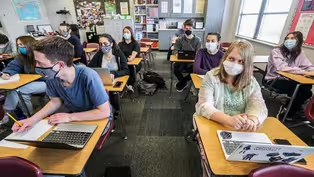
Education's Digital Divide - Preview
Preview: S2 Ep11 | 30s | On the next Utah Insight, how Utah educators are working to close the digital divide. (30s)
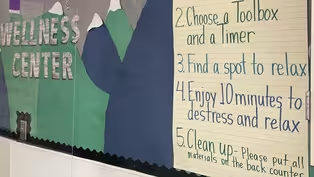
Elementary School Wellness Center
Video has Closed Captions
Clip: S2 Ep11 | 3m 10s | Educators innovate new ways to improve kids’ mental health at school. (3m 10s)
Providing Support for PBS.org
Learn Moreabout PBS online sponsorship
- News and Public Affairs

Top journalists deliver compelling original analysis of the hour's headlines.

- News and Public Affairs

FRONTLINE is investigative journalism that questions, explains and changes our world.












Support for PBS provided by:
Utah Insight is a local public television program presented by PBS Utah