
Efficacy of the COVID Vaccine/Snyder in Flint Water Crisis
Season 4 Episode 8 | 26m 46sVideo has Closed Captions
Efficacy of the COVID Vaccine/Snyder in Flint Water Crisis | Episode 408
DPSCD Superintendent, Dr. Nikolai Vitti, wrote a letter to Governor Whitmer, urging the governor to let Michigan schools to resume school sports. Dr. Arnold Monto talks with Will Glover about their efficacy with the new COVID variants. And, Karen Weaver reacts to the charges against former governor Snyder in Flint water crisis. Episode 408
Problems playing video? | Closed Captioning Feedback
Problems playing video? | Closed Captioning Feedback
One Detroit is a local public television program presented by Detroit PBS
Efficacy of the COVID Vaccine/Snyder in Flint Water Crisis
Season 4 Episode 8 | 26m 46sVideo has Closed Captions
DPSCD Superintendent, Dr. Nikolai Vitti, wrote a letter to Governor Whitmer, urging the governor to let Michigan schools to resume school sports. Dr. Arnold Monto talks with Will Glover about their efficacy with the new COVID variants. And, Karen Weaver reacts to the charges against former governor Snyder in Flint water crisis. Episode 408
Problems playing video? | Closed Captioning Feedback
How to Watch One Detroit
One Detroit is available to stream on pbs.org and the free PBS App, available on iPhone, Apple TV, Android TV, Android smartphones, Amazon Fire TV, Amazon Fire Tablet, Roku, Samsung Smart TV, and Vizio.
Providing Support for PBS.org
Learn Moreabout PBS online sponsorship- Hi, I'm Christy McDonald, and here's what's coming up this week on "One Detroit."
Governor Whitmer is taking heat from school leaders, including Detroit's Dr. Vitti about delaying kids winter sports.
Plus challenges fighting COVID with the new variant, and slow vaccine rollout.
Then new developments in the case of one of Michigan's longest serving inmates, and former Flint mayor Karen Weaver on fixing Flint's infrastructure after the water crisis.
It's all coming up this week on "One Detroit."
- [Narrator] From Delta faucets to Behr paint, Masco Corporation is proud to deliver products that enhance the way consumers all over the world experience and enjoy their living spaces.
Masco, serving Michigan communities since 1929.
- [Narrator] Support for this program provided by the Cynthia and Edsel Ford Fund for Journalism at Detroit Public TV.
The Kresge Foundation.
Community Foundation for Southeast Michigan.
- [Narrator] The DTE foundation is a proud sponsor of Detroit Public TV among the state's largest foundations, committed to Michigan focused giving.
We support organizations that are doing exceptional work in our state.
Visit dtefoundation.com to learn more.
- [Narrator] Business Leaders For Michigan, dedicated to making Michigan a top 10 state for jobs, personal income and to help the economy.
Nissan Foundation.
Ally.
And viewers like you.
(upbeat music) - Hi there, and welcome to "One Detroit."
I'm Christy McDonald.
Thanks so much for being with me.
Governor Gretchen Whitmer made her State of the State address this week, talking about the state's recovery from COVID, and her agenda.
Restaurants are allowed to open for limited indoor dining on February 1st, but her policies on winter school sports are making a lot of coaches, parents, and administrators upset, including Detroit School Superintendent, Dr. Nikolai Vitti.
He tells me about his letter to the governor, plus addressing learning loss among his students this year.
And as we wait for more vaccine to be available U of M, Epidemiologist, Dr. Arnold Monto, talks about the efficacy of these vaccines against the new COVID variant.
Then a change in the case of one of Michigan's longest serving inmates.
We'll have the latest on Ray Gray.
And Flint's former Mayor Karen Weaver on the new criminal charges, and replacing lead lines.
It's all ahead.
(soft music) - This week you sent a letter to Governor Whitmer asking for kids to play winter contact sports saying that there's been contradictory messages between policy and what you're seeing.
What is your argument that these kids should be playing right now, that they could not be the cause of community spread?
- There are several.
One, I think we went through fall sports.
Obviously, it's hard to argue that there's anything more contact driven from a sports perspective than football.
And in order to restart the latter part of the playoffs, the health department state level and the governor require students to be tested.
When they tested 99.6 tested negative.
And that was at the height of the recent surge in positive COVID rates in the city and the state.
So that number clearly shows us that it's not student athletes that are spreaders of COVID.
That's one issue.
The second issue is we played football throughout the fall with little incidents, hiccups, challenges, but we're all dealing with positive cases from businesses to schools.
The third issue is 80% of states throughout the country are playing high school basketball and winter sports.
So why aren't we?
The bordering states of Michigan are playing.
Why aren't we?
And at the end of the day these are consenting families that are measuring the risk of playing.
We're telling our young people they can go to school.
They can go to the movies now.
They can go to eat.
They can even practice basketball, but they can't compete.
I think it's contradictory.
I don't think it helps with the reopening, the economy reopening our schools.
And, lastly, I know that the governor is better than this.
I believe in our leadership.
I believe in our judgment.
And at the end of the day she just needs to explain why, and she hasn't done that.
We all have higher expectation for her.
I believe in her, I think she will step up, and we've all as leaders been in difficult situations.
We've all been in situations where people disagree with us, but what strong leadership represents is telling people why you feel the way you do, giving data, giving concrete examples why you should support the opposite opinion.
And then you move forward.
There hasn't been transparency on this issue, and that needs to change.
And I'm worried that the governor is going to lose support among her supporters if she doesn't become more transparent about phases of reopening and closing.
We need concrete data.
We need concrete data to know why we should open schools, why we should close schools, why we should stop sports, why we should continue sports.
At the end of the day if schools are open, sports should be played.
- So we're at the week of January 25th.
What is the timeline for DPSCD to have in-person learning?
What are the numbers that you're looking at?
- The daily average is lately been below 5%.
So we're hopeful that we'll open all of our schools as learning centers next week so that all children can come to school and login, eat breakfast, eat lunch, be supported by paraeducators, administrators.
And then if the rate goes well below 5% let's say three and steady, then we're looking to open up in-person learning by the first week after our mid-winter break, which is February 22nd.
- One concern that I've heard from parents, teachers across the spectrum it doesn't matter where you are, in what district is learning loss.
How concerned are you?
What kind of measures do you have in place in the district to see what kind of learning loss we might be dealing with?
- We're certainly seeing learning loss, anecdotally I would say.
Our data is skewed right now.
We do assessments at the K-eight level in literacy and math to look at grade level proficiency or performance, but the data is skewed because it's missing about 2,000 students that did not enroll in DPSCD, and we're dealing with chronic absenteeism.
So the students that would normally test in school, and participate in school are not consistently engaged with online learning.
So, actually, when you look at our K-8 numbers they're actually higher from a performance perspective than last year, but that data is like I said, skewed.
So our plan moving forward is we're going to dramatically increase summer school access.
We're looking to possibly have every school opened in the summer for voluntary summer school, not mandatory.
We're hoping that our employees will be willing to participate and be paid.
We'll offer online, and in-person.
We also envision offering online, and in-person support over the breaks next year.
So spring break, winter break, our mid-winter break.
Still continuing with our employees, working with our students, we're having partners come in as well.
We're adding more partners for literacy already, and we want more partners for math to work with students in small groups during the school day and afterschool.
So those are some of the things that we're looking at as far as trying to make up for that learning gap.
- The supply of COVID vaccine in Michigan is still not enough to meet the demand for everyone eligible to get the shot.
University of Michigan, Epidemiologist, Dr. Arnold Monto, chaired the federal committee that recommended the Pfizer and Moderna vaccines for emergency use.
He talked with Will Glover this week about their efficacy with the new variants and more.
- What is the difference between the COVID-19 vaccine, and the vaccines that we're normally used to getting like the flu vaccine?
- Well, the vaccines basically work the same way.
The COVID vaccine that we have now is a new concept, a new platform where they inject the mRNA, the stuff that makes the body produce the spike protein, which then the body responds to by producing antibodies.
- So we're not injecting the virus itself.
We're injecting a material that mimics the virus so that the body can learn how to fight it off once it does actually encounter it?
- Right, and it's only part of the virus.
It's only the part of the virus what we call codes for the spike protein.
So it's that part of the virus that produces the antibody that prevents infection.
- How well-equipped are the vaccines that we're currently distributing for dealing with the new mutations of COVID-19 that we've seen?
- Viruses just mutate as they transmit.
Some viruses mutate a lot like our flu viruses.
Coronaviruses tend not to mutate quite as much, but some of the mutations have the changes right in the spike protein, which is the portion we're giving, and the portion that the body needs to respond to.
So they're checking it out to make sure that there aren't so much of a change to make the vaccine less effective.
The good news is that it looks okay with the British variant, the UK variant, the South African variant.
There have been a number of different reports.
I think we'll have more definitive information soon.
The thing is we're so high in our efficacy at 95% that even if it is reduced somewhat, we still will have an effective vaccine.
And the mRNA vaccines are relatively easy to substitute a new mRNA, which would code directly for the South African variant.
And that's what Moderna is trying right now.
- Historically, black Americans haven't been treated well by a lot of institutions in the United States, the health care system being one of them, if you look at those statistical health outcomes.
In your opinion, and obviously, no one's expecting you to have all the answers in the world, but in your opinion, what should be done to address that natural skepticism surrounding the vaccine in certain communities?
- Well, let me tell you what has been done.
And that is that in the clinical trials, they have required that the African American, the Latinx community be represented in the testing.
So there's no question that the vaccine is going to behave differently in these populations.
Now it's a question of education and availability.
And my big concern is the fact that with vaccine shortages those who are more linked into the system may be able to get the vaccine more easily than those who are not linked into the system.
And we have to be careful that the vaccine can get to the population that is not linked into the system because that population is particularly vulnerable to the infection because they're living in crowded surroundings, less affluent surroundings.
That's where the virus has had its greatest transmission.
- We have some news now about Ray Gray, a Michigan man who is one of the state's longest serving inmates.
He's also well-known for the art he has created while incarcerated.
We did a story on him this fall, and the push by the Innocence Project for Ray to be released almost 48 years behind bars.
Now, Wayne County Prosecutor, Kym Worthy, says she may be ready for Ray to go free.
Bill Kubota has the story.
- Or welcome if you're just joining us.
We are at the famous Heidelberg Project, the entire block of Heidelberg Street in the city of Detroit.
One of the more famous landmarks here.
- [Bill] Retired TV Reporter, Bill Proctor's mission, freeing innocent people behind bars.
He's hosting an online fundraiser for a man locked away in Muskegon.
- It's the art community in the entire city of Detroit stepping up for a cause today.
And that cause is a fellow named Ray Gray.
He is a wrongfully convicted man, who has been in the Michigan prison system since 1973.
- We're selling our friend, Ray Gray's artworks.
We actually have 50 of them.
We're working really hard to find $15,000.
- [Bill] The money to cover legal costs for a new hearing.
Supporters of Ray Gray, now 68, say they've got evidence that would clear him of a murder 47 years ago.
- Obviously, some of Ray's work is still with him in prison, but his wife is lucky enough to have 70, maybe 80 pieces.
And we've chosen a few and we're making them available.
- [Bill] What's this one now?
- Blue Madonna.
There's the original, a man looking inside himself.
The doors represent decisions, open one door and you go a certain way.
Open another, you go another way.
- And I think he's a really good example of how people can actually teach themselves incredible skills.
- [Bill] At the University of Michigan, Nora Krinitsky and Janie Paul are part of the Prison Creative Arts Project, PCAP.
Paul was there from the start 25 years ago.
- For a while we were having a record number of prisoners in general, but that number has gone down, but have you seen the number of artists go down?
- No.
- Oh, no.
- No, no, no, it's just exponentially increasing because of the show.
- [Bill] The show every year, PCAP curates the best art from 28 Michigan prisons.
Thousands come to see 700 works submitted this time, but this time COVID has stopped the show.
- In the beginning, there was more work that was what you traditionally called prison art like tattoo related images, girly pictures, motorcycles, things like that.
And then there were a few artists who were doing incredibly unique work that was just idiosyncratic.
- [Bill] Here examples from this year's exhibition in an online preview.
Not what some collectors are looking for, so-called murderabilia, ghoulish stuff by the most heinous of criminals.
Those are not these.
And these according to the curators in Ann Arbor are truly fine art.
- Do these works gets sold?
Is there a market for it?
- Absolutely, so that's another really important part of the annual exhibition.
At the artist's prerogative, all of the artwork is for sale, and the proceeds of every sale go back directly to the artists themselves.
I think that last year, cumulatively, PCAP sold over $25,000 worth of art.
I think the total was closer to 27,000.
- This is the one I was telling you about.
- [Bill] Moving them around makes me... - [Barbara] Nervous?
- [Bill] I think, yeah.
Yeah, if curators saw what you're doing here, they wouldn't feel too good.
- [Barbara] Oh.
- [Bill] Barbara Gray first met Ray Gray in the late '70s.
Part of an arts in prison program even before PCAP came along.
- I had very little talent, but I did have the ability to teach somewhat.
- [Bill] They eventually married.
- Hello, Ray.
- [Bill] They talk every day.
- You're still negative?
- [Ray] Oh yeah, I got a thing back today it was negative.
- Fortunately, we don't have capital punishment in Michigan 'cause he'd be dead, but right now he's in Muskegon Correctional Facility that it's almost like a death sentence because it's a hotspot of the prison systems.
It seems like more people with COVID-19 than without.
- [Bill] Gray entered prison at 21, a boxing champ could have gone pro.
When a man he met in passing said to be a drug dealer was shot dead, Gray was I'd, charged and convicted.
To this day, Gray says he's innocent.
- So you were painting before you went to prison?
- [Ray] Yeah, I was considering to go to high school at that time.
And I've been involved in art since I was about five years old.
- [Bill] Really?
- [Ray] Yeah, my father was an artist and my mother.
- Does art help you as you go about your day?
Do you do a lot of it on a given day?
- [Ray] Yes, it's sort of my religion.
It helps, it helps greatly.
I guess you'd call it a form of escapism, but I don't look at it in that manner.
You know, sometimes I paint things that I don't even fully understand myself.
It's almost like a different entity, or something.
It's as if something else takes over.
It's like a relationship between you and your painting.
- It helps to keep him sane.
At one point he said it was like he was behind glass, and he was screaming and nobody could hear him.
Now it seems like he's getting through, and his paintings kind of speak for him even when he can't.
- Well, Ray's been in the show for a long time.
He is highly respected.
He's taught a lot of people.
His work is really skillful.
And I think what makes it exceptional is his sort of incisive critique like his social critique.
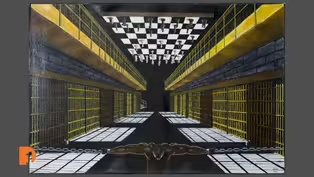
There's a painting of Governor Snyder in a bottle that's about the Flint water crisis.
There's this fish with a gas mask on.
I mean, he's really kind of brilliant at these metaphors where you don't really have to say anything.
You just get it, and you feel his conviction behind it - Many obvious pieces aren't just portraits.
They tell a story.
And I think that's another thing that makes him different.
- [Bill] What about the Ray Gray story, will that change?
His supporters want to bring evidence never presented showing he couldn't have done the killing.
They say they know who really did, although, that man has died.
- How are things going in terms of you getting out of prison?
- [Ray] Well, I talked to my attorney yesterday, and there's some real positive things beginning to happen.
There are some things that are being relooked at.
- [Bill] In the meantime, more paintings wait to be sold for the free Ray Gray legal fund.
So far they've raised about 2,500 of the $15,000 goal.
- He honed his talent over many years on the inside.
I can only imagine how wonderful his work would be had he had a chance to attend at art school, and to flourish on the outside as a free man.
- We just could not substantiate his claims of innocence.
And so, therefore, we denied relief in the case.
That was the recommendation of my team, but in looking at that, and reading over everything myself as well, and my team felt this way as well.
We think this is a good candidate for commutation for many reasons.
It's been a long time, it's been I think, 48 years.
And there are some, even though we couldn't substantiate the claims of innocence, we feel that this is a case where we would be pushing very hard to support any claim of commutation that he chooses to make.
- We will continue to follow the next steps for Ray at onedetroitpbs.org.
Recent charges against former Governor, Rick Snyder, his former Health Chief, Nick Lyon, and several others in the Flint water crisis have brought renewed focus on the recovery of Flint, and the health of its residents.
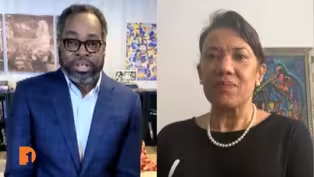
The process of replacing lead service lines is still ongoing and former Flint Mayor, Karen Weaver, talked with Stephen Henderson on "American Black Journal" about the criminal charges, and the broken trust many residents still have.
- The attorney general announced recently that Rick Snyder, the former governor of the state of Michigan, the person who installed the emergency managers in Flint, and oversaw the water switch, and the failure to add the chemicals that would stop the water from the Flint River from causing lead to leach out of the pipes is going to be charged with two misdemeanors for willful neglect of duty.
I see you laughing already about that.
- And believe me it's not laughing funny ha-ha.
It's just like, this has got to be a joke.
- Yeah, so let's start there your reaction to those charges.
- You think, okay, justice is coming as far as wanting to hold someone, and more than just one person, but whole people, but the governor as well criminally responsible for what happened.
And so you get happy, you get hopeful.
And then the next day you hear just what you talked about willful neglect, a misdemeanor, up to a year.
So we know that means no time, or $1,000.
It's absolutely ridiculous.
It's a bad joke.
And one of the things I've always said is this was a slap in the face to the residents of the city of Flint it really is.
- What was it that he was doing that in your mind rose to the level of criminality?
Well, actually, the death of so many people in the city of Flint and he played a big hand in that.
He had the biggest hand in contributing to that.
I thought, and I know many of the residents of this city thought that he would get slapped with manslaughter.
And it's interesting that you see others charged with manslaughter that reported to him and that were under him, but he doesn't get manslaughter.
And how does that not happen?
- So catch us up on where we are in Flint with the repair to the massive damage that was done.
- One of the things we know is the service line replacement has not been completed, and why?
That's a very good question.
- That was supposed to be by the end of last year, is that right?
- Exactly, one of the other things we had always talked about was keeping the water PODS open until that process was not only completed, but until we had consistent test results that, we, the residents were comfortable with, and that the people we have looking out for us as far as public health, the medical scientific community, saying, okay, we're satisfied.
And so that's something that hasn't happened.
We've asked for addressing the in-home plumbing, and fixtures, and appliances.
If I have new pipes in the front of my house but my in-home plumbing, and appliances, and fixtures are damaged, I still don't have access to clean water.
So there's a lot that's going on that we're not hearing about anymore that has just stopped.
And that's not fair to the residents.
- For more stories on "American Black Journal" plus all of the daily reports we're working on just head to our website at onedetroitpbs.org and connect with us there.
That is gonna do it for me this week.
We'll see you on Monday for "One Detroit Arts and Culture."
And see you next Thursday for "One Detroit."
Take care.
- [Narrator] You can find more at onedetroitpbs.org or subscribe to our social media channels, and sign up for our "One Detroit Newsletter."
- [Narrator] From Delta faucets to Behr paint, Masco Corporation is proud to deliver products that enhance the way consumers all over the world experience and enjoy their living spaces.
Masco, serving Michigan communities since 1929.
- [Narrator] Support for this program provided by the Cynthia and Edsel Ford Fund for Journalism at Detroit Public TV.
The Kresge Foundation.
Community Foundation for Southeast Michigan.
- [Narrator] The DTE Foundation is a proud sponsor of Detroit Public TV, among the state's largest foundations, committed to Michigan focused giving.
We support organizations that are doing exceptional work in our state.
Visit dtefoundation.com to learn more.
- [Narrator] Business Leaders for Michigan dedicated to making Michigan a top 10 state for jobs, personal income, and a healthy economy.
Nissan Foundation.
Ally.
And viewers like you.
(soft music)
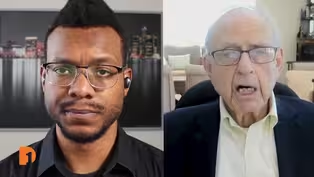
Dr. Arnold Monto: Efficacy of the COVID Vaccine
Video has Closed Captions
Clip: S4 Ep8 | 4m 16s | Dr. Arnold Monto: Efficacy of the COVID Vaccine | Episode 408/Segment 2 (4m 16s)
Video has Closed Captions
Clip: S4 Ep8 | 3m 22s | Karen Weaver reacts to the charges against former Governor Snyder in Flint water crisis. (3m 22s)
Video has Closed Captions
Clip: S4 Ep8 | 8m 23s | More on Ray Gray: after decades behind bars, could commutation be possible? | E408/S3 (8m 23s)
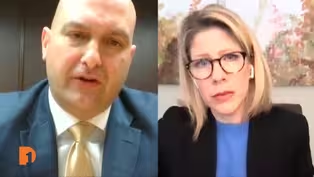
Sports, Learning Loss and COVID with DPSCD’s Dr. Vitti
Video has Closed Captions
Clip: S4 Ep8 | 5m 42s | Sports, Learning Loss and COVID with DPSCD’s Dr. Nikolai Vitti | Episode 408/Segment 1 (5m 42s)
Providing Support for PBS.org
Learn Moreabout PBS online sponsorship
- News and Public Affairs

Top journalists deliver compelling original analysis of the hour's headlines.

- News and Public Affairs

FRONTLINE is investigative journalism that questions, explains and changes our world.












Support for PBS provided by:
One Detroit is a local public television program presented by Detroit PBS