Here and Now
Eileen Fredericks on Staff and Security in Youth Corrections
Clip: Season 2400 Episode 2426 | 9m 24sVideo has Closed Captions
Eileen Fredericks on concerns in youth prisons after an incident in Racine County.
Wisconsin State Public Defenders Office attorney Eileen Fredericks considers concerns over violence among staff and juvenile residents of youth prisons after an incident at a Racine County facility.
Problems playing video? | Closed Captioning Feedback
Problems playing video? | Closed Captioning Feedback
Here and Now is a local public television program presented by PBS Wisconsin
Here and Now
Eileen Fredericks on Staff and Security in Youth Corrections
Clip: Season 2400 Episode 2426 | 9m 24sVideo has Closed Captions
Wisconsin State Public Defenders Office attorney Eileen Fredericks considers concerns over violence among staff and juvenile residents of youth prisons after an incident at a Racine County facility.
Problems playing video? | Closed Captioning Feedback
How to Watch Here and Now
Here and Now is available to stream on pbs.org and the free PBS App, available on iPhone, Apple TV, Android TV, Android smartphones, Amazon Fire TV, Amazon Fire Tablet, Roku, Samsung Smart TV, and Vizio.
Providing Support for PBS.org
Learn Moreabout PBS online sponsorship>> Nine years after a lawsuit over abuse of juveniles at Lincoln Hills and Copper Lake youth prisons in northern Wisconsin, the facilities still operate.
The 2021 state-mandated deadline to close them has long since passed and been extended.
They're to be replaced with a new youth prison in Milwaukee, set to open this year, and county-based secure residential care centers.
The footage you're about to see could be disturbing.
Just after the first such care center opened in Racine County last spring, the State Public Defender's Office learned of an incident, shown on camera [boy groans] where a 15-year-old housed in the Jonathan Delagrave Youth Development and Care Center was punched repeatedly by adult security workers.
Staff was asking the boy to return to his room, and he can be heard saying, "Don't touch me."
The boy's family has retained a civil attorney, and the office of Representative Angelina Cruz told us she is working to learn more about the incident with the possible intention of having the governor's office investigate the facility.
For its part in a statement to WPR, the administrator of youth rehabilitation services for Racine County said, "Situations like this are complex and unfold quickly," and said, "We maintain our commitment to ensuring that staff have the training, oversight, and support needed to manage difficult situations appropriately and professionally."
The Racine County DA declined to prosecute the security staffers.
But how does this kind of treatment of a youth offender in trouble for retail theft square with best practices?
We turn to the youth defense practice coordinator in the State Public Defender's Office, Eileen Fredericks.
And thanks very much for being here.
>> Thank you for having me.
>> So when you first saw this footage from cameras inside the facility, what was your reaction?
>> I was horrified.
I had known that there were these allegations, but obviously I didn't know kind of the extent of them.
So when I saw them, I was shocked to see that, you know, right out of the gates, this facility opening in May and having this happen, it was so disappointing and upsetting to know that this is kind of the result of, you know, the Lincoln Hills incident and all of the problems there.
Now we have this new facility opening, and the same problem seemed to still be there.
>> Is this kind of incident a rarity do you think behind the doors of these facilities?
>> I mean, research across the country would suggest that it isn't, that, you know, that the punitive nature of these correctional facilities and how the power dynamic and these vulnerable youth, that abuse is a major issue in these facilities.
And I do think that, you know, the culture obviously isn't what we need it to be.
It's not seen as a treatment facility, it's a jail, essentially, for kids.
And with that attitude, I think the staff thinks of it that way.
And they're not necessarily trained in a treatment mindset.
They're not trained to kind of deescalate situations.
They're not trained to recognize in themselves when they're becoming, you know, dysregulated and struggling.
Obviously seemed to be the case in this situation.
>> Because this facility, when it talks about itself, it talks about that kind of care and support, but it looks just like a correctional facility.
>> Yes, and I think that, you know, when they built this, they, you know, had all this beautiful ideas about what it was going to look like, but they did not really, I think have a treatment focus like they could have.
I think that they had already, they already had a facility in Racine that was housing kids long-term, and they had that just kind of move to this nice new building and hoped that it would kind of just carry itself.
But the culture and the staff and the ideas that the workers are coming with are really what drive how the kids respond, right?
That they have the support that they need, that they're building relationships, that they want to help the kids, that they see the kids as kids and not as, you know, criminals or inmates.
>> You've touched on this a little bit, but why does this kind of volatile violence inside these facilities persist?
>> I do think it's a cultural thing, and I think that they just are not basically coming from a treatment model to begin with.
That they're kind of like, this is a correctional facility, this is a prison for kids.
They call it a school, but, you know, everything about it kind of screams like it's more, we're just controlling these kids, not, we're actually trying to rehabilitate them.
And so there are residential treatment centers in the state that actually are built around a model of treatment, and they are much more, I think, working on rehabilitating and building relationships and providing therapy and doing assessments and seeing what needs the kids have and then responding to those needs, where I think that this is a setting where it's a much more one-size-fits-all, and really, they don't have the, you know, the goal of getting to the bottom of kind of what was going on.
They're more just trying to hold them for the time that they, you know, keep them out of the community for the time that they feel is appropriate and is allowable under the law.
>> What kinds of laws do staff and administrators of these juvenile facilities have to follow pertaining to treatment of children that are housed in them?
>> So as far as their, you know, qualifications, I just think that a lot of them just need to have a high school diploma.
These people who are coming in here.
And the counselors are not the ones who are supposed to be necessarily providing the treatment, but the whole culture of the institution or like of the facility is very much driven by who the kids are seeing on a regular basis.
And they're much more frequently seeing these youth counselors and the people who are kind of the correctional guards there than they are the treatment providers that might be there once a week or something like that.
So they do need to be building relationships and understanding the kids and trying to figure out how to address the needs that they have.
So I think that there needs to be a lot more training, you know, ahead of time.
They need to be much more thoughtful about who they're hiring.
And, you know, these jobs don't pay well.
So it isn't that we're going to get people who have tons of experience working with kids, but we have to have people with the right mindsets who are empathetic, who understand trauma, who want to work with kids, not people who are thinking they're coming to this correctional setting where they can control kids.
>> Well, is there a list of kind of best practices for helping and supporting and also housing youth offenders?
>> There are lots of resources out there.
You know, the Annie E. Casey Foundation, the Gault Center, that provide guidelines and they put out things, the Sentencing Project.
There's lots of resources that talk about the harms of incarceration just to begin with.
So, first of all, I think we should be using it as an absolute last resort.
We should not be incarcerating kids if we don't need to.
And somebody who's in there for retail theft, I don't think that's appropriate.
But I think that when there are times when people need to, you know, when people feel like there are no other options and no other placements will take them and that they need to do this for the protection of the community, there are best practices that really look at assessment, that really look at getting to the bottom of like what are their actual needs and how can we specifically address those needs and have it individualized for each kid there.
And then also when they are able to be released for a time.
You know, some of these facilities, the transfer over from this facility in Racine, there was a program that was just a detention facility that's also allowed them to the statute, that allowed for, you know, there's a potential for kids to be able to be released for small periods of time.
And that helps kids build skills to like be out in the community, that, you know, they can't build when they're locked up and they don't have the opportunities that they have.
So I think that there are lots of clear best practices that we need to get on board with in the state.
>> As additional facilities open, including the one in Milwaukee, how might this incident in Racine inform the treatment and care of juvenile offenders?
>> They need to really look at these best practices.
They need to be very careful about how they're staffing these places.
They need to have leadership that is empathetic, that is, you know, positive in their mindset toward these kids, and really be focused on making sure that they hire people who kind of demonstrate a positive culture in the facility.
That did not seem to happen in Racine, and I think that, you know, just even that there was four people involved in this incident, and then it just didn't come out, and I just don't know how that happens.
It needs to be that everybody kind of is like, you know, eyes on and expecting of each other that they're treating these kids with care and compassion.
>> All right, we leave it there.
Eileen Fredericks, thanks very much.
>> Thank you.

Advocates Push Regulation on Drug Prices, Medication Access
Video has Closed Captions
Clip: S2400 Ep2426 | 54s | A rally at the Wisconsin State Capitol urged lawmakers to pass Cole's Act. (54s)
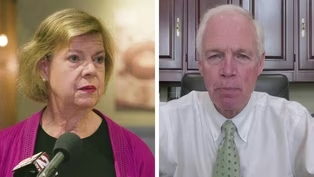
Baldwin, Johnson React to Killing by ICE Agent in Minnesota
Video has Closed Captions
Clip: S2400 Ep2426 | 1m 2s | Tammy Baldwin and Ron Johnson on an ICE agent who shot and killed a woman in Minneapolis. (1m 2s)

Here & Now opening for January 9, 2026
Video has Closed Captions
Clip: S2400 Ep2426 | 56s | The introduction to the January 9, 2026 episode of Here & Now. (56s)
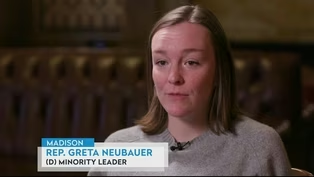
Rep. Greta Neubauer on a 2026 Agenda for Wisconsin Democrats
Video has Closed Captions
Clip: S2400 Ep2426 | 8m 54s | Greta Neubauer on what policies the Democratic caucus is prioritizing going into 2026. (8m 54s)

Wisconsin THC Businesses Prepare for End to Federal Loophole
Video has Closed Captions
Clip: S2400 Ep2426 | 5m 48s | Businesses that sell legal THC products are considering next steps as federal law changes. (5m 48s)
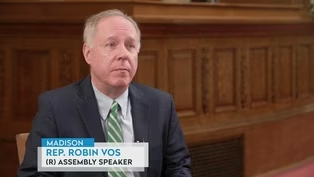
Speaker Robin Vos on a 2026 Agenda for Wisconsin Republicans
Video has Closed Captions
Clip: S2400 Ep2426 | 8m 16s | Robin Vos on what policies the Republican caucus is prioritizing going into 2026. (8m 16s)
Providing Support for PBS.org
Learn Moreabout PBS online sponsorship
- News and Public Affairs

Top journalists deliver compelling original analysis of the hour's headlines.

- News and Public Affairs

FRONTLINE is investigative journalism that questions, explains and changes our world.












Support for PBS provided by:
Here and Now is a local public television program presented by PBS Wisconsin