
EKU President on New Programs Coming Online Soon
Clip: Season 4 Episode 120 | 8m 14sVideo has Closed Captions
EKU president on new programs and his asks from Frankfort this upcoming session.
Eastern Kentucky University president David McFaddin talks to Renee Shaw about the new school of osteopathic medicine to come online in a few years, and his asks from Frankfort in the upcoming legislative session that begins in January.
Problems playing video? | Closed Captioning Feedback
Problems playing video? | Closed Captioning Feedback
Kentucky Edition is a local public television program presented by KET
EKU President on New Programs Coming Online Soon
Clip: Season 4 Episode 120 | 8m 14sVideo has Closed Captions
Eastern Kentucky University president David McFaddin talks to Renee Shaw about the new school of osteopathic medicine to come online in a few years, and his asks from Frankfort in the upcoming legislative session that begins in January.
Problems playing video? | Closed Captioning Feedback
How to Watch Kentucky Edition
Kentucky Edition is available to stream on pbs.org and the free PBS App, available on iPhone, Apple TV, Android TV, Android smartphones, Amazon Fire TV, Amazon Fire Tablet, Roku, Samsung Smart TV, and Vizio.
Providing Support for PBS.org
Learn Moreabout PBS online sponsorshipWe continue part two of my conversation with Eastern Kentucky University President David McFadden, who says the kernels are making great strides in providing a higher education to students in the region and beyond.
We pick up the interview where I asked him about the hands on training, that the facility that they have is educating the next generation of professionals and several fields.
If we go back to 1906, all of our comprehensive universities in Kentucky, eastern, Western, Murray, Morehead, we were all founded as as teachers colleges, and all of us had lab schools.
Those were effectively the laboratory by which we trained those educators.
And over time, many of the institutions kind of transitioned away as we saw more student teaching taking place in the in the traditional public schools and, other ways of delivering that education.
But we've really held onto that at EKU.
And so in some ways, it's almost been a restoration movement to have that laboratory space where we're training that next generation of teacher, school, psychiatrist, school law enforcement.
I mean, so it's really when we think about schools and, you know, kind of the connective tissue that schools are in every community, there are so many professions they find themselves working in and around a school.
It's just a unique opportunity for us to have that laboratory setting to make sure that those graduates have been there, they've seen it, and they're ready to go out and transform it in a big way.
I joke I've got three kids who go there, but the school's not for those.
You know, through 12 kids.
They are the beneficiaries of it.
It is for our post-secondary students who are using that lab to really be the best at what they do.
Yeah.
Well, let's talk about the legislative session that is coming out as Fast and Furious.
Doctor McFadden.
As we speak, we're just really a 2 or 3 weeks out from the start of the session, January 6th.
What what are the asks from EKU and what are you going to play some defense on?
Yeah.
You know, for us, College of Osteopathic Medicine, you know, we work through this process for a couple of years.
The legislature last year passed a pathway for for schools like EKU to pursue post-baccalaureate degree.
So we will be moving forward with our Doctor of Osteopathic Medicine program.
That program comes with, a bond issuance that has some escrow requirements.
And so we'll be working with the Commonwealth of Kentucky to help, secure, those funds, as we go through the accreditation process.
Like any good university president, we do have some building needs.
We're looking at our health, such a growth area for us.
Over 4000 of our students on campus are connected to the health care sector.
We do a great job in that space.
The EKU School of Nursing.
As I said, year after year, 100% pass rate on the clinics.
We just celebrated 60 years of serving Kentucky in health care.
But but we've been doing it in the same building, for those 60 years.
And so, we're due to, to really build a, an integrated health innovation space, we're going to bring all of our health care programs under one roof.
It will create a simulation experience for, for our professionals that when they leave EKU, they will go into their, you know, into that job setting.
Better prepare to work with all of the other professionals who they're going to end up working with in that space.
And so that's our big ask is our health care innovation, facility and our escrow, for, for our med school.
But really excited about that.
Thankful to to Speaker Mead, who has continued to help us and support us and so many others who have been such a big, big supporter of that that, you know, program up to this point.
When do you expect to have the first graduating class of the School of Osteopathic Medicine?
Well, you know, with construction, we were just talking about the studio a little bit, and we're working on Model Lab.
You know, construction is a little slow these days.
I think best case scenario, our first incoming class would be the fall of 2030.
They would graduate 20, 2034.
We may have a little give or take in that a year or so, but, really, we're we're geared up to, to look at that.
And, you know, as I look across Kentucky, you know, I'm a native of Johnson County, when 94% of our counties are underserved and primary care, when nearly half the counties in Kentucky have no pediatrician, when we think about women's health, we have so many health care deserts across the state.
You know, the reason we've continued to look at this program is trying to solve some of those big problems.
And so we're eager to continue to move forward, on that front and, and excited to to view this as a great investment for the Commonwealth and a solution to a big problem, but probably not something that's going to happen tomorrow.
Right?
Right.
Hold on for that.
Right.
Let's talk about the performance funding model for higher education and what that means for eastern and the impact it's having.
And is it working in your view or I, I know the answer, but maybe others may want to hear you say how are comprehensive universities really fairing from this new performance model structure?
You know, for us it's the 2017 was the first year that we stepped into this.
And I was you know, I've been at EKU the whole time that we've navigated this, you know, unfortunately through the first, you know, four years effectively of the model, it was either cuts or no money.
And so, in some ways it was performance cutting for, for those early years.
And then we've seen a significant investment in higher ed the last three years.
And we're grateful to the legislature and for, for their investment in higher ed.
I think as we've seen those dollars flow through the model, there's some things that that probably need some attention.
As we look at our institution, we we've we've set record growth, record freshman classes, record retention rates.
However, the distribution of funds in the model probably have not been, you know, directly reflective of that success.
And so I think if you talk to, to all the presidents, I think we all would say we have enough data now to start to making some informed decisions about how to shape this model.
And perhaps a more informed and more equitable way.
I think we would also say that across the board, all of our institutions are looking for for base resources as we think about just the inflationary costs that that come with operating.
You know, if we think about our own household, there's nothing cheaper today than it was a year ago, two years ago, three years ago.
And and so, I think to continue to be competitive in the higher education space.
And I really view our, our universities as economic engines and really job recruiters, the ability to, to import talent to the state.
You know, we're going to have to continue to make those investments.
And so we're eager to continue to work with the Council on Post-secondary education, to work with the other institutions.
But but to shape the model, in a bit more intentional way, that that is more reflective of the performance distributions.
And so what I would say is I think we're measuring the right things.
I'm just not sure we're measuring them the right way.
Right.
Let's talk about how you're engaging with the federal delegation, in Washington, our Kentucky delegation.
What are the needs that you're petitioning them to, to uphold for you?
Yeah, I think that, you know, federal financial aid is one of the top things.
You get a lot of conversation back in the summer about, you know, who was going to be eligible, what title for funds we're going to look like.
Largely, we're not big changes in the undergraduate space to that.
And so we're grateful for a Kentucky delegation, lots of conversation with them.
In fact, I'll be in DC next week, within CSL and working on a panel group.
So we want to continue to, to make sure that that those funds are out there and available because of course, for our students, 50% of our students are Pell eligible.
They're bringing Pell dollars to the table.
50% of our students are first generation college students.
We are serving the underserved in that way.
And so we want to make sure there's maximum resources available to them.
So so that conversation with our federal delegation critically important, we're continue to engage in research activity and things that are really important for Kentucky.
And so as we step into this medical school space, you know, continuing to to really look at those, there's great opportunities to try to do meaningful research that addresses issues that are really important to Kentucky.
On Monday, president McFadden will share how eastern has dealt with policy changes already handed down from Frankfort.
When it comes to diversity, equity and inclusion policies.
And he'll talk a little bit more about what he hopes the Kentucky General Assembly will deliver for eastern and other regional universities in the upcoming lawmaking session that begins in less than a month.
That Monday night on Kentucky Edition.
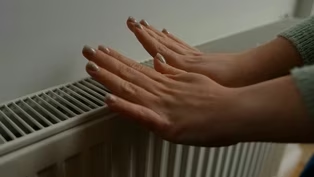
Efforts to Keep Kentucky Households Heated
Video has Closed Captions
Clip: S4 Ep120 | 3m 20s | Advocates ask state leaders to help keep the heat on in Kentucky households this winter. (3m 20s)
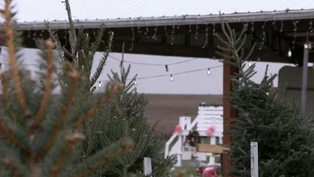
Holiday Agritourism Keeping Small Farms Afloat
Video has Closed Captions
Clip: S4 Ep120 | 3m 18s | Some small Kentucky farms are turning to holiday agritourism to stay profitable. (3m 18s)
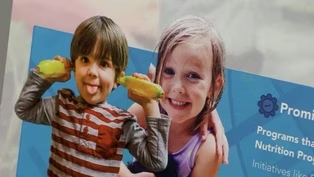
Report Released on Wellbeing of Kentucky's Children
Video has Closed Captions
Clip: S4 Ep120 | 3m 38s | Report show food insecurity and obesity rising among Kentucky's children. (3m 38s)
Providing Support for PBS.org
Learn Moreabout PBS online sponsorship
- News and Public Affairs

Top journalists deliver compelling original analysis of the hour's headlines.

- News and Public Affairs

FRONTLINE is investigative journalism that questions, explains and changes our world.












Support for PBS provided by:
Kentucky Edition is a local public television program presented by KET