
EKU's President Discusses Transfer Credits
Clip: Season 4 Episode 121 | 4m 31sVideo has Closed Captions
McFaddin says EKU has made great strides when it comes to easing the transfer of course credits.
A new state law removing DEI from state colleges and universities doesn't mean that every institution of higher learning is abandoning its mission to serve the underserved student populations. Renee Shaw talks with Eastern Kentucky University President David McFaddin about that and possible legislation to ease the transfer of course credits.
Problems playing video? | Closed Captioning Feedback
Problems playing video? | Closed Captioning Feedback
Kentucky Edition is a local public television program presented by KET
EKU's President Discusses Transfer Credits
Clip: Season 4 Episode 121 | 4m 31sVideo has Closed Captions
A new state law removing DEI from state colleges and universities doesn't mean that every institution of higher learning is abandoning its mission to serve the underserved student populations. Renee Shaw talks with Eastern Kentucky University President David McFaddin about that and possible legislation to ease the transfer of course credits.
Problems playing video? | Closed Captioning Feedback
How to Watch Kentucky Edition
Kentucky Edition is available to stream on pbs.org and the free PBS App, available on iPhone, Apple TV, Android TV, Android smartphones, Amazon Fire TV, Amazon Fire Tablet, Roku, Samsung Smart TV, and Vizio.
Providing Support for PBS.org
Learn Moreabout PBS online sponsorshipNow turning to higher ed, a new state law ridding state colleges and universities of D-I diversity, equity and inclusion positions and programs doesn't mean for one institution that they're abandoning their mission to serve underserved student populations.
And the final installment of my interview with Eastern Kentucky University President David McFadden.
We talk about that and possible legislation to ease the transfer, of course, credits.
How has EKU had to pivot from that space, and how do you still serve the underrepresented populations as you mission to do?
You know, I think it's I talk about, you know, so many first gen, so many, students who are coming that are Pell eligible for a low income student population.
I really have experienced and and led by the notion that if you choose EKU, EKU chooses you.
And so, when it comes to student support services and student success, you know, we have just doubled down on making sure that all students who are on our campus are getting the resources, the support, the education that they need to be successful.
And so, you know, as we've kind of navigated, you know, those changes as they've been very explicit and house before and a few other things.
I think that that's been, you know, kind of it's been in some ways reassuring to us that as we think about serving all students, that we take a lot of pride in the fact that we felt like we were doing it, really well.
And so as we talk to our students and engage with them, I think that, my feel is that our students feel supported, they feel like that, campus is is a place that, you know, they feel engaged.
Just finished up a survey that was part of, House bill for that to come out.
And I think that early preliminary results, you know, show that the students feel like it, that they have the ability to express themselves and that they feel welcome on their campus and that that ECS, you know, their second home or in some case, their first time.
And so we're proud of that and eager to continue to move forward and and serve students and meet them where they're at.
Finally, just yesterday, I believe it was in Frankfort, Representative Vanessa Grassle, who serves the Lexington and Fayette County Scott County area, is expected to follow legislation.
And she talked about this bill in committee to make it easier for college students to transfer course credits between Kentucky's public universities, which many would say, I thought they already did that.
It's called the post-secondary.
Credit alignment, plan.
Why is that even needed?
Isn't that already happening?
And what could be done better?
Yeah, I think for us, and I think we're we're engaged in this conversation right now with the council, with, with Representative Grasso, excited to to to really better understand kind of, you know, some of the things that she's trying to accomplish, perhaps be able to share some, some, some data that shows, you know, where we've made some strides.
And I would say this, you know, having been a part of this for now, for 15 years, we are so much better today.
And, in that credit articulation and making sure that those credits are going toward the degree requirement than ever before.
Advising has got so much better.
But, you know, I do think we still have the instances where our student thought they wanted to be, a health care professional and then said, hey, maybe I want to be an architect.
And sometimes that just comes with, you know, some, some opportunity cost, in that experience.
But I would largely say that for us, we're Kentucky's number one transfer institution.
We transfer more credit from CTCs than any other institution.
I think we're we're doing a lot of good work in that space.
Could we get better?
I would say we absolutely could.
We're looking forward to working with Representative Grosso to to better kind of refine, you know, where those those key areas are that we feel like that there's some stumbling blocks for students.
Continue to identify those, eliminate those roadblocks, and help students, you know, navigate that transfer in the most seamless way.
But I will say that, you know, I commend, you know, President Coral's, I think he's got agreements with every one of our institutions.
We're doing joint advising with those students.
I think the key is while they're whether they're in high school or whether they're a community college or whether they're going from four year to four year, the advising is so important.
And so just being intentional about, you know, making sure students know that they know exactly where they want to get to and laying out that pathway is important.
So eager to engage with Representative Grasso to to better understand that.
But I will say I do think we if we look at the data, we've gotten tremendously better at transfer credit.
There's always the opportunity to get to get better, each and every day.
And we're committed to doing that.
You can see the other interview segments with Eastern Kentucky University President David McFadden online at Wkyt.
Org slash Kentucky Edition.
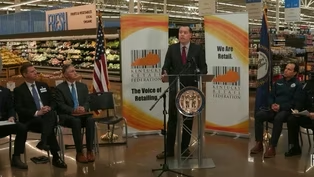
Attorney General Targeting Organized Retail Crime
Video has Closed Captions
Clip: S4 Ep121 | 1m 36s | AG Coleman is asking the state legislature for more money for a new organized retail crime unit. (1m 36s)

Ford Shifting Focus of Battery Plants in Kentucky
Video has Closed Captions
Clip: S4 Ep121 | 1m 31s | Ford is laying off all of the 1,500 employees at the Hardin County plant. (1m 31s)
Local Pediatrician Still Recommending Hepatitis B Vaccine
Video has Closed Captions
Clip: S4 Ep121 | 3m 8s | The move is in contrast with a new recommendation from a CDC advisory panel. (3m 8s)
Meet Kentucky's First School Resource Detective
Video has Closed Captions
Clip: S4 Ep121 | 3m 16s | Warren County Public Schools is adding to its SRO roster. (3m 16s)
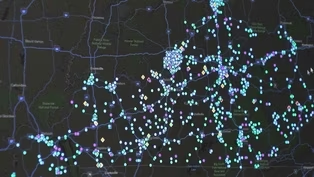
New Alert System Tracking Overdoses
Video has Closed Captions
Clip: S4 Ep121 | 3m 12s | The system is designed to alert local health departments and recovery groups. (3m 12s)
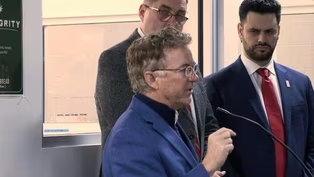
Sen. Paul Shows Support for Kentucky Hemp Business
Video has Closed Captions
Clip: S4 Ep121 | 2m 36s | Cornbread Hemp unveiled its expanded facility in Louisville on Monday. (2m 36s)
Providing Support for PBS.org
Learn Moreabout PBS online sponsorship
- News and Public Affairs

Top journalists deliver compelling original analysis of the hour's headlines.

- News and Public Affairs

FRONTLINE is investigative journalism that questions, explains and changes our world.












Support for PBS provided by:
Kentucky Edition is a local public television program presented by KET