
Election 20/20: Detroit to DC
Season 5 Episode 44 | 56m 46sVideo has Closed Captions
Election 20/20: Detroit to DC | Episode 544
One year after the U.S. Capitol Insurrection One Detroit's Christy McDonald, Stephen Henderson and Nolan Finley examine the aftermath and long term consequences of the events surrounding the 2020 election in a special one-hour episode. Go inside the TCF center protests on election night; hear from U.S. Congress members about the Jan. 6 assault; and hear a roundtable on the state of our democracy.
Problems playing video? | Closed Captioning Feedback
Problems playing video? | Closed Captioning Feedback
One Detroit is a local public television program presented by Detroit PBS
Election 20/20: Detroit to DC
Season 5 Episode 44 | 56m 46sVideo has Closed Captions
One year after the U.S. Capitol Insurrection One Detroit's Christy McDonald, Stephen Henderson and Nolan Finley examine the aftermath and long term consequences of the events surrounding the 2020 election in a special one-hour episode. Go inside the TCF center protests on election night; hear from U.S. Congress members about the Jan. 6 assault; and hear a roundtable on the state of our democracy.
Problems playing video? | Closed Captioning Feedback
How to Watch One Detroit
One Detroit is available to stream on pbs.org and the free PBS App, available on iPhone, Apple TV, Android TV, Android smartphones, Amazon Fire TV, Amazon Fire Tablet, Roku, Samsung Smart TV, and Vizio.
Providing Support for PBS.org
Learn Moreabout PBS online sponsorshipHi, I'm Christy McDonald and here's what's coming up this week on One Detroit.
A year since the assault on the capitol marks deeper reflection on where we stand as a nation.
And a closer look at the aftermath of the 2020 election here in Detroit that started it all.
Join us for this special hour as One Detroit, in collaboration with the Detroit Free Press trace the days following the election, talk with Michigan congressional leaders, and look ahead at the strength of our democracy.
It's all coming up on One Detroit.
ANNOUNCER 1: From Delta faucets to Behr paint, MASCO Corporation is proud to deliver products that enhance the way consumers all over the world experience and enjoy their living spaces.
MASCO, serving Michigan communities since 1929.
ANNOUNCER 2: Support for this program is provided by the Cynthia & Edsel Ford Fund for Journalism at Detroit Public TV, the Kresge Foundation, Community Foundation for Southeast Michigan.
ANNOUNCER 1: The DTE Foundation is a proud sponsor of Detroit Public TV.
Among the state's largest foundations committed to Michigan focused giving.
We support organizations that are doing exceptional work in our state.
Visit DTEFoundation.com to learn more.
ANNOUNCER 2: Business Leaders for Michigan, dedicated to making a top ten state for jobs, personal income, and a healthy economy.
Also brought to you by... And viewers like you.
♪ Hi there and welcome to One Detroit.
I'm Christy McDonald.
Thanks so much for joining me.
We are on at a special time tonight to mark a sobering anniversary.
The January 6th insurrection at the U.S. capitol building.
The sight was shocking.
Angry Americans broke through barricades and forced their way through the capitol to stop the certification of the 2020 electoral votes back on January 6, 2021, one police officer, four others were killed while lawmakers hid and feared for their lives.
In the year since there are investigations into what happened and how much responsibility former President Donald Trump bears for stoking the big election lie and calling into question the results.
Countless investigations did not find voter fraud.
The associated press just released a report that showed in the six battleground states, Michigan included, there were less than 475 total cases of voter fraud in six states, not nearly enough to throw the results.
But that still hasn't changed how people feel about the election, where we stand as a democracy.
And the concern on all sides on how our votes count in the future.
In the last year at One Detroit we collaborated with the Detroit Free Press to look at the days following the election in Michigan, the threat of mistrust that happened in Michigan and other battleground states and culminated at the U.S. capitol months later.
Coming up over the next hour, you'll see part one in our series that focuses on count at the TCF Center from the Free Press reporters who were on the scene, plus our One Detroit contributors, Nolan Finley and Stephen Henderson meet up to talk about our political divide here in Michigan.
Also, you'll hear from Democratic Congresswoman Brenda Lawrence and Republican Congressman Fred Upton, both Michigan lawmakers who were at the capitol on January 6th.
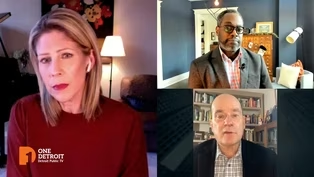
And then I meet up with the editor of the Detroit Free Press, Peter Bhatia, and then Dean of the University of Michigan's Ford School of Public Policy, Michael Barr.
We take a look at combating misinformation and encouraging more citizen involvement.
It's all ahead.
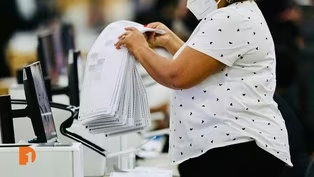
We're starting with the first installment of our series with the Detroit Free Press called Election 2020: Detroit to D.C., on what happened election night when all eyes turned to Detroit.
[indiscriminate talking] ANJANETTE: Everyone was expecting things to start out red and then turn blue sort of overnight as we started getting in votes from other areas.
All right, let's look at Michigan right now with about a third of the expected vote in.
The president is ahead in Michigan.
ANJANETTTE: If you're not super familiar with the process.
It's going to be a kind of back and forth.
ANJANETTTE: So, you go to bed Tuesday night and things are looking good for Trump.
You wake up then next morning and things are looking better Joe Biden.
This is 5 a.m. One more.
Micghian as well.
JAMES: Trump was saying, well, this had to be fraud because at 10:30 we were ahead by 100,000 votes.
And then by 2:00 in the morning we're behind by 100,000 votes.
MAN 1: We're just getting this.
These are people bringing them in coolers.
There's no one around.
ANJANETTTE: We started seeing evidence online that these were magic votes, you know, that somebody showed up somewhere with a bunch more blue votes.
WOMAN 1: Looks like one of those lock boxes.
I wish I could tell.
CLARA: Yeah, there were a number of viral images and videos purporting to show mysterious suitcases and wagons being brought into the TCS center carrying ballots.
So, one of them actually turned out to be a WXYZ photographer carrying his camera equipment.
WOMAN 1: I thought all the polling places were closed.
Yet, we have a box.
ANJANETTE: All of this happened, you know, where people felt like something happened in the dead of night.
♪ ANJANETTTE: There were thousands of ballots that arrived at the TCF Center early in the morning on Wednesday November 4th.
♪ MAN 2: All right could you please state your name?
SHANE: My name is Shane Trejo.
MAN 2: What days this year were you involved in the election?
SHANE: I served as a poll challenger on the night shift after the election had concluded.
So, I was there at TCF as a poll challenger.
The ballots show up in the dead of night at 3:30 a.m. 61 boxes of mystery ballots show up from the city clerks office.
There was no chain of custody, no transparency, no accountability, no one would answer any questions about where they came from.
And in my opinion, this was when they started the vote steal and to take this away from President Trump.
CLARA: Early in the morning on Wednesday, November 4, far from being a sign of anything nefarious, it's actually a sign of the system working as intended.
Election officials had warned that it was going to take a while for all the ballot verifications steps to be completed.
If you don't understand how that process works, then it's easy to say, oh, I saw a van pull up in the middle of the night and unload a bunch of boxes and you to be like, ah, see, there was something going on there, even if, you know, there was nothing nefarious about it, that's just the process.
TRESA: See, that's where we're at folks.
WOMAN 2: Tell us where we're at.
Yes, I am Tresa Baldas.
I am a reporter at Detroit Free Press.
And I am reporting live from the TCF Center behind me, as I said, where they are counting, the city of Detroit still has 25,000 absentee ballots that are still being counted.
They anticipate that this will be counted by the end of the night.
Also 96% of the votes in Michigan have been counted now.
That night -- actually, it started that day when they said, you know, you keep hearing this call, get to the TCF, get to the TCF.
We are witnessing what everyone expected to be a historic vote count.
ANJANETTE: I mean, this was intense.
I mean, Election Day became Election Week, became -- and we were prepared for it to be Election Week.
It became Election Month.
That was one of the biggest epiphanies I had after the 2020 election was just how many people needed to go back to civics class and understand how an election works and how it runs.
Because for most people, it's just one of those things that happens behind closed doors.
It's the sausage making, all they know is they go pick it out and they cook it and eat it.
All eyes are on the the city of Detroit as the Biden campaign hopes and has counted on the largely African American vote in Detroit to pull Biden through.
JAMES: The reporters are down there.
They're watching it because no one's ever seen anything like this.
This is all new for everyone, quite frankly.
I've covered lots of election campaigns.
And this was just something that was unprecedented.
As then presidential campaign started ramping up, you had President Trump saying, you know, the only way I'm going to lose to this guy is if the election is stolen, if the election is rigged.
The ballots are out of control.
You know it, and you know who knows it better than anybody else?
The Democrats know it better than anybody else.
Go ahead.
KATHLEEN: That idea was kind of baked in even before they started counting the votes.
The pandemic kept a lot of people going to the polls personally.
Of course, you had Donald Trump encouraging, you know, his supporters, no, don't vote absentee, go to the polls.
And so, those two dynamics were playing out on election night.
We also had a record turnout in Detroit, the most in 20 years, even from the Obama presidency.
A 25% voter turnout.
DAVID: I think anybody that's watched Michigan politics for more than like a week understand that Detroit's like a Democratic hot spot.
There are not hundreds of thousands of Republican votes to give out in Detroit.
Wayne County hasn't gone for a Republican president since Herbert Hoover in the '20s.
Nobody in Michigan watching politics thought that Donald Trump had any chance to do anything in Detroit or in Wayne County.
And yet, almost the entirety of the focus of election fraud in Michigan focused on the TCF Center, where only ballots in Detroit were being counted, not in Wayne County, just in Detroit.
I remember an email going out to conservative activists saying, you've got to get down to Detroit.
There's something happening there.
CLARA: There were messages spreading around in Republican circles to go storm TCF Center because Biden was pulling ahead of Trump and to observe the count and make sure that nothing nefarious was happening in Detroit.
And all the sudden just this crowd of people starting to just merge onto the scene there.
That day started out, I mean, it was crazy.
I went in there and I was shocked at how easy we could get in.
They had a spot designated for the media.
We were all standing, you know, there were more than 100 of us.
National media was in a corner.
Bemuses we are behind this orange tape line.
MANDI: We're really far back from the counting.
We're not there to distract, but it is hard to cover in a granular way.
And so, we really just wanted people to be a part of watching this vote head.
TRESA: We're staying live just ahead.
You, the public, our readers, our viewers, our subscribers, keep an eye on the process here.
But there's this massive room with tables and people are all counting the ballots.
But just roaming freely on the floor were all these challengers, hundreds of them.
Where are you from?
Oh, I'm down river.
I'm here because of the 38,000 ballots that arrived here at 3:45 a.m. that are just sitting there getting counted, supposedly.
TRESA: Okay.
That's why I arrived.
TRESA: And I did not quite process that.
These people are just regular, normal people off the street who walked in here, presented with a badge with whatever party they were with and said, I'm a challenger.
There was so security to go through, no metal detectors.
Anybody could have gone in with anything.
And it was a little bit nerve-racking.
And so, finally I stood at this table and I said to the woman, what are you doing?
She said, I'm checking in people as they come in.
And so, I decided to stand there and count them as they came in.
You know, and then the numbers were going up and up and up.
The craziest it got were folks in the middle of counting ballots.
You'd get a big group of Republican challengers that were forming a circle around one table.
There's some chanting going on.
And they'd start chanting, stop the count, stop the count.
And clapping as they did it.
And as you can see right now, we've got several police officers out there on the floor.
And the police would come in, they'd escort them out.
MANDI: The number of Republican vote watchers were removed from the hall.
And so, a group of angry protesters came down and started banging on the windows of the basement, you know, we were at.
TRESA: And then you'd have people complaining, we were getting kicked out of the process.
Well, you were chanting in the middle of the floor and casino a scene.
MAN 2: We want all of the Republican challengers out of this room.
Everybody s standing in this area needs to be... A lot of conspiracy theories that were being thrown at us, and there was also a directive from folks, they said, challenge everything, challenge every ballot.
And they were doing it.
They were, you know, this doesn't look good because of this and because of that.
And at some point, you know, someone had to step in and say, enough.
So, all of this fervor is kind of coming up around Detroit and focusing on Detroit.
Obviously a Democratic apparatus and supposedly part of this cabal to undermine the election.
And so, this is happening, lawsuits are starting to come out, lawsuits that have national resonance are being files in Michigan.
The campaign says it has, quote, "not been provided with meaningful access to numerous counting location to observe the opening of ballots and the counting process as guaranteed by Michigan law.
Now, it's asking the state's quote of claims to stop counting ballots until, quote, "meaningful access has been granted."
I've been trying to some of these challengers out here.
Some of them are very skits about talking.
But what we are learning is that, people who are getting thrown out and several have been now escorted out of here, what they are doing is one of the following, they are either getting too close, or they're going up behind people and they're saying things like, listen, I'm challenging this ballot, there's litigation, I'm challenging this ballot, there's litigation.
They keep citing that there's litigation out there.
Well, there are lawyers working at these tables and they're looking at these challengers and saying, you know what, doesn't matter if there's litigation out there, this ballot is being counted.
There's wall-to-wall people in here.
Nothing is being obscured about this process.
We're all watching it, observing it, citizens of Michigan, the media.
I'm Mandi Wright with the Detroit Free Press.
I'm outside at the TCF absentee ballot counting.
And there are several poll watchers who are really disgruntled right now.
TRESA: So, the next thing you know, you see more police presence, and they decide the room is getting too filled.
We're at capacity now, as soon as they count down, they'll let some people in.
Okay, just step back a little bit.
Thank you.
Make a hole so people can come in and out of the building, emergency personnel.
TRESA: Behind these glass doors and a glass wall they were telling people, we're closing down the room.
You can't come back in.
At this point we have 100... [police radio] We have 134 spots for each group.
134 Republicans partisans, 134 Democrat partisans, 134 nonpartisans.
That is the max, okay.
MANDI: Summer Woods, she was the person who was in charge of maintaining order inside the hall, keeping it fair and square in terms of who was at each table watching these vote counters.
So, at this point we are not letting anymore affiliations to the Democratic Party and Republican Party.
And we only have spots for about 52 more people in nonpartisanship group.
WOMAN 3: What about the people who did not sign up?
What about the people who did not sign up?
Everybody stop.
She tried to calm the crow down by talking very specifically about what was happening and who was allowed in and who wasn't.
And we're also dealing with COVID, too.
So, we're also, like, balancing the safety numbers, too.
I need for you all -- hold on, hold on.
People started to lose their minds.
WOMAN 4: You don't know what a socialist country is.
TRESA: Screaming, you know, we're not being allowed to witness this process.
And she yelled, everybody back up.
Back up off the door.
Whether you are Republican or Democrat, back up off the door.
Only nonpartisan at this point.
WOMAN 3: You never told people to sign out, so you don't know how many are in there.
That is a lie.
MAN 3: Our job here is to do nothing but take sure that the name that's on the ballot is the name that's on the poll book.
That's all we're here for, but we're being blocked from doing our function, excuse me?
WOMAN 4: You do have poll challengers, correct?
They do, but they don't have one at every percent.
And I've heard it said many times, as a Republican leaves, they're not replacing him with another Republican.
They're stopping us from having fair representation at each table.
You have a flood of Republican challengers who were here earlier who stepped out to either get lunch or go to the bathroom, now they can't go back in.
So, they're frustrated, which is understandable.
But security is saying, listen, we're at capacity, you're stuck out here.
As they're coming out, we try to go in and they say, sorry we're at capacity.
Anybody knows, you click five out, five can go in.
Anyone who's been a Summerset Mall recently knows how that works.
Five people come out, five people go in.
Are you concerned that something is going wrong then?
Or do you feel the process is working?
I'm a Democrat, I can't get in either.
TRESA: Okay.
And I was there this morning and I'm a lawyer and I can't get in.
TRESA: Each side is only allowed 134 challengers in the room.
Right now both parties have more than 200.
I think the Democrats had 268 and the Republicans had like 230.
And the nonpartisans had like 75, so they could have more people in there.
CLARA: The number of challengers in the room far exceeded the allowed limit under state election law.
We're certified poll challengers and they're not letting us in.
WOMAN 5: What are they telling you?
They're telling us that they're not letting anyone else in but media and lawyers.
Just on the other side of those windows there have been pounding on the windows, at one point saying, stop the count.
Their objection right now is there is various violations going on.
TRESA: And then you had one of the Fox News reporters who was there live on the floor next to me, you know, not checking them, saying, no, they're here right now, I can watch them.
I can see them.
We haven't seen that, we cannot independently confirm that.
But the allegation is that these poll challengers, or these challengers on the Republican side are not being allowed in the process while the Democrats are.
We can't confirm that.
I wanted to jump in the live shot and say, what the hell are you talking about?
You know, they're -- they're right here.
But of course, I can't, that's their show.
I couldn't wait to just set that record straight.
There was some misinformation that was really becoming, now, a part of a bigger conspiracy that somehow things were not operating properly in the TCF.
TRESA: People were not only banging on the windows, but they were taking their phones and they were videotaping the counters as they were counting the ballots.
A, that's not allowed and B, it was intrusive and bothersome.
So, the ballot counters said, listen, folks outside these windows are videotaping me.
So, they taped up the windows.
PRESIDENT TRUMP: One major hub for counting ballots in Detroit covered up then windows, again, with large pieces of cardboard.
It riled people up for sure, because in the mind of someone who thinks that they're already being shut out of a process, you put up a piece of paper so they can't see it, they're like, ah ha, they're hiding something.
So, they wanted protect and block the counting area.
They didn't want anybody seeing the counting, even though these were observers who were legal observers that were supposed to be there.
TRESA: I've heard from other clerks that this is actually standard.
In some municipalities they do tape up the windows when they count the absentee ballots.
They cover them up so that no one can see.
You have people from both sides in there to ensure that, you know, there's no foul play.
Well, my colleagues were in the counting room at the TCF Center observing what was happening there.
I started to see all of these posts on Facebook going viral.
They're not letting us in.
Cheaters.
That's what they are, cheaters.
I knew they were going to cheat their way up to the top.
CLARA: And that was sort of a claim that got rehashed over and over again.
I have some friends inside.
They said, they wouldn't even let them approach the table.
No.
And they said the few Republicans that were there, were three Democrats for every Republican.
Two media outlets just interviewed me.
They said, there are people in there.
And I said, yeah, they're treating them like crap.
And the president said that in a national address Thursday of Election Week.
Our campaign has been denied access to observe any counting in Detroit.
TRESA: We all witnessed the same thing, but people come away with different interpretations of what happened.
And I don't know how you can misinterpret 450 challengers freely roaming the floor and them come around and claim that challengers were not allowed to be in the room.
That just didn't happen.
A lot of our stories came down to fact checking, because there were so many of these claims that were going back and forth that we wanted to set the record straight.
But we wanted to try to present it as objectively as possible, you know, just the facts.
And you know, this is what happens.
There are people who, you know, no matter what you tell them, you know, sky is blue.
Eh, no it's not.
Sky is blue.
No, it's not.
Detroit is another place and I wouldn't say it has the best reputation for election integrity.
You hear this regularly, you know, that Detroit is messed up.
Detroit can't handle an election.
Detroit's got problems galore.
Detroiters who were here that night are just pissed.
They're like, you know what, this last election, when it swung in your favor, you were okay with how we counted the ballots.
This time around you're having a fit.
I interviewed a lot of people, people who were working.
A lot of them who were nervous.
A lot of them were like, okay, you know, it's always tense, but I just went about my job.
There was a lot of resentment at being questioned and scrutinized in that way.
My past experience with that would be 2000 and the hanging Chads in Florida.
But you didn't have Facebook and Twitter and all of these places where people could really spread as much fairy tales as they wanted.
For a lot of people this wasn't rational, this was very personal.
For a lot of people they felt that they were losing something.
They took these losses very personal.
They took the theories of, oh, massive fraud very personal, because there was so much of this back story that they didn't understand.
This was their last stand, quote-unquote.
This was, you're fighting for the soul of this country.
[chanting] TRESA: The Detroit Free Press subscriber, you've got a push alert.
Kristen Jordan Shamus is going to update us.
What do we know?
What we know right now is the Detroit Free Press has called Michigan for Joe Biden.
The Republicans and Donald Trump are leading right now in Georgia, North Carolina, and Pennsylvania.
But those states are all still too close to call.
TRESA: Thanks so much, Kristen.
KRISTEN: Thank you.
With me now are One Detroit contributors, Nolan Finley, the editorial page editor of the Detroit News.
And Stephen Anderson, the host of "American Black Journal'.
You know, guys, when you watch that story, I think mostly about the process of vote counting, really who can be a challenger and the process of how misinformation can spread, Stephen, what were your thoughts coming out of this?
Well, it brought back really bitter memories.
And I think bitter is the right word.
I mean, the challenge to the idea that Detroiters were voting, that African American Detroiters were voting was completely unfounded and based on racist mythology.
And you know, the -- the challenges to the votes, the hoopla outside trying to disrupt all of it was -- was completely inappropriate.
And as somebody who was the son of somebody who didn't get to vote in this country until the Voting Rights Act passed, it reminds me of the same kind of arguments that got made before about illegitimacy and -- and black voters.
Nolan, what were some of your perceptions?
Well, I think 2020 was a very difficult time to have an elections and all of the rapid changes, all of the new procedures that were put in place created an atmosphere of mistrust, and that's never good.
And so, a lot of people saw things, hey misinterpreted, thought they saw things they didn't see.
And I think that speaks to why we need to address transparency.
We need to be very careful in explaining all -- anytime we change how voting is done and how vote counting is done.
People need to understand what they were seeing.
And clearly they didn't understand what they were seeing that night.
Have we learned anything from it moving forward, Stephen?
No, I -- I would like to say we have.
And in some ways I think the local reaction to it has been -- been really great.
We've got a secretary of state in Michigan who is really focused on making sure there aren't reasons to -- to question, and tryin to tie up procedures so that things that have gone on for years and years and years, that aren't as clear to the public as they should be, are made clear.
But at the same time, we have a really concerted effort by the people who perpetrated the misinformation on Election Night of 2020 to carry that over into 2022, and especially into 2024, both in the legislation that they've been trying to pass and post where they're trying to win where they can question the outcome of votes.
I think we tend not to learn anything in Michigan except how to fight, as we do now.
That's what we're doing now.
There's no reason that the two parties can't get together and decide what changes actually need to be made in the voting process, what things need to be put in place, what steps to make sure the vote is secure and there is integrity in the elections.
I think nobody will give an inch here in this -- in this state on so many issues, including voting.
We're going to talk about some of those challenges to voting process and access that are happening not only in Michigan, but across the country right now and how that really contributes to how we feel about our democracy and if government is working for us right now.
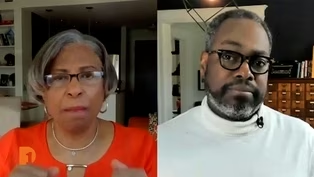
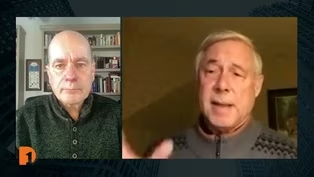
But I want to say, each one of you talked to a member of our congressional delegation.
Stephen, you talked to Brenda Lawrence, and Nolan, you talked to Fred Upton.
Both were there at the capitol on January 6 and they talk about their work now in D.C. a year later.
Let's go ahead and take a listen to those interviews.
On January 6 at the U.S. Capitol, you were there while...
Yes.
This mob, this insurrectionist mob was trying interrupt the official counting of votes in the presidential election.
Let's go back to that day for a second and just talk about what that was like.
So, Stephen, one -- one of the things that just really stood out as I try to suppress this memory is the words from the Sergeant at Arms, they're headed our way.
I had not seen TV.
I know they had whisked out Nancy Pelosi somewhere, but I figured something was really serious.
And they said -- they had locked the doors.
And they said, they're headed our way.
Find shelter, some place to protect yourself.
And it was -- it was surreal.
Then they told us, put on the gas mask.
And I didn't even know under the seats that we sit on all the time to vote in the capitol chambers were gas masks.
So, I'm trying to put on this gas mask.
And then you hear this banging at the door.
And it's vibrating, because the door's locked, and it's a mob.
You can hear them screaming and they're banging on the door.
And I'm looking around and I'm saying, oh my God, am I going to die today?
What in the world is happening?
At that point capitol police came in with their guns drawn and said, everybody exit this place.
It was the opposite end of the chamber.
So, the chamber has about six or eight doors that you can get into to, to come on the floor, and it was the opposite end.
And their guns are pulled, and they're telling everybody, move, move, go, go, go.
And Democrats and Republicans.
So, the is the point I want everyone to understand.
This is not a partisan moment.
And I tell people, it's probably the most nonpartisan moment I've seen on the Hill lately where Democrats and Republicans were literally running down back staircases and hallways to get to some place of safety.
We were literally running.
Because I had to grab the hand of one of the staff, because she was older and she wasn't able to run.
And I just pulled her and said, we gotta go, we gotta go.
TCF and what happened here on the Hill and the Capitol was not the America I know.
I was raised by a southern woman who lived by Civil Rights and Jim Crow laws, who took her right to vote as one of the most precious gifts of being an American.
I was taken by the hand every Election Day to stand next to my grandmother as she voted.
So, she could teach me and she could constantly say, this is what will protect your rights and freedoms in America.
And as an American citizen, you must vote.
And so, to -- we call it the big lie, to see criminal behavior and to see just people who are misinformed to the point where we saw an attack on our democracy.
And that's what all of this summed up to be, an attack on our democracy.
Which is so unacceptable, so disappointing, and it's just not the America that I know and I love.
So, congressman, you were in the Capitol on January 6 when the demonstrators poured in.
Where were you when that incident began?
So, the Speaker actually asked because of COVID no more than 80 members of the 435 of the House floor.
So, I've decided, I've seen this a number of times.
Normally I was there on the floor when they would count the electoral ballots.
But I let the freshman, the new freshman, Peter Myer from Florida, one of them, to be on the House floor.
I went back to my office and then watched it on TV.
And the interesting fact here was I'm one of the couple of members that actually has a balcony in the Reagan building.
So... Yeah.
It overlooks the Mall.
And I had seen all the protesters who had taken a subway to the Capitol South Metro stop, walk then down to the White House, 16 blocks, not all that far.
It was a cold morning, and then walk back.
And I was out on my balcony watching this.
And in fact, the National Guard, the state police, all of those folks, they literally came and emptied out all their vehicles right below my office as I watched this thing unfold that afternoon.
Now, congressman, from your perspective, having been there that day, was this a riot?
Was this a demonstration?
Was this an insurrection?
How would you categorize it?
I would call it an insurrection.
They knew what they were doing.
Yeah, there was a lot of mob.
I'm sure there were some people that sort of got caught up into it.
But there were thousands of people, I mean, tens of thousands of people is my guess.
I watched the president's speech from the TV in my office.
And went back and forth to my balcony, which I left the door open.
The individuals were cleared out about 6 or 7:00 that night.
It started about 2:30.
I'm watching it on my CSPAN in my office.
I saw when the Speaker literally said, let's get out of here.
I knew that the chamber had been broached.
And after it was quiet, I would say, I went over to the Capitol an hour or two before votes started again.
It was important to finish the job on January 6.
I spent time talking to the swat team folks.
They had been beaten up.
They were just literally lying on the floor, there was broken glass.
You saw the vestiges of what they did.
And certainly afterwards, I know that we have a capitol policeman from my hometown, Saint Joseph Benton Harbor, that I spend time with.
I also spent some time there literally out, as they described it to them -- to me.
One of them telling me is they literally dragged him out of the Capitol door.
Shoot him with his own gun.
What capability do you feel former President Donald Trump has in what happened on January 6?
What disturbed me the most was probably when it was over, President Trump said that they he had done everything, in his words, totally appropriate.
I didn't think that was the case.
Okay.
And I know, just to close, Kevin McCarthy, the minority leader for us, the Republican leader, called him from his office and said, Mr. President, call the dogs off.
You know, these are your supporters.
Tell them to stop.
They're doing a terrible thing for your legacy, as we all know.
And the President's reposes, allegedly, that Kevin reported was, I guess they care more about the election than you did.
That's not totally appropriate in my book.
So, congressman, I wanted to ask you about that as we close.
The broader issue here, the Vice President Kamala Harris said the other day, the threat to our democracy is her biggest concern.
Do you feel our democracy is threatened?
And this represents some sort of broader movement that may undermine our republic.
I sure hope not.
I don't know that I would go as far as what she said.
I didn't see specifically her comments.
But we're a democracy.
Every vote should count.
I believe that there are a safeguards there to make sure the votes are counted.
But I do believe that we have to get to the bottom of what happened a year ago on January 6.
All right, back here now with Nolan Finley and Stephen Henderson.
Nolan, let me start what you.
What do you feel is the political climate in Michigan right now?
You know, we have been making a little progress lately on getting agreements on spending.
As much as I sort of rejected the independent redistricting commission and the results it produced, I think had that been left with the legislature and the governor, might not have gotten done.
It's just so many things that we can't come to consensus on in this state.
And I think that's in some ways a natural product of having two parties sharing control.
But at some point you've got to come up -- come to agreement on practical solutions.
And we're not consistently getting there today.
Stephen, would you agree with that, or how would you describe the political atmosphere?
Yeah, I think it's pretty rotten.
And -- and we gotta be clear about what is driving a lot of that.
You have one party in this country, in this state, that is increasingly influenced by people who don't want to see everybody have the same access to voting, who want to question institutions like voting in the face of no evidence, of course, that there's any issue.
All claims that were made in 2020 about voting turned out to be just false.
Absolutely false.
And yet, we hear this constant narrative questioning that.
That party, Republican Party, that's influenced by that, it's hard to have a conversation about that with people who don't want to see the rules executed in a way that's fair to everybody.
We've got to have both parties be able to have these conversations on an equal -- on a level playing field when it comes to the rules, and we can't do that right now because of these influences on the right side of political spectrum.
I think one of the problems we have in this country is the emergence -- emergency of hard partisanship that has taken the place of principle and this extreme loyalty to party is destructive to the country, whether it's Republicans or Democrats.
But to Steve's question, I mean, he -- when he talks about changing the rules, the rules were changed radically in Michigan before the 2020 vote and changed by Democrats.
And you know, the courts check Johnson Benson on some of the rules changes she wanted to force to, but still forced a number of them without getting a consensus and without even trying to get a consensus, and I think that led to a mistrust.
But hear Democrats and the folks on the left saying, well, gosh, nothing was wrong with the 2020 election, there was no frauds, everything went as it should.
I tend to agree with that, but why then do they want to take the -- over elections from the states and give it to the federal government contrary to what the Constitution dictates?
If everything went so well in 2020, why do we want to give the federal government such control over a function that's clearly assigned to the states.
So, the rules were changed, let's be clear, by the people of Michigan in 2018, radically.
It was not... That's one -- that's one issue.
But before the 2020 vote.
It was all of them, it wasn't one issue.
The 2020 vote, Johnson Benson and democrats put in all sorts of requirements.
Let's be clear what she was doing.
The Constitutional changes in 2018 require all kinds of things to be executed in a way that made sense.
They were radical changes that the people voted for -- what the secretary of state was trying to do was make those things work at a practical level at all these polling sites and all these different communities.
And the question about federal involvement that is for voter protection, which is the federal government's obligation, it is the reason that we had to have a Voting Rights Act in the first place.
It's the reason that Republicans, for instance, have decimated that legislation and cast it aside and don't want to take it again is because what they fear is it leads to more people of color in this country voting mostly for Democrats, of course.
And so, Republicans don't want it.
Look at what Democrats are doing in the name of voter participation -- increasing voter participation.
Increasing the number of non citizens being allowed to vote in New York City, that erodes trust.
Should there be concern less about access and more about the post vote process?
Are we putting emphasis in the wrong place?
We need emphasis on both, but certainly you need some structure as we move to this new way of voting.
I think vote by mail is here to stay, early voting is here to stay.
I think we'll move into electronic voting.
All those changes need to come with -- with processes that ensure the integrity of the vote.
And we're not keeping up.
If we're not keeping up, then you would see all these instances of fraud taking hold than were not.
There isn't anymore fraud now than there was before there was mail in voting, before early voting.
So, I think you're both illustrating -- you're both illustrating the point right now that we are very far apart.
And it feels like both Democrats and Republicans, and you can even take party out or you can just take leaning that you're entrenching -- that you're entrenching so far now onto either side?
So, where do we stand?
I think democracy has held and held very well.
You've got more people expecting to file for office and run for office in Michigan and across the country this year than ever before.
Do we trust the process?
I think no, but there's a lot of reasons we don't trust the process, because I think our political leaders have done everything possible to break that trust.
There shouldn't be barriers to voting for people who are eligible to vote.
Whether you have I.D., or not, which is a matter of all kinds of other conditions that we've invented in this country should not affect your voting status.
And that's why Democrats push back.
I think we will see where we are with this democracy with the elections this year.
If we see a repeat of the kinds of efforts of disenfranchisement, of disqualification that we saw in 2020, then I think the democracy is -- is under threat.
My thanks to Nolan and Stephen.
As we look forward, what kind of impact does increasing partisanship and doubt in government have in our democracy?
And what role does the media play in combating misinformation.
I met up with the editor and vice president of the Detroit Free Press, Peter Bhatia, and Michael Barr, the Dean of University of Michigan's Ford School of Public Policy.
A year later the investigations continue.
The increasing divide between the parties and several polls have come out in just the last couple of days that show the difference in how Republicans and Democrats saw how what happened on January 6 as either protecting democracy or threatening it.
So, Michael, let me start with you?
How do you think what happened on January 6 in '21 has changed the way the public views our democracy or the strength of it?
Well, I think it highlighted a significant set of weaknesses that we're going to need to be addressing for a number of years to come, maybe even decades.
We have so much work to do to try and rebuild the fabric of our society, to help people who have very different perspectives on the world, relearn how to have conversations with each other across those differences.
I think January 6 highlighted an underlying problem, which was that we had a false view that the election in the United States was stolen.
And we had politicians who are willing to push that line out, we had media personalities who were willing to push that line out, and lots of people now believe that the election was unlawful.
And that's false.
It's just a verifiable fact that the election that took place, there was no widespread fraud.
And that really gets into the conversation of misinformation, what truth means to people, and the role of the media.
Before we get to that, you know, Michael brings up a good point.
According to the ABC News poll that just came out this week, 65% of Americans believe that Biden's election was legitimate, 65%.
It's a very interesting number.
But I want to ask you, Peter, going back to the original point of how you believed January 6 has changed the way the public sees our democracy and the strength of it?
Yeah, it's a scary time.
I have a seven-year-old grandchild.
And I worry, will our society, will our democracy be there for him when he's an adult?
Because -- because as Michael just said, it's so hard just to have a fundamental conversation with people about can our democracy survive?
Is our democracy working?
What really happened then?
You know, that -- that even a third of the country doesn't believe the election was legitimate is deeply, deeply troubling.
It runs counter to everything we stand for as a democratic society.
And trying to communicate with people about it through our work has become exponentially more difficult, because people are just not willing to believe the truth.
So, does that inspire or lead to more civic engagement from people, or does it lead to more estrangement?
People pulling back and saying, I don't even want to participate in what I'm seeing, Michael?
So, I don't think we're in even the worst period in modern history.
But we're in a very troubling period in our democracy.
And it does require civic engagement, it does require all of us to take responsibility for our own work, to take and enhance our democracy.
It's one of the reasons why at the University of Michigan we started a year ago, democracy and debate initiative.
And we get students, faculty, and staff involved in thinking about the tough issues, in trying to understand voting rights in exercising the right to register and to vote.
We saw Michigan's -- University of Michigan's student voting patterns go way up in the last election because there was this civic engagement, this desire to be involved.
And I know for our students at the Ford School, at the Gerald R. Ford School of Public Policy, our students are deeply and engaged, they're not cynical or detached about the work that has to happen in our democracy.
And so, really looking at the next generation.
So, Peter, do you really think that this will -- this will enhance people's need or desire to be involved, to be civically engaged, as Michael says?
Well, I think it's important for those of us who have a role in creating that civic engagement, it makes it very, very important that we take that very seriously.
And it has to go beyond traditional ways we think about journalism.
It has to go beyond just writing stories and putting them on our website and -- and printing them in the paper in hopes that people will take action based on that.
It does require those of us in media, I think, to take a much more aggressive role in terms of civic engagement, in terms of getting out there and talking to people and to listen to people.
I know that can be -- I know that personally can be difficult when someone just wants to yell at you and say, you're part of the coverup.
And they use more colorful language than that quite often.
But the fact is, we have to be relentless about that.
We have to be really aggressive, yes, in our traditional ways, but also in taking that to the public in a way that maybe less traditional, doing town halls, opening up what are called -- what's been called mobile news rooms in communities.
Particularly for us, getting out of metro Detroit and getting out in the rest of the state and hearing what people are thinking and having to say.
You have to be -- you have to be very aggressive about it and listen to people, and not immediately label them as kooks.
Because some of this is coming from a heartfelt place, some of this is the result of relentless propaganda.
I've had a conversation with some of my staffers about how do we cover the future of democracy as a Michigan phenomenon?
You know, our situation in Michigan is different than it is in Georgia or Pennsylvania, or as it is in some of the other so-called battleground states and where you have this as most intense, at least as where the discussion has been most intense.
But we have to make a choice that if it means we cover a few fewer courts, say, or a fewer -- fewer police stories, say, in order to spend more time trying to get, trying to understand the mood and the heath of the electorate and really our democracy here in Michigan, than we need to do that.
I can't think of a more important journalistic function in 2022 than that.
I think there's a really important local and state story to saving our democracy.
It's true in Michigan and it's true all over the country.
It's true in a mechanical sense and the sense that lots of the battle ground issues are occurring at the state level.
People are fighting about secretary of state positions in ways they didn't before, or local election officials in the ways they didn't before, because they understand how important it is for the integrity of the electoral process.
Because it matters very much on that.
We have ballot initiatives and legislative initiatives that are in the state of Michigan that are trying to reduce access to the polls, and I think those are significant issues that need to get covered that are really important for the health of our democracy, again, beginning with voting here in Michigan.
And then I do think that the answer to the question, how we're going to bring our country together starts in our communities.
It doesn't start necessarily at the national level.
Can we -- can we build a way that people can connect to each other in our communities, begin to rebuild trust in each other to create a generous sense of belonging that we're all in this together.
We're going to see this ramped up political activity this year with the House and Senate nationally at stake, with redistricting and you know, everything that that means in terms of our local and state elections.
It's going to be, in a lot of ways, more of the same.
And I think that's why it puts pressure on us to cover the election in a -- in a more health way, in a more -- what really matters to people who live here, what really defines us going forward, because you know, we have -- this country we have profound issues that aren't being addressed, whether it's big, global issues like immigration and housing and health and so on.
But also more micro issues, you know, the -- the pave the damn roads debate, if it is even a debate in Michigan.
So, I think our coverage really has to try to get at those and get away from -- away from the rhetoric.
It's going to be really hard because both the left and the right are going to be banging that -- those drums very, very loudly in 2022.
Michael, from your perspective, what should we be watching?
I do think the most important issue facing the country is the health of our democracy, and I think we need to keep coming back to that theme.
We can't take for granted that the elections are going to run smoothly, we can't take for granted that people are going to uphold the constitutional order.
I think January 6 called that into question.
In the end, our democracy has been strong, but it's definitely been deeply challenged along the way.
And I think it's really critical that our media, that our citizenry focus on the hard work every day that is required to preserve a functioning democracy.
So, I think that is the story.
Finally, coming up after our show tonight, we invite you to watch the new PBS documentary series called "Preserving Democracy, Pursuing a more Perfect Union".
It explores the ideals and flaws of democracy, cycles of civil rights progress, informed citizenship.
Take a look.
♪ JOANNE: January 6 revealed that democracy is a lot more fragile than I thought it was.
I knew intellectually and as a historian and as a scholar.
But watching that on TV and watching it transpire drove that home for me in a way that it hadn't before.
JELANI: We're in the crucible right now, we're in the midst of that conflict that ongoing, seemingly redundant conflict in American history, the conflict over voter access, the conflict over basic voter accuracy.
All that's going on right now.
And if we wanted to understand, you know, anything about this particular moment, then history is our guide.
♪ "Preserving Democracy" airs right after One Detroit, right here at 9 p.m. That is going to do it for us tonight.
Thank you for joining me.
From the stories you saw tonight show, our extended interviews, and more on our "Election 2020: Detroit to D.C." project with the Detroit Free Press, just go to our website at OneDetroitPBS.org, find us on social media @OneDetroit.
I'm Christy McDonald and from all of us at Detroit Public Television, have a good night and take care.
You can find more at OneDetroitPBS.org, or subscribe to our social media channels and sign up for our One Detroit newsletter.
ANNOUNCER 1: From Delta faucets to Behr paint, MASCO Corporation is proud to deliver products that enhance the way consumers all over the world experience and enjoy their living spaces.
MASCO, serving Michigan communities since 1929.
ANNOUNCER 2: Support for this program is provided by the Cynthia & Edsel Ford Fund for Journalism at Detroit Public TV, the Kresge Foundation, Community Foundation for Southeast Michigan.
ANNOUNCER 1: The DTE Foundation is a proud sponsor of Detroit Public TV.
Among the state's largest foundations committed to Michigan focused giving.
We support organizations that are doing exceptional work in our state.
Visit DTEFoundation.com to learn more.
ANNOUNCER 2: Business Leaders for Michigan, dedicated to making a top ten state for jobs, personal income, and a healthy economy.
Also brought to you by... And viewers like you.
♪ ♪ ♪ ♪
Brenda Lawrence Shares Experiences from Capitol Insurrection
Video has Closed Captions
Clip: S5 Ep44 | 4m 8s | Rep. Brenda Lawrence Shares Her Experience from the Capitol Insurrection (4m 8s)
Fred Upton Shares Experiences from Capitol Insurrection
Video has Closed Captions
Clip: S5 Ep44 | 4m 28s | Rep. Fred Upton Shares His Experience from the Capitol Insurrection (4m 28s)
Recounting Election Night 2020: Trouble at TCF Center
Video has Closed Captions
Clip: S5 Ep44 | 20m 5s | Recounting Election Night 2020: Trouble at TCF Center | Episode 544/Segment 1 (20m 5s)
Where Does Democracy Stand One Year After an Insurrection?
Video has Closed Captions
Clip: S5 Ep44 | 3m 35s | Where Does Democracy Stand One Year After an Insurrection? | Episode 544/Segment 2 (3m 35s)
Providing Support for PBS.org
Learn Moreabout PBS online sponsorship
- News and Public Affairs

Top journalists deliver compelling original analysis of the hour's headlines.

- News and Public Affairs

FRONTLINE is investigative journalism that questions, explains and changes our world.












Support for PBS provided by:
One Detroit is a local public television program presented by Detroit PBS