
Election maps, Holocaust Center, Carl Craig, Weekend Events
Season 8 Episode 33 | 26m 46sVideo has Closed Captions
New Detroit election maps, Holocaust survivor stories, Carl Craig and weekend events.
Detroit residents are being asked to weigh in on newly proposed election district maps. The Zekelman Holocaust Center revamps its core exhibit to highlight local survivors’ stories. Detroit techno producer and trailblazer Carl Craig talks about the city’s techno roots and carving a lane for African Americans in electronic music. And, celebrate Black History Month and more around town this weekend.
Problems playing video? | Closed Captioning Feedback
Problems playing video? | Closed Captioning Feedback
One Detroit is a local public television program presented by Detroit PBS
Election maps, Holocaust Center, Carl Craig, Weekend Events
Season 8 Episode 33 | 26m 46sVideo has Closed Captions
Detroit residents are being asked to weigh in on newly proposed election district maps. The Zekelman Holocaust Center revamps its core exhibit to highlight local survivors’ stories. Detroit techno producer and trailblazer Carl Craig talks about the city’s techno roots and carving a lane for African Americans in electronic music. And, celebrate Black History Month and more around town this weekend.
Problems playing video? | Closed Captioning Feedback
How to Watch One Detroit
One Detroit is available to stream on pbs.org and the free PBS App, available on iPhone, Apple TV, Android TV, Android smartphones, Amazon Fire TV, Amazon Fire Tablet, Roku, Samsung Smart TV, and Vizio.
Providing Support for PBS.org
Learn Moreabout PBS online sponsorship- [Announcer] Coming up on "One Detroit," Detroit residents are being asked for their opinions on new election district maps.
Contributors Nolan Finley and Stephen Henderson offer their thoughts on the redistricting process.
Plus the Zekelman Holocaust Center updates its main exhibit to focus on the stories of Michigan Holocaust survivors.
Also ahead, we'll examine the roots of Detroit techno music with one of its pioneers, Carl Craig.
And the weekend is almost here.
We'll fill you in on what's happening around town.
It's all coming up next on "One Detroit."
- [Narrator] From Delta Faucets to Behr Paint, Masco Corporation is proud to deliver products that enhance the way consumers all over the world experience and enjoy their living spaces.
Masco, serving Michigan communities since 1929.
Support for this program is provided by the Cynthia & Edsel Ford Fund for Journalism at Detroit Public TV.
- [Narrator 2] The DTE Foundation is a proud sponsor of Detroit Public TV among the state's largest foundations committed to Michigan focused giving.
We support organizations that are doing exceptional work in our state.
Visit DTEFoundation.com to learn more.
- [Narrator 3] Nissan Foundation, and viewers like you.
(upbeat music) - [Announcer] Just ahead on "One Detroit," we'll take you to the reopening of the Zekelman Holocaust Center's main exhibit focusing on Michigan Holocaust survivors, plus one of the Detroit pioneers of techno talks about its influence on African American music.
And Cecelia Sharpe and Peter Whorf of 90.9 WRCJ have some ideas on things you can do this weekend.
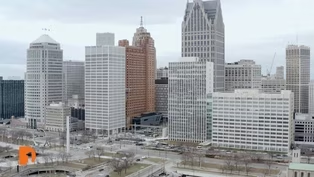
But first up, Detroit residents are being asked to weigh in on proposed new election district maps.
The Michigan Independent Citizens Redistricting Commission is holding public hearings next week for Detroiters to provide input on the redrawing of boundaries for seven Michigan house districts.
"One Detroit" contributors, Nolan Finley of the Detroit News and Stephen Henderson from American Black Journal offered their own feedback on the redistricting process.
(light music) - So Nolan, I actually think, I mean, even though this is a do-over technically, and I think there are some people who are kind of claiming victory over the process saying that this process didn't work and that this is proof of it.
I actually think this is exactly the demonstration that we want and need for this community.
We need people to show up for this, but the idea that voters themselves will get to show up and say, "Hey, we like this.
We don't like that.
We would prefer that you gave more weight to this factor than to that factor.
I don't mind you messing up this district, but I don't want you to mess up mine," is a little messy.
But this is the democratic process that I think laid at the foundation of this change, which allows citizens to draw the lines instead of politicians.
If this was under the old system, a bunch of politicians to be in a room with the door closed, they'd fix it the way they want to fix it and no one else would have a say.
- Well, I think this whole redistricting process has proven impervious to fairness.
It doesn't matter who draws 'em, you're gonna have people who say, "We really got to short shaft here."
This is a process.
If you think this is the process we should go through, should have been gone, should have happened two years ago before we've held a round of elections and elected both senators and representatives from these new districts.
Now you gotta throw all that out.
Start over again.
There's a question about whether you're gonna have to hold new Senate races before those terms expire.
You know, was there a better way to do it?
You said politicians in a backdoor room.
Okay, what about politicians or other qualified representatives of the people in an open door room?
The folks that were selected to do this, most of 'em had absolutely no background in politics or in political districting, simply throwing it to the people, all that did was give the consultants, the lawyers, much more influence over the process.
And you see what happened here.
They gave the folks from the Redistricting Commission really bad advice, particularly on the Voting Rights Act and proportional representation.
- Well, I mean, actually two years ago when we went to this the first time, they did do the process right, and they did have citizens show up and say what they wanted and say how they wanted to do.
And in fact, the mistake here that the court points out is not about the Voting Rights Act, which is about the districts you end up with and what they do, it was the process they went through.
They're saying that they relied too much on race in the process, and that that was a violation of the 14th Amendment, which requires a certain level of colorblindness.
And it's an honest mistake.
I mean, what they were trying to do was honor what the constitutional amendment says we want them to do, which is to deemphasize things like political affiliation and geography and create districts that represent communities in a more accurate way.
The truth of the matter is that if you are trying to create the best chance for African Americans in this region to elect people who look like them, you have to think about something more than Detroit now.
That was never true before, but because in the 2020 Census, we saw that for the first time, more African Americans live outside the city than inside, this has implications for the suburbs that it didn't have before.
They did their best to try to represent that.
The court says they did it by relying too much on race.
But I think in terms of the outcome here, what they did made pretty good sense.
But they'll go back and fix it.
And yeah, I would rather have citizens do that than politicians.
I mean, any day of the week.
- Well, you look at the outcome, let's talk about that.
You end up with fewer Black representatives and senators in Lansing, and you end up with Black neighborhoods, Black communities, large number of them represented by white suburban heights.
It didn't produce the sort of broader representation that it should have.
And you have a lot of experts in this state on redistricting.
I think it would've been possible to put together a panel, had we not had this amendment written the way it was, to put together a panel that brought together a bipartisan group of true experts to do this.
And was the old system perfect?
No, but just like the old system, this one's ended up in court at a much later date when it's harder to fix the wrongs, I mean, it's gonna affect more than these 13 houses.
- Yeah, it'll affect the whole region.
- The whole region is touched by this, and we're headed in rapidly headed into primaries, and candidates don't know what the districts are gonna look like.
This is not going to turn out well for representative governing in Michigan.
- Yeah, I mean, the timing is bad and it's unfortunate.
This could have happened earlier if people had gotten their act together to file suit.
I will quibble with the idea that the maps that they had wouldn't have produced over time a better representative sample of actually more people of color in Lansing.
What happened was that, and this happens in every redraw, people have to get used to the idea of those new districts and the chance that they might have to run.
You had a bunch of Detroit representatives who didn't want to campaign in the suburbs, African Americans from the city who didn't feel like they wanted to campaign in the suburbs.
But in subsequent elections, I think what we would've seen would've been African Americans who live in the suburban parts of those districts who would've stepped up and said, "Well, I'm gonna be a candidate for this."
They would've pulled votes from the suburban parts of those districts and parts of the city, and you would've had a new generation of African American leadership.
That was what this commission was looking at.
It didn't work out, but it still may.
I mean, I think there's a possibility that they do it in a way that preserves that opportunity.
- [Announcer] And those public hearings on the Detroit district maps take place on Wednesday, February 21st at Greater Grace Temple, and Thursday, February 22nd at 2nd Ebenezer Church, 10:00 AM until 8:00 PM both days.
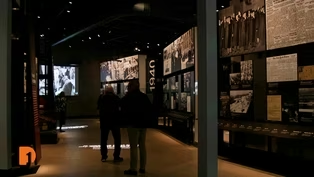
The Zekelman Holocaust Center in Farmington Hills is welcoming visitors to its newly renovated core exhibit, which now centers on the stories of Michigan Holocaust survivors.
An estimated 400 survivors are living in the state, and the exhibition uses new technology and updated historical information to recount their memories and honor their legacy.
"One Detroit" contributor Sarah Zientarski was at the center for the opening of the new exhibition space.
(light music) (somber piano music) - This is what we really imagined the exhibit could be.
- You just hear all of these amazing stories, and it's a way of learning about the Holocaust, not just through your mind, but through your heart and your soul.
- [Speaker] We are not here to tell you how to apply those lessons to your life, just that you can.
- Can you talk about what the museum exhibition was before the renovation and why the change?
- When the exhibit was first created all those years ago, it was following what at the time were best museum practices.
But of course, we know so much more now.
We know more about wanting to be sensitive to the humanity of the victims and not tell a perpetrator-centered story.
- We're surrounded here by pictures of the local Holocaust survivors, and we've lost so many in the last few years, and so we knew we had to center survivor stories in the exhibit.
When you talk about the Holocaust, it's so overwhelming.
It's so big that it's hard to sort of imagine what it means.
Six million Jews murdered, it seems overwhelming.
The right way to talk about these things, to open up the conversation is through individual stories.
What was it like as one person going through it?
- They gave us a few minutes to scoop up whatever we could, and they marched us to a train station where there was a long line of cattle cars and they were shoving as many people as they could in each of those box cars.
My sister and I cried and cried that we would not go without our parents, and those soldiers kept on telling us all kinds of lies.
- One of the things that we did is we very specifically said, you know what, what can we do that no one else can do?
And that is to tell the stories of our Michigan Holocaust survivors.
We have quotations almost everywhere you look, from Michigan Holocaust survivors, and we identify them with a little logo of the state of Michigan and the words Holocaust Survivor next to them.
It's bringing those personal stories and humanizing the victims and survivors of the Holocaust as much as possible.
- We want people to understand who they were and how they lived, and to really see them as fully fledged human beings who are just going about living their lives and had this major upheaval occur to them.
So of course, we have to talk about what the Nazis did and how they did it, but we also wanna make sure that every step of the way that we tell that story, we're talking about what the impact was on the victims and on the survivors, and how they reacted, what choices they could or could not make.
And so people really have an understanding of life before, during, and after the Holocaust, for those people.
- How has the story arc of the exhibit allow the viewer, the visitor to be empowered at the end?
- Well, we start the exhibit really with the voices of the survivors.
We start and end that way and they tell us why it's important to study the Holocaust and what the lessons are and how we need to treat each other.
And then we move into talking about pre-war Jewish life so that people have an understanding of what life looked like and that it wasn't monolithic, that there were religious Jews and secular Jews, Eastern European, Western European, urban and rural, et cetera, so that people really understand who we're talking about.
So that when we start to talk about the rise of the Nazi party and their hateful ideology, and what they were trying to do, there's an understanding that there were real people who were impacted by their ideology, which eventually became state policy.
- There's another room for contemplation, and there we talk about modern atrocities, mass atrocities, the creation of the idea of genocide, which came out of the Holocaust, what contemporary antisemitism looks like and how it draws on these old tropes to tell the same kinds of lies through history and how they're still being used today.
One of the things that we've included in that last exhibit is that these kinds of terrible things happen because of context.
It takes at first a society that to a certain extent, is broken, and then people find ways to try to take advantage of that.
And so we want people to recognize that and figure out how do you improve a society?
- And to have those local connections and to say like, oh, she could of walked down the same sidewalks as as me or my father.
That type of connection makes it so much more easy to connect to.
- So the Holocaust Center does hold Survivor Talks.
- Yes.
- When do they hold them and who can come and see them?
- Our Sunday Survivor Talks are Sundays at noon.
Anyone can come.
They are open to the public.
And following the survivor talk, we also have a public tour, which is available to anyone who would like to join.
- People were extremely hungry, many was getting sick and everyone scared and anxious not knowing or understanding why the soldiers picked us up, where they taking us, and what they would do with us.
- It's hard to know what to say, when a survivor gives their talk, in many ways, they're reliving their experience every time.
And so what else can we say but thank them profusely for their willingness to do that and impart their memory to us?
- I do think that the people who have chosen to speak and speak on a regular basis are doing so because they really do believe that they can make a difference.
And they really believe that by telling their story, they can help the next generation work to make the world a better place.
And I think that it's that belief in the future and the possibility of humanity and not having given up on humanity that really comes through in their talks.
- But as you can see, I survived.
I don't want anyone to think and feel here is this poor woman who has such a tough life because I don't think of myself that way.
Not only am I fortunate that I survive, but I am more fortunate that I was able to create a very meaningful life and significantly contribute to my community.
- How does the viewer hearing these stories help to remember the past, and again, to hopefully make it so that this doesn't happen in the future?
- Well, I think that it becomes our obligation to then continue to tell their stories and continue to teach and not just feel, oh, the past is in the past because it isn't.
And we know that hate exists today and we have to stand up and do something.
And how you can take those lessons and think about the choices that we can all make in our lives and how we can get involved in whatever way is meaningful for us to make our communities better, stronger, safer for everyone.
- [Announcer] February is Black History Month, and Detroit Techno has played a major role in the history of Black music.
Techno dominates the electronic music scene around the world today, and it got its start right here in Detroit in the late 1970s and early '80s.
American Black Journal host and "One Detroit" contributor Stephen Henderson sat down with one of the second wave of techno pioneers, Grammy-nominated music producer and DJ Carl Craig to talk about the creation of techno.
(light music) - I grew up here in the '70s and the '80s, just like you did.
And I remember so poignantly when you and Derrick May and Kevin were making all of this new noise, right, is what my mom called it when she first heard it.
And I think even then it was really obvious that you guys were changing music in a really fundamental way, changing the way we think about it, changing the way we move to it, changing the way it influences our lives.
So let's go back to that time and talk about where this comes from and how you guys came up with the sound and the drive that is hip hop and rap and all of the things that come out of it.
- Yeah, Detroit techno started with Juan Atkins and Rik Davis, Cybotron.
That was the beginning.
And by the time I came around, my cousin had done technicolor with Juan and I would play basketball in the backyard listening to Kevin and Derrick's music and listening to Jeff Mills on the radio as a wizard.
So by the time I got in, it was already primed, and well-oiled early baby machine.
(both laughing) So when I had the opportunity to meet Derrick, I thought he was Big Brother Almighty when I first met him and went down to the music institute and partied down there with just this multicultural crowd of people that were coming down, people that I knew from when I went to Cass, people that I knew when I went to Cooley, people that I was meeting when I was going down to the shelter at St. Andrew's Hall, that club.
So I was seeing these amazing things that were happening on a multicultural level that was way different than anything that I had experienced before.
So I was happy, happy, happy to be a part of it, and I knew that it had to be my destiny.
- Yeah.
Talk the importance of this being Black music.
- Man, it is crazy important.
Now we have a lot of influence that comes, of course from craft work and- - Germans.
- Early '80s synth pop because we are using synthesizers and drum machines.
Someone that had said something that was real funny to me when they read an article of what Ike Turner's favorite record was, which was "Rumors" from Fleetwood Mac, it was like, what the heck is this?
And I think this is what people think about Detroit Techno is when we talk about craft work as an influence, then they get kind of confused and they want to just hijack the whole thing and say that we're only influenced by this white music.
But no, we're influenced by George Clinton, we're influenced by James Brown, we're influenced by Prince, we're influenced by Stevie Wonder, and the electronic stuff that came out through Motown, so we're heavily influenced from Black music and as Black artists that are from essentially the hood, (both laughing) we're making music that had as much roots to urban culture as rap music, gangster rap as any other form of, we're celebrating hip hop 50 or celebrated hip hop 50.
And you know, the thing about hip hop that has been able to be so strong over the years is because it really delved into its urban and many times its underworld culture.
In order to get people to be interested and stay interested in the story, like watching "Scarface" or watching any type of gangster movie.
But with Detroit techno, we didn't, we purposely didn't try to make it into some sort of gangster music because we're not gangsters.
So it's the other side, we're not nerds either.
But it's something that people would see more on a nerdy side, they would see us more like the "Big Bang Theory" maybe than they would see us as "In Living Color."
- Yeah.
Yeah.
- [Announcer] From theater productions to music concerts and Black History Month activities, there are several events taking place in metro Detroit this weekend and beyond, Cecelia Sharpe and Peter Whorf of 90.9 WRCJ offer up a list of suggestions in today's "One Detroit Weekend."
- It's that time of the week when we get to chat about what's going on around metro Detroit this weekend and beyond.
Why don't you start us off?
- All right, Peter.
Well, as you know, it's Black History Month and Detroit doesn't disappoint with the amount of events being held to honor and celebrate Black culture.
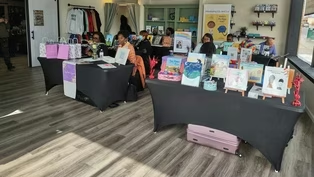
On Saturday, the 8th, Annual African American Family Book Expo is taking place at Historic People's Community Church on Woodward.
This is Michigan's largest book fair to showcase Black independent authors.
- [Peter] And throughout the month of February, the Carr Center has an exhibition called Black: A Built Language Across Culture and Knowledge.
This collection of art by Black artists highlights the rich diversity and different forms of expression within the Black community.
- [Cecelia] And on the weekends throughout the month, the Henry Ford Museum reflects on the past, commemorates the present, and looks forward to the future with celebrate Black History and Black Futures.
This Sunday, the 18th, there will be dance performances by the Institute of Dance at Marygrove in the Museum Plaza.
- [Peter] Also, on Sunday, the Detroit Medical Orchestra has a concert coming up at the congregation Beth Shalom Oak Park at 3:30 PM.
They'll perform Bruch's "Concerto No.
1 in G minor, Op.
26," and Gershwin's "An American in Paris," among other pieces.
- [Cecelia] And through March, Tipping Point Theatre is presenting "The Chinese Lady."
The play is based on the true story of Afong Moy, who was thought to be the first Chinese woman to set foot in the United States.
- And there's even more going on around Metro Detroit in the upcoming days.
So here's a few more events to check out.
Have a great weekend.
(light music) - [Announcer] That'll do it for this week's "One Detroit."
Thanks for watching.
Head to the "One Detroit" website for all the stories we're working on.
Follow us on social media and sign up for our weekly newsletter.
- [Narrator] From Delta Faucets to Behr Paint, Masco Corporation is proud to deliver products that enhance the way consumers all over the world experience and enjoy their living spaces.
Masco, serving Michigan communities since 1929.
Support for this program is provided by the Cynthia and Edsel Ford Fund for Journalism at Detroit Public TV.
- [Narrator 2] The DTE Foundation is a proud sponsor of Detroit Public TV.
Among the state's largest foundations committed to Michigan-focused giving, we support organizations that are doing exceptional work in our state.
Visit dtefoundation.com to learn more.
- [Narrator 3] Nissan Foundation, and viewers like you.
(light music) (dramatic piano music)
Detroiters asked to weigh in on new election district maps
Video has Closed Captions
Clip: S8 Ep33 | 7m 17s | Detroit residents being asked to weigh in on seven new election maps at public hearings. (7m 17s)
Holocaust Center’s revamped exhibit tells survivor stories
Video has Closed Captions
Clip: S8 Ep33 | 7m 43s | Zekelman Holocaust Center re-opens newly renovated exhibit highlighting survivor stories. (7m 43s)
One Detroit Weekend: February 16, 2024
Video has Closed Captions
Clip: S8 Ep33 | 1m 58s | Ways to celebrate Black History Month in and around Detroit throughout February. (1m 58s)

Tapping into Detroit’s techno roots w/producer Carl Craig
Video has Closed Captions
Clip: S8 Ep33 | 5m 25s | Trailblazing Detroit-born techno producer Carl Craig on the Black music experience. (5m 25s)
Providing Support for PBS.org
Learn Moreabout PBS online sponsorship
- News and Public Affairs

Top journalists deliver compelling original analysis of the hour's headlines.

- News and Public Affairs

FRONTLINE is investigative journalism that questions, explains and changes our world.












Support for PBS provided by:
One Detroit is a local public television program presented by Detroit PBS