
Election Roundtable/Voter Turnout
Season 49 Episode 45 | 26m 47sVideo has Closed Captions
Election Roundtable/Voter Turnout| Episode 4945
Taking an in-depth look at the election results in Detroit. The roundtable weighs in on the major races and proposals on the ballot. Plus, a joint report with Bridge Detroit on the city’s low voter turnout. Episode 4945
Problems playing video? | Closed Captioning Feedback
Problems playing video? | Closed Captioning Feedback
American Black Journal is a local public television program presented by Detroit PBS
Election Roundtable/Voter Turnout
Season 49 Episode 45 | 26m 47sVideo has Closed Captions
Taking an in-depth look at the election results in Detroit. The roundtable weighs in on the major races and proposals on the ballot. Plus, a joint report with Bridge Detroit on the city’s low voter turnout. Episode 4945
Problems playing video? | Closed Captioning Feedback
How to Watch American Black Journal
American Black Journal is available to stream on pbs.org and the free PBS App, available on iPhone, Apple TV, Android TV, Android smartphones, Amazon Fire TV, Amazon Fire Tablet, Roku, Samsung Smart TV, and Vizio.
Providing Support for PBS.org
Learn Moreabout PBS online sponsorshipJust ahead on "American Black Journal."
Election 2021 is in the books and we're gonna take an in-depth look at the results here in Detroit.
Our round table is gonna weigh in on all the major races and the proposals that were on the ballot.
Plus we'll have a joint report with Bridge Detroit on the city's low voter turnout.
Don't go anywhere.
"American Black Journal" starts now.
ANNOUNCER: From Delta faucets to Behr paint, Masco Corporation is proud to deliver products that enhance the way consumers all over the world experience and enjoy their living spaces.
Masco, serving Michigan communities since 1929.
ANNOUNCER: Support also provided by the Cynthia & Edsel Ford Fund for Journalism at Detroit Public TV.
ANNOUNCER: The DTE Foundation proudly supports 50 years of "American Black Journal" in covering African American history, culture and politics.
The DTE Foundation and "American Black Journal," partners in presenting African-American perspectives about our communities and in our world.
ANNOUNCER: Also brought to you by AAA, Nissan Foundation, Inpact at Home, UAW, Solidarity Forever, and viewers like you.
Thank you.
(upbeat music) Welcome to "American Black Journal."
I'm Stephen Henderson, your host, and as always, I'm glad you've joined us.
There were quite a few major decisions made in the city of Detroit on November 2nd, during the elections.
Residents gave mayor Mike Duggan, a third term in office and city clerk, Janice Winfrey was easily reelected to a fifth term.
Plus there are several new faces on city council.
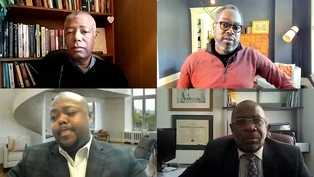
We have pulled together our ABJ round table to talk about all the results and what they mean for the city of Detroit.
Here's my conversation with Greg Bowens, Kerry Leon Jackson and Brandon Brice.
All right, let's get started on the election 2021 wrap up.
Welcome to "American Black Journal," Greg Bowens, Brandon Brice, and Kerry Leon Jackson.
Great to see you guys.
Good to you see you.
Thanks for having me.
How are you?
All right, let's start with, I think, the biggest news in Detroit, in the Detroit elections, you have mayor Mike Duggan elected to a third term, only the second mayor in the city's entire history to be elected three times.
At the same time, the city council saw major, major changes.
We will have somewhere on the order of six new members on council.
That could create a really interesting dynamic.
Greg, I'm gonna start with you.
What do you make of those two results?
Well, I think it's really interesting.
I mean, no one expected Mike Duggan to lose a third term here.
I guess more people were surprised that he would wanna do it (laughs) given the kind of challenges that he's had in the past with the pandemic and the land bank and all that stuff.
So the fact that he has been reinvigorated, as it were, to take on a third term is, I think is probably the most surprising thing.
The other thing is is that with city council, you have all these new members.
And I said, the big elephant in the room was corruption.
And the idea that people seem like that they were kinda tired of the same old same old downtown when it came to city council.
And we gotta see how this is gonna stand.
Now Stephen, you know that one of the things that the mayor loves to do and that, you know, seems to hang over everybody's head is the state and state finances.
And so, whenever people push back on a plan that has to do with the budget or anything like that, they pull out the big hammer of, well, the state is still watching.
So you might wanna be careful here and just do the thing that we laid out.
So I'm not so sure that we're gonna have as much of an activist council as we would otherwise have with that kind of thing hanging in the background.
Yeah.
You've also got the mayor with $800 million in his pocket that nobody could've predicted that he would have.
I can't remember any mayor in this city ever starting out any term with that kind of financial advantage.
That gives him some leverage, I think, with the new council members who will be eager to show their constituents that they can deliver.
You can't deliver without cash, Brandon Brice.
Well, I mean the, the reality is, 20 years ago, you could probably win the mayor of Detroit race with three or 400,000.
The game has changed.
It costs to be the boss.
It costs to run a major campaign, especially against a guy who, let's be honest, has a very close relationship with probably one of the wealthiest people in the state.
That is Dan Gilbert, and so I think, looking at the Anthony Adams challenge, I think he had a couple challenges going in.
One, regardless of all of the scandals and issues, people still like Mike Duggan, and they look at him as a man who delivers.
The other part is that this is a guy who, I think, you know, if I'm Anthony Adams, it was really about a ground game, and it was also, we're gonna be fair.
It was also the fact that the media that's you, Steve, I like you, but I gotta call you out, the media picked this candidate.
You know, even looking at something as simple as a debate, one debate didn't happen, and so I don't think that was, and I don't think that was really fair to a lot of Detroit voters, and unfortunately, as we saw, I think most people knew the mayor was gonna win, but not by this big margin.
Yeah.
So, I mean, I agree with you about the debate, and I actually twice got after the mayor, when we were having conversations on air about it, about how unfair I thought it was and how disrespectful, in fact, I thought it was of Detroit voters who might wanna vote for somebody other than him.
I think everybody deserves that chance to see their candidates square off.
I actually don't think that's the media's fault in totality.
I mean, the mayor didn't wanna do it and there is no mechanism to force him to do it.
I have been trying for about a decade, in fact, to get an independent debate commission started in the state of Michigan that would at least handle debates for statewide, and probably in, in Detroit.
The media is one hurdle to that, but the parties are hurdles to it too.
I mean, everybody likes to have that control in their own camp and nobody's willing to give it up for the public good, but I absolutely agree with you, that there should have been in debate.
There should be a debate every time, and the fact that the mayor wouldn't debate Anthony Adams, Anthony Adams, who, by the way, is one of the most qualified people to ever run, at least on paper, for the mayor of Detroit, how do you distinguish not debating him from debating Benny Napoleon?
Again, a qualified candidate, but equal, really, to Anthony Adams and Coleman Young II, who he also had a debate with.
So yeah, I'm 100% with you on that.
I don't think that was fair.
I'm not sure it would've made a difference, but it would have at least given voters a real sense of what was going on.
Kerry, what do you make of this idea of a white guy from Livonia winning for mayor three times in the city of Detroit?
When he takes office on January 1st of 2022, he will be the second longest serving mayor in the city's history.
I never would've seen this coming.
I'm pretty sure that when he moved in from Livonia and filed, he didn't see it coming either.
But the truth is there are quite a lot of Detroiters, apparently 69,000 Detroiters who are very, very, very happy with what they see going on in the city, whether they believe, whether he actually had anything to do with the improvements in the city or not doesn't really matter to them.
They voted based on what they see right now.
And you're right.
I've known Anthony Adams for almost 30 years.
He's one of the most qualified, but I gotta tell you, and I've said this probably a dozen times, if I was running Duggan's campaign, I would've said the same thing.
You're not about to debate him, because if you debate him, he's gonna make you look bad on the stage.
So there's no real reason to debate him.
And you're right.
Parties and candidates don't want to have to go into a fight.
Nobody really ever predicted this sort of a fight, but a candidate, a mayor that's had all of the challenges that he's had with somebody who actually would be pretty good at debating, he would've eaten them up on the stage.
So there was no real reason for him to debate him, and instead of him winning by 55%, he won by 75% of the vote.
So it was just, he did the right thing, whether we all agree with it or not.
In this one case, he did the right thing.
Yeah, he did the right thing for him and his campaign.
No question.
I keep saying that the question needs to be what's right for voters, and in order to get to that, we gotta take that power away, I think, from candidates themselves.
Greg, I wanna talk also about the proposals that we had on the ballot in Detroit, some really interesting ones.
Proposal R, and I think it was Proposal E, which was the mushroom ordinance.
Proposal R was reparations.
Those both passed with no problem at all.
I mean, some of the largest margins I've seen.
Proposal S, which would have given citizens a little more say in government spending was not successful.
I was a little surprised.
I mean, you don't see voters turn down proposals a whole lot in Detroit.
It's only happened a few times recently.
What was it about proposal S that couldn't drag it across the line the way R and E seemed to have such an easy time with?
You know, I was working the polls.
I was out there talking to people and stuff like that, and most people weren't even really aware of the proposals.
The only thing that I can surmise is the reason why S didn't pass was because of money, and money is tied to corruption and the feeling of corruption that people have out there.
Do they really want to have people to have the opportunity to play with more money when we're seeing so many people get caught up playing with money when it comes to towing and the firefighter fund and all this stuff?
And so that's, I think that's a pretty big underlying current that is out there, and it may have factored when it came to Proposal S. I mean, ah, reparations, hey, brother, give me my money!
(both laughing) We like money when it's coming this way.
Right.
Maybe don't like when it's going the other way.
(laughs) Well, I mean, and the 800 million that you were referencing, was that the number you're talking about in relationship to the federal money that's- That's the ARPA funds, yeah, $800 million.
That's huge, and given the corruption that has occurred and the specter of corruption that has occurred, you gotta wonder how things are gonna shake out with almost a billion dollars at the mayor's disposal.
I mean, this is gonna be really interesting.
Yeah.
I don't know that we've seen anything quite like that opportunity.
Brandon, I'm curious about your reaction to the passage of Proposal R. You and I have talked in the past about the issue of reparations and how that oughta work.
What do you think of the idea of making it so local?
In other words, just having the city of Detroit sit down and think about what it might owe African-Americans who were the victims of discrimination?
Well, let's even go before that, to COVID.
I mean, we've got $300,000 of the city's money that's still missing, and so, you know, one of the biggest challenges is, you know, but my question is always about I'm for it, but what does that look like?
And so, are we talking about, now again, this goes back to the mayor's issue that I know Anthony Adams had brought up.
Did we really talk about subcontract agreements for local Detroiters, or getting them involved in the change in economy, in Detroit?
Here's a couple of facts.
Detroit is changing.
The question is, is it changing for actual people who live there and Detroiters?
That's the big question mark right now is that what does reparations look like, and who's gonna actually be the one to give it and push it out?
Kerry, what do you think about this commission to study reparations in the city of Detroit?
They say they wanna look at things like housing and jobs.
I think we can all think of instances in which African-Americans in the past were certainly left behind on opportunities.
We can certainly also think of instances still in the present where that happens.
Is this something that could work on a local level to fix those things and come up with some kind of recompense for people who didn't get what they should've?
Well, let me answer your earlier question.
And what's the difference in the two proposals, why one passed and one didn't?
It was the open opposition from the mayor and Conrad Mallett to the proposal that did it.
They definitely, the attorney, Todd Russel Perkins, who was behind the proposal, said twice on my show that he had gotten quite a lot of feedback and that the mayor's office had said they were for the city council proposal, but not for his proposal.
And that's the word that they sent to their voters, who they turned out.
It was a heavy hurdle for him to try and get over, fighting against the mayor, and we see what happened.
The mayor won 75% and the mayor's proposal, the mayor's choice in proposals passed, and the one that he opposed didn't.
Is it time for, I think that it's, at least Detroit can do what Evanston did, what Evanston, Illinois has done, except it was just a much smaller city.
And it was easier to identify which families they had discriminated against in taking their property.
How are we gonna figure out the real families that were discriminated against in the city of Detroit and what property was taken so that we can figure out a way to put a dollar value on it?
There's gonna be a lot more work that has to be done, but is it time that different cities, different institutions, such as colleges and large Fortune 500 corporations, is it time for them to draw the line and say how much money we made off the back of Black folks?
Yes.
Can it actually wind up coming to the point where there's a dollar amount?
I think we've got people smart enough.
We can figure out how much money we've gotta pay to those folks that we did wrong, that our country did wrong.
Yeah.
Now we don't have much time left, but Greg, I wanna ask you specifically about Jenee Ayers, who was the first finisher in the primary for city council at large, then the FBI raided her office and her home, and she finishes outside the top two for the general.
I have never seen something like that happen in Detroit politics, that kind of direct effect of the specter, not even an actual announcement of, but just the specter of a criminal investigation.
Was she done wrong here?
I had told her, and I still believe that she should've gotten out there earlier to address this issue as it unfolded.
I mean, you know, voters are forgiving for, by and large, particularly Black voters when it comes to Black folks.
You know, we tend to give people the benefit of the doubt, because we know how the criminal justice system has unfairly targeted people.
And so there was an opportunity for her to do the same thing.
Now being quiet, and, you know, I know my man is a lawyer and lawyers like to say, don't say nothing.
Keep their mouth shut, right?
Right, you know?
But in this kinda situation, standing up in some kinda way and proclaiming your innocence, I think would've been helpful.
And, you know, curiously enough, Mary Waters, she got the benefit of the doubt, even though she had taken a plea to a misdemeanor for accepting that Rolex watch and got convicted.
So, you know, folks were willing to forgive her past transgression, as it were.
And I think they would have done the same for Jenee, but she didn't, and she had the bully pulpit.
That was the interesting part.
You know, she had the power of incumbency on her side and she didn't take advantage of it.
Yeah, Kerry, you are a lawyer.
If Jenee had been your client, would you have told her to come out and say something or would you have said, listen, the jeopardy that you face from anything, you saying publicly being used against you in a criminal action is just too much?
What would you have advised her?
Well, Stephen, you said, you haven't seen this happen before and there's a reason that the Justice Department has a very specific rule that says, we don't do this during an election time, because this is what's gonna happen.
And in this case, it happened, and, but unfortunately, when they break that rule and hold a press conference on the steps of City Hall and say, corruption, corruption, corruption, it shifts the burden from they broke the rule to now you've gotta push it back.
You don't have a choice.
You've got to, if you're running for office and you wanna win, you've gotta go in front of the cameras and say, I didn't do anything wrong, and they think that I did or something like that.
Whatever she's gotta say, she should've said it.
Now she didn't and now we see what happened.
All right.
That's all the time we have.
Of course, we could go all day with all of these issues with the three of you, but Greg Bowens, Brandon Brice, and Kerry Leon Jackson, thanks for being here, and we'll look forward to more craziness in Detroit politics as these folks take office.
Thanks for being here.
Thank you.
All right.
Just under 19% of registered Detroit voters cast their ballot in this month's general election.
Now, historically the city has had a light voter turnout, especially in certain parts of the city.
But the question is why?
We know weather can play a role, but there are also some differing opinions in the African-American community about the importance of voting and whether it really has an impact.
Bridge Detroit reporter Bryce Huffman and "American Black Journal" producer, AJ Walker went in search of some answers.
AJ: The city of Detroit struggles with low voter turnout.
Only 51% of eligible Detroit voters actually voted in last year's presidential election.
Despite the low number, that was the best turnout the city had seen in the last 20 years.
Less than 15% of eligible Detroiters voted in the August primary this year.
This number leaves some Detroiters scratching their heads.
Detroit resident Willmore Allen says the importance of voting should be obvious to Black people.
Well, it's a shame because you know, through slavery and you know, all the things that Black people have went through and fought through just for the opportunity to vote and they won't take it.
AJ: Cyera Davis is another Detroit voter who sees going to the polls as important.
If you wanna see a change in the community, then that's your time to make your voice be heard and get out and vote.
AJ: So why are so few Detroiters showing up to the polls?
Jerome Webber is a Detroiter who doesn't believe in voting.
Well, 'cause I believe our votes don't go nowhere.
And only thing we voting for is the things that we think and hope for that's gonna come to pass, which never come to pass.
So this is why I don't believe in voting.
AJ: Webber said he believes no matter who he would vote for, nothing would actually change.
What do it have to benefit me to vote in this next election?
AJ: Detroiter Demetrius Knuckles strongly disagrees.
The vote does count.
The only time a vote doesn't count is when you don't vote.
AJ: Knuckles spent 28 years behind bars before getting out of prison in 2018.
He now works as a street team leader with Michigan Liberation, a grassroots organization focused on criminal justice reform.
He now spends his time talking to people like Jerome, hoping to inspire them to vote.
Knuckles says often, one of the reasons people don't vote is simply because they don't know they can.
People who are on parole, probation, they don't think that they can vote.
People who are awaiting trial, they don't think that they could vote.
You have people who have warrants out for their arrest.
They don't think that they could vote.
AJ: Knuckles spends a lot of time working in areas of Detroit with low voter turnout, particularly in the city's 48205, 48215, and 48213 zip codes on the East Side.
Some of the precincts in this area had less than 3% voter turnout during the August primary.
Knuckles says, given some of the hardships facing thousands of Detroiters, he understands why a lot of them don't care about voting.
When you have been down like we have been down and impoverished like we have been impoverished, and discriminated against like we've been discriminated against, we automatically are against the system that is discriminating against us and keeping us impoverished.
So we don't wanna vote for that system.
Therefore, we don't think that our vote really matters in the grand scheme of elections.
AJ: According to census data, nearly a third of families in the 48213 zip code live in poverty.
Knuckle says Detroiters who lack resources have bigger things going on than an election.
When people are down and hopeless, they have no money, he says, I'm broke, I don't have anything, I'm homeless, he do not care about an election.
AJ: Knuckles believes educating citizens on the importance of voting is the only way to overcome these challenges.
But what about areas that have a different set of challenges like Southwest Detroit?
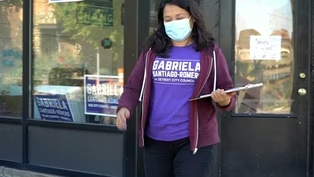
Gabriela Santiago-Romero is running for city council in the 6th District, which includes Southwest Detroit.
She says one of the big hurdles in those precincts is so many people living there weren't born in the U.S.
There's actually a lot of folks that can't vote right now.
And those that can have not been engaged to do.
AJ: Santiago-Romero says immigrant populated communities in Detroit have to deal with more problems than just the language barrier.
So I think folks in general, we are not asked or really told about the importance of our vote for every election.
It's not something that we're practiced in doing.
And then, since it's not something that it's in practice, you know, new immigrants, as soon as they can vote, often, don't, because it's not something that we practice here.
AJ: Her opponent in this race is Hector Santiago.
He agrees that getting people to vote in municipal elections is important.
That's why he's been going door to door, not only trying to get people to vote for him, but just to get them to vote.
As we seen, there hasn't been no noise around the city council race or mayoral race, and it should be a lot of noise about this, because this is actually as important as a presidential race, because we are running a budget, we are doing ordinances.
You know, we're representing our districts.
You know, we are the public servant for our peoples, so.
AJ: And he feels he's responsible for getting people informed.
Oh my goodness, but.
If it's my district, it's my responsibility.
If I'm running for it, I gotta educate my people, right?
And I'm not, the clerk has her job or his job, right?
But at the end of the day, I got my job, and if I want the people to know who I am and to come out and vote, I gotta do my work.
I gotta educate my people, why to vote, who to vote, why to vote.
You know, I'm not saying who to vote for, but these are the pros, cons, because at the end of the day, education is key.
AJ: The city saw less than 20% of eligible voters cast ballots this time around, but that's about what city officials had expected since it wasn't a presidential election.
That number could improve heading into next year's gubernatorial primaries in the spring.
On election day, we caught up with Latisha Johnson, a city council candidate in District 4.
Here's what she had to say about the voting process.
But I went at 7:00 this morning, so it was nice, clean, easy, simple.
AJ: Detroiter Hubert Edwards was happy to be among the relative few who voted in this most recent election.
Today, to vote and I'll vote.
Hi, how are you?
All righty.
I voted!
That is gonna do it for us this week.
Thanks to Bridge Detroit for contributing to today's show.
You can find out more about our guests at americanblackjournal.org.
And you can always connect with us on Facebook and on Twitter.
Take care, and we'll see you next time.
(upbeat music) ANNOUNCER: From Delta faucets to Behr paint, Masco Corporation is proud to deliver products that enhance the way consumers all over the world experience and enjoy their living spaces.
Masco, serving Michigan communities since 1929.
ANNOUNCER: Support also provided by the Cynthia & Edsel Ford Fund for Journalism at Detroit Public TV.
ANNOUNCER: The DTE Foundation proudly supports 50 years of "American Black Journal" in covering African American history, culture and politics.
The DTE Foundation and "American Black Journal," partners in presenting African-American perspectives about our communities and in our world.
ANNOUNCER: Also brought to you by AAA, Nissan Foundation, Inpact at Home, UAW, Solidarity Forever, and viewers like you.
Thank you.
(bright music)
Video has Closed Captions
Clip: S49 Ep45 | 16m 26s | Election Roundtable | Episode 4945/Segment 1 (16m 26s)
Video has Closed Captions
Clip: S49 Ep45 | 6m 7s | Voter Turnout | Episode 4945/Segment 2 (6m 7s)
Providing Support for PBS.org
Learn Moreabout PBS online sponsorship
- News and Public Affairs

Top journalists deliver compelling original analysis of the hour's headlines.

- News and Public Affairs

FRONTLINE is investigative journalism that questions, explains and changes our world.












Support for PBS provided by:
American Black Journal is a local public television program presented by Detroit PBS