Unspun
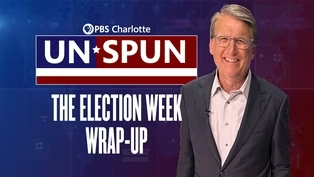
Election Week Wrap-Up | Unspun
Season 1 Episode 123 | 28m 29sVideo has Closed Captions
A big night for Republicans could mean a fight among the Democrats over what went wrong.
This week on Unspun, it’s our election week wrap-up. A big night for the republicans could mean a big fight among the democrats over what went wrong with the Harris campaign. Meanwhile, North Carolina is still Trump country, but why didn’t he have the coattails here that the GOP was hoping for? We’ll also take you to the watch parties for both parties on election night, and I'll count down the top
Problems playing video? | Closed Captioning Feedback
Problems playing video? | Closed Captioning Feedback
Unspun is a local public television program presented by PBS Charlotte
Unspun
Election Week Wrap-Up | Unspun
Season 1 Episode 123 | 28m 29sVideo has Closed Captions
This week on Unspun, it’s our election week wrap-up. A big night for the republicans could mean a big fight among the democrats over what went wrong with the Harris campaign. Meanwhile, North Carolina is still Trump country, but why didn’t he have the coattails here that the GOP was hoping for? We’ll also take you to the watch parties for both parties on election night, and I'll count down the top
Problems playing video? | Closed Captioning Feedback
How to Watch Unspun
Unspun is available to stream on pbs.org and the free PBS App, available on iPhone, Apple TV, Android TV, Android smartphones, Amazon Fire TV, Amazon Fire Tablet, Roku, Samsung Smart TV, and Vizio.
Providing Support for PBS.org
Learn Moreabout PBS online sponsorship- [Announcer] This is a production of PBS Charlotte.
- This week on "Unspun," it's our election week wrap up.
A big night for the Republicans could also mean a big fight among the Democrats over what went wrong with the Harris campaign.
Meanwhile, North Carolina is still Trump country, but why didn't he have the coattails here that the GOP was hoping for?
We'll also take you to the watch parties for both parties on election night, and I'll count down the top five blind spots that the political pros in Washington all missed.
In today's America, welcome to the spin game.
Believe me, I know.
I'm Pat McCrory.
When I was governor and mayor, I played the spin game.
I was played by the spin game.
But aren't we all done being spun?
Let's take the spin out of the world we're in, here on "Unspun."
(exciting music) Good evening, I'm Pat McCrory and welcome to "Unspun," the show that tells you what politicians are thinking, but not saying.
You know, the Trump campaign made history on election night, and it all started right here at home in North Carolina.
- North Carolina, I love these places.
Georgia, Pennsylvania, and Wisconsin.
(audience cheering) - [Audience] USA!
- Well, I wanna thank you all very much.
This is great.
These are our friends.
We have thousands of friends on this incredible movement.
This was a movement like nobody's ever seen before.
- So as the numbers came in nationwide, North Carolina was first among the seven so-called swing states to fall into the Trump column.
But to understand what happened, you also have to understand maybe why it happened.
You know, just recently on election day, I had lunch with a financial guy.
And as we talked about investments in money management, you could tell that the server at our table was listening in.
She was about 24-years-old with a master's degree in marketing.
She said she was waitressing to make ends meet, that she needed help, and that they'd never taught her in school the skills she needed to save for the things she wanted, but couldn't afford, not on a server salary.
Does that sound like you?
Or maybe someone you know?
It's a story that's all too common here in North Carolina and across the country.
People who care less about politics and the press and more about their next paycheck, people will get more helpful information from strangers at a restaurant than they do from months of candidates campaigning.
We don't know who our waitress friend voted for, but we do know that in her life, she's ready for a change.
She wants something better, and she's willing to work for it.
Now, maybe all she needs is someone in Washington who will work with her, not against her.
Joining us now to talk more about what happened behind the scenes on election night is a guy who's been there before.
Chuck Todd is the Chief Political Analyst for NBC News and the former host of "Meet the Press," who also covered the White House during the Obama years.
Chuck, it's always great to see you and listen to you break it down for us here on "Unspun."
Thanks a lot, really appreciate it.
- Great to be here, Pat.
Good to see you.
- So Chuck, what was the blind spot that the Democrats didn't see and maybe also the media pundits didn't see?
- I don't know if it was a blind spot, I think everybody saw, I mean, well, I think the Democrats had a blind spot about Joe Biden.
Okay?
You know, sometimes politics is very simple.
Unpopular president leads to a new party taking over the White House.
And ultimately, you know, I had said, I think I'd written this in my column the week before the election.
I said there were sort of three different scenarios in my head, right?
And you had scenario one was the fundamentals, the mood music was always with Trump, the economy, immigration, President Biden's unpopularity.
You had the data, which said, tie.
And then you had what appeared to be a campaign that was a bit more coherent at the end than Trump's.
I mean, you know, there's not a Republican strategist alive who would say the way Trump closed was a good idea, now they'll say it was, but nobody in the last 10 days thought what was happening was the best way to go about it.
But the question was, can campaign momentum overcome the fundamentals?
And I think ultimately it did not overcome the fundamentals.
I mean, he had a 40% job rating.
And I think when you look at, Kamala Harris never separated herself from Joe Biden.
It was the one thing that kept coming up over and over again.
And she had nothing definitive.
It was almost like she was afraid to offend him.
I understand the personal loyalty, but you know, politics ain't beanbag.
And she made it I think a fatal decision by essentially sticking by Biden in a way that that sent the message to voters that she wasn't gonna be much change.
And that was always, that was another issue she was dealing with.
One of the things I thought at this election, Pat, was which president are you thinking about when you're in the voting booth?
Joe Biden or Donald Trump?
And I think if you were thinking about Joe Biden, you voted for Donald Trump, and if you were thinking about Donald Trump, you may have ended up voting for Kamala Harris.
But I think more people thought about Joe Biden and the Biden administration.
- So watching the three major networks or four major networks on election night, well into three o'clock in the morning, there seemed to be a lot of shock.
You saw three scenarios.
What did your pundit colleagues see as potential behind the scenes?
- I don't know, I mean, I think there's a lot of, look, there's always, you know, I think unfortunately the news media is mixed with people that are activists masquerading as journalists, and then those of us that are just covering what it is.
I always say I cover politics as it is, not as I wish it were.
And I certainly think there were.
And look, Donald Trump made it personal for a lot of members of the media for a good 10 years.
And it's only human nature, I think for some people to have sort of a personal reaction to that.
But, you know, that was explainable to me eight years ago, it's less explainable today.
You know, ultimately, I do think that there really is a, there are two Americas right now, and there's two ecosystems, and there's sort of two cultures.
We're not necessarily separated geographically, although there is some geographic separation between urban and rural and all this stuff.
But I definitely think there is a sort of a cultural hurdle that essentially folks on both sides are struggling to jump over, it's just that the Republican side is bigger right now than the Democratic side.
- Did one voter group, 'cause during the last six months, we've always talked about voter groups.
You know, Latino vote, the Black vote, the women vote, the men's vote.
Did any particular voter group surprise us?
- Well, I think they were so, this was something else before our own polling saw this.
Both Harris and Trump were overperforming with constituencies neither one had ever won before.
You had Donald Trump in polling was overperforming with Hispanics.
And you had Kamala Harris was overperforming with older white women.
The Democrats thought trading Hispanics for older white women was gonna be advantage for them.
But I don't think they saw this 25 to 35, depending on the area of point swing of Hispanics from Democrats to Republicans in essentially one election cycle.
And, you know, I remember remarking about four or five years ago that Donald Trump could put together a. excuse me, there was an opportunity for the Republican party to put together a multi-ethnic working class coalition.
The question was whether Donald Trump was the right front man for this, right?
Well, it turns out he was good enough because this realignment that we've seen, this is a major realignment.
This isn't a realignment of working class, whites and Hispanics in one group.
- But we saw- - Democrats did not, Democrats did not yet lose working class African Americans.
But notice the word yet.
I mean, I do think that we are sorting more by class than any other identity group you can throw at me.
- Bring it back to North Carolina real quick.
We actually saw a pretty sophisticated voter in North Carolina, the Democratic governor won by a huge margin as predicted, but even in other races, people split their ticket.
Arizona, by the way, split their ticket.
So in one regard, we see a trend, but we see some states split their ticket.
- Well, I'm gonna, I wanna dig in more.
I'm not 100% convinced it's split ticket as much as it is Trump voter drop off.
One of the phenomenons, and this is for instance, it explains why Tammy Baldwin won in Wisconsin and Donald Trump carried Wisconsin.
There was no, there was, I'm sure, look, there's always a little bit of split ticket, split ticket voting, but there wasn't a lot.
What there was was about 100,000 Trump voters who voted Trump and didn't vote for anybody else down the ballot.
And this is a phenomenon we saw over the last couple of cycles.
I want to study the North Carolina vote a little bit more because when you have such a close presidential, you can, you know, if you have 100,000 drop off voters of Trump voters, then suddenly that can explain how Democrats swept all the statewide offices, right?
Not saying there wasn't some split ticket, Mark Robinson clearly, I think drove some voters away that probably did vote Trump, Stein, that I get.
But the fact that they won all the statewide races, I think some of this is gonna be Trump drop off voter and there'll be some split ticket, but I don't think it's in as greater numbers as it might first appear.
Again, this is something we have to unpack.
- In the remaining minute, I've been on the winning side, the losing side, there's a blame game.
Where's the blame game go right now?
- Well- - Right now, where does it go in the Democratic party?
- Number one is Joe Biden.
- All right.
- That ultimately in different ways, should have he ever run?
Should he gotten out sooner?
All of those things.
I think number two are progressives in general, and just sort of the progressive lean, you know, sort of drag of the Democratic party to the Left.
I think those are gonna be the two sort of finger pointing.
But progressives are gonna fight back.
I mean, you've seen it inside the Republican party when things go bad, it becomes a fight between sort of the conservatives and the mainstream wing.
And conservatives usually fight harder to make sure they don't get blamed.
And I think progressives, you know, conservatives will say, you didn't go conservative enough, and progressives are gonna go out there to say she wasn't progressive enough.
And there's also gonna be a third blame game, Pat, which is the decision by her to make this about Trump and democracy and not about the economy.
You know, most Democratic House and Senate candidates, they didn't close on Trump and democracy.
They closed on Social Security and abortion rights.
- All right, I need a yes or a no.
- And clearly, Democrats did better down the ballot than obviously the person at the top.
- I need a yes or no, in the next two weeks, will Trump as President-elect start already on his foreign policy making phone calls?
- Oh, I think he's already done it.
He's probably doing it right now.
I mean, that's who he is.
He was doing it before.
So 100%, I think it's already happening.
- Chuck Todd, I appreciate your assessment.
It's great having you back on "Unspun."
- All right, my friend.
Thanks, Pat.
- Take care.
Next up, PBS Charlotte's Jeff Sonier takes "Unspun" on the street to find out how voters are feeling about the next four years now that the election is finally over.
- Yeah, we're checking out the watch parties for both parties on this election night talking to Democrats and Republicans as they watch the returns come in, both good and bad.
(light nervous music) - [Reporter] Here's where we are, too soon to call, but Donald Trump right now up by almost five points.
- Let's take four years under Trump all day over what we've had the last four years.
- [Jeff] You think it'll be the same kind of four years or a different kind of four years?
- No, I think it'll be a different kind of four years.
- We always ask that question, are you better off four years ago than you are today?
And in my household I can absolutely say yes that we were.
So we're looking forward to that return.
- [Jeff] What do you think will be different in the next Trump administration from the first Trump administration?
- I think the first Trump administration was very good for the United States.
And I think he will do better because he will have the experience of the path and he will make things better.
I think he's going to be more stable, more calm and relaxed.
- Well, it's all relative.
But yeah, I think he'd be a little bit more mellow.
I mean, he's aged some and he's has more political experience in the past and he's been through this rodeo before.
- Not only that, he's also seen the mistakes that have been made in the last four years under the current administration and the deterioration of all the things that he built up.
One, he has to dig out of those things and then rebuild and exceed beyond that.
(people cheering) (light music) - [Jeff] What do you think the next four years will be like?
- Back to the word chaos, just like it was from '16 to '20, I'm sure of it.
- I think it'll be very chaotic.
I think we've had that same chaos times two now and the Supreme Court has taken the rails away, so anything can happen.
- We fight.
- [Audience] We win!
- [Speaker] When we fight.
- [Audience] We win!
- [Speaker] When we fight.
- [Audience] We win!
- I hope we'll not be divided, but I think if there is a stability and wealth and economic stability, I think people may be happier.
- There's gonna be drama, there's gonna be feelings hurt, and I would love nothing more than to think that we could all come together, but time will tell.
- Yeah, both parties looking for the positives in these election results.
Although, if you're on the wrong end of the results, well, that's when the party's over.
Pat?
- Thanks, Jeff.
So what do you think about the recent election?
Email us your comments on the results of election night to unspun@wtvi.org.
Or even better, send us a video and we might use it on the air.
(exciting music) All right, tonight on our "Unspun Countdown," we've got my list of the top five blind spots that political pros in Washington missed on election night.
Let's start out with number five.
Number five, self-made supporters versus celebrities.
All the pros said all these celebrities supporting Harris, especially during the last month, they're gonna make a difference in the voting outcome for Harris.
That's gonna make the difference, these famous celebrities.
But the self-made supporter, a guy named Musk might have made a difference more than anyone else.
Number four, Wall Street versus Main Street.
You know, it's kind of interesting the Biden-Harris administration's been saying for the past year, "Look how good the economy's been going, just look at the stock market."
It's very similar to what Trump was saying five years ago.
Look how well he did with the stock market.
But the fact of the matter is, the Main Street voter has not been feeling the effects of the stock market.
They've been feeling the effects of inflation, especially at the grocery store, the gas pump, and your electric bills.
Main Street had more of an impact than Wall Street.
Let's go to number three.
Number three, young voters choosing work versus woke.
Eight years ago, the young college students were protesting on every issue you can imagine, almost every social issue, protest on the college campuses, but on most college campuses this year, the young students were going, "I care more about work and my studies and paying off my debt than any woke protest whatsoever."
Big change this year in the college vote, a lot of college students who used to vote only Democratic now voted Republican.
Big change.
Number two, green versus green.
Green versus green.
It used to be green politics regarding the green environment was gonna get more young people to vote.
But actually, the green of how much people were paying to pay their electric bill, the gas bill and everything else, especially at the grocery store, was much more important to them than the green movement of the environmental movement.
Big change during the last two years.
And number one, back to the future.
You know what?
The Harris campaign kept saying, "Let's don't go back," but the majority of voters say yes, let's go back to the Trump tenure for the future.
Back to the future was the big sign of the political results in this year's election.
(exciting music) PBS Charlotte's Jeff Sonier joins me now for "Unspun 1-on-1."
- With lots of questions because it's election week, obviously, I ask and you answer, that's why we call it "1-on-1."
I wanna start with Mr. Trump.
So he's not gonna run again.
This is his last chance to be in public office for four years.
Does that change your perspective coming in as a president or a governor or any other major office?
- Absolutely, it's like a second term where you know it's your last term and that means you have much more freedom, you don't have to spend any time on the campaign trail, you don't have to spend any time raising money.
It's all about what you want to do and the heck with any of the pundits who might criticize you, you have more freedom.
Except for one thing, after two years, his vice president might start campaigning for president along with a lot of other Republicans who are gonna try to position themselves to be Donald Trump's successor.
So that could be very awkward.
Look at the awkwardness we've already saw between Biden and Harris during a campaign where Harris was afraid to criticize Biden, and yet separate from him.
It's very difficult to do.
And who knows, Vance might be in the same position two years from now.
- Let me ask you about the second term of Mr. Trump.
The first 100 days is what everyone focuses on.
He's been there before, he's done this before.
Does he do it differently the second time around?
- I think he's gonna have actually more professionals around him ready with the executive orders on what he's gonna do in the first week.
I anticipate executive orders on immigration, I anticipate executive orders on some crime issues.
I anticipate executive orders on maybe some cost saving issues where he might bring in Musk.
They probably already have some ideas that they want to implement.
He had no ideas coming in during the first term.
He was a total rookie.
Now he understands government a little bit more.
- And now I wanna talk about Vice President Harris.
She didn't give her concession speech on election night, but she did give it the following day, and I wanna take a look at a clip and then ask you a little bit about the speech itself.
(people cheering) - Now I know, folks are feeling and experiencing a range of emotions right now.
I get it.
(chuckles nervously) But we must accept the results of this election.
Earlier today, I spoke with President-elect Trump and congratulated him on his victory.
I also told him that we will help him and his team with their transition, and that we will engage in a peaceful transfer of power.
(people cheering) - So a little dig there at the end, referring to January 6th of four years ago.
But I wanna talk about the speech itself.
You've been there, you've delivered a speech.
- Sadly, I've been there on both sides of the podium.
Where it's a lot more fun to give a victorious speech than a speech, which you really don't mean deep down.
I mean, at this point in time, you're worn out, you're a bit angry, you're a bit bitter, you don't understand what happened.
You've already been blamed for what's been happening on all the morning talk shows on that Thursday yesterday where she gave that speech, and you have people in front of you crying.
- Are you talking to your supporters at that point?
Or are you talking to also the people who didn't support you?
- You're talking a little bit, she did make a dig, and maybe a deserved dig.
- Yeah.
- But you're really, you're really ready to break down.
It's something you, you know, on election night, you gotta prepare for three things, a speech of victory, a speech of concession, or a speech of, we're not gonna give it right now.
She had already made that decision the early morning before.
But it's a tough speech to write, it's a very tough speech to write.
And I feel for all the people at the state, local and federal level, more people had to give a speech of defeat than a speech of victory.
- Yeah.
Is Harris' last speech of this campaign the first speech of her next campaign?
- I don't think so.
I think her future could maybe be on the Supreme Court.
Maybe if a Democrat wins in four or eight years again and returns to the White House, I think that could be a potential future for her at the Supreme Court.
But I think based upon the defeat she had in so many states, that you're gonna have people like Shapiro already start running for president of the United States.
The battle begins within the Democratic party.
- Line's forming already, I suppose.
- Oh, no doubt about it.
The fundraising's already started.
They're calling the people who raised the big super PAC money right now.
- Also, President Biden spoke this week about the election results as well.
His legacy as president, is he the guy who never lost to Trump, or is he the guy who allowed Trump to win again?
- Well, he wants the first one.
- Yeah.
- But, you know, I think his legacy's really gonna be dependent upon what happens with Trump in the economy in the future.
And the dilemma he's had, his biggest legacy was probably the infrastructure bill.
And Trump might break that up now, especially if he has control of both the House and the Senate.
They might rewrite that bill and cut a lot of that funding, especially on green energy.
There goes his legislative victories right there.
You know, it takes time to establish legacy.
And as time goes, almost every past president, approval rating goes up.
- Here in North Carolina, we saw a lot of Democrats win top spots for Governor, for Lieutenant Governor, for Attorney General.
But what happened in the General Assembly that really is gonna change things over the next four years?
- Well, the House of Representatives is controlled by the Republicans, but it's not a super majority, which means Stein is gonna be doing the veto stamp an awful lot, very similar to what Cooper did during his first term.
And that gives him a little bit more leverage.
But what it might mean also in the future is stalemate and maybe not have budgets approved for two or three years, like which happened during the Cooper administration when both the Senate and the House had the super majority.
- We saw a lot of newcomers move to North Carolina over the past four years after COVID, primarily, those newcomers are now North Carolina voters.
How did they change the way the state voted this time and how will they change it in the future?
- I call it the COVID transplant voter.
And I think it made a difference in the Sunbelt states of Georgia, of North Carolina, Nevada, Arizona.
I think they made a difference because so many people moved from New York and California to these Sunbelt states and we're finding out most of 'em were Republican, and most of them voted for Trump.
And that could have been the difference right here in North Carolina, which once North Carolina went down for Biden or against Biden, the election was about over.
- Yeah, 30 seconds left.
Now that the 2024 election is over, what's the number one storyline politically for 2026?
- In North Carolina, it might start happening in the next week.
What happens to our incumbent governor?
Term-limited Governor Roy Cooper.
Will he do what Jim Hunt tried to do is be governor for two terms and then run for the Senate, which didn't work out for Jim Hunt?
Will Roy Cooper try to follow his mentor, Jim Hunt, and do what Jim Hunt couldn't succeed in?
But what we've learned in North Carolina, it's easier for a Democrat to win the Governor's seat, but very difficult for a Democrat to win a Senate seat.
- We got two years to think about it.
Two years of potential- - I think less than years.
I think that will be probably within the next six months.
- But that's all the time we have right now.
Governor, thank you.
That's this week's "1-on-1."
(exciting music) - Well, when it finally came time to make up your mind this week, there were a lot of maverick voters right here in North Carolina.
That's what I call voters who didn't want to do what we thought they'd do on election day.
Mountain voters who are still suffering from the storm that destroyed homes and disrupted lives in Western North Carolina didn't sit out this election as expected.
And instead, they showed up to vote in record numbers, even higher than the rest of the state, even higher than Mecklenburg County.
Young voters, Latino voters, first-time voters, and voters without a college education.
They all turned out for Trump in significantly higher numbers for this election compared to how they voted just four years ago.
And the independent voters who supported Trump, and pushed him to his third straight Republican victory in North Carolina, crossed over, and also voted for Democrats who won races for Governor, Lieutenant Governor, Attorney General, and Secretary of State.
There is no one reason for all this change, but that's the definition of a maverick, someone who doesn't go along with the group or the party.
And maybe that's the lesson from this election that as North Carolina continues to grow more diverse, candidates can't take groups for granted anymore or count on their support without earning their support.
Well, that's the reality as I see it.
I hope you'll come back next week as we look at the politics of transition.
When the campaign is over, how do you put aside those hard feelings and welcome the opponent who defeated you?
How do you hit the ground running if you're newly elected?
And what it's like when you're suddenly on the outside looking in?
That's on our next "Unspun" where we'll tell you what politicians are thinking, but not saying, Goodnight, folks.
(light upbeat music) - [Announcer] A production of PBS Charlotte.
Election Week Wrap-Up Preview | Unspun
Preview: S1 Ep123 | 30s | A big night for Republicans could mean a fight among the Democrats over what went wrong. (30s)
Providing Support for PBS.org
Learn Moreabout PBS online sponsorship
- News and Public Affairs

Top journalists deliver compelling original analysis of the hour's headlines.

- News and Public Affairs

FRONTLINE is investigative journalism that questions, explains and changes our world.












Support for PBS provided by:
Unspun is a local public television program presented by PBS Charlotte