
Elections, JB Pritzker, Darren Bailey
9/16/2022 | 26m 46sVideo has Closed Captions
Elections, JB Pritzker, Darren Bailey
With the November General Election just a few weeks away, the candidates for Illinois Governor are stepping up their campaigns across the state. In this edition of CapitolView, we analyze the week’s news from the race for Governor, to Supreme Court, and more.
Problems playing video? | Closed Captioning Feedback
Problems playing video? | Closed Captioning Feedback
CapitolView is a local public television program presented by WSIU
CapitolView is a production of WSIU Public Broadcasting.
Elections, JB Pritzker, Darren Bailey
9/16/2022 | 26m 46sVideo has Closed Captions
With the November General Election just a few weeks away, the candidates for Illinois Governor are stepping up their campaigns across the state. In this edition of CapitolView, we analyze the week’s news from the race for Governor, to Supreme Court, and more.
Problems playing video? | Closed Captioning Feedback
How to Watch CapitolView
CapitolView is available to stream on pbs.org and the free PBS App, available on iPhone, Apple TV, Android TV, Android smartphones, Amazon Fire TV, Amazon Fire Tablet, Roku, Samsung Smart TV, and Vizio.
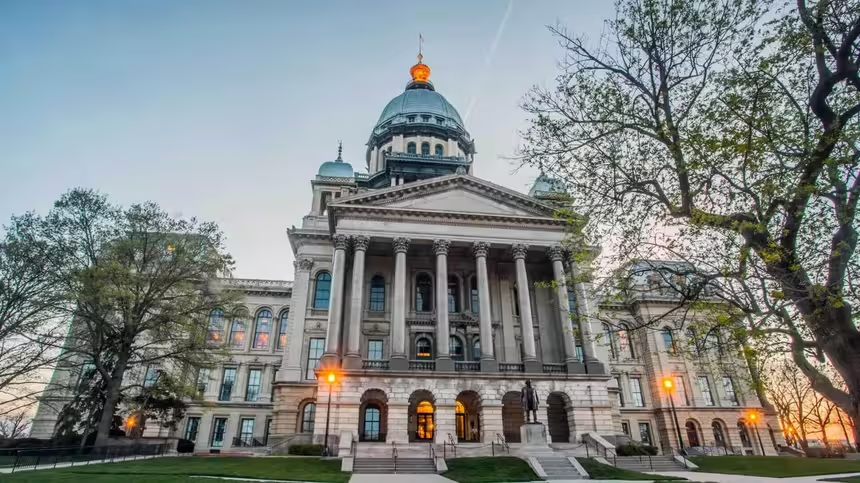
CapitolView
CapitolView is a weekly discussion of politics and government inside the Capitol, and around the state, with the Statehouse press corps. CapitolView is a production of WSIU Public Broadcasting.Providing Support for PBS.org
Learn Moreabout PBS online sponsorship(upbeat music) - Welcome back to another episode of "Capitol View."
Our weekly look at the happenings inside and outside the Illinois State Capitol, I'm Jennifer Fuller.
Our guests this week are Peter Hancock with Capitol News, Illinois.
And Kent Redfield, and emeritus political science professor from the University of Illinois, Springfield.
Gentlemen, thanks for your time.
- Good to meet you.
- Good to be here.
- Let's get started with perhaps a big move of sorts, Republican gubernatorial candidate, Darren Bailey announced this week that he has moved to the city of Chicago, rented an apartment in what was once the Hancock building downtown.
A lot of people are looking at at that and wondering why he says he wants to immerse himself in the culture and the happenings in the state's largest city.
Peter how's that playing across the state?
Is it a stunt or do people see it as a genuine move?
- Well, it's kind of confusing.
I mean, he spent a lot of time on the campaign trail really criticizing the city of Chicago calling it a corrupt, crime ridden hell hole.
And so he decides that he wants to immerse himself in the culture and see what it feels like to be a Chicagoan.
And he moves into the poshest, ritziest apartment building you could possibly find, I mean, I've joked on Twitter that even I can't afford to stay in the Hancock tower and I'm practically family, but I mean he supposedly say his apartment there is probably never going to get broken into and his car is never gonna get stolen.
So, Chicago's a big city.
There are a lot of other places he could have chosen to hang out but this is the one he chose.
And so I think a lot of people are just kinda scratching their heads about it.
- Kent, politics can be somewhat like real estate.
It's all about location, location, location.
There's been this criticism when politicians live in Chicago and they don't move to the governor's mansion.
For example, now there's criticism that perhaps a gubernatorial candidate doesn't know enough about Chicago.
Is there a balance here or should it matter where you're from or where you live?
- Well, location is a way of signaling empathy or understanding.
And so people want their leaders to understand them, to care about them.
And so, this is one way of signaling that.
I mean obviously, Bailey has an identity that is very Southern rural Illinois, and in a general election you've got to expand your electric.
And so, whether this is the most effective way to deal with that problem, I think is certainly quite, it's up for debate, but it is, he is doing that's what he's trying to achieve.
Now, the other thing that's going on is that in relative terms, he does not have a lot of money.
I mean, some money is being spent on his behalf through independent expenditures but his actual campaign fund does not have a lot of money.
And so when you can't spend money on TV ads and direct mail you want to do things that get attention.
You want earned media, you want to go out and have reporters follow you.
And so if you're taking up residency in Chicago and then you go out and you hold a media event at the site of a shooting in a park, all of those things, we're trying to get on the air, get attention.
When if you had the money you would be communicating in other more varied, more effective ways.
- You know, you bring up the, the point that I wanted to get to next with our next question.
And that is, there was a press event the day after a shooting at a park in Chicago and candidate Bailey along with his running mate were there, talking about crime in Chicago, which has been one of his big issues.
Peter, that announcement though that press conference really didn't go I think the way Bailey might have wanted it to go.
- Yeah, I actually didn't sit in on that news conference, but you're right.
I mean, he's been using crime as a major campaign theme as similar to Republicans all over the country, really and crime in Chicago, there is a lot of violent crime there and it's possibly something that resonates with some voters.
And then they try to bring this back to the controversial law called the Safety Act and the Pretrial Fairness Act referring to the fact that come January 1st, Illinois will basically abolish cash bail.
And they're using that to try and stir up concern about public safety.
I think the interesting part about that is that the Democrats are now having to spend a lot of time and a lot of resources explaining that law which tells me they didn't do a very good job of communicating it at the time they passed it almost two years ago.
- Peter, there have been a lot of traded accusations between the Bailey campaign and the Pritzker campaign when it comes to crime and when it comes to effective ways to deal with crime.
But is this issue really moving the needle with any moderate voters or voters who may still remain undecided?
- I can't really tell, I haven't seen polling data on this, but I do think, when Bailey comes out there and talks about the governor's not doing enough to address crime, governor Pritzker can come right back and say Darren Bailey voted against bills that enhanced law enforcement.
So in that respect, I'm not sure it's moving the needle one way or the other.
- Kent, you mention this a little bit earlier as well.
There is money being spent on behalf of Senator Bailey's campaign for governor, particularly by Dan Prof's, people who play by the rules pack.
There was an ad out this week that used surveillance video of a woman being attacked.
It's a very powerful set of images and can be difficult for some people to watch.
It was roundly criticized by Democrats who said that it was in ways racist and that it really got to a a level that didn't need to be exploited, I think is some of the words that they were using.
How is this ad playing out?
Darren Bailey says, hey, this isn't my ad.
- Yeah, this is the current world we live in in terms of regulating political campaigns and campaign expenditures.
The committee is an independent expenditure committee.
As long as they do not coordinate with the Bailey campaign then they can accept unlimited contributions and they can make even all of us make unlimited expenditures.
So they have to report these things.
But, and so you have plausible deniability in terms of saying, I didn't have anything to do with it.
Now, the reality is that there's implicit coordination.
I mean, when Bailey says crime is the major issue and the independent expenditure committee puts out an ad on crime, that they're essentially following the lead that is in the candidate's campaign.
And there's, campaigns will put out visuals and footage and they'll put it on the website, B roll would be one become a term this often used.
And then those, but it's on the public airways, the Independent Expenditure Committees pick those visual images up and then put them in their commercials.
And so, there's a lot of wink and nod in terms of this, but clearly, and there certainly are cases where someone will come in and do an ad that you really wish they hadn't done.
Or in the primary, we saw the Pritzker campaign doing ads, attacking Bailey but attacking him on being too conservative hoping to help Bailey get more support so that the Republicans wouldn't nominate a more moderate candidate.
So, there's just a lot of going of back things that make it hard for voters to sort out exactly, who's speaking for whom what's the intent behind it?
And so you've got $20 million in people who play by the rules.
That's not at nearly as much money as Pritzker is gonna spend, but Bailey will be on TV or at least themes that would help Bailey's campaign are going to be on TV.
And so, yeah, the ad itself, again when there's no restraint, Bailey could not stop that commercial if he wanted to.
And so when you get people with strong opinions and lots of money, and essentially no restraint you get a much coarser kind of political debate, which is, that's a trademark of what we're been seeing in the last, three or four cycles of March.
It's you throw red meat out there and you really don't there's a way to hold people accountable for that.
- Does this prompt in any way, talk of campaign finance reform?
there's always talk of campaign finance reform, of course but since citizens united, we've seen a lot more of this political spending on behalf of a candidate rather than from the actual campaign.
Is there any thought that that could be reigned in?
- Well, you can do things that reign will reign in the money but once you have the resources, however you acquired them then it is a matter of free speech.
And the Supreme court has been very consistent that political speech is free speech and so there really is not anything that you can do in terms of restraining people from spending resources that they have acquired, however, they have acquired them to.
- Peter let's change gears if we can just a little bit.
And we've seen quite an influx over the last couple of weeks of asylum seekers being put on buses and sent to Chicago and governor JB Pritzker announced this week a state of emergency, he's asking for the help from the Illinois National Guard to try and help provide services for these asylum seekers.
As the government tries to figure out what to do with people seeking asylum here in the United States, how is this evolving and what are you seeing in your reporting?
- Well, I think this is unprecedented.
I mean, governor Abbott in Texas has just unilaterally decided that these people who are arriving in Texas across the Southern border can be shipped to other places in the country.
And he does it without giving the receiving city any kind of advanced notice.
When officials in Chicago try to call the Texas agencies that are doing this, they get no response.
We just heard Thursday morning that there was another group that was flown from Texas to Florida.
And then the governor of Florida flew them up to Martha's Vineyard in Massachusetts.
And these people, they had just arrived in the country and all of a sudden they're being whisked off to places that they're completely unfamiliar with.
Some of them may have connections in places like Chicago or New York or Washington DC but it's really just an unprecedented situation of state governments working against each other.
Usually if there's an emergency in one state other states will come to their aid and I'm not gonna sit here and say that Texas isn't facing significant strain with all of these asylum seekers coming across the border and winding up in small border towns that aren't equipped to handle them.
But I think there must have been some more cooperative way for other states to come to Texas's aid without having to go to these extremes.
It's really and if you look at the public statements of governor Greg Abbott, it's a political move because it's his way of protesting the Biden administration's policies on immigration.
And the fact that the Biden administration did away with a certain kind, a Trump era policy that allowed the federal government to send people back to Mexico and make them wait there while their asylum cases are being heard over here.
- Is there any thought that this, you called it a political stunt?
Is there any thought that this would actually prompt though when you're seeing states of emergency being declared the federal government to try to expedite some kind of solution or resolution to the problem?
- Well, I ultimately, this is the federal government's problem.
I mean, the fact that it takes so long to process asylum requests and other kinds of immigration requests the ball is really in their lab, the state of emergency, it's a term that's really easy to misinterpret.
It's merely an action that allows the governor.
It frees up resources so that you can deploy national guard people in non-military kinds of roles to help line up services and make sure these people are being taken care of.
And at least they're safe while they're here and waiting for their cases to be heard.
- And we should be absolutely clear that governor Abbott is on the ballot.
He is running for reelection as governor of the state of Texas.
Governor DeSantis is on the ballot.
He is running for reelection for governor of the state of Florida.
And so this is playing this is not about affecting public policy in Illinois.
It's a little bit about affecting public policy nationally but it's about the governors, these candidates images and their narrative about who they are and how they're gonna deal with problems.
And so, we were shipping people, throughout the country to make political statements that help with their reelection campaigns and it's certainly a national failure for us to deal with our immigration law and we need serious immigration reform that deals at a number of different levels, but this is not advancing that, this is about political futures and political ambitions in terms of the two votes visible actors, the governor of Texas and the governor of Florida.
- Let's take another look at the political future when it comes to the Supreme court of the state of Illinois, we've talked a little bit in the past about two open seats that are up for election this year in this this cycle that could potentially sway the political control of Illinois Supreme court, which right now leans democratic.
We also heard this week that chief justice Anne Burke has announced her retirement, she'll retire before the general election in November which sets up potentially yet another open seat that would perhaps tip the balance of the Supreme court.
Peter, how critical is the balance of this Supreme court in Illinois?
- Well, it's the Republicans' only chance really to gain control of any branch of government, and what I'm talking about the general assembly where Democrats have super majorities.
Currently, the executive branch is controlled entirely by Democrats from the governor on down but the Supreme court is split four to three in favor of Democrats.
So if they can flip one of those seats, Republicans conceivably could take control of the Supreme court and there, they would have a lot of influence over state policy.
So these two races that are on the ballot for this election are certainly being very closely watched.
And then you mentioned chief justice Burke, who announced that she's stepping down just ahead of her husband, Chicago city alderman, Ed Burke will soon be going on trial for corruption charges.
That's been an uncomfortable situation for a long time but I think the biggest reaction I'm hearing is the fact that so many members of the Supreme court got there by means of appointment rather than election.
When the people of Illinois ratified this constitution in 1970, it provided for an elected Supreme court and elected judiciary which would seem to indicate that the people of Illinois wanted an elected judiciary.
But in most cases, they're not really elected.
They get appointed by the other members of the Supreme court and then the next general election around they get to run as an incumbent.
So I think you're seeing a lot more attention paid to that aspect of it.
And maybe the fact that we elect Supreme court justices to 10 year terms.
Maybe 10 years is a little too long because it seems like a lot of people aren't able to fill out the full 10 year term that they were last elected to.
- Kent, we've talked a lot in the past both on this program and elsewhere about the amount of spending in judicial elections and particularly for the state Supreme court.
These are people who really can't talk on the campaign trail about issues that they might rule or might decide.
So it's a lot of money spent on a lot of issues that they really aren't commenting on.
Do you expect to see high expenditures in these two races this year and potentially in the next couple of years?
- Yeah, absolutely.
I mean, we just, one of the open seats is a result of justice Kilbride not winning retention first time we've ever failed to retain a Supreme court judge.
You get elected to a 10 year term after that 10 year term is up, you can run for retention.
You need 60% in order to be retained but you have no opponent.
This was a $5 million, I mean, I'm sorry 9 million race for just a retention.
And now we've got two open seats in two competitive districts.
We're already seeing a lot of fundraising and a lot of endorsements.
And that's the other part of this is people are perceived not only as Democrat and Republican judges but they're also perceived as being, socially conservative judges, liberal judges, we've got endorsements from the Illinois Education Association or labor unions or pro-choice groups.
And so there's an, when you get to court and you lose and you are, a business and you see your judge, the court is control, is electing, been elected by labor unions.
Then you start to talk about, well was this a fair fight?
And so, you get some real problems with the public perception about exactly what's going on, are judges representing the law?
Are they representing their campaign supporters?
- Sure, probably one last topic that we can get to in this week show goes back to something we talked about a little bit earlier and that was the Safety Act which changes a lot of rules and regulations.
When it comes to the criminal code in Illinois, Peter, there's still a veto session.
There's still a lame duck session before the people who are running for election and reelection this year will take office in January.
Do you see any wiggle room for some modifications to that law or perhaps new legislation?
- Yes, I do.
And it's very convenient that the veto session will take place after the November general election.
So, lawmakers will have the ability to come in and do some fixes to the bill without ever having to admit on the campaign trail that the bill needs to be fixed.
But there are some problems with the bill, some inconsistencies, some internal contradictions that lawyers have told us about that really do need to be addressed.
And I think lawmakers are willing to address it.
They just don't want to talk about the fact that there are problems with the bill as long as they're up for reelection.
And this is a big issue.
- And of course, it's not unusual to pass a large piece of legislation and then have to come back and make some modifications to that.
Kent, we talk earlier in the year about the potential for a special session to address whether it was reproductive health rights, perhaps gun legislation, things like that, that is all kind of fizzled.
Do you think that we'll see any movement in November?
- It's part of that is going to depend on the election.
And so, if you get a signal one way or another, that it's full stream ahead with the Democrat control of state government, you might get some attempts to find democratic consensus on guns or reproductive rights.
If the election doesn't go the way the Democrats expect it to go then they might be reluctant to do something.
But then, we also have a history of passing things where the majority, the critical votes are supplied by people who are walking out the door.
And so, if you can get somebody who's not gonna be on the ballot two years from now to help you move legislation.
That's one less tough vote that the new members have to make.
So it's always an interesting dynamic as people try to figure out what the election means and how can we use it to our advantage going forward.
- Already looking past an election that hasn't even happened yet.
In just a minute or so that we have remaining, Peter, do you see any other issues that may be a part of a veto session or that lane duck session in early January?
- Well, we still have the issue of how the state is going to respond to the US Supreme court's Dobbs' decision overturning Roe versus Wade.
I remember as soon as that decision came out governor Pritzker said he wanted to call a special session and that he intended to, but then that got put on the back burner for a variety of different reasons.
So we still have that and there may be an attempt to deal with gun safety as well.
- We'll certainly be keeping an eye on that and we'll have more on the next episode of "Capitol View."
For now, Kent Redfield, Peter Hancock, thanks for joining us.
You can find all of our "Capitol View" episodes by going to our website, WSIU.org and find us on our YouTube channel at WSIU Television.
For "Capitol View," I'm Jennifer Fuller.
(suspenseful music)

- News and Public Affairs

Top journalists deliver compelling original analysis of the hour's headlines.

- News and Public Affairs

FRONTLINE is investigative journalism that questions, explains and changes our world.












Support for PBS provided by:
CapitolView is a local public television program presented by WSIU
CapitolView is a production of WSIU Public Broadcasting.