At Issue with Mark Welp
Elmwood Filmmaker Tiffany Thomas
Season 4 Episode 1 | 26m 30sVideo has Closed Captions
Mark Welp talks with filmmaker Tiffany Thomas about uncovering Central Illinois history.
Mark Welp talks with Elmwood filmmaker Tiffany Thomas about turning Central Illinois history into compelling documentaries. Thomas discusses the research behind her Prairie Tales films, the people and industries that shaped Peoria County, and her latest project, Over a Barrel, exploring the region’s past and the stories still waiting to be told.
Problems playing video? | Closed Captioning Feedback
Problems playing video? | Closed Captioning Feedback
At Issue with Mark Welp is a local public television program presented by WTVP
At Issue with Mark Welp
Elmwood Filmmaker Tiffany Thomas
Season 4 Episode 1 | 26m 30sVideo has Closed Captions
Mark Welp talks with Elmwood filmmaker Tiffany Thomas about turning Central Illinois history into compelling documentaries. Thomas discusses the research behind her Prairie Tales films, the people and industries that shaped Peoria County, and her latest project, Over a Barrel, exploring the region’s past and the stories still waiting to be told.
Problems playing video? | Closed Captioning Feedback
Where to Watch At Issue with Mark Welp
At Issue with Mark Welp is available to stream on pbs.org and the PBS app.
Providing Support for PBS.org
Learn Moreabout PBS online sponsorship(upbeat music) (upbeat music continues) - From Native Americans arriving thousands of years ago to the founding of many of our towns in the 1800s, Central Illinois is rich in history.
And the town of Elmwood in Western Peoria County, that was founded in 1852.
And for the past few years, a team has been making many documentaries about some of the more interesting historical stories in that area.
Filmmaker Tiffany Thomas joins us with more on "Prairie Tales" and her latest documentary, which debuted this week.
Thanks for coming in.
- Thanks for having me.
- So your latest documentary, very interesting, the whiskey era of Peoria.
And we've seen books, documentaries about that.
Tell us kind of what your angle is on that and what people can expect from this documentary.
- So a lot of what is out there now, I mean, there's fantastic work, right?
But it centers largely on the city of Peoria.
And as I started getting into the research, when we decided to kind of do this longer length documentary, I was kind of looking for an angle, and it had to incorporate the county.
The Center for the Humanities, who is kind of behind these documentaries, they're in Elmwood, and a lot of our focus to date has been the rural areas.
But this subject kind of begged to be told from two points of view.
So the city, obviously, you wouldn't have had the whiskey boom without the city, but you also wouldn't have had the whiskey boom without the county.
The coal mines, the farming, the labor, the water, the railroad, all of those pieces kind of intertwined with everything that was happening in the city.
And so that was kind of the story that I wanted to tell.
I actually got a little nervous because looking at some of the whiskey boom material that's out there right now, of course there are great books.
WTVP did a great special, I think in 2016, 2017.
Amazing.
And I actually got a little concerned after I watched it because I'm like, "Well, how am I gonna tell this story?"
But my process when I do these documentaries is just immersing myself in the research.
So I just find out as much as I can about the subject, going in with no kind of preconceived notions or no plan, no outline, just pure research, which is joyful.
I'm a researcher.
That's what I love.
But as I was reading all of these different accounts and everything that went into it, I kind of realized that the story of the whiskey boom is the story of my family in Peoria County.
And I think it's the story of a lot of our families in Peoria County, right?
I had German immigrants who came to rural area outside of Kickapoo and farmed the farmland that they bought at the time in the 1840s.
It's still in our family today.
I think that's true of a lot of rural farm families.
I had family who were involved in coal mining who then went to the railroad and worked on the railroad in Edwards and Kramm and kind of that rural Western Peoria County area.
And I had family who were immigrants that came to the city of Peoria.
My ancestor was a baker, he came from Germany, and got involved in baking here, but the tide was kind of turning where a lot of that grain that was coming in.
It wasn't being used for bread.
It was being used for alcohol.
And so he was able to kinda transition over and he was a liquor wholesaler for many, many years up until Prohibition.
And so as I was looking at all of these stories that went into the whiskey boom history, I saw my family.
And so that I can remember sitting in the local history and genealogy department at the library downtown, and it was like a light bulb went on in my head.
I was like, "This is how I'm gonna tell the story.
This is the story of our families, our ancestors in the Peoria area, both in the city and in the county."
And once I kind of had that idea, I was able to focus my research at that point, write my outline, do my script, do the interviews kind of from that perspective.
And it kind of came together for me at that point.
It was exciting.
- Would you say that without those people working in the mines and the railroad and the farmers, there may not be a whiskey city?
- Well, I would say that absolutely.
I think maybe some people might argue that fact, but I mean the raw materials for the whiskey, the alcohol, the beer that was made here in the city, all of those came in from out of town.
- There's some people who say, "Well, whiskey put Peoria on the map."
Others would say whiskey is the downfall of a lot of people.
Through your research, I mean, can you say, was whiskey a good thing or a bad thing, or is just kind of somewhere in the middle?
- I mean, I think it was both, right?
It was a good thing because it brought people to the area.
It provided jobs both directly in the distilleries and the breweries, but then also all of the labor that went into it.
I mean, when you look at the construction that went on in the city to build homes, churches, shops, everything for the people who were working in the area, that brought in skilled trades.
So carpenters, tinners, operating engineers, all of those people.
And of course, once they got in, that was the time of our big labor boom too.
And so you saw unionizing, and that changed the face of the city.
And so all of these layers, both good and bad, I think kind of made our city and our county what it is today.
And that's what's fascinating to me.
Why?
Why is this the way it is today?
And when we look at our history, and I think there's a lot of passion for history right now, it's that, why is this the way it is today?
Well, a lot of it is that whiskey boom.
- Yeah, and even after the boom was over, we still had those workers who were skilled and could do other things, thankfully.
So it wasn't like the city went downhill because of the whiskey boom being over.
I'm curious a little bit about you.
You were telling me earlier you're an area native and you've got some fun stories about your past.
Tell us a little bit about yourself and then how you got into the documentary business.
- History is in my blood, you would almost say.
So my family bought a house in 1987 that was actually built in 1876.
So it's the old store, post office, train station for the town of Kramm, which of course is gone now.
But it was an old coal mining town just outside of Kickapoo between Edwards and I would say kind of the Elmwood-Brimfield area.
And it didn't exist for very long, but the building that was there that was the train station was eventually turned into a private home and my parents bought that home, and I grew up in it.
So you get all that history because, in the attic, when they bought the house, there were old pictures, there was a miner's, a coal miner's lunch pail.
There was an old lantern.
So a lot of that ephemera of the town was still there.
And I was fortunate enough to spend a lot of time with my grandparents growing up, and my grandparents loved history.
And so I kind of started to hear a lot of the stories even as a kid and just really enjoyed it.
And then I was a big reader, So the "Little House on the Prairie" books, and then a lot of "Diary of Anne Frank," "Number of the Stars," all of those books.
I had a great history teacher in grade school.
And so it kind of turned me into this person who just saw history as a collection of people's stories.
And so then as I went into college and got into writing and all of those things, kind of went about my business.
But around 2010, I started really getting into our family's history and I wrote a couple books for my family and I decided to do a book about the town of Kramm.
So I wrote "Kramm: The Forgotten Town," had a big local following.
Everybody wanted one.
I was shocked.
But the executive director of Elmwood Center for the Humanities, Bill Seipel, we were kind of mutual friends.
He went to Elmwood also and he heard about the book.
He was involved with the Palace Theater in Elmwood at the time, and they were just kind of looking for something a little bit different.
So he contacted me and said, "Hey, would you be interested in doing a film about Kramm?
I see you did the book, but I would love to put a prototype together."
And I said, "Well, if you're just doing a prototype.
I have a little time right now.
I'd be happy to do one little short five-minute film for you and then you can take it and you can do whatever you want with it."
So- - And here we are.
- Yeah, yeah, yeah, exactly.
It adds up, right?
- Yeah, did you have any filmmaking experience, script writing experience, shooting, editing experience, anything at all?
- Nope.
- Just self-taught?
- Self-taught.
I had done a lot of writing.
One of the big things that people laugh about in the genealogical community is everybody loves the research, but nobody loves the writing.
I love the writing.
And so I like to share those stories.
I don't look at myself as a film filmmaker necessarily, or even a writer.
I look at myself as a storyteller, and I'm so fortunate that the world that we live in makes the technology easily accessible, affordable, so that those stories can be told in a way that people are going to access them in short, succinct, visual ways so that it's easy to tell those stories.
- Yeah, and it's nice you don't have to go far away to a film school and the spend a whole lot of money.
You can do it right from your living room if you want to.
- I mean, I can tell you that since I started this project, so the "Prairie Tales" films, I believe we started in 2024, if I remember correctly.
And it was all about learning all the things that I don't know about writing scripts, about filmmaking, about all of the little details.
As soon as I started getting into it, I realized, well, I need more.
So my way is to read, to research.
So there are a lot of books that I have read about the process that have been incredibly helpful.
My favorite approach when I don't know something is to find somebody who does, and then just talk to them just to learn from them.
And that's been, I think, the most fun part of this process, is all the people that you meet that share their knowledge with you, that share their passion.
I mean, there is nothing in this world that is better than sitting down and talking to somebody about their passion.
And this project allowed me to do that.
- Very cool.
And you did on the "Prairie Tales" anyway, you had help with there.
You mentioned Bill earlier and you had a professional voiceover person.
So those are pretty cool.
And we'll tell people how they can see those in just a minute.
Let's talk about some of those episodes that you did.
You mentioned Kramm where you... It's got to be weird when someone asks you where you grew up and it doesn't exist anymore.
That's gotta be kind of strange.
- It is.
It is.
But as soon as I moved away from the Peoria area, when I say Elmwood, well, nobody knows where Elmwood is.
And when you move even further afield and you say Peoria, sometimes people don't even know where Peoria is.
- Yeah, you have to say halfway between Chicago and St.
Louis or whatever.
- That's exactly right.
So let's talk about Kramm and that mini documentary that you did.
Tell us what the focus is on that.
- So Kramm was a company town, right?
So there was a coal mine in town.
The entire stretch of land where the mine was, was purchased.
They put mine housing up.
There was some land that was set aside for a store.
So they had a company store there like many company towns.
And so the miners came in, some of them were locals, some of them came from a little further afield.
They lived on the property, they worked in the mine, they shopped at the store, and the mine owner kind of had control over all their lives.
Not an uncommon story in various industries, especially coal mines, but the coal miners were kind of at the whim of the mine owner, right?
So I found records that said, in this year, the mine was closed and all the miners were laid off because they were accused of sending up short weight, right?
So they were accused of cheating the mine owner, and so he just closed everything.
And then you start to think about, well, those miners and their families, because most of them had families that lived in the mine housing too, what are they gonna do?
And it really... It's a stark reminder of how much workers were kind of at the mercy of these people who had capital, who owned the land, who owned the businesses.
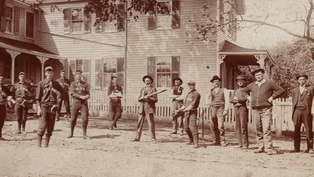
But Kramm had a baseball team, so I was able to find pictures of the Kramm baseball team.
And when I started talking to my neighbors... Because that's what you do, right?
You talk to somebody and they're like, "Well, have you talked to this person?"
So then you call them up and then they send you to somebody else, and it's kind of a chain.
But I kept hearing that there had been a murder at Kramm.
And so I kept kind of talking to people and kind of narrowed the window a little bit.
And then I started doing newspaper searches and just looking for the word Kramm.
And fortunately, it's kind of an odd spelling, right?
K-R-A-M-M.
- Yeah.
- So I was able to find a Rock Island paper that detailed a shooting at the town of Kramm.
It was after a baseball game.
People's tempers got a little heated.
Perhaps the outcome wasn't what they wanted.
And one of the miners was talking trash and got into a fight, and there was actually an off-duty Peoria County deputy who was there to keep order because the baseball games had just been so rough and tumble that they needed somebody there to kind of keep the peace.
So this deputy steps in and tries to break up the fight, and this miner punches him in the back of the head.
And so then chaos ensues, and the deputy pulled his firearm out and shot into the crowd and this miner was killed.
And so of course there was a riot and the deputy had to be spirited away to somewhere else.
But that story, nobody knew that story.
I mean, the neighbors remembered maybe there was a murder, but it just kind of made you think, in all these little communities and all these places, look at all these stories that are just fascinating that nobody knows.
- What haven't people heard about, yeah.
Out of all these that you did, you did 10 of them, is that right?
- That's right.
- Do you have a favorite?
- Oh boy.
When I was in the process, my favorite was the one that I was working on at the time.
But I think I liked the one about the Interstate 74 interchange between Brimfield and Elmwood.
It was a little bit more recent.
So it was in the 1960s and that's newer than I like to write about.
- And was that "Elmwood's fight for an interchange"?
- That's right.
- The shaping of the last seven miles of I-74.
What was the issue?
- Brimfield wanted it one place.
Elmwood wanted it another place.
And as that kind of back and forth continued, more municipalities joined on either side.
And so when you start to look at the records, Henry, the hog capital of the world, wanted it here, and Farmington wanted it here, and Canton bankers wanted it here.
And so you start to see all of these people kind of dog pile into this fight, and they ended up settling it, but that seven miles of 74 ended up being delayed by I think over a year because they just couldn't kind of make their mind up.
And one side would get involved with somebody and pull some influence to bear, and then the other side would, and the governor was involved at one point, and the senators were involved at another point.
And so just that back and forth, which I think kind of still exists a little bit today, right?
Elmwood and Brimfield co-op for a lot of sports, but there's still kind of that rivalry between the two towns.
And to see it on such a big arena was awesome.
- Well, and it's a big deal with our interstate system because as we know with Route 66, a lot of towns disappeared because the interstate went too far away from them.
Let's talk a little bit.
For history documentaries, you don't necessarily talk about a lot of famous historical figures except Frederick Douglas, you did one on him.
Tell us about that one.
- Yeah, Frederick Douglass, when he was on his last speaking tour in 1870, ended up stopping in Elmwood to give a lecture on our common humanity.
It's a fantastic speech.
It was actually covered by the Peoria papers and you can read it if you go down to the library.
But he was there, he was in Elmwood.
He had some friends in town who are abolitionists who had been kicked out of their town in Massachusetts and come to Elmwood because it was such a friendly place to people who were anti-slavery, pro-education.
So he was there visiting, lecturing.
He's walking to the train station with one of these friends, and he's concerned because when he was in Peoria the last time, which was his next lecture stop, he wasn't able to find a hotel that would allow him to stay there.
So his friend said, "Well, when you get to Peoria, if you have any trouble, you go and see our friend, Robert Ingersoll," which of course we all know who that is.
And so he put him on the train, and Frederick Douglas went to Peoria, was able to find a great place to stay.
It all was great.
After that, he went on to his next stop, which was Bloomington Normal.
But that little stop over in Elmwood was really interesting.
And then I started researching that family a little bit more, the Browns, and there were three brothers who moved to Elmwood, the Elmwood area.
One of them ended up marrying into the Bush distilling family and became Bush and Brown.
Another one was a big lecturer writer in Elmwood.
And then the other ended up getting into education in Knox County.
So this Brown family was a big family, but I had never heard of them.
And so it was just fascinating.
- That is.
Let's come back to present day and "Over a Barrel: Fighting for Peoria's working class during the whiskey boom."
Now this is longer than these other mini documentaries that you did.
You said it's about 40 minutes.
- It is, that's correct.
- So does that mean you put in four times as much work or did you put in a whole lot more?
- When Bill and I were writing up the proposal, we applied for an arts partners grant, and we tried to figure out how long it was gonna take based on the five-minute films.
And I was looking over my records this weekend, and I had budgeted 60 hours of work for a 30 to 40 minute film.
When I added up the hours that I actually put into it, it ended up being about 200 hours of work.
- Okay.
- So a little different.
Part of that is my own fault.
I start to research, and I went down what we call a rabbit hole, and yeah.
- Research more than you need.
- That's exactly right.
- But hey, it's interesting stuff.
Were you more hands-on on this than you were on the other ones?
Because like we said, Bill was helping out, he had a voiceover person.
What was it like on this project?
Did you have to enlist more help or did you do more yourself?
- I would say I did many of the same types of things.
One of the things about "Over a Barrel" is we were able to work with an amazing local videographer, Mike Rundle.
And so he did our video for our interviews.
He did some really great B-roll at a lot of our locations.
And then he kind of helped me a little bit with some of the guidance.
He's got a lot more experience than I do.
And so we had his help and that was fantastic.
We use the same voiceover artist, Asia Blue.
She's out of Chicago.
She does a great job.
She always has to laugh though because I have to send her a pronunciation key with any of my voiceover scripts because when you look at the town of Monica, it looks like Monica.
- But if I tried to put out a film where it was pronounced Monica, they'd run me out of town, right?
- Right, right.
- And then I actually had a local research assistant here on the ground, which was great.
I made research trips back, but when you need somebody to go to the library and look up a newspaper or chamber of commerce records or something like that, you've got to have a local.
And so I had Katie Bro, who is a local artist here.
She did research for me as well.
So I had a little bit of a local team, which was great.
But yeah, I did a lot of it.
It was very hands-on.
- Well, it's good you had Mike.
We had him on when we talked about the St.
Jude documentary that he did.
Very talented guy, so I'm sure you did learn a lot from him.
What do you hope people learn by watching this documentary?
- I think that the biggest thing I hope people take away is how similar the period of time in question, the whiskey boom, how similar that is to today.
And that sounds crazy, right?
1870s, 1880s, turn of the century, up to Prohibition, so different.
But that time was so full of upheaval, both from the Civil War ending, immigration, and then from new technology.
So you had the Industrial Revolution coming in and a lot of changes in industry, but you had the railroad, and the railroad changed everything for central Illinois.
And you had people coming in, and there were different types of people coming in.
When my ancestors who were German and Irish and Polish came in, they were treated with a lot of the same attitudes that some of our immigrants today are treated.
And then when you look at right now, there's a lot of conflict maybe within our country.
There's a lot of immigration happening, and there's brand new technology, right?
So we have AI.
We just came off of the internet boom.
And so there's so many similarities between those times.
And the every day Joe or Jane during the whiskey boom was able to succeed and become stronger by coming together.
So whether that's labor unions, whether that's the people in the Woman's Christian Temperance Union, whether that's farmers coming together in the Grange Halls and sharing equipment usage, that's the way we kind of came through that period of upheaval and came out stronger on the other side.
And I think I would want people to see that when they look at this documentary, and see, okay, this is what's happened in the past.
These are the mistakes.
These are the great things that we can take forward, and that's really when I tell any historical story, that's what I want.
- So you had a nice debut last night at the Peoria Riverfront Museum on the big, big, big screen.
In the future, how do you think people are gonna be able to watch your documentary?
- So the important thing with Elmwood Center for the Humanities is sharing with the public.
So I know that the plan is to put it online, so it's publicly available, just like the 10 shorter "Prairie Tales" are available on YouTube right now.
We had talked about maybe showing it at some other local theaters, but definitely the plan is to share it.
- Great, and yeah, like you said, people can watch those "Prairie Tales" episodes now.
Just go to YouTube, the Elmwood Center for the Humanities YouTube page.
They're very interesting and they're short.
For all of us with short attention spans, they're great.
Watch one at a time and see what happens.
Any other projects that you're working on now or thinking about for the future that involve Central Illinois?
- I'm getting that question a lot.
I told my family my first priority is to breathe a little bit, but there are a lot of stories to be told in our area and I think a lot to learn from our history.
"Over a Barrel" ended pretty much with Prohibition.
So that story ended with Prohibition.
It doesn't even get into any of the great migration when we had a lot of people moving into the Peoria area from Southern communities, looking for more opportunities just like any immigrants do, right?
I would love to get into that a little bit more and maybe make some local partnerships to help tell that story in whatever way seems appropriate for me.
But I mean, there's a lot of stories to tell.
- All right, well, we'll tell people to stay tuned on that.
And again, you can go to the Elmwood Center for the Humanities YouTube page to watch those documentaries that you've done.
And boy, we appreciate you coming on.
It's very interesting stuff, Tiffany, and we're glad you decided to make these projects about Central Illinois.
- Thank you so much for having me.
- All Right, Tiffany Thomas.
And again, "Over a Barrel: Fighting for Peoria's working class during the whiskey boom."
is her new documentary.
We thank you for joining us and you can check us out anytime online, wtvp.org.
Have a good night.
(upbeat music) (upbeat music)
Video has Closed Captions
Clip: S4 Ep1 | 1m 45s | Tiffany Thomas uncovers the forgotten story of a deadly shooting in the town of Kramm. (1m 45s)
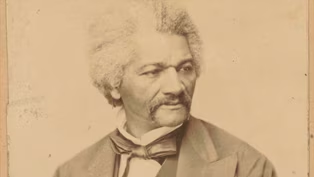
Frederick Douglass Comes to Elmwood
Video has Closed Captions
Clip: S4 Ep1 | 1m 54s | Tiffany Thomas shares the story of Frederick Douglass’ 1870 visit to Elmwood. (1m 54s)
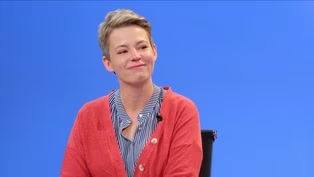
Tiffany Thomas on Becoming a Storyteller
Video has Closed Captions
Clip: S4 Ep1 | 1m 31s | Tiffany Thomas explains how curiosity and community helped her become a storyteller. (1m 31s)
Providing Support for PBS.org
Learn Moreabout PBS online sponsorship New Episode
- News and Public Affairs

Top journalists deliver compelling original analysis of the hour's headlines.
 New Episode
- News and Public Affairs

FRONTLINE is investigative journalism that questions, explains and changes our world.
 New Episode
 New Episode
 New Episode
 New Episode
 New Episode
 New Episode
 New Episode
 New Episode
Support for PBS provided by:
At Issue with Mark Welp is a local public television program presented by WTVP