
Emily Blunt, Paul Mescal, Natalie Portman and more
Season 19 Episode 4 | 26m 39sVideo has Closed Captions
Emily Blunt, Anne Hathaway, Taraji P. Henson, Paul Mescal, Natalie Portman, Jeffrey Wright
Emily Blunt ("Oppenheimer") with Anne Hathaway ("Eileen"); Taraji P. Henson ("The Color Purple") with Jeffrey Wright ("American Fiction"); Paul Mescal ("All of Us Strangers") with Natalie Portman ("May December").
Problems playing video? | Closed Captioning Feedback
Problems playing video? | Closed Captioning Feedback
Variety Studio: Actors on Actors is a local public television program presented by PBS SoCal
Emily Blunt, Paul Mescal, Natalie Portman and more
Season 19 Episode 4 | 26m 39sVideo has Closed Captions
Emily Blunt ("Oppenheimer") with Anne Hathaway ("Eileen"); Taraji P. Henson ("The Color Purple") with Jeffrey Wright ("American Fiction"); Paul Mescal ("All of Us Strangers") with Natalie Portman ("May December").
Problems playing video? | Closed Captioning Feedback
How to Watch Variety Studio: Actors on Actors
Variety Studio: Actors on Actors is available to stream on pbs.org and the free PBS App, available on iPhone, Apple TV, Android TV, Android smartphones, Amazon Fire TV, Amazon Fire Tablet, Roku, Samsung Smart TV, LG TV, and Vizio.
Providing Support for PBS.org
Learn Moreabout PBS online sponsorshipClayton Davis: Take a peek behind the big screen.
Emily Blunt: It kind of made me go, "Let's roll."
Anne Hathaway: Oh, yeah.
Clayton: As Variety Studio brings you conversations between your favorite actors.
Paul Mescal: Playing somebody that toxic was actually really fun, you know?
Natalie Portman: I'm sure.
Taraji P. Henson: How come we've never worked together?
Jeffrey Wright: I don't know.
Taraji: Where your people at?
[laughing] Clayton: With Emily Blunt and Anne Hathaway, Taraji P. Henson and Jeffrey Wright, and Paul Mescal and Natalie Portman.
Clayton: Welcome to Variety Studio "Actors on Actors," I'm Clayton Davis.
Angelique Jackson: And I'm Angelique Jackson, today we're hearing from some of the world's most talented actors.
Clayton: And the secrets behind their unforgettable performances.
Angelique: Emily Blunt and Anne Hathaway infamously played rival assistants to the boss from hell in "The Devil Wears Prada."
In this conversation, the award-winning actors dish on their latest projects.
In "Oppenheimer," Emily Blunt plays the wife of the man who made the atomic bomb.
She's a quiet fuse that burns at the center of the story, stealing the show with her fiery intensity.
Kitty Oppenheimer: It's happening, isn't it?
Angelique: Oscar winner Anne Hathaway is an improbably glamorous prison psychologist in the twisty thriller "Eileen."
Hathaway delivers another stunning and intoxicating performance.
Anne: No, I can't have roommates, I like my own space.
I still like to have fun and I can make a lot of noise and I can make a mess, as you can see, but I can make music as loud as I want to, I can scream as loud as I want to.
[screams] Emily: We're back.
Anne: We're back, hi, honey.
Hello, hello.
So, I'm sure everyone is curious, how did we meet?
Emily: We met, did we meet before the table read at "Devil Wears Prada or" was it at the table read?
Anne: This is so embarrassing, because I remember every second of the first time I met you and you're like, did we?
Emily: No, because I also am very blurry on most memories.
Anne: I'm just so much more into you than you are into me.
It's fine, it's fine.
Emily: How did we meet?
Anne: I remember, because I joined the cast just before you, and I was like, oh, who's going to play Emily?
Who's going to play Emily?
And they said, it's this amazing girl out of England, and she's so funny.
And then I remember David calling and saying that you'd gotten the part, and I remember walking into the room and, like, turning and meeting you, and I just remember going like, "Hi, buddy," in my head, and instant thought, I was like, "What a movie star."
First thought, there was, like, you were, like, shedding stardust, it was crazy.
Emily: Are you getting this?
Anne: And I just remember thinking to myself, Emily Blunt is going to be the biggest deal.
And so, we are in "The Devil Wears Prada" club together, which is incredible, and now we're in another club together, the Christopher Nolan club, so, oh, yeah, oh, yeah.
Emily: Captain Extraordinary.
Anne: That's a perfect name, the perfect name.
When we did "Interstellar," Matthew McConaughey noted that when we were up in the glacier, like, the colder it was and the harder the conditions were, like, the bluer Chris's eyes got and the blonder his hair was, and he just-- Emily: I always feel with Chris's hair I can tell when he's very happy with a take, because his hair starts to dance.
He has quite expressive hair, I noticed.
And I can tell it's almost like he sort of vibrates a little bit when he's really happy with the take.
He's not gonna tell you that he's that happy, because he's very English, and so his version is, like, happy, yeah, moving on, okay.
Yeah, alright, let's go.
And you're like, was it good?
But he is extraordinary.
I get lost for words about him, and we all felt that way, and we're all so proud to be in it.
Like, we're so blown away.
Anne: Can I tell you that I saw that watching the movie?
Because the movie's the movie, and I am at a loss for words, and you are just so wonderful in it.
Just because I've known you for so long, I was so proud of you.
She was so different than you, like, so different, and you're so warm, and you're so funny, and you're just like, just a room is better with you in it, and she's kind of like the opposite of you.
She's kind of like a dying star that, like, contracts, painfully and dramatically, and reacts to things, and is frightening, and I just, knowing you as I do, I knew that that's a stretch.
And so, and then when you just let it rip at the end, the pain that she'd been in the whole time, and sort of the indignity of her life.
Emily: That's an amazing word to use, and actually the perfect word to use.
And yeah, so that scene that you talk about, the testifying scene, in the scene, Jason Clarke, who's just a great dance partner, you know, for a scene to be so brilliant, but I remember he said to Chris, "I think I'm gonna just move my chair in and I'm gonna get really close to her," and it made me, like, bristle, and it kind of made me go, "Let's roll."
Like, let's do this.
Anne: Because he and the character wanted to invade your space?
Emily: Yeah, he wanted to intimidate me, and invade my space, and, like, that thing is most women have experienced when a man tries to intimidate you.
Anne: You go up to the wall but not through it.
Emily: That's right, and it's just like it kind of just makes you wanna fight.
It was really fun.
It was a very exhilarating scene.
It was so fun.
Anne: It looked really, really fun.
And when you let this cackle out, I was like, there she is.
Emily: I was so relieved.
Anne: There she is.
Emily: Probably, like, relieved.
Yeah, it was such a heroic moment for her, and I'm so grateful that she gets that moment, because she had deteriorated to such an extent, it was so wonderful to give her a moment of, you know, soaring at the end.
So, I found "Eileen" completely riveting, and I was completely intoxicated by Rebecca.
And I felt this ferocious allure that you have.
You are so sexy in this movie, it's crazy.
Anne: Thank you, she ruins it.
Emily: So sexy in the movie, and you just would glide in, I couldn't even figure out if you were, like, almost a ghost of her mother, or the idealized version of who her mother was, like, is she like a specter?
Is she a friend?
Is she a foe?
Is she a--oh, it was so deliciously deceptive.
And I want to know why you wanted to do it and what was it about the part that made you go, oh, I'm so in?
Anne: William Oldroyd, the director, made a film called "Lady Macbeth," Florence Pugh, and I saw it when it came out because I'm always really curious about emerging filmmakers, and I was just--my jaw was on the floor.
I mean, I couldn't believe it.
I thought it was so bold, so I was really curious about what it would be like to work with him, and I had to trust him so much because it was such a--I was stepping so far outside my comfort zone, you know, with this one.
I remember sitting with a friend just like this, and he's like, you okay?
And I'm just like, I think I've gone too far this time.
And he was just like, tell me everything.
And I'm just like, oh, God, I'm blonde and I invented an accent, and I'm just like, cause she's self-invented, and so I did all these.
I just made all these choices that don't have any kind of, I don't know, I'm not playing some, I'm not basing it on anyone except for my own imagination.
This is the way I saw her and this is how I just want her to be, and I just feel like maybe I've gone too far.
Emily: Oh, but that's why she's so--she's, like, this rare bud that comes in and just bewitches everybody, and so it's sort of wonderful that everything was so put on because you couldn't get a bead on her.
Anne: That was the hope, thank you.
Emily: You couldn't get a bead on her, she was so mysterious.
Anne: Well, he turned to me and he just goes, "I hear that, but you'd have been so mad at yourself if you hadn't gone for it."
And I was just like, oh, yeah, you're right.
And then the film came out and I realized I was so happy because my instinct was to trust Will, so it was kind of like, stop worrying so much, just be here.
Clayton: No matter if their roles are small or large, Taraji P. Henson and Jeffrey Wright always make an impact on screen.
Their latest projects allow them to fully seize the spotlight.
Oscar nominee Taraji P. Henson puts her musical theater training and powerful vocals to use as a sultry songstress, adding grit and gravity to her role in "The Color Purple."
♪ You gotta push it if you wanna come in.
♪ ♪ Push the button.
♪ ♪ Give me something to let your baby know ♪ ♪ it ain't no thing.
♪ ♪ If you wanna feel the train a comin' your way, ♪ ♪ baby, push the button and pull the windows down, ♪ ♪ come on and-- ♪ Clayton: Emmy winner Jeffrey Wright takes on his first lead role in decades in "American Fiction," playing a novelist whose work takes on a life of its own, contrary to his intentions.
Jeffrey: Wait a minute, why are these books here?
Ned: I'm not sure.
I would imagine that this author, Ellison, is Black.
Jeffrey: That's me, Ellison, he is me, and he and I are Black.
Ned: Oh, bingo.
Jeffrey: No bingo, Ned, these books have nothing to do with African-American studies, they're just literature.
The blackest thing about this one is the ink.
Taraji: Jeffrey Wright.
Jeffrey: Hello, Taraji, how are you?
Taraji: I'm good now.
Jeffrey: Good, oh yeah?
Very good, very good.
Taraji: I just want to start by giving you your flowers, I must.
I've been a student of your work for a very long time, and I remember watching "Basquiat," and I was like, that's the work I want to do.
And then after that, I watched everything you did like this.
Jeffrey: Don't look too close.
Taraji: No, I promise you, you're humble, that's great, I get it, but in your new film, I love that you get to show your comedic chops.
Jeffrey: Oh, yeah, yeah, you know, when I first started acting, actually, when I was in college, this first teacher that we had, he was this whole, like, he was kind of a patrician, New England, you know, and I said, yeah, you know, I think I wanna be an actor.
He said, oh, oh, oh, you know, you might be an Eddie Murphy type, but I don't think you would be serious.
Taraji: He said that, really?
Jeffrey: It was ridiculous.
I mean, I love Eddie, I mean, Eddie's one of the baddest ever, but it was also because I used to, like, just cut up with everything that I did.
We could be doing Chekhov, and I would try to find, like, the humor.
And there often was, but it was, you know, so I've always done comedy, particularly on stage, you know, but I was like, wow, I've never been asked, you know, to do this much comedy, but also I've never been asked to play, you know, these family dynamics.
Taraji: That's interesting you say that about the comedy and how that was your thing in the beginning of your career, well, before you became Jeffrey Wright, the serious, dramatic actor, but that's true for me, too.
Like, when I moved to L.A., I moved to be, I thought I was gonna book a sitcom, and then I booked "Baby Boy."
And then after that, I was just this dramatic actress, and I was like, but I'm funny.
Like, literally, that's what I came to L.A. to do.
I wanted to book a sitcom.
I wanted to be the funny girl.
Jeffrey: But you have that, I mean, you have that energy, you know, about you.
Because I think sometimes the funniest stuff is in the most dramatic films, you know, because in this film, your father is played by David Allen Grier, and David has this thing where, in his face, it's like is he gonna go to the other side?
But he's riding right on that line, and it's just the two of you together, really, it's lovely.
Tell me about, where'd you guys film this?
Taraji: We filmed in Atlanta, you know, all over Atlanta, Savannah.
Jeffrey: Do you have roots in the South at all?
Taraji: I do, my mom's family is from Scotland Neck, North Carolina.
Jeffrey: Okay, Scotland Neck.
Taraji: Scotland Neck, that town, I don't even know if it's made it on the map yet, that's how small it is.
So, when you talk about these southern women, actually, my mother, I was, like, the only cousin.
We have a big family, I was the only cousin that would get shipped down South for the summer, every summer.
Literally, my mother would pick me up from school with my bags packed in a trunk.
And I used to hate it because I was from the city, and I went from honk, honk, to cricket, cricket, can't see your hand in front of your face at night.
But as I grew older, I don't even know if my mother was clear on what she was doing, she was saving me from the environment that we lived in.
And whenever I play these southern women, that's what I draw from.
The women of this time and era, you talk about sexy, those women were sexy.
They left so much to the imagination, and so that's what that all means to me.
It means class, elegance, Black excellence for sure.
Jeffrey: Well, but that's what the film is very much about, too.
A sisterhood, a family of women who honor and protect one another to the extent that they can, one another's safety, you know, and it's a celebration of that in such a beautiful way.
And it's also a celebration of the South, and of where we, many of us, emerged out of.
And the women who led the charge, you know, yeah, cool, man.
Taraji: Thank you, this is a question I want to ask you.
How do you pick your roles?
Jeffrey: I think the thing for me really has always been the words on the page, the script.
Like this movie, it was sharp, it was sharply tuned, and smart, and topical.
For me, really the heart of the story and the thing that I connected to on a personal level was the story of this crazy, loving, weird, as they all are, family that happens to be Black folks.
And for me as well, it's really the most subversive element of the story, of the film, because while the film discusses these tropes and these stereotypes that are too often pushed out, and commodified, and monetized in our culture, the antithesis of that is a story about people being people.
And that for me was what drew me and what I understood emotionally and personally.
You know, because we reach that age where, you know, all of a sudden, everybody's looking at you to be the adult in the room.
Oh, I'm the adult now?
Now, have you, I mean, you've done other pieces where you sang like this though?
Taraji: Never, no, you know, what was very challenging for her was that she's the only one in the film that really sings pretty much all the genres.
She sings gospel, jazz, and the blues.
She's the only one.
But I guess what I did proved to myself, and people that know, that went to school with me and know that I can sing, know, right?
But like I said, acting, I'm strong in that because that's something that I practice every day.
This is my instrument, I have a switch, I can turn it on, I can turn it off.
I live in between takes, you know, that's something I can do with my eyes closed, right, in my sleep.
Singing is something I really have to focus on, and I'm not as confident in it as I am my acting.
Jeffrey: But maybe in some ways though, because it's interesting that you say that she traverses all of these genres of American music and all that music comes from the South, you know?
Anybody can sing.
Taraji: Right, can you make me feel it?
I can close my eyes and hear pretty tunes and tones, but can you make me feel what you're saying?
Angelique: Actors Paul Mescal and Natalie Portman have crossed paths on set, but have never had the chance to share the screen until now, as they discuss their latest nuanced and complex roles.
Irish star Paul Mescal, hot off earning his first Oscar nomination, delivers a touching and moving performance in "All of Us Strangers," playing the mysterious neighbor to a screenwriter.
Harry: Do I scare you?
Adam: No.
Harry: We don't have to do anything if I'm not your type.
There's vampires at my door.
Angelique: In "May December," Oscar winner Natalie Portman executes a brave and brilliant turn as an actress doing research for her upcoming role about a woman who was once a tabloid fixture.
Elizabeth: I've lost track of where the line is.
Who even draws these lines?
All I know is that I love you and you love me.
Paul: Hi, Natalie.
Natalie: Hi, Paul.
Paul: How's it going?
Natalie: I'm good, I'm so glad to see you.
Paul: Yeah, likewise, first of all, I want to say, like, I want to get the sycophantic stuff out of the way, but if my drama school self knew that I would be talking to you, I would pinch myself many, many times.
But I just want to say how utterly brilliant you are in "May December."
And the fact that it is innately, or a huge part of it is about an actor's process, and we're gonna be here talking about process and many other things, but I wanted to know if that was a big part or a big reason for you to say yes to that project.
Natalie: Well, one of the things I loved about it was all the questions it raised about performance and how we as actors, and I guess artists in general, are seeking to understand the human heart in such a beautiful way.
But there's also the paradox that you're, like, cannibalizing emotions and stealing people's true stories, true feelings, and exploiting it in some way, it can be exploitative, so that kind of ethical.
Paul: Yeah, I think the film navigates that in such a, like, elegant and actually quite funny way, or to begin with, and then you suddenly start, I don't know if you agree with this, but your perspective on Elizabeth suddenly shifts into--she becomes malignant, or this kind of slightly terrifying, but also from an actor's perspective, she's incredibly diligent and approaches her work in a very kind of thought-provoking way.
And I wondered if the duality of those things was something that interested you in that.
Natalie: I feel like we always say, I'm sure you've had it before when people are like, how can you play a bad character?
So I mean, we don't judge the characters, we're here to, like, understand human behavior, and sometimes you play someone who's a criminal, and that doesn't mean--but also, ultimately, is it possible to really be amoral with your art?
Like, is depicting something, you know, when you're portraying something, are you somehow popularizing it in some way?
And then when you see how that bleeds into her personal behavior, you kind of feel like that can be a dangerous stance.
Paul: Totally, there's something kind of, I find artistically or creatively liberating about, I don't want to play people who are perceived as good all the time, because I think films and art would be very boring as a result.
Natalie: Well, that was something in "All of Us Strangers" that I was so impressed by, because I also, like, am always interested in characters that are kind of tricky.
And your character's, like, dream man.
Like, he's so emotionally available, and caring, and loving, and it almost at some points I was like, is this also a fantasy?
Like the way, you know, it feels so, so beautiful, but you managed to make it so real.
Like, when you have a character that's so good, obviously, he's flawed, but how do you make him that human?
Paul: Well, it's the kind of the--my hook onto that film was the first scene that you see Harry and Adam together when he kind of arrives to the door, and there's a sexual energy to that scene, but also I found Harry to be quite unsettling in that.
He's kind of on the front foot, he's asking to be let into this flat.
Natalie: I found it very unbelievable, because I was like, who would say no?
How is he saying no?
Paul: I wouldn't let him in.
I feel like somebody who walks up to the door with half a bottle of whiskey, it depends on what night you're looking for, I suppose.
But I think it was important for me to have that scene at the top, because that's also his spirit and kind of, like, the fantasy or the dream boyfriend is kind of almost another part to his character.
And to get to play both of those things was, I know it sounds general, but to play love is such a great privilege, I think, like to get to really, and to do it with Andrew Scott, who's, I think, the king of playing love, and it's just like innate in his being, both as an actor and as a human being, but to kind of go into scenes with him, it is one of the greatest honors of my career today.
Can you talk a bit about what it was like being in scenes with Julianne Moore, the great?
Natalie: Well, I've just admired her for so long, and especially her collaborations with Todd.
I mean, "Safe" is one of the performances I have in my head all the time, all the time.
Like, I watch it almost every year.
It's one of my favorite films, and really one of my favorite performances, and then to see Julie's work here, her choices for the character were so thoughtful for me, because while she was creating her character, she was like, what can I give Natalie to copy?
Like, she could have made choices that didn't have a lisp or, you know, the gestures, like she was like, I need to choose things that are right for the character, but also that Natalie can grab onto, which is like, not everyone would do that.
Paul: Is there any part of your process that tracks with Elizabeth, or like, do you, like, yeah, where did that kind of meta element kind of intersect or did it?
Natalie: Yeah, no, it was super meta.
I mean, Julie was talking about how she did all this research for her role, like, she spent time with the baker, and, like, a florist to do the flower arrangements.
She was like, I was an actress, like, studying people, and then Natalie was playing an actress studying me.
Like, the levels of, you know, meta are amazing.
And I feel like it's really important for women, I think particularly, like, it's all humans that construct their identity from various layers of performance, but I think women in particular are required by society to perform in so many ways.
Like, you know, someone says something rude to you and you have to, like, smile and be polite.
Yeah, but I was so amazed because the last time I saw you perform was on stage in "Streetcar," and it was such an incredible performance of, like, so much, like, toxic masculinity, and like, you know, that machismo, and then to see you in this where you're so delicate and able to explore this very, you know, emotional, vulnerable, different side, like, how does that kind of gender fluidity inform what you do, and like, how conscious of it are you?
Paul: I think I would say conscious.
I think I enjoy as much as possible existing on both ends of that spectrum, because I do believe there's, like, humanity is contained, like, on all parts of that spectrum is contained within us all.
And I think I enjoy interrogating those parts, because I think it's an artist's responsibility to kind of go to places that are both comfortable and uncomfortable, but also playing somebody that toxic was actually really fun, you know?
Because you can't, nor do I want to, kind of go around my life existing like that, but it's also to work with that material and to get to play somebody who's so brilliantly motivated by the writing, but so far away from my own kind of thought process, it's kind of--I think when you can become frightened when you're working, it's such a kind of fizzy feeling, and that was definitely one of those.
Clayton: We hope you've enjoyed this episode of Variety Studio, "Actors on Actors."
Angelique: Please join us again next time.
Emily: And I'm supposed to crash into Meryl, or try almost crash into her at the end, and I had to do this, like, turn, and I fell so hard out of frame, and I just remember Meryl going, "Oh, oh," you know?
Jeffrey: You know, we'd go down to The Wharf down in D.C. Taraji: Oh, get some crabs and some scrimps?
Jeffrey: Keep it simple.
Taraji: Yeah, we can, totally, that's easy.
Jeffrey: Let's do it.
Taraji: Eat us some crabs.
Natalie: I've been working for 30 years.
I've been working longer than you've been alive, man.
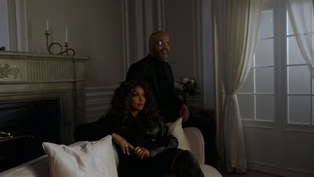
Emily Blunt, Paul Mescal, Natalie Portman and more (Preview)
Preview: S19 Ep4 | 30s | Emily Blunt, Anne Hathaway, Taraji P. Henson, Paul Mescal, Natalie Portman, Jeffrey Wright (30s)
Providing Support for PBS.org
Learn Moreabout PBS online sponsorship

- Arts and Music
The Best of the Joy of Painting with Bob Ross
A pop icon, Bob Ross offers soothing words of wisdom as he paints captivating landscapes.











Support for PBS provided by:
Variety Studio: Actors on Actors is a local public television program presented by PBS SoCal