One-on-One
Emma Joy; Daryl Stewart; Petal Robertson
Season 2022 Episode 2516 | 28m 48sVideo has Closed Captions
Emma Joy; Daryl Stewart; Petal Robertson
Steve Adubato sits down with Emma Joy, Co-Founder of Girls Helping Girls. Period. about menstrual health equity and feminine hygiene products for low-income women; Daryl Stewart, performer, producer, educator, and NJEA Award for Excellence Winner, discusses arts education in inner cities; Petal Robertson, Secretary-Treasurer, NJEA, talks about the highlights from the annual NJEA Convention.
Problems playing video? | Closed Captioning Feedback
Problems playing video? | Closed Captioning Feedback
One-on-One is a local public television program presented by NJ PBS
One-on-One
Emma Joy; Daryl Stewart; Petal Robertson
Season 2022 Episode 2516 | 28m 48sVideo has Closed Captions
Steve Adubato sits down with Emma Joy, Co-Founder of Girls Helping Girls. Period. about menstrual health equity and feminine hygiene products for low-income women; Daryl Stewart, performer, producer, educator, and NJEA Award for Excellence Winner, discusses arts education in inner cities; Petal Robertson, Secretary-Treasurer, NJEA, talks about the highlights from the annual NJEA Convention.
Problems playing video? | Closed Captioning Feedback
How to Watch One-on-One
One-on-One is available to stream on pbs.org and the free PBS App, available on iPhone, Apple TV, Android TV, Android smartphones, Amazon Fire TV, Amazon Fire Tablet, Roku, Samsung Smart TV, and Vizio.
Providing Support for PBS.org
Learn Moreabout PBS online sponsorship- [Narrator] Funding for this edition of One-On-One with Steve Adubato has been provided by The Russell Berrie Foundation.
Making a difference.
Holy Name.
This place is different.
TD Bank.
The Port Authority of New York and New Jersey.
Moving the region through air, land, rail, and sea.
Kean University.
Where Cougars climb higher.
NJ Best, New Jersey'’s five-two-nine college savings plan.
NJM Insurance Group.
Serving New Jersey'’s drivers, homeowners and business owners for more than 100 years.
Community FoodBank of New Jersey.
And by Summit Health.
A provider of primary, specialty, and urgent care.
Promotional support provided by BestofNJ.com, all New Jersey in one place.
And by Northjersey.com and Local IQ.
Part of the USA Today Network.
- This is One-On-One.
- I'm an equal American just like you are.
- The way we change presidents in this country is by voting.
- I'’m hopeful that this is the beginning to accountability.
- Life without dance is boring.
- I don't care how good you are or how good you think you are, there is always something to learn.
- I did do the finale, and guess where my trailer was?
A block away from my apartment, it couldn'’t have been better!
- People call me 'cause they feel nobody's paying attention.
-_ It'’s not all about memorizing and getting information, it'’s what you do with that information.
- (slowly) Start talking right now.
- That's a good question, high five.
(upbeat music) - Hi, I'm Steve Adubato.
On this program we recognize people who make a difference, make a difference in the lives of others.
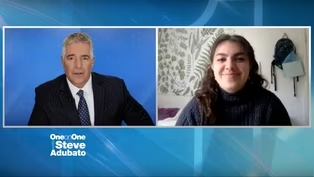
We are honored to be joined by Emma Joy, who is a one of the co-founders, together with her sister Quinn of an organization called Girls Helping Girls Period.
And she is one of the 2021 Russ Berrie Making a Difference honorees.
Emma so good to see you.
- Good to see you too Steve.
- Tell us exactly what the organization is A and B.
Why is this such an important subject?
- Sure, so Girls Helping Girls Period is a nonprofit organization that raises funds and donates menstrual products to period users who are in need of help.
And the reason that this is such a very important topic and educational issue is because it's not talked about a lot.
When we first found out about this issue there was almost no research, no work being done on the matter.
And slowly over time people have realized that this is something that is very important and it is a necessary need in the lives of people who can't afford to have these products.
And we think that menstrual products are a basic right for menstruators and we hope that other people do as well.
So our mission is just getting the word out there about why this is an important matter and educating others on what they can do to help people in their community.
- Well, first of all, Emma, you and your sister Quinn are to be, not just recognized and honored, but you're a role model for others.
And as we put up the website for the Russ Berrie Foundation, nominate someone, recognize someone who is making a difference.
We have been part of this.
I've been hosting that event for well over 20 years.
And I've met some extraordinary people.
But one of the things that strikes me about you and your sister Quinn for doing this is you started this, give me the ages again Emma.
How old were you?
Was it ages 12 and 15?
- It is, it is 12 and 15, yes.
- What triggered it?
- At the time, I was also working on another volunteer initiative.
Our mom sort of instilled in us always to give back to other people.
From the time we were very young we were always doing volunteer work with her, and I was working on a food canned drive for my synagogue.
And in doing this, I was brought to light this issue by a news reporter that was doing a short story on us for our local newspaper.
And she told us, "did you know that food stamps in America don't cover menstrual products?"
And that kind of got the wheels turning.
So we started to do some more research and we realized that the bigger issue is that there are menstruators who are missing school and work because of their periods.
They don't have the necessary products they need to go to school and take care of this normal bodily function in a proper way.
And so they just skip and or in some cases, they don't have like a tampon or pad when they need it.
So they spend a lot of time going to the school nurse, going to the social worker, asking friends.
In all honesty they should just be free and readily available in public bathrooms.
So that's kind of what started it.
And then just learning more and more through other people who did know about the issue which in 2015, what, wasn't a lot of people.
So we then had a collection where we asked all of our friends and family to bring us products and everyone of course wanted to learn more.
So we took it upon ourselves to keep this going.
And a year later Girls Helping Girls Period was formed.
- Emma let me let ask you something.
First of all, I'm just struck by this because so many of us I wanna say this the right way, parents, and I don't know if it's proportionally fathers.
I'm not sure about this.
I just know that, we have a daughter, a young daughter and I'm thinking how challenging it is.
And it shouldn't be for me, And my wife and I talk about how to deal with this.
It's not about us, but I'm sitting there going for just a family that has the means that is comfortable.
It's challenging enough to make sure the young woman understands, feels confidence, deals with this in the healthiest way, from an emotional, mental and physical health perspective.
But now you're talking about economically disadvantaged in communities that are disproportionately black and brown and struggling.
It's that much more challenging and difficult, Is it not Emma?
- It absolutely is.
For sure we see that in a lot of communities that are more economically disadvantaged.
This isn't even a topic of conversation.
They don't have any supplies necessary in their schools or in their places of work.
- One second, Emma, I'm sorry for interrupting.
Should schools be doing more?
And if so, what is that exactly?
- Absolutely, our shift in the last two years has been on prioritizing schools and pushing schools to bring it upon themselves to take care of their issue.
In a perfect world, we don't have to do anything.
We shouldn't have to help anyone because schools and other public administrations are taking it upon themselves to provide products to people that they care about.
If schools want to care about their students these products should be free and readily available in their bathrooms.
And so while we still, of course, donate supplies to all of those organizations a big shift in our mindset has been educating school boards school nurses, social workers to do the work so that they show that they care about their students.
- So Emma, lemme just tell you this I'm a student of leadership and you are the embodiment of a leader at any age and making a difference in the lives of others.
And as we put up the website, one more time, I believe that there are 24 unsung heroes that are being recognized by the Russ Berrie Foundation with the Making A Difference awards.
In this last minute we have, let me ask you this.
How would you describe or what would you describe drives you and your, dare I say passion for doing this work?
- That's a great question.
I think what drives me is knowing that there's always going to be something to do to make a difference in my community.
And I'm a very fortunate person.
I grew up with all of the things that I needed to be successful but I know that there are a lot of things that I needed to get myself there.
And there are a lot of people going through the education system in this country that don't have those things that I have.
And so education to me is number one important thing.
And if someone can have more things that they need like menstrual products to make them more successful in their education, that's what drives me to work on this.
- Hey Emma, you just made a significant difference in the seven or eight minutes you were on the air with us.
I cannot thank you enough.
Also, thank your sister Quinn for us and your entire family.
And we appreciate you joining us.
Thank you so much, Emma.
- Thank you, Steve.
- That's a leader right there.
We'll be right back after this.
- [Narrator] To watch more One on One with Steve Adubato find us online and follow us on Social media.
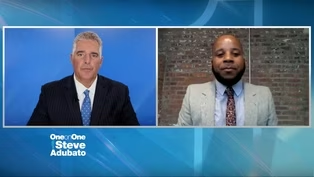
- We are honored now to be joined by Daryl Stewart who is a performer, producer, educator and artist as well.
At the New Jersey Performing Arts Center NJPAC and also winner of the NJEA Award for excellence.
Daryl, great to have you with us.
- Thank you so much Steve it's a pleasure.
- Yeah, first of all before we talk about the Award, talk about the arts in your life.
When did you know that the arts would be such a big part of your life, particularly, the performing arts.
- Well, I knew pretty early Steve.
I went to the Paper Mill Playhouse at a very early age.
A student rushed a ticket to a performance of A Chorus Line around 12 years old and that, after I saw that show I knew that I was going to dedicate my life to the arts.
And I've been I've been at that work ever since.
So, I was I was introduced to the arts early, I was introduced to professional theater early, and that allowed me sort of the opportunity to really dive deeply into my passion for it.
- Talk about this award.
- This award is super special to me because I'm a teaching artist, Steve, and so, I spend a lot of time and energy and effort working with schools and working with teachers In districts public, private, and parochial to make sure that the arts is a part of the school community's culture.
So to win this award, for me, to be presented with this award by by NJEA is super special because it's a community of people who I have a great deal of admiration and respect for.
So I was I was shocked.
And so excited and honored to accept it and to be able to go to the convention in person also meant a lot to me.
So I'm super super grateful.
- You know, I'm sure you're grateful for a lot of things but the thing that we're grateful for is a you read about and hear about your story and try to understand your journey, is your resilience.
So let me ask you something, the most challenging part as an artist, performer, producer educator of this pandemic as we tape this program at the end of 2021 it'll be seen in the New Year as well.
The most challenging part for you has been?
- The most challenging part for me has been holding on to hope.
Holding on to hope in a way that feels accessible and tangible because for artists we are still very much trying to find our way, as we all are, through the pandemic.
But particularly for theater, which I call a contact sport, is very difficult because sometimes we're not sure what the future will look like.
And so, that can begin to wear on you and it certainly has on me.
And you begin to sort of second-guess or question "Is this the right field?"
"Is this the right lane?"
"Should I should I switch out?"
"Should I go and pursue something else?"
But ultimately, I know that my love and my passion and my fierce vision for what the arts means and what it can mean for our communities and for our future, outweighs any any doubt or any trepidation that I may have.
So the whole the hardest part for me has been just holding on to hope and knowing that this time will pass and we will be able to move forward with great new ideas and new vision.
- But the other part of this Daryl, and again, we don't...
I like to call ourselves artists, those of us who are independent producers and public connected to public broadcasting, but you are the real artist.
We're broadcasters, we're producers, we try to create important content.
But at the same time, whether it's our not-for-profit or what you're doing; no money no mission.
Meaning, you told our producers that you took a real financial hit, so it's great to talk about belief and faith and staying with it, but how the heck did you deal with the economic hit that you'd get... Why is that making you laugh?
- Steve, it was no joke.
- That had to be tough.
- It was no joke Steve, I I lost about $10,000 in two days.
- How?
Gigs that just went away?
- Gigs were canceled, performances were canceled, residencies were canceled, commissions were you know, canceled.
It was by far the most amount of money that I've ever lost in my life.
And what I did, and what I encourage the members of my artist community to do, was to to really tap into resources for support.
So I applied- - What does that mean?
- I applied for a ton of grants: city, state and national.
I connected with social workers and other folks who I knew could provide me with additional support.
The city of Newark has an incredible program with Newark Arts called the Creative Catalyst Fund- - Say it again we're gonna put up the website.
The creative what?
- Creative Catalyst Fund and that- - Put that up and also the Newark Arts Council we'll put up as well.
Keep talking please, Daryl.
- And they were able to provide support financial support, that allowed me to make ends meet while I re-imagined, right, what could I offer as a performer in a pandemic.
Which brought me to Broadway in the Bricks and other strategic partnerships.
But while I was kind of re-imagining what I was going to do, right, if I'm a performer and I can't perform what am I going to do, right.
And so I began to re-imagine other options and opportunities as a performer and as an artist.
- Real quick, sorry to interrupt, is Broadway in the Bricks is that part of this re-imagining and the innovation?
- Absolutely, so while I was- - What's Broadway in the Bricks?
- While I was sitting home during the pandemic I began to talk to my neighbors because for the first time, everyone- - You live in Newark I want to make it clear... You live in the heart of downtown Newark.
Go ahead - I live in the heart of downtown Newark and I began to talk to my neighbors, and what I realized was that a lot of my neighbors didn't know what I did.
And so I began to talk about the arts and ask them "Hey, have you ever seen a musical theater production, have you ever been to Broadway or to the Paper Mill?"
And they were like "No, not really."
And so I thought to myself I would love to take every neighbor that I have to Broadway.
Unfortunately, I'm an artist in a pandemic and I can't afford to do that.
So I thought "Well what can I afford to do?"
I can't bring my neighbors to Broadway but I can bring Broadway to my neighbors.
- So where'd you perform?
We're running tight on time.
Where did they perform?
Where'd you perform?
- We launched the series at the Newark Museum of Art I pitched the idea to the Newark Museum of Art, they were like "Yes!"
"We love it!"
"Here's some money."
"Bring on the Broadway talent!"
Steve, and that's what I did.
I called my friends in New York and I got everyone together and I said "Let's do our show."
"Let's bring some Broadway right to Brick City."
And we've been doing that ever since.
I'm very very proud of that.
- By the way, Broadway in the Bricks.
The Bricks as Daryl just mentioned, Newark has always been, for those of us born and raised in the city.
And those who came to the city like Daryl.
is always and will always be Brick City.
Before I let you go, first, NJPAC is open for business.
I wanna make that clear.
Put up the website for NJPAC so our friends can find out more.
But really, real quick before I go.
One highlight from the New Jersey Education Association Convention for us Daryl.
Share with the audience please.
Got 30 seconds.
- One highlight for me, was at the end of the speech where I began to thank publicly my teachers, my colleagues, my former and current students for the opportunity to do what I love.
Which is simply to share my passion for the arts with everyone who will hear me.
That for me was the highlight of 10 years of work and grit and tenacity.
And I'm so grateful for that opportunity.
So thank you NJEA and thank you Steve.
- I tell you what Daryl, there's nothing like performing live.
There's nothing like broadcasting live in the studio or in person, but I would say this, your passion, your enthusiasm, comes across whether you're in person or virtual.
And so I I have a feeling you just helped a lot of artists who are struggling and those who believe they wanna be and should be and are born to be artists.
Daryl Stewart, we thank you so much and wish you nothing but the best in 2022.
All the best.
- Thank you so much.
Thank you.
- You got it.
Stay with us we'll be right back.
- [Narrator] To watch more One on One with Steve Adubato find us online and follow us on Social media.
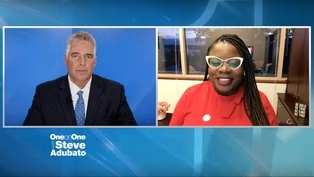
- We're now joined by Petal Robertson, who is secretary-treasurer in the NJEA.
Good to have you with us Petal.
- Nice to be here.
- We're talking about it before we get on the air.
You're a teacher in my hometown in Montclair.
You teach at the high school right?
- Yes, I'm a high school English teacher.
- When did you know that teaching was going to be the profession you were gonna go into?
- At five years old, Steve, when I made my brothers play school with me alongside all of my dolls and their G.I.Joes that I lined up and I had a- - You didn't do that?
- I did.
- Petal you didn't do that?
(laughs) - You did that?
- I did and I had a little tiny square chalkboard with the little, those little sponge erasers.
Oh yes, I did.
(Steve clapping) And we met daily.
(laughs) - They met and they could not be late and I had to be prepared.
- Absolutely not, I had lesson plans Steve.
That's how far I took it.
(both laugh) - Where to tell everyone where you grew up.
- So, I grew up in Brooklyn, New York, and then we moved to Plainfield, New Jersey.
And I actually went to high school in Toronto, Canada and came back here for school.
My parents actually, I am the only American born child in my family.
My family is actually from Guyana in South America, so.
- Let may ask you, Petal I'm sorry for interrupting.
What has that meant to you being a first-generation American educator leader here in this organization?
What has it meant to you and your family?
- Everything, it's funny just last week, I was saying someone that it's like watching a dream fulfilled and a promise fulfilled.
So, my family, I come from a very very big family.
My mom was one of eight.
My father is one of 16.
I have a zillion cousins Steve and they're everywhere and (indistinct) - You sound like Italians, but that's okay.
(both laugh) - Yes, yes, just this close.
- I here ya.
- And so then you understand, there's definitely this aspect of like collective power and togetherness that forever existed in our family.
And as a child of immigrants, I recognize that that was the way my parents succeeded.
Our survival, our success was dependent upon each other.
We also had to depend upon each other to get through.
And so, that was my constant push.
And to now see for my parents to have come to this country with really big dreams for their children, especially in terms of education and to come to this point is just so rewarding for me.
- When you were in college, and I believe it was at Seton Hall University, you got involved in activism.
So, beyond the work in the classroom, or maybe it's not beyond to me, it could be a part of it I'm not sure, you got more and more involved in activism, be more specific and precise because this 8:46 Project is fascinating and it's important and needs to be talked about.
Put it in context your activism, please Petal.
- Sure, sure.
So, believe it or not Steve I'm actually incredibly shy even though nobody believes it.
- You're about that still, still?
- I, you know, I don't know I don't know, but I think, part of one of the beautiful things that I say I got from my mother is this, I'm unable to watch an injustice and just stay quiet.
And so, that's what started, and it started in college.
I saw it for the first time in college and I became the president of what was called the African Student Leadership Coalition.
And it really was an umbrella organization for all of the different coalitions serving students of color.
And when we began to have some racial incidents on campus, we had to make the decision that are we going to step over our fear and step into courage and actually take viable steps to make the campus safer for students of color and all students and the students that come after us.
And once you get a little taste of activism Steve, like there's no turning back.
So, and I think that's sort of where it started for me.
Once I started there and I saw the change that it made in people's lives.
I saw the change that it made in the community.
I realized that there really is no separation between education and activism.
As an educator, you have a responsibility to your community.
So, when I became the president of the Montclair Education Association, we saw the need in the community and that's sort of where the 8:46 Project started.
It, go ahead, sorry.
- No, I got 8:46, this so, we can clarify this.
And I'm sorry, if you were about to say it, the murder of George Floyd with Darrell Chauvin, the police officer had his knee on his neck for eight minutes and 46 horrific seconds.
A murder on camera, for all of us to see, witness, experience.
That project, what is it?
And why is it so important?
- So, the 8:46 project is a promise from the education association to the community that we'll never stop fighting for racial, social, economic, and educational justice.
That 8:46, those horrible eight minutes and 46 seconds, are the constant reminder of all the ways that oppression and inequity stifle our children, stifle our teachers, stifle our community.
And so, for the 8:46 Project, we decided to make a focus on how do we rebuild our community?
How do we focus on our children when it comes to creating equitable learning environments?
And so, from the 8:46 Project, one of the things that we did, is we decided to hold community conversations and following the murder of George Floyd, that became a very necessary thing to do, to provide spaces, safe spaces, not necessarily comfortable spaces, but safe spaces for these conversations around race and racial justice to be held.
- Yeah, real quick on this.
Cause I know this was also a theme at the NJEA convention.
And again, we'll put up the website for people to find out more about the convention.
I need you to respond to this though.
And I talked to Sean Spiller, your president about this as well.
We talked about the role of teaching race and racism in our schools.
How do you respond to those watching right now, those across the region, New Jersey, the region and the nation who say quote, "I just don't see race."
- Then I tell them, then you don't see me.
And you don't see the hundreds upon hundreds of students that sit in our classrooms every day.
Then you're not seeing their families, their histories.
You're not seeing America, because race, America is built of all of these races, the history of all these races, the victories of all of these races, all of that is what America is.
So, to say that you don't see it means that I lack visibility to you as well.
And so, that's why it becomes imperative as educators that we teach truth, that we make sure that all students see themselves represented in our curriculums, in our classrooms, in our teaching staff.
it's almost mandatory.
- Well, I wish I could talk to you for a lot longer, real quick, biggest memory, most significant impactful memory from the education, New Jersey Education Association Convention, Atlantic City was, is?
- My biggest memory was simply the unionism.
You literally got to see unionism in action.
You got to see the power of collective voice everywhere you walked on the floor.
You saw every single aspect of our union represented.
We had our SOGI committee.
We had our members of color committee.
We had teachers from early career to retirees and we all were able to gather safely together and remember why we joined the union in the first place.
And so, that feeling when I hit the floor, was probably the best memory I could have of the entire convention.
- Petal, I gotta let you go, and by the way the NJEA longtime supporter of public broadcasting, the work we do as well.
What the heck is Petal Plus One?
What did you do?
(laughing) In Atlantic City did you hang out with people and what did you do?
- Really quickly Steve, I love company.
I love company.
So Petal Plus One is what unionism is to me.
Unionism is about being together.
So, for the Petal Plus One, what I have decided all year and including convention, every time I'm getting invited to something, I wanna make sure that I'm bringing a member along with me.
Not necessarily the local president, any rank and file member that they can come along and they can be on this journey with me so that we can journey together, cause that's what being a union is about.
So, I had a lot of Petal Plus Ones with me in Atlantic city.
- Yeah, hey Petal that's awesome.
I'm gonna thank you so much for joining us.
- Thank you so much for the time.
- [Narrator] One-On-One with Steve Adubato has been a production of the Caucus Educational Corporation.
Funding has been provided by The Russell Berrie Foundation.
Holy Name.
TD Bank.
The Port Authority of New York and New Jersey.
Kean University.
NJ Best, New Jersey'’s five-two-nine college savings plan.
NJM Insurance Group.
Community FoodBank of New Jersey.
And by Summit Health.
Promotional support provided by BestofNJ.com.
And by Northjersey.com and Local IQ.
Part of the USA Today Network.
(Music playing) NJM Insurance Company has been serving New Jersey policy holders for more than 100 years.
But just who are NJM'’s policy holders?
They'’re the men and women who teach our children.
The public sector employees who maintain our infrastructure.
The workers who craft our manufactured goods.
And New Jersey'’s next generation of leaders.
The people who make our state a great place to call home.
NJM, we'’ve got New Jersey covered.
Video has Closed Captions
Clip: S2022 Ep2516 | 10m 41s | Art Education in Inner Cities (10m 41s)
Highlights from the NJEA Convention
Video has Closed Captions
Clip: S2022 Ep2516 | 10m 6s | Highlights from the NJEA Convention (10m 6s)
Tackling Menstrual Health Equity
Video has Closed Captions
Clip: S2022 Ep2516 | 8m 24s | Tackling Menstrual Health Equity (8m 24s)
Providing Support for PBS.org
Learn Moreabout PBS online sponsorship
- News and Public Affairs

Top journalists deliver compelling original analysis of the hour's headlines.

- News and Public Affairs

FRONTLINE is investigative journalism that questions, explains and changes our world.












Support for PBS provided by:
One-on-One is a local public television program presented by NJ PBS