State of Affairs with Steve Adubato
Emma Joy; Jose Linares; Sen. Troy Singleton
Season 6 Episode 8 | 27m 53sVideo has Closed Captions
Emma Joy; Jose Linares; Sen. Troy Singleton
Steve Adubato sits down with Emma Joy to talk about menstrual health equity and how her organization is tackling the lack of access to feminine hygiene products; Jose Linares talks about the opioid epidemic and differentiating treatment of criminals and those who struggle with addiction; Sen. Troy Singleton discusses climate change and making NJ more affordable.
Problems playing video? | Closed Captioning Feedback
Problems playing video? | Closed Captioning Feedback
State of Affairs with Steve Adubato is a local public television program presented by NJ PBS
State of Affairs with Steve Adubato
Emma Joy; Jose Linares; Sen. Troy Singleton
Season 6 Episode 8 | 27m 53sVideo has Closed Captions
Steve Adubato sits down with Emma Joy to talk about menstrual health equity and how her organization is tackling the lack of access to feminine hygiene products; Jose Linares talks about the opioid epidemic and differentiating treatment of criminals and those who struggle with addiction; Sen. Troy Singleton discusses climate change and making NJ more affordable.
Problems playing video? | Closed Captioning Feedback
How to Watch State of Affairs with Steve Adubato
State of Affairs with Steve Adubato is available to stream on pbs.org and the free PBS App, available on iPhone, Apple TV, Android TV, Android smartphones, Amazon Fire TV, Amazon Fire Tablet, Roku, Samsung Smart TV, and Vizio.
Providing Support for PBS.org
Learn Moreabout PBS online sponsorship- [Narrator] Funding for this edition of State of Affairs with Steve Adubato has been provided by The Russell Berrie Foundation.
Making a difference.
Horizon Blue Cross Blue Shield of New Jersey.
Here when you need us most, now and always.
New Jersey Sharing Network.
The Turrell Fund, supporting Reimagine Childcare.
The New Jersey Education Association.
Holy Name.
This place is different.
The Port Authority of New York and New Jersey.
Moving the region through air, land, rail, and sea.
Georgian Court University.
And by The Adler Aphasia Center.
Promotional support provided by Meadowlands Chamber.
Building connections, driving business growth.
And by NJBiz.
Providing business news for New Jersey for more than 30 years, online, in print, and in person.
[INSPRATIONAL MUSIC] - Hi, I'm Steve Adubato.
On this program we recognize people who make a difference, make a difference in the lives of others.
We are honored to be joined by Emma Joy, who is a one of the co-founders, together with her sister Quinn of an organization called Girls Helping Girls Period.
And she is one of the 2021 Russ Berrie Making a Difference honorees.
Emma so good to see you.
- Good to see you too Steve.
- Tell us exactly what the organization is A and B.
Why is this such an important subject?
- Sure, so Girls Helping Girls Period is a nonprofit organization that raises funds and donates menstrual products to period users who are in need of help.
And the reason that this is such a very important topic and educational issue is because it's not talked about a lot.
When we first found out about this issue there was almost no research, no work being done on the matter.
And slowly over time people have realized that this is something that is very important and it is a necessary need in the lives of people who can't afford to have these products.
And we think that menstrual products are a basic right for menstruators and we hope that other people do as well.
So our mission is just getting the word out there about why this is an important matter and educating others on what they can do to help people in their community.
- Well, first of all, Emma, you and your sister Quinn are to be, not just recognized and honored, but you're a role model for others.
And as we put up the website for the Russ Berrie Foundation, nominate someone, recognize someone who is making a difference.
We have been part of this.
I've been hosting that event for well over 20 years.
And I've met some extraordinary people.
But one of the things that strikes me about you and your sister Quinn for doing this is you started this, give me the ages again Emma.
How old were you?
Was it ages 12 and 15?
- It is, it is 12 and 15, yes.
- What triggered it?
- At the time, I was also working on another volunteer initiative.
Our mom sort of instilled in us always to give back to other people.
From the time we were very young we were always doing volunteer work with her, and I was working on a food canned drive for my synagogue.
And in doing this, I was brought to light this issue by a news reporter that was doing a short story on us for our local newspaper.
And she told us, "did you know that food stamps in America don't cover menstrual products?"
And that kind of got the wheels turning.
So we started to do some more research and we realized that the bigger issue is that there are menstruators who are missing school and work because of their periods.
They don't have the necessary products they need to go to school and take care of this normal bodily function in a proper way.
And so they just skip and or in some cases, they don't have like a tampon or pad when they need it.
So they spend a lot of time going to the school nurse, going to the social worker, asking friends.
In all honesty they should just be free and readily available in public bathrooms.
So that's kind of what started it.
And then just learning more and more through other people who did know about the issue which in 2015, what, wasn't a lot of people.
So we then had a collection where we asked all of our friends and family to bring us products and everyone of course wanted to learn more.
So we took it upon ourselves to keep this going.
And a year later Girls Helping Girls Period was formed.
- Emma let me let ask you something.
First of all, I'm just struck by this because so many of us I wanna say this the right way, parents, and I don't know if it's proportionally fathers.
I'm not sure about this.
I just know that, we have a daughter, a young daughter and I'm thinking how challenging it is.
And it shouldn't be for me, And my wife and I talk about how to deal with this.
It's not about us, but I'm sitting there going for just a family that has the means that is comfortable.
It's challenging enough to make sure the young woman understands, feels confidence, deals with this in the healthiest way, from an emotional, mental and physical health perspective.
But now you're talking about economically disadvantaged in communities that are disproportionately black and brown and struggling.
It's that much more challenging and difficult, Is it not Emma?
- It absolutely is.
For sure we see that in a lot of communities that are more economically disadvantaged.
This isn't even a topic of conversation.
They don't have any supplies necessary in their schools or in their places of work.
- One second, Emma, I'm sorry for interrupting.
Should schools be doing more?
And if so, what is that exactly?
- Absolutely, our shift in the last two years has been on prioritizing schools and pushing schools to bring it upon themselves to take care of their issue.
In a perfect world, we don't have to do anything.
We shouldn't have to help anyone because schools and other public administrations are taking it upon themselves to provide products to people that they care about.
If schools want to care about their students these products should be free and readily available in their bathrooms.
And so while we still, of course, donate supplies to all of those organizations a big shift in our mindset has been educating school boards school nurses, social workers to do the work so that they show that they care about their students.
- So Emma, lemme just tell you this I'm a student of leadership and you are the embodiment of a leader at any age and making a difference in the lives of others.
And as we put up the website, one more time, I believe that there are 24 unsung heroes that are being recognized by the Russ Berrie Foundation with the Making A Difference awards.
In this last minute we have, let me ask you this.
How would you describe or what would you describe drives you and your, dare I say passion for doing this work?
- That's a great question.
I think what drives me is knowing that there's always going to be something to do to make a difference in my community.
And I'm a very fortunate person.
I grew up with all of the things that I needed to be successful but I know that there are a lot of things that I needed to get myself there.
And there are a lot of people going through the education system in this country that don't have those things that I have.
And so education to me is number one important thing.
And if someone can have more things that they need like menstrual products to make them more successful in their education, that's what drives me to work on this.
- Hey Emma, you just made a significant difference in the seven or eight minutes you were on the air with us.
I cannot thank you enough.
Also, thank your sister Quinn for us and your entire family.
And we appreciate you joining us.
Thank you so much, Emma.
- Thank you, Steve.
- That's a leader right there.
We'll be right back after this.
(grand music) - [Announcer] To watch more State of Affairs with Steve Adubato, find us online and follow us on social media.
- We are honored to be joined by the Honorable Judge Jose Linares, who is the former U.S., United States Federal District Court Chief Judge, and currently a partner at McCarter and English.
Good to see you my friend.
- Good to see you, Steve.
- Jose let's disclose something.
Several weekends ago, I got a call from you, and I know when you call me on a weekend, it's important.
And he said to me, look, we need to focus more, spend more time and talk seriously about the opioid crisis, the drug crisis, and how we as a country are dealing with it or not dealing with it.
And long story short, you said that our entire approach, much of our approach, to treating those who are involved with drugs, using drugs as criminals is all off.
Help expand upon that, please Judge.
- Sure, look, we were having that conversation over a weekend about the drug use in the country in general and the opioid epidemic specifically.
And I come at this from a different perspective having spent many years in court and having sentenced many young kids either because of drug related crime, or drug use related crimes.
I saw the fact that the way we're handling this it's not working.
Years ago, back in 2018, the federal court in New Jersey held what was at the time I believe, the largest opioid symposium in the country.
And we were able to bring together, not only people from you know, from politics, legislators and senators were there, the drug czar at the time was there, we had people from the pharmaceutical industries, the medical field, the psychological field, we had addicts, recovering addicts there.
We had treatments people there, we had law enforcement people.
In trying to figure a way comprehensive approach to how to deal with this problem.
The problem with the opioid epidemic and drug abuse in general in this country, is that it's a many, it's not an issue specific problem.
It involves many different components, right?
It's got a psychological component to it, it's got a medical component, especially when we're dealing with the opiod epidemic, it's got a law enforcement component to it, and it's got a treatment component, and how do all these things play together?
For example, when we were in court, when I was in court, you would get a kid that comes in, has committed a drug use related crime, you decide, well, I'm gonna give him a shot, I'm gonna give him a chance, I'm gonna put him in in house treatment for 28 days.
And you tell 'em, I don't wanna see you come back, right?
And then two months later, you have 'em back in court and you say, I gave him a chance why?
Because it doesn't work.
28 days worth of treatment because that maybe that's what the insurance coverage is, is not sufficient to treat the problem.
That's one aspect.
- Why would, Judge, why have we been doing that for so long?
Why is that the standard judicial response?
- Well, the standard judicial response in fairness of the judiciary was to try to not just be punitive but to try to get treatment.
And we could only get treatment, and these in house treatment facilities who are only taken for the time that they're getting paid.
And so it becomes a vicious circle.
That's one aspect of it.
The other aspect even from the law enforcement perspective is that we look at drug related crimes differently than we do mental illness crimes.
- What do you mean?
- By that I mean the following.
We treat mental illness differently from a law enforcement perspective.
You have some person that's got a mental deficiency throws a brick off of a overpass on Route 21, and we take that person and we take them to get treated.
We don't lock him up, right?
An addict really has a mental problem, has a mental deficiency caused by the addiction.
He commits the same crime, the first thought is not let's give him treatment, the first thought is we lock him up.
Well, now you put him in a correctional facility, and the question is, does that correctional facility have the wherewithal and the understanding of how treatment is necessary?
- The basic answer is not, that's not happening consistently.
Meaning one of the things you said to me when we spoke, spoke offline Judge, is that they're not getting the treatment that they need when they're incarcerated on average.
- On average, because of the length of the treatment that is necessary, right?
If you think about it, and if you talk to the medical doctors that specialize in this kind of thing, they will tell you it takes probably a year's worth of treatment to be able to get some of these kids off of the opioid addiction, and the progression of that addiction.
But no nobody's doing it for now.
There has been a lot of litigation over the years, a lot of money has been infused into the system by way of these settlements, right?
Which is supposed to be earmarked, a lot of it for treatment, I hope to God it is, but there's one missing component, Steve, and I know our time is limited.
- No, go ahead, what is it?
- I don't wanna lose the ability to talk about this aspect of it.
It's education, education, look, it has worked with the tobacco industry right?
People, lot less kids are smoking.
A lot of our people from our contemporaries are not smoking because we saw the horrors of cancer, and what happens if you're smoke and what happens to smoke addiction you still have horrific commercials on TV.
You don't see it about addiction, you really don't.
You don't see the kids being educated at the level before.
One thing is treatment once they're there but what about not getting there?
- Why do you think Judge, why do you think it's been so difficult to incorporate that into our educational system?
- I don't know, it is insane to me that look, kids are dying a 100,000 people a year I mean, it's crazy.
If terrorists were killing American citizens at the level that people are dying of overdoses, we would be drawing billions upon billions of dollars to fight it right?
We're not doing this, we're not doing it in treatment.
And we're starting to do it in treatment somewhat, and certainly as a result of the infusion of the money but we're certainly not doing it in education.
Look at TV, you can go through TV the entire night and you don't see one horrific hard pounding commercial directed at kids that show them dying and show them not breathing, and showing all the horrific effects of opioid addiction and opioid addiction by the way, it's unlike the other ones that we're, you know, usually hear of the heroin kids and all that.
When I said there was a psychological component, a lot of these people, a lot of these young, by and large young people, get involved because of pain medication, right?
They either athletes that get hurt, or they get the pain medication at some level.
Oxycodone on all this, and unfortunately there is no prescription pain medication, that's not a addictive out there, right?
And the stronger the pain medication you need, the more addictive.
- More addictive.
- Right the more addictive, so you have like oxycodone or fentanyl, for example which is a 100 times more powerful than morphine, if you think about it.
So the kids start taking these pills and they don't think of themselves psychologically as even being a addicts right?
They think of themselves, I'm taking this little white, cute pill that a doctor gives me is medicine and they take, they don't view themselves and society doesn't view them originally as addicts shooting up in some stairway or some, you know, bathroom sitting on a toilet, right?
Oh, they're taking the pill, well, what happens is they end up taking the oxycodone the oxy, eventually the doctor stop prescribing it.
Now they gotta go in the black market, it's very expensive.
Well, what's the next cheaper drug?
- And dangerous, extremely dangerous.
- Extremely dangerous because you don't know what is being cut with, it could be getting cut with fentanyl which can kill you, or heroin, and then you slip into oxycodone, legal oxycodone oxycodone in the black market not legal.
Oxycodone is very expensive in the black market.
Go to the cheaper drug, heroin, heroin with fentanyl and you die.
And one out of five addicts dies.
I mean, it is insane, insane and we are not educating the American public about that, we're not educating our children about it.
And that's what I felt very passionate about.
- Judge, first of all, in a short period of time you've sent a powerful message.
Second, I'm glad you called to have this conversation.
And most importantly, I promise you this will not be, and I know a lot of people say that in the media this will not be the last conversation we have, or bring others into this, from a variety of perspectives and a clinical perspective, law enforcement perspective educational, et cetera.
The honorable Judge Jose Linares.
- I'm sorry to interrupt you, I know we're done, but people like you have a responsibility I think to educate the public, and I know you take that seriously, but I'm sending the message out there to everybody else.
Let's start educating people, let's start coming up with commercials that really educate our youth about this.
- Jose Linares, the Honorable Judge Jose Linares also a partner McCarter and English, Jose, thanks my friend, we'll talk soon.
- Thank you.
- Stay with us we'll be right back.
(grand music) - [Announcer] To watch more State of Affairs with Steve Adubato, find us online and follow us on social media.
- We are honored now to be joined by State Senator Troy Singleton.
The State Senate Majority, that's the Democratic Party Whip.
Good to see you, Senator.
- Good to be seen, my friend.
- Absolutely.
Senator, let me ask you this, the issue of affordability, was a big part of the election in 2021 for Governor.
The Governor talked about affordability in his budget address.
He talks specifically about tax rebates for both homeowners and renters.
A, what is it?
B, is it doing enough?
- Well, I think the affordability conversation begins and ends with property taxes.
I think for all of us in the state, we've been around a long time, and have tried to wrestle with this issue.
We just haven't done enough.
And what the Governor is proposing, is to repurpose some additional funds along with the existing Homestead Rebate Program, which will be phased out into a new program to bring money back to residents and try and make sure that they can get their arms around the challenges we have with affordability in our state.
I think that's just the first thing, though.
I think all of us need to double down, and redouble our efforts, to actually address this issue more systemically, not just by returning money, just in the form of a check one time per year, but looking at the cost drivers to our government and trying to be responsible and make sure that we can actually afford the services that we think all New Jerseyans want, and be honest with New Jerseyans that they cost a significant amount, and start prioritizing what we're getting the biggest bang for our buck for.
- Hey Senator, I appreciate you saying "Prioritize", and I appreciate you saying "Let's be candid" with tax payers, citizens, voters, dare I say, about the price it takes, what it costs, to provide the services they're getting.
Do you actually believe that such an honest conversation can take place, where people can be told, if you want the so-called Cadillac if you will, whatever it is, it's gonna cost more, including local school districts, local police chiefs, local fire departments, local everything.
No consolidation, no mergers, no sharing of services, this is what it's gonna cost.
'Cause I haven't heard that conversation.
- Well, as you know, there's a lot of cynicism in government, and there's a lot of cynicism in our world today because, you know, government has talked a good game, to be frank, and we haven't always delivered on those promises.
But to your point, I don't think we've ever sat down and had that honest and very candid conversation about what drives expenses in our state and then collectively working together, not chasing one electoral victory or the next from either political party, but really trying to come together and say, "All right, no sacred cows.
Let's have the discussion about what we can solve and how we need to actually solve this problem, once and for all."
That, I think, the public is open to that conversation.
What becomes the important part, is the messengers who are doing it, cannot come to that conversation with a political agenda just to one-up themselves over the next electoral cycle.
We have to be honest with the citizens of this state, and if we do that, and have that honest, candid conversation, I think they'll be receptive to what the outcome is.
- Senator Singleton, lemme try this.
You've been very committed to the issue of safe and clean drinking water.
What exactly does that mean, beyond caring, what specifically, in terms of policy, are you working on?
- Well, we were fortunate enough to pass last year, what we believe is landmark legislation that will provide the process and tools necessary to remove lead piping all throughout the state of New Jersey.
That effort has been bolstered by our colleagues on the federal level, through the Federal Infrastructure Legislation that was passed under President Biden that will provide financial resources to the state to effectuate that process.
Already, right now, Mayor Baraka in the city of Newark, they've been champions and leaders on this effort, in removing lead piping from their community.
And most older communities, no matter where they're at in the state, face the same challenge.
Now we've created a framework and a process to allow an inventory of those lead pipes, and now we'll also have the resources to be able to finally remove them, and take away the challenges that come with developmental disabilities from water flowing through these pipes and ending up for children to drink.
These are the things that we have to try and combat and address.
And now we have a means to do it, both a process and the financial resources.
- Senator was that part of the reason why Vice President Kamala Harris came to New Jersey to talk about this issue?
Is that in connection to what you're talking about?
- Absolutely.
I think the Vice President's recognized the leadership of Mayor Baraka, Governor Murphy, and those of us in the Legislature who stood at the forefront in getting this done.
And I'm excited that she thought us worthy enough to be there, to amplify that work.
We look forward to getting the work done.
- Senator, lemme ask you this.
Members of the Congress, members of the State Legislature, people in public life, I've asked this question of, and I'm gonna ask it of you.
There'll be a graphic on the screen that talks about our ongoing series, "Democracy at a Crossroads".
Here's the question.
January 6th, means what?
Not just then, but a year, well, a year past, January 6th.
Why is it so important?
- It's important, because I think it turned almost a looking glass into our nation as to how partisan, how disconnected to our basic tenants of democracy we have become.
And when you've had this climate of misinformation consistently being spread, I think the fundamental tenants of our democracy are still at state just as they were that day on January 6th.
So for those of us who believe in civic education, creating a foundation to make better citizens, better, more educated voters, that's the effort that I've tried to lead in the Legislature as we've passed civics education to go in through our middle school and high school levels.
And we're working through for our colleges as well.
We think it's important that we have a more educated citizenry that just doesn't regurgitate talking points on either side of the political spectrum, but are able to discern for themselves what is actually in front of them, and recognize their key role in our democracy.
- Senator, we had two of your colleagues, but particularly Senator Anthony Bucco, a Republican, who came on and said, "Look, climate change is real.
It's a problem, but the Governor's Energy Master Plan, which has been in place for two plus years, we don't know what it's gonna cost".
And he is very concerned.
He said approximately $20,000 plus to every family, if you will, of four per se, that it's gonna cost too much, and we don't really know what it's gonna cost.
And the Governor hasn't been public about what it's gonna cost.
Do you buy into the argument that we can't move forward on the Governor's Energy Master Plan, to move away from our traditional sources of energy to more alternative sources, long-winded question, I know, until we know "Exactly what it costs".
- I think there's two sides to that coin, and my friend and colleague, Senator Bucco, is right.
It is incumbent upon the Governor to tell us how much the Energy Master Plan costs, but equally as important, that needs to be compared to what is the cost of inaction.
What is the cost of us doing nothing to our environment, to the way of life, the quality of life we have here in New Jersey.
So I'm all for full accounting of what the Energy Master Plan will cost for New Jersey tax payers and businesses.
But at the same time, we also have to look at if we do nothing, what will that cost us, as well?
And that's a fair comparison for us to look at and make that determination.
Again, being candid with voters, what we can accomplish, and what we should accomplish, to avoid the catastrophe if we do nothing with climate change.
- State Senator Troy Singleton.
He is the Majority Whip in the Senate for the Democratic Party.
Senator, I wanna thank you so much for joining us.
We really appreciate it.
- Thank you, Steve.
- I'm Steve Adubato, that is Senator Singleton, thanks for watching.
We'll see you next time.
- [Narrator] State of Affairs with Steve Adubato Is a production of the Caucus Educational Corporation.
Funding has been provided by The Russell Berrie Foundation.
Horizon Blue Cross Blue Shield of New Jersey.
New Jersey Sharing Network.
The Turrell Fund, supporting Reimagine Childcare.
The New Jersey Education Association.
Holy Name.
The Port Authority of New York and New Jersey.
Georgian Court University.
And by The Adler Aphasia Center.
Promotional support provided by Meadowlands Chamber.
And by NJBiz.
- Hello, I'’m Dr. Luke Eyerman, a family medicine specialist at Holy Name.
When was your last visit to your primary care doctor?
Throughout the pandemic, many patients have put off their annual physicals and screenings, but preventative healthcare is critical for early detection of illnesses and to avoid future health problems.
Your doctor can also help you develop a wellness plan to achieve your personal health goals.
Your health can'’t wait.
Be proactive and talk to your primary care doctor today about scheduling your annual physical.
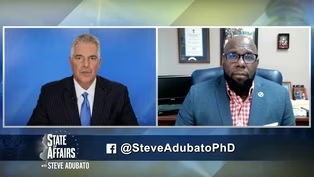
Climate Change and Making New Jersey More Affordable
Video has Closed Captions
Clip: S6 Ep8 | 9m 19s | Climate Change and Making New Jersey More Affordable (9m 19s)

The Opioid Epidemic and Treating Addiction
Video has Closed Captions
Clip: S6 Ep8 | 10m 51s | The Opioid Epidemic and Treating Addiction (10m 51s)

Tackling Menstrual Health Equity
Video has Closed Captions
Clip: S6 Ep8 | 8m 28s | Tackling Menstrual Health Equity (8m 28s)
Providing Support for PBS.org
Learn Moreabout PBS online sponsorship
- News and Public Affairs

Top journalists deliver compelling original analysis of the hour's headlines.

- News and Public Affairs

FRONTLINE is investigative journalism that questions, explains and changes our world.












Support for PBS provided by:
State of Affairs with Steve Adubato is a local public television program presented by NJ PBS