
Empowering African American children, philanthropy’s role in Detroit’s growth
Season 54 Episode 10 | 25mVideo has Closed Captions
American Black Journal sits down with “Encourage Me I’m Young” and The Skillman Foundation.
The leader of a local nonprofit, “Encourage Me I’m Young,” talks about the group’s efforts to raise the reading levels of African American boys. Plus, a conversation about the important role of philanthropy in growing Detroit’s economy and empowering children and families.
Problems playing video? | Closed Captioning Feedback
Problems playing video? | Closed Captioning Feedback
American Black Journal is a local public television program presented by Detroit PBS
Empowering African American children, philanthropy’s role in Detroit’s growth
Season 54 Episode 10 | 25mVideo has Closed Captions
The leader of a local nonprofit, “Encourage Me I’m Young,” talks about the group’s efforts to raise the reading levels of African American boys. Plus, a conversation about the important role of philanthropy in growing Detroit’s economy and empowering children and families.
Problems playing video? | Closed Captioning Feedback
How to Watch American Black Journal
American Black Journal is available to stream on pbs.org and the free PBS App, available on iPhone, Apple TV, Android TV, Android smartphones, Amazon Fire TV, Amazon Fire Tablet, Roku, Samsung Smart TV, LG TV, and Vizio.
Providing Support for PBS.org
Learn Moreabout PBS online sponsorship- Coming up on "American Black Journal," a local nonprofit talks about its efforts to raise the reading levels of African-American boys.
Plus, we'll discuss the important role of philanthropy in growing Detroit's economy and empowering children and families.
Don't go anywhere, "American Black Journal" starts right now.
- [Announcer 1] Across our MASCO family of companies, our goal is to deliver better living possibilities and make positive changes in the neighborhoods where we live, work, and do business.
MASCO, a Michigan company since 1929.
Support also provided by the Cynthia & Edsel Ford Fund for Journalism at Detroit PBS - [Announcer 2] The DTE Foundation is a proud sponsor of Detroit PBS.
Through our giving, we are committed to meeting the needs of the communities we serve statewide, to help ensure a bright and thriving future for all.
Learn more at dtefoundation.com.
- [Announcer 1] Also brought to you by Nissan Foundation, and viewers like you.
Thank you.
(bright music) - Welcome to "American Black Journal," I'm your host, Stephen Henderson.
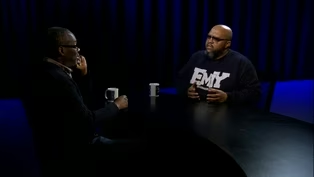
The nonprofit organization, Encourage Me I'm Young, or EMIY for short, has a mission of empowering children and families to reach their full potential.
It has two initiatives underway right now.
One is a reading program, which encourages African-American fathers to read books to children and families.
The other is Respect Day, which will be observed on April 6th.
Here to tell us more, is the founder of EMIY, Dr.
Calvin Mann.
Welcome to "American Black Journal."
- Oh, well, thank you for having me.
- Yeah, so before we get to the work that you're doing, I want to pick up on something we were talking about before the cameras started rolling, and that's just the tough environment for nonprofits right now.
I'm not sure everybody is really aware of how hard it is to do the kind of work that you do, which is, it is in that nonprofit space, that public-service space.
Because the economy is changing and has gotten so bad, nonprofit organizations like yours are really struggling to, just to keep going and doing the work that you do.
- Oh, yeah, we are most definitely filling the brunt because we weren't on the scale of a number of the nonprofits who might have a surplus- - Yeah.
- That could sustain.
- A reserve that- - A reserve could sustain.
- Kind of to and through.
- We didn't have that, we've never had that type of support.
- Mm-hm.
- So, we were, in the beginning, as a volunteer nonprofit where we were 1.2, 1.4 million in volunteer hours.
But for 19 years, we tried several times to move to that area, but we understand there's a lot of competition- - Yeah.
- In the format of grants.
And because we focused on boys and family, it was different.
You know, we've heard that it was, your cycle has passed.
We've heard it all.
But with us having the success that we've had, 98% parental involvement, 16,000 males since 2007, all our boys are husbands and fathers and leaders, and families have been restored, we thought maybe that that was something that was worth being invested in, right?
And so, when we transitioned as we have, we have to do it in pieces and places.
So, we have all these traditions that we've created for families.
But we recognize that we are not the crim de la crim as far as when it comes to supporting our boys.
- Yeah, yeah.
- And in southeastern Michigan, boys, as you well know, are most definitely in a considerable amount of trouble.
Even when we did the "Smash Suicide" campaign for boys 5 to 11, recognizing that boys were number one in suicide crickets, right?
So, what we have had to do, is take these little tidbits and then bring the success to the community.
- Yeah, yeah.
Let's talk about that focus on boys.
Obviously, boys are in lots of trouble, but I think, a lot of times, people don't quite understand why that's true and why that's different from what goes on with other children.
What is it about the way we react to, the way we interact with boys, especially African-American boys, that is causing these outcomes that we see?
- Well, most boys in the State of Michigan, across the State of Michigan, they're the least fathered.
- Yeah.
- They doesn't have a high interaction with their dads.
- With their dads, yeah.
- And in this area, when you look at the single household, those environments, the boy is spending a considerable amount of time with his mom, aunties, right?
Because of the other pieces of violence and biasness.
I mean, like in the study in the State of Michigan, Black boys were 44 times likely to be removed from my daycare.
- Mm-hmm.
- Right?
And followed by White boys, right?
And then when we get into the areas of what's happening to all boys, we recognize literacy is an issue- - Yeah.
- We recognize those are very, that literacy is very, very, which is why we named the program Reading is Life.
- Mm-hmm.
- We understand that that falls into the man, husband, and the father.
- Mm-hmm.
- So, if I can't read at the boy level, it's gonna be very difficult at the man level.
- To read to your kids, yeah.
- And so, relationships are impacted by literacy, family stand together is impacted by literacy.
So, we knew that we had to make a move because our Reading is Life program was such a powerful program.
- Mm-hmm.
- We had one 6-year-old read 84 books in six weeks.
- Wow, wow.
(chuckles) - Right?
And so, when we took that to the marketplace, we even did tried to do a crowdfunding, it wasn't, the support wasn't there.
And so, we were trying to figure out, who is really gonna take the time to say that these boys actually matter?
- Mm-hmm.
- And so, that's where, you know, we kinda stayed.
- Yeah, yeah.
Let's talk about this April event, what's the idea there?
- So, April 6th, Respect Day was created when, in our mentoring program, we sent our boys to school to get the schools involved, right?
Where our young men, because our program is called EMIY Future Leaders, where we teach our boys 11 pillars of character, those types of things, responsibility, our boys are cooking, cleaning supporting the home, we sent them to the schools, the schools never responded.
So, in 2016, we kicked off EMIY National Respect Day, and what we discovered was powerful.
So, for years, because it's April 6, it impacts education and the community.
So, because of Respect Day, the schools and the people that, you know, invested in Respect Day, we had these outcomes.
Mumford had their highest male graduation population rate two years in a row under Angela Prince, who was the principal at the time.
We saw where the kids who had their RESPECT me RESPECT you RESPECT we T-shirts, it cut into violence, the young men started opening the door for the young ladies, the communication increased throughout the community, elderly people were approached respectfully by kids.
So, the second, that last part of school was impacted all the way across, all the way through the community, right through the summer.
So, we noticed in the last, this is our 10th-year anniversary, which we got the word we are gonna kick it off again at DSA.
- Yeah.
- Detroit School of Arts has been one of our strategic partners in this work and for Respect day.
And so, we're excited about it because now we got Ferndale at the table, we have Detroit Prep at the table, and we have Southfield Christian at the table, and we are building a committee that the kids can run from this point on.
- Yeah, yeah.
When you're interacting with young men, you know, and I'm always asking folks this who spend a lot of time with young people, what are they telling you about what they need and what they're missing?
What do you hear from them?
- So, (chuckles) because we work in the prevention, right?
They bring, Reading is life is for boys, three to seven, EMIY Future Leaders is for boys 8 to 24.
When you bring them to us, our secret sauce is fatherhood.
So, our mentors are fathers, because it takes two mentors to equal one father.
- Right.
- So, in that sequence of them being with us, we kind recognize the things that they're going through early.
- Mm-hmm.
- So, in prevention, if you get a EMIY boy from my program, my boys have gone on to be all Americans, academic, just across the board.
But what we do, what we recognize is that the drama, we take that out of them, right?
- Mm-hmm.
- We put the physical in them, the exercise, which is all cognitive, I got a cursive writing book so they have to learn to write their signature.
- No one's teaching that anymore in school other than signing your name.
Right?
(chuckles) - Right, and how are you, signing your name when you saw the, that's what made us pivot was because I saw that the kids didn't even have signatures, which was crazy.
So, I put together, I have a cursive writing book.
And so our boys, when they go through the cursive writing book, when they get to the end- - Mm-hmm.
- Sign your signature like a star.
- Hmm.
- That's even impacted sports, because a lot of athletes don't have signatures no more.
- Right.
- Right?
And so, that means that their apparel is gonna take a hit.
- Yeah, right.
- Right?
- As part of the branding and the franchise.
- Right, so I can't really resell a heart and and a dot, you know what I mean?
- Yeah.
- So, we teach our boys all of that, get 'em in shape, they have to do a community-service project.
So, what we are hearing from our boys, is thanks.
- Hmm, wow.
- We are hearing thanks- - Yeah.
- I love you, coach.
You know, they call over, you know, our kids are in constant contact and we challenge them.
Even when they hit high school, even some in college, we challenge 'em.
In our mentoring, we don't mentor to hold them, we meant them to set 'em free.
- Yeah.
- Then that way, he can become a man, husband, and a father.
Restoring order for the boy is very, very strategic for us.
- Yeah, there's something hopeful about that, right?
That you're hearing, thanks, right?
As opposed to, help me or I can't find help.
- Yeah, no, we get a lot of calls about, you know, I need a mentor for my son, right?
- Mm-hmm, mm-hmm.
- But we are not in that position, so to speak, to just take you in for 14 weeks.
You know, we've had to charge, right?
But in that, we got a 98% parental involvement.
Our kids have gone places that they would've never gone.
We fundraise together, the families, we do Family Day.
So, inside of that 14 weeks, is the family restoration.
The mother comes into our BOS sessions, which is Build Our Sons.
So, we teach the mothers, which is headed up by, what we teach the mothers, is by Dr.
Heather, where we teach the mothers how to get out of the way of helping their sons grow.
We do a lot when it comes to our boys of trying to dictate their decision making, right?
And sometime, we give our boys too many choices.
And what I discovered, is we hand our boys video games, and our girls books.
Who's excelling?
(Stephen chuckling) - Right.
- So, the one that should, who should be having the books, right?
Is both.
- Mm-hmm.
- So, make sure your sons and your daughters are getting the books, because the one thing I don't believe in is that one is smarter than the other.
- Yeah, yeah.
- I don't believe in that philosophy at all.
- Yeah, we gotta support all of them, right?
- All the way.
And if a boy doesn't have, you know, and I speak on fatherhood all the time, but if a boy doesn't have his father, right?
You are creating him just for the system.
- Yeah, yeah, yeah.
Well, it was great to have you here.
And the work that you're doing is just- - I'm hanging on, brother.
- Right?
(chuckles) - Yeah, (chuckles) I'm hanging on, I really am, but- - Things will turn at some point.
- Yeah, hopefully, and we can get the support, because right now it's- - It's a struggle.
- It's a very big struggle for us to do anything.
- Yeah.
- So, yeah.
- Well, thanks for being here.
- Thank you for having me.
- Mm-hmm.
Up next, we're gonna talk about philanthropy's role in Detroit's growth.
But first, here's a clip from a 1999 "American Black Journal" conversation with Dr.
Anne Beal, Co-Author of "The Black Parenting Book."
- Our kids need to understand that they're very much loved and appreciated, and we have different ways of telling them that.
So, for example, in the first six months, you do anything that that child wants.
That child is telling you that they're hungry, then you feed 'em, if they wanna be held, then you hold them.
But when that child is a teenager, if they want to go out and do what they want to do, then part of what you have to do as a loving parent sometimes is to say no.
And so part of it, it really does change over the course of a child's life, and we need to be able to respond to those changes.
- And so, we are consciously looking at everything that's happening with that child, say from birth to, well, let's just look at it this way.
- [Anne] Mm-hmm.
- We hear so much about the fact that one of the things we have to consider, is that from the time that child is born to the time that child is five-years old, let's say, their world is formed, their die is cast, that's it.
If you mess up there, they're messed up for life.
Are children messed up for life in the first five years, or enhanced for life in the first five years?
- Well, every day, as a parent, I do the best that I can.
And every night, I have to say, all right, you'll try to do better next time.
One of the things that we talk about in the book, is that we have to forgive our parenting mistakes.
And one of the things that I tell my patients who come to me, is that we saw our parents as being these ubiquitous people who knew everything and always did the right things.
They were making it up as they went along in the same way that we as parents are making it up as we go along.
And the best that we can hope to do for our children, is to just bring them the best that we can and to give them the experiences that we think will help them to be productive people as they become adults.
- The book has a decidedly for-us editorial tone.
- [Anne] Mm-hmm.
- We've already alluded to it.
However, is there something the Black child needs to develop mentally, physically, emotionally, psychologically, environmentally, that other children don't need?
- Absolutely, I think the reality is, is that life in America is often painted in different colors, and that our experiences are different for our children.
So, a good example is a friend of mine who has a teenage son, he just learned how to drive.
And one of the things that he wants to do as a teenager, is go out with his friends in a car and drive around.
But the reality is for her as an African-American mother with an African-American son who's driving around in a car, is what will happen if he gets stopped by the police as opposed to a White American mother.
- Philanthropy plays a crucial role in growing a city's economic ecosystem.
I had a chance to speak with Sarida Scott, who's Vice President of Program at the Skillman Foundation at this year's Detroit Policy Conference hosted by the Detroit Regional Chamber.
We talked about the importance of philanthropy in fostering economic development and interacting with the new leadership here in Detroit.
Philanthropy plays this incredible role in Detroit that it doesn't play in other communities.
What do you think it needs to be playing right now with all the transition that we're seeing?
- This is a really critical time.
- Yeah.
- And this is a moment where we talk a lot about the need to connect.
I really see philanthropy playing that role of connecting.
One of the things that I always say is like the philanthropy superpower is the convening power.
We can bring people together.
- Yeah, yeah.
- And we really need this now in this moment.
- Yeah.
So, at Skillman, you guys are focused on youth education.
Tell us what you're up to now, given how different things are than they were just a year ago.
I mean, it's amazing to think of all the things that have changed, and all the problems that have surfaced or gotten worse in that time.
- In this moment though, we're really focused on education, as we say, People Powered.
So, listening to those who are most impacted by the education system, students, educators, the community to help us in, you know, driving the solutions, identifying the solutions, it's also a part of the bridging.
I mean, for as much as we want to do in the city, and as much as we invest, no one entity can impact and change the education system.
- Yeah.
- And it's really this moment that we need to remind everyone that education touches everything.
And so, when we're here talking about business and economic development, it all goes back to education.
So, that's really a lot what we're trying to do, is remind people that we need to listen to those who are impacted by the system, they need to be brought in and be working on the solutions, And we need to be doing this all together.
- Yeah, I know that's work that you've been involved in for years and years long before you came to this role at Skillman.
I wonder if you can help people understand the things that you hear and see from those folks, from students, from parents, from educators, especially in Detroit, about how things are going, and what they need so that we can go faster and further.
- So, there's, I mean, there's so many challenges we know.
I mean, so we still, we talk a lot about the post-COVID, and the COVID generation, and the challenges.
So, we all know that mental health has been a lot of the issues that have been raised.
- Wow.
- We know that there is a concern about, what's AI?
And how does AI look for the, you know, the careers for the future, and how are we helping students be prepared for that?
And students are concerned about that.
We also know we're in this moment where we have, there's a lot of talk about the value of higher education, and is that still worth it for students?
So, there's so many things that they're grappling with.
And also just the rest of what's going on in the country.
- Right, right.
- I mean- - And it has an effect on young people that I think we don't stop and think about all the time.
- Yes, and we need to, because they are experiencing in such a different way, because it also then impacts the way they think about their future and what opportunities they have and what's possible.
So, there's so much that we need to do around helping them continue to think about the future.
Just as we were talking about the reminding ourselves, we will move out of this.
- Yeah, yeah.
- This will pass.
- Yeah, right, everything does at some point, right?
- Exactly.
- We just gotta survive that.
And that's always- (chuckling) - And also how are we setting things up so that we recognize that children can thrive in the future.
- Yeah, yeah.
So, I wanna talk a little about the transition that we're seeing politically here in Detroit right now.
We've got a new mayor, a lot of new council people.
Philanthropy worked very closely with the last two mayors, really, in terms of just trying to get things going in Detroit again.
Is there a different role philanthropy will be asked to play for this new administration, or is it just kind of making sure everything's still standing up and moving forward?
- Well, to start, philanthropy has already expressed support for the new administration.
- Yeah.
I mean, this historic time with Mayor Sheffield.
- Yeah, right.
- And we all wanna see her succeed because if she succeeds, the city succeeds, the region succeeds, the state succeeds.
It remains to be seen if there are some different roles that she might be interested or the administration might need.
But what is consistent, is that there is clearly an intent across the sector that we wanna be supportive and do what we can.
- Yeah.
Her focus on poverty, to me, is the thing that stands out the most.
I mean, we're only a couple weeks into her being mayor, she's still gotta, you know, get settled and figure out what she wants to do.
But she has, time and again, come back to this idea of government's role in solving poverty and moving people out of it.
She's got some innovative stuff already going on with RX Kids coming from Flint to Detroit that didn't get as much attention as I think it should have.
That's a huge step forward.
I wonder, for philanthropy, how it plugs into that part of the administration, which is very different from what we have seen from the past two mayors.
- Well, you know, there's so many, I mean, philanthropy supports different things, but for us, it's very exciting because, of course, all of these things impact children and youth.
- Yeah - We supported also RX Kids, which is wonderful.
- Uh-huh.
- She's also created a new youth director, which is an amazing role.
- Yeah, right, right.
- You know, youth affairs.
And so, we are really very much interested in seeing how we can support that.
So, I would hope that for most in philanthropy, supporting Detroiters, supporting residents on basic needs, it hinges on everything that we're interested in and that we want to see happen for the city to thrive.
- Yeah.
You know, it is interesting to me, I mean, obviously, the milestone that she represents is the first African-American woman, first woman in the mayor's office.
it already feels very different.
Partially because of the things that she notices, partially because of the things that she's keying on.
I'm not sure I expected it to be so starkly different from every other mayor we've had, but it's gotta be, you know, for philanthropy and for you as an African-American woman.
That's gotta be just the sweetest little note, I guess, in all of this.
- Well, I don't know if you remember the op-ed that Meredith Freeman and I wrote a few years back and we said, the next Mayor of Detroit- - Will be a Black woman, yes.
- Should be a black woman.
And we mentioned some of the things that women think about.
And she has shown that those are the things- - She's doing it.
- She's thinking about it.
You know, families and children, and so all of us thrive.
- And not just as ancillary concerns, but as the focus.
- Yes.
- She just has come right out of the gate saying, this is what I want to do, and this is what's important for this country.
- Yeah, I love it.
- Yeah, right.
- It's very exciting.
- All right, well, Sarida, it's always great to see you.
Thanks for sitting with us here.
- Always good to see you too, Stephen.
Thank you for having me.
- That's gonna do it for us this week.
You can find out more about our guests and connect with us anytime on social media.
Take care, and we'll see you next time.
(bright music) - [Announcer 1] Across our MASCO family of companies, our goal is to deliver better living possibilities and make positive changes in the neighborhoods where we live, work, and do business.
MASCO, a Michigan company since 1929.
Support also provided by the Cynthia & Edsel Ford Fund for Journalism at Detroit PBS.
- [Announcer 2] The DTE Foundation is a proud sponsor of Detroit PBS.
Through our giving, we are committed to meeting the needs of the communities we serve statewide, to help ensure a bright and thriving future for all.
Learn more at dtefoundation.com.
- [Announcer 1] Also brought to you by Nissan Foundation, and viewers like you.
Thank you.
(gentle music)
Video has Closed Captions
Clip: S54 Ep10 | 12m 11s | Dr. Calvin Mann said he focuses on Black boys and their families because of challenges they face. (12m 11s)
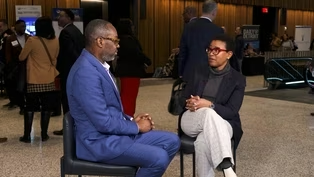
Sarida Scott of The Skillman Foundation discusses philanthropy at the Detroit Policy Conference
Video has Closed Captions
Clip: S54 Ep10 | 7m 23s | A discussion about the importance of philanthropy in fostering economic development in Detroit. (7m 23s)
Providing Support for PBS.org
Learn Moreabout PBS online sponsorship
- News and Public Affairs

Top journalists deliver compelling original analysis of the hour's headlines.

- News and Public Affairs

Today's top journalists discuss Washington's current political events and public affairs.












Support for PBS provided by:
American Black Journal is a local public television program presented by Detroit PBS