Empowering Seniors
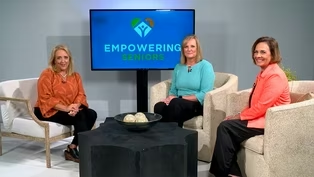
Empowering Seniors Episode 602
Season 6 Episode 2 | 27m 30sVideo has Closed Captions
Empowering Seniors with Katherine Ambrose Fridays at 8:30pm
Empowering Seniors with Katherine Ambrose Fridays at 8:30pm
Problems playing video? | Closed Captioning Feedback
Problems playing video? | Closed Captioning Feedback
Empowering Seniors is a local public television program presented by PBS Kansas Channel 8
Empowering Seniors
Empowering Seniors Episode 602
Season 6 Episode 2 | 27m 30sVideo has Closed Captions
Empowering Seniors with Katherine Ambrose Fridays at 8:30pm
Problems playing video? | Closed Captioning Feedback
How to Watch Empowering Seniors
Empowering Seniors is available to stream on pbs.org and the free PBS App, available on iPhone, Apple TV, Android TV, Android smartphones, Amazon Fire TV, Amazon Fire Tablet, Roku, Samsung Smart TV, and Vizio.
Providing Support for PBS.org
Learn Moreabout PBS online sponsorshipFrom the Alvin and Rosalie Sara Check studio.
PBS Kansas presents Empowering Seniors.
Welcome to Empowering Seniors.
I'm your host Katherine Ambrose.
Today we get to meet the Mama Bear team.
Meet Nicole Robilotto and Tasha Beckman who've come here from Denver Colorado.
Welcome ladies.
Thank you.
Well I heard Mama Bear and that just resonated so much.
I've been in real estate all my life and then I've you know kind of morphed into empowering seniors which has been such a joy.
And you're doing the same thing in Denver.
So what brought that about?
And how did you get the name Mama Bear Team?
Well Mama Bear Team comes from fiercely protecting our clients because we take that really seriously.
There are so many real estate professionals who don't approach it the right way.
They chase the transaction.
They you know are all in it for themselves.
And it's really more about taking care of the community and our population especially when we're talking about seniors.
So we take this fiercely protecting piece really seriously.
About six years ago it became obvious to us that there wasn't a great solution in the Denver community for a one stop shop for consumers to go to to get answers to even know the path to follow.
Right.
And so we decided that it was important for us to gather around the people that we knew liked and trusted.
And we put together a legacy connections group and then Covid hit and it's a little bit of a change.
We had a shift in the regrouped a little.
But we're so passionate about helping our community members know that they have options they have choices but really narrowing down to who those choices could be and should be is a daunting process and we want to be that resource for them.
I really love that.
I'm a real estate nerd.
I was in real estate my entire life and I think that the industry sometimes tries to dumb down real estate agents and there's 80% turnover rate for one thing.
Come on.
But also there's a thing that oh you shouldn't recommend a certain inspector or certain electrician.
You should give a list.
Well that's what people are paying for is for expert guidance.
So I love that you own being a fiduciary protecting our seniors is such a daunting task when you just approach it with the wrong focus.
It used to be historically we had elders in our community that everyone went to.
They were the wise ones.
They were the ones that we all trusted to guide us down the right path.
And that's a forgotten part of our whole community structure anymore.
You know we forget and the the seniors are then by themselves and they don't know who to call and who to talk to.
And it's really important for us to have the right approach and the right language.
Right.
When we're talking about removing items out of the home for example we can't say will call the junk caller.
We refer to it as memory removal because they're somebody's memories in the home.
So let's work on organizing your memories and keeping the things that are important to you and letting go of the things that aren't.
So that's true for a family too.
Yeah.
So curating what's really important to take with you to what's next.
And for family and then being able to identify what just needs to go.
And you had talked about having the resources so that resources.
So it's not knowing just who to work with.
It's also knowing who not to work with.
So and a lot of times we will use the the partnership and our own homes and kind of and get to know the vendors so that we know that if we are recommending somebody to to our clients then we know that they can be trusted and they're going to treat that client just as we would as well.
And the vendors know that if they don't they have to deal with that.
That's exactly that's exactly what I was thinking of that.
Oh that was a little mama bear accountability.
And so they're on their toes for sure.
I shop in the house once and and he says I thought they were going to clean out my cabinets.
And I said they are.
And he said no they said they're not.
And I'm like oh they are definitely.
And it took about two minutes of a conversation to just gently remind them that they were going to be cleaning the cabinets with a smile.
Yeah absolutely.
Yeah because it's really good to work with a team.
I say a lot of times the aging is a team sport.
And you know I just don't think that consumers understand how important it is that you plan out your bench you plan out your roster and you're working with the right people because the wrong people can put your loved one in the hospital immediately.
Just taking a class and sitting for a certification is not what's going to make you the best partner for our aging community.
It's really it starts with the heart and it starts with someone who truly wants to serve and listen for what the needs are.
And it's not self-serving.
It's really about how can we provide the solutions.
You know real estate is 95% sales 5% service.
No it's 5% sales 95% service and 100% solution.
Absolutely.
Especially when you're working to empower seniors and support their family.
We want people to be homeowners that at some point the home can be an extreme detriment.
When is that the case?
A lot of the times the detrimental piece of it comes when the family support system is not in the local community.
They're you know siblings that are all across the country cousins friends even you know if if an elder grew up in a different community and moved into our area.
They just don't have the resources and the support structure and that safety net.
Right.
So it becomes even scarier for those options because they don't know what their choices are.
And we really have to partner with them to say is aging in place the right solution for you.
And can we make your house safer.
Move some of the items that are maybe trip hazards and that kind of thing change the paint.
And the conflict of the colors when you're going down the stairs or what have you or is transitioning to alternative housing the right option or is it a if I make this decision it's a permanent decision right.
My parents moved into an independent living scenario probably 5 or 6 years ago.
And my dad passed last year when my mom moved back to our family's farm.
Right.
It was important for her soul to be fed by where she wanted to be and not feel like she.
Well I'm I'm here.
I can have a different choice.
Right.
It's about options.
And we need to be part of the education piece for those options.
Yeah.
So so we've gone way off real estate because there's just like a different industry.
This is helping people age and place age their way understand options.
Because there aren't very many people that really understand the options right with what you really want what you want to make your own decision which means you have to gather a lot of information.
So you're in the position to make good decisions.
And sitting down side by side and explaining the options.
And often we've had where families you know if this support system is not in Colorado but they could be in another state also having the communications with the family members and talking through the options and including everybody in the discussion so that we're making sure that the the solutions are right for you know the couple that may be moving into assisted living.
And if the family members are not local we just maintain that communication with them so that they feel connected and that there's not a decision that's being made.
We don't have to.
Yeah because aging in place can mean just aging in the community but just a different location.
And it might be retirement living or something else.
Sometimes it's really important to look for what are those options.
Because a living situation is not the ideal situation from a health and safety perspective.
Yeah.
Which is counterintuitive because people think I'm going to have my independence if I'm home where a lot of times I can have a lot more independence somewhere else and they can maintain independence because they're not getting injured and they have the support right?
Maybe they're in a house that they've been in for 50 years and they have the garden and they have the housekeeping and they have all of the things where if they were in a different living scenario they have a support structure that can come in and provide.
Not that we're saying well you can't garden anymore.
No but maybe limit the amount of gardening that you're doing.
You know it's not a quarter of an acre.
Maybe it's you know an elevated raised garden that you still get your passions kind of taking care of too.
Yeah.
Awesome.
So what have you done in terms of putting together information for the public?
Because I think you you've worked on doing some writing and doing some spelling things out for people.
Yes.
So last year I released an estate planning book and it's really about the documents that you need to gather and the where are important things.
Where's your passport?
Where's your birth certificate?
What kind of retirement benefits do you have?
Is there a plan?
Is it railroad retirement?
What about military?
But it's also this whole planning document to be able to hand to the family to remove some of the pressure points.
About 50% of the people who end up being personal representatives aren't ready.
They don't know what questions to ask and what resources to go to.
They don't even know what accounts their parents or their family members have.
So it's important to document that information.
And then the back of the book is about probate because probate can be really daunting for someone who's never been through it.
It's a court process.
It's important for us to increase our education to make sure that we're staying relevant and up to speed with all of the changes that are going on from the geriatric care and the senior services that are available to what we do and how we provide those services.
Yeah that's just one small.
So state real estate license does not cover any of this.
This is like a whole new thing.
So you are certified senior advisors I think that most of us that are working with seniors we're not doing it for the transactions or the volume.
We're doing it because this is really needed.
it's a process.
It's a process and it's about a journey.
Right.
And it's not our journey.
So we're not there to move things along quickly just for our sake.
It's really about what is the best for the individuals that that need the services.
And we're there to provide those.
Yeah.
And otherwise people wouldn't know because there's just so many real estate agents out there and different people out there.
And it's important that family understands that who you work with really matters.
And it's also about understandin guidelines that realtors have or real estate professionals have.
We have a lot of options.
Just because I can sit for a class and get a certification doesn't mean I'm an expert in the area.
It's really the intention of learning what that community needs and really approaching it.
Like we don't refer to it as transactions ever.
It's a project for us.
Right.
So there's project management that comes into play.
There's a lot of moving parts and it's really understanding what the family needs are right.
It's not our plan coming in.
We listen and ask the pertinent clarifying questions to make sure we can put the plan into place.
That can just help them whether there's real estate sale involved or not.
So what do these projects look like?
What could they entail?
It could be a hoarder situation.
We had one where there were five buildings on property.
I am 61.
I was in the house four times before I realized there was a piano in the house.
You can imagine how long it took me figuring that out.
Yeah and it was right at the beginning of Covid.
And normally in a hoarding situation especially when someone has passed there are items left in the house that matter to someone.
Right?
But then there are items in the house that nobody has an emotional connection to and sorting through those can be an overwhelming task where the family feels like they have to go through all of those parts and pieces themselves and it could take months and months and months and years because they're trying to do it on a weekend here and they're doing soccer practice and piano lessons and Girl Scouts.
Right.
Because there could be cash hidden.
Yeah.
Yeah.
I mean there's behind photos and books coffee cans in the sofa cushions and the hands and drenched and the shoes.
We found glasses in the walls where there was you know some renovation done.
And.
Oh we wondered where dad left his glasses.
Will.
They were in the joist.
Wow.
So and so.
It is important if you care about what's there to have things sorted carefully you know getting a roll off and just putting everything that's not.
That's a danger too because sometimes people are so overwhelmed that there are predatory practices out there where a cash investors can make all their problems go away.
you really need a licensee involved preferably someone that really understands this end of the business not just chasing the closing.
Right.
So Cash Investor or what we would call a wholesaler that's just shopping the deal to somebody.
But you know saying oh I'll take care of all these things Yeah.
We had an owner that experienced that by the time the estate sale company that we work really closely with called us to come and help she had three offers from developers to purchase her property.
And every single one was at about 70% of the value that we thought she could gain if she really followed the right path.
And we helped her with that.
And really the the increase of the money that she got helped pay for long term care for her and she wouldn't have had that option.
But yeah these are ruthless people that with a smile.
Well then go on Facebook groups and say I made 50000 at the closing table or 100000.
I mean they are really low balling people.
And oftentimes to they're preying on hospice professionals and senior living advisors saying you know I'm a nice guy I'll buy the house.
I'll make it really easy.
But yet there's no one licensed that is overseeing it.
There's no one that's responsible no one that is first of all licensed with the state of Colorado in your case or members of the board of Realtors that are upheld to ethics and standards of practice.
Not good not cool.
That's right.
It should be illegal in every state.
And there's a time where there's so the emotions are so high and there's everybody is you know not sure what's which direction to go.
So we try to come in and not only in protecting them but bring the data points and help them understand what is going to make that be the best decision for them.
So because there's just so many especially if there's different a lot of different family members involved.
So making sure that we are kind of managing as she says project management.
Right.
So not only the project but also the emotions and trying to keep that out and just saying let's look at the data and then look at what the decision is going to be best.
Because I'm sure that you have methods that you can be the easy button and make it happen really fast.
Just as fast as Cash Investor.
And sometimes selling for cash is a good opportunity depending on the condition of the property.
So we don't have an issue with that.
We just have an issue on predatory practices where no one is overseeing it.
Well and it comes down to in the real estate world the question of assigned ability.
So if I can sign a contract with you but I can assign it to someone else during the process before I even close with you.
That's not cool.
And take great grandma's money.
Take great grandma's equity.
Yeah exactly.
Slick.
It also requires the real estate professional who is representing that elder or that family to say no is sign ability is available on this contract.
You know it's just the little things that we can do because of our experience and expertise to come in to further protect what's going on.
The huge advice.
That was huge advice.
What do you think about hospice professionals senior living advisors saying oh we have this cash investor that can come buy your home versus sending them to I would immediately ask what's in it for you?
Because there has to be something in there that they're buying into the idea that it's a benefit to the member and the community member and they're not understanding all of the moving parts and all of the risks that are involved.
When we work on the probate side there's also a court process and guidelines that you have to follow within.
You will be in trouble very quickly if you don't follow the right rules and processes and you know stick within those guidelines.
And that could come back to the hospice company.
So to me that's practice.
That's practicing real estate without a license.
If you're referring to cash investors practice law without a license.
Right.
We're just there is a little piece of the representation.
There's a lot of liability there.
Nor do I have the skill set to help.
On the hospice and palliative care side.
There are experts that are in those arenas so I need to know who to call on in my community.
And that is true nationwide.
So if there is a senior that is traveling and has an issue and they land in Wichita Kansas I need to know the professionals to call to make sure that they're cared for is if I'm standing in the room.
Right.
So it's really important to have a network of nationwide support as well.
If you're only living within your bubble right then you absolutely don't have the knowledge to write in the right expertise.
There's a lot of professionals that just live in their little local bubble well.
And it's not a cookie cutter process.
Right.
Every client is different.
Every scenario is different.
Every house is different.
All of the needs are unique right.
Even if at first glance it looks the same you cannot approach it with the easy but you just can't.
You have to figure out all of the ramifications of the decision process for you and your client.
It's really important to work with someone who has that expertise and continues to grow in their knowledge.
Because our knowledge from six years ago is not the knowledge from today.
I would almost say to just like someone that might be licensed to practice real estate in the state and that enables them to do residential commercial work any part of the state that we're really only qualified to work in our area of expertise Absolutely.
Because in residential you have agents who specialize with working with first time homebuyers or you know military luxury relocation.
Like there's different niches.
I don't like when somebody refers to senior services as a niche.
It's a calling.
It's truly elevating the emotional approach and the understanding of that world.
Dealing with a first time homebuyer is completely different than dealing with a senior who needs additional guidance and counseling.
So we become their champion and we become their counselor in the options that they have.
It's not just about what's on the contract for real estate it's all the other things.
The contract for real estate is minor compared to all of the other things that need to come into play.
How do people feel often when you're meeting with them about the prospect of selling their last home?
Well I think they're giving up.
They feel like they're losing a part of themselves.
It's all the memories with the spouse from the you know 45 years that they were in that environment or the friends that are next door or used to be next door.
And they're no longer there either.
Right?
Or my church is right down the street or I see all of the elementary kids walking by to go to school every morning when I'm having you know my morning coffee or whatever it is.
Right?
It's all those memories.
It's really scary for our seniors to think about change.
Any amount of change right?
Anything will just kind of throw them off their regular schedule.
And I think the emotional piece of that is really daunting for a lot of seniors I would agree.
I mean my mother's in her 80s and we have conversations all the time.
She's in upstate New York and I'm in in Denver and I know that I would love to have her in Denver with me but I also know that bringing her out of that environment she has all of her friends in her community so it would feel like a loss.
So I'm you know we're talking through as we're in this space we're having these conversations which is important to have these conversations rather than waiting until it's too late.
And she has to make we have to make a decision that's not going to be right for her.
So having because we're in the space having the conversations now to make it not as scary but no let's have a plan and make sure that you're going to be in the best base possible.
And it may not be Denver sad for me but it may not be the best decision for her because it is scary.
And it does.
It would feel like a loss for her.
Do that.
It's paying attention to the emotional effect.
Right.
So if we take an action and we don't pay attention to what the emotional effect on our consumers is we've done them a disservice.
It's really important for us to have that full one 8360 degree view of what are our actions as the professionals coming in going to be the ripple effect of affecting their lives moving forward?
And sometimes we disagree right?
We might give them a recommendation and it doesn't fit what's in their head.
And it could be six months or six years later that they come back around and say oh yeah now I see what you were saying right?
But it takes a minute.
It takes their process to get through.
Oftentimes people say I'm not ready yet.
So let's talk a little bit about that.
Breaking that down when they say I'm not ready yet.
What could that mean?
I know when my parents moved away from the farm into independent living they had an idea in their head of what they would be giving up rather than what they would be gaining.
Right.
So when we started talking about this independent option for them it was more of the conversation for us as our family members to say why don't you just go explore it and see what they have to offer and what the day to day looks like and maybe take a look at one of the rooms and you know where would you park your car and all the things.
And it was you know a month and a half later I get a phone call.
You don't you can't imagine what we did.
Like what did you do?
You just put down a deposit.
Like what?
I thought you didn't.
You know you weren't ready?
No we liked it.
Right?
There's more community activity and more you know just things that they could do versus having to drive in from the farm all the time.
You know there's just all kinds of community activities they could plug into that wasn't part of their mindset when they were thinking of what are what?
What am I giving up?
I'm giving up 1800 square feet to move into 700ft.
How am I going to do that?
Can I take my grandfather clock with me?
Whatever it is?
It's really about okay what are the opportunities on the path not the detriment of making that decision.
And it's different for every single person.
Yeah.
So special.
That is because it is different for every person.
So when we have the conversations it's gathering all the information first and not jumping to a conclusion like this is what you should do.
No you should go here.
No it's it's not.
Let's find out what are your fears what are your concerns.
And let's talk through that.
And just really being that that listening confident and just trying to come up with a solution we problem solve all the time.
And as Tasha had mentioned there's no I'd say transaction but there's no time that we're working with a client that it's the same.
Right?
Because it's always different.
So we put our heads together and we say okay let's gather the information and figure out what's going to be best for this individual.
And I love that you're already talking to your mom.
And so it's giving you both the opportunity to think about all the what ifs.
Well and as we age right we need to know the resources that are available in our community.
Because you know there are there are surprises every single day you know what do I do about this?
Right?
You know and it's great to have resources that we know we can call on to say all right here's a new experience for me personally.
Right.
So it helps us grow as people along with growing our practice.
Yeah.
And so finding the kind of people that have been doing that is so important being the people that can be the resource to the resources.
And we have the advantage in that we're getting to watch this generation go through it.
So it's also educating the family.
Right.
And it's showing them that you know even though mom and dad are older it doesn't mean that mom and dad don't have the ideas in their head about what's right for them.
Right.
Unless there is a health challenge that they're dealing with it makes that you know not feasible.
But siblings sometimes have differing opinions.
And as the professionals coming in we have to manage those different roller coasters as well.
Like all of the people are on different paths and have their own opinions about what mom should or shouldn't do and where dad should or shouldn't be.
Right.
And sometimes we have to put on that hat of balancing act and the juggling act with all the plates spinning.
Just for the family.
Yeah.
To make sure that they're listening.
Also to what they're elder one it's very emotionally charged and there's so many different motivations and intentions behind all that.
But I have a feeling that the Mama Bear team is up for it.
We are.
Yeah.
Well thank you for doing such great work.
You're our neighbors right next door in Colorado.
Thank you so much for coming here to be on PBS Kansas and educating us on the Empowering Seniors Program.
Thank you so much.
Thank you for tuning in.
If you have questions about this topic or anything else that we cover please reach out.
You can give us a ring at 316-686-4500 or email us at Empowering Seniors at KPTS.org I'm Katherine Ambrose and I'll see you on the next Empowering Seniors.
Empowering Seniors Episode 602
Preview: S6 Ep2 | 30s | Empowering Seniors with Katherine Ambrose Fridays at 8:30pm (30s)
Providing Support for PBS.org
Learn Moreabout PBS online sponsorship
- News and Public Affairs

Top journalists deliver compelling original analysis of the hour's headlines.

- News and Public Affairs

FRONTLINE is investigative journalism that questions, explains and changes our world.












Support for PBS provided by:
Empowering Seniors is a local public television program presented by PBS Kansas Channel 8