Empowering Seniors
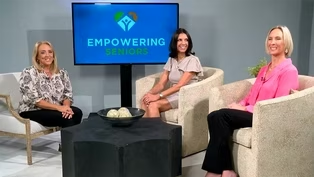
Empowering Seniors Episode 603
Season 6 Episode 3 | 26m 15sVideo has Closed Captions
Empowering Seniors with Katherine Ambrose Fridays at 8:30pm
Empowering Seniors with Katherine Ambrose Fridays at 8:30pm
Problems playing video? | Closed Captioning Feedback
Problems playing video? | Closed Captioning Feedback
Empowering Seniors is a local public television program presented by PBS Kansas Channel 8
Empowering Seniors
Empowering Seniors Episode 603
Season 6 Episode 3 | 26m 15sVideo has Closed Captions
Empowering Seniors with Katherine Ambrose Fridays at 8:30pm
Problems playing video? | Closed Captioning Feedback
How to Watch Empowering Seniors
Empowering Seniors is available to stream on pbs.org and the free PBS App, available on iPhone, Apple TV, Android TV, Android smartphones, Amazon Fire TV, Amazon Fire Tablet, Roku, Samsung Smart TV, and Vizio.
Providing Support for PBS.org
Learn Moreabout PBS online sponsorshipFrom the Alvin and Rosalie Sara Check studio.
PBS Kansas presents Empowering Seniors.
Welcome to empowering seniors I'm your host Katherine Ambrose.
On this episode we're talking about the National Aging in Place Council.
And I have two phenomenal guests with me.
I have the director of the NAACP, Tara Barman, and the Rising star of the year, Mary Lynch.
Welcome, ladies.
Thanks, Katherine.
we're so excited about being part of the National Aging in Place Council and having you come here to Wichita to talk to PBS Kansas viewers about what's going on across the country to support seniors and aging their way.
can you tell us a little bit about what the NAACP is all about?
Sure.
I would love to.
So the National Aging in Place Council is a nonprofit trade association.
There are about 450 of us across the country.
And we're really focused on education, collaboration and advocacy.
So we're really focused on helping older adults in their families think about what it takes to age in place.
And that doesn't necessarily mean the home they lived in their whole life.
It's in their community.
And maybe that is the home that they've been.
And maybe that's assisted living.
Our memory care and we're really built on what we consider the five pillars of aging, which is housing, health care, finance, transportation and social engagement.
So we like to think of that as a stool.
And we need all five pillars of the stool to really have a plan, because if one is off, it gets a little a little wobbly.
So a lot of people we find spend time on health care or health care or housing and forget about the transportation.
And then when they don't have a way to get around and their social life, it's impacted.
And then that affects maybe going to the doctor or you know, where they can live.
So it's really important to plan for all five of those areas and then finance because people worry so much, no matter how much money they have or don't have, they worry so much about outliving their money.
So how do you address save finance and money concerns?
Yes.
So we have a lot of members in the finance category, and we have everything from reverse mortgage providers, life insurance settlements, VA benefits, a lot of local resources and government resources.
They can help connect people with those, resources that they may not have heard of before.
So we really try to educate.
Not so we're not in the business of selling.
We just want people to be aware of what the options are.
And like a reverse mortgage, it might be good for some people and some people.
It's not you to have the knowledge and the power of education to make that decision for yourself.
Yeah, and not be sold like you don't want to do one 800.
Number and be sold on that.
This is a very important financial tool.
And like you said, it's not the best option probably for a lot of people, but for the people it's a good option for, like it can be the option that makes all the difference.
Can you explain a little bit about why that is?
Well, just having, you know, if paid into your home, and built up that equity your whole life and so people are sitting on a lot of money that they could be tapping into, but they're scared for whatever reason.
Maybe they want to leave money for their estate.
There's actually products out there now where you can say, I want to preserve 20 or 30 or 40% of my home equity so that I can leave something to my ears, but then they're able to tap into that to pay for health care, to pay for maybe the pharmaceutical needs that they would otherwise be skimping on.
So and transportation and just, you know, being able to access that additional a little bonus because things are so expensive right now and I don't think people have planned in their retirement plans the cost of maybe, in-home care, even if it's just four hours a day for three days a week, those costs are astronomical.
And so they're thinking about how they're going to pay for these things.
And, you know, there should be a lot more options.
And other than moving or moving in with a family or relying on a neighbor to take care of us.
So using that home equity is a great way to, give yourself a little bit more freedom and independence.
Yeah, because some people can live in their home a lot longer because they've access that equity.
And so it enables them to stay there longer.
So there's you really need to talk it over with a professional and weigh out all the options for sure.
Absolutely.
And they're actually new products out right now.
There's a lot for seniors that just came out three months ago.
So if somebody is a little bit leery about a reverse mortgage, maybe the health is a better.
So knowing what they are and he like what.
Tell us what that stands for.
Home equity line of credit.
Sorry reverse mortgage lingo.
Mortgage lingo.
It's like a home equity line of credit.
So with a reverse mortgage, you don't make monthly payments like you do, but their interest only, so it's a little bit safer.
There's no balloon payments, like with the traditional bank line of credit.
So there's a lot more, flexibility coming out.
When it comes to tapping into home equity, there's some benefits for being age qualified.
The government has made some of these products available and the market is addressing it, and things are changing all the time.
And so the reverse mortgage of years ago is not what is available today.
And then some people are using it to purchase with a heck on the home equity conversion mortgage.
So you can use a reverse mortgage process to buy a home that's going to be a better living situation.
So tell us a little bit more about that.
Yeah.
So it's a great way, if you're right sizing into your home, that you can really save some of that cash instead of putting it all into a down payment for a new home.
And a little trick that people don't realize if they just put a little bit of money into a line of credit when they do the purchase, that line of credit is going to grow just like the equity in the home.
It's going to grow so they can have a little, a little, I don't know what you would call it.
Surprised if they ever needed it for a surprise or a diagnosis or an accident that happens.
They can still tap into the equity in their home even though they have a reverse repurchase.
That reminds me to you live in California, not too far from where all the fires were, and people that had a reverse mortgage on their home had huge benefits because they could still tap into that money even if their home was gone.
Absolutely.
That was a great benefit of having a reverse over a traditional bank loan, because those those home equity lines of credit refrozen because the asset was gone, where with the reverse, those homeowners could still access the funds, could still take care of themselves.
And, you know, it was a lot easier for them than some of the other homeowners, for sure.
And, gosh, sometimes, you know, education comes out of tragedy and, that you are just a ray of sunshine.
And I appreciate that.
was so excited to meet you.
I don't know, a couple of years ago, maybe.
And you took us up on this idea of launching a National Aging Place Council in Baltimore.
And Katherine's actually the reason that I found out about National Aging in Place Council in my community in Baltimore was just really lacking community resources, sort of a one stop call someone right and find out all of those opportunities within the five pillars rates.
So it has just been such an amazing opportunity to blend education with socialization and then sprinkling some fun.
Right.
Because we don't want to beat folks up.
Maybe they haven't lived the best life over the last couple of years.
We don't want to tell them all of the stuff that they're doing wrong.
We want to tell them how to start today.
Living the best so that they can, you know, just really be the best that they can be in the, in the older, in the final quarter.
Right, as we say.
So for us, it's educating opportunities, all of these amazing financial pieces that most people don't know.
Right, right.
We have health options.
You know, so many folks are just waiting for a crisis.
And that then takes you where you don't have any options left.
So it's been just, such an amazing ride to be able to not only bring this to my community, to educate myself and my family.
And we are really doing some great things out and about to, make Baltimore really amazing.
you're doing a lot of advocacy, and you have inspired a lot of other senior services professionals to follow you into this mission.
And so you really are making a difference because Baltimore, Kansas, we have like unlimited land and and, you know, we deal with a lot of the same challenges with housing.
The other cities, too.
But in Baltimore, you're talking about aid is so very limited on housing in Baltimore.
And so, you know, folks didn't necessarily plan.
And so we are thrilled that I was a part of earlier this spring, part of a mission, in in convincing the legislation that, we really needed that.
Right, to have ease, make it easier for folks to be able to have an Adu on their.
Okay.
So I don't think in Kansas we know where Adu is.
Okay.
Accessory dwelling unit.
And that's really just a second house contained or a second residence contained on your property, you know, for years you can have a basement in law suite, right?
You could have a, happy days.
Fonzie.
Right, was over the garage.
She's like the original, the OG of the ADUs.
But it really gives so many options in our area.
Folks are over housed there in that family home that they bought that five bedroom colonial that they bought because it was in the right school district.
Now they're in their and, they're clogging up the inventory, whereas they could move family members into the main house.
They could have a wonderful little granny pod out back.
They could stay in the main house and maybe put a caregiver out back.
So it really is happening.
So many wonderful options because this is it's a way they can make money on the property that they own.
So they can think about how they can divvy up the property and have someone living there.
That could be caregiving, which would save a lot of money, or they could have a family member or someone else who is helping support them financially because you've created another living space, opens up the ability to have those conversations sessions right when what that next chapter looks like.
Should you stay?
Can you modify what else you can do?
And so we just love having options for folks to give them as many resources as possible.
Yeah.
And your passion just really comes through.
And so you're just like the perfect person to have launched this.
And you selected her to be Rising Star last year because tell us why.
What did she accomplish?
She went from having a brand new chapter to being the third largest chapter in the NPK organization.
And she did that just through education and getting out there and promoting, proactive planning.
Thank you for everything you did.
Rising Star.
So in our empowering seniors like world, like you've been national news because of what you've accomplished in Baltimore by taking Npcc and the five pillars and really taking it to heart, it's just it is so heartwarming.
My journey started actually as a caregiver, and during that time, you know, I had my kids were at home, I was laughing, you know, and it felt like such a chaotic and stressful time for me as a caregiver.
Fast forward and being able to reflect back, it was really some of the greatest moments of my life.
I'm so honored to have been a caregiver for the guy.
That was everything to me in my life.
That was my grandfather.
And so this is just such, support arising peace that my life has taken me to.
And the honor is just right.
Being able to carry on this legacy in honor of someone that meant so much to me that I cared for her.
What did you learn through that journey of caring for your grandfather, Katherine, that that list is so very, very long.
what I learned is that if you're not in the health care industry, right?
I had, been born and raised.
I was in the Baltimore community for, you know, at the time it was almost 50 years.
And when you have that crisis, you don't know what to do.
And I'm watching that on this on a weekly basis with folks that I know in the community that are crying out for help and aren't aware of resources that are available to them.
So what I learned is that so many people don't know what's out there.
that's where that marrying of, you know, here's this person that was in real estate for 30 years and now what what is aging in place, right.
And how that is married and being able to say, I have access to all of these community resources for anyone else in that caregiving, situation.
The other part, as we know, is caregivers really need to take care of themselves.
Right?
And so I remember those nights where I was so stressed out and waking up in the middle of the night and not sure, you know, who to call, what to do, where to go.
And so that's been the blessing.
And the full circle honor of my grandpa's legacy is that I then get to champion for other folks in his position.
What was maybe the hardest, kind of or tender moment that you had in caring for your grandfather that maybe made you realize the, the enormous behind the task you took on.
That's easy.
Decades in real estate.
And this man that meant everything to me was in his underwear in my dining room on a rented bed, right.
With no full bathroom on the main level.
How was I not aware?
Casually throwing out a term of forever home almost at every closing, right?
Congrats.
Forever home.
None of my family members were in forever homes.
Very few people actually are.
So the moment was standing there knowing that, you know, if if love could do it all right, I had that by it.
How much easier it would have been had I just known and planned a little bit more to have the right house for him to stay and say, you realized you didn't have the right environment for him and you wanted to care for him, but the house was limited.
Yeah.
So what now?
Now that you've learned all this, what is what is the forever home mean to you?
Well, definitely a full bath and a full bedroom on the main level.
And at least one entrance where you can get in level ground.
Right.
And that can be if you're going to do a ramp, I highly recommend something you do in a garage so that it's not advertising to the community that there's someone in house with a disability, potentially.
So that's really the basics.
Of course, there are grab bars and handrails and some additional items, but for me, the basics, I will never live in another home again.
That doesn't at least have that bedroom, bathroom, main level and entry.
So even for first time home buyers, you would probably say, look you never know, your most beloved family member might move in with you or you yourself could have an injury even for a time that makes them possible for you to stay in your own home.
And so first time home buyer, you would tell them find well and it's true.
You know, we still do have that housing situation.
But at least for me it's having that conversation and of you know, oh, you're going to be having a baby in a couple of months.
How you know, do you want grandma to visit.
Right.
How about other family members?
It's always good to just you really have no idea.
There could could be a car accident.
I have friends that, you know, even young folks, right.
That need maybe temporarily.
They need some living arrangements on the main level.
So certainly want to at least have that conversation, you know, because of the housing shortage, sometimes they're not able to find that.
But by me saying that to them, sometimes it strikes a little thought.
Right.
And then we go into a different direction for housing okay.
So at least gives them some food for thought.
So they can can think about that or think about adaptability, what they could maybe do with a particular home.
Because visit ability is really important.
And so what does that mean visit ability.
Oh visit ability is really the allowing access for anyone to come into your home on the main floor level.
So just making your home more visible, for anyone to stop by and see you, whether they're older, a younger children in a stroller, just, having access.
The first floor of your home.
So since kind of our empowering seniors efforts, which has kind of evolved into senior home coach national network, how many chapters have been opened and where are they.
Oh wow.
So we have about 12 chapters that are existing now.
Of our 450 members, probably two thirds are in chapters.
And because of the senior home network, we have 18 new chapters.
Wow, wow everywhere from Oregon, Oklahoma, Massachusetts just all over the place.
It's very, very exciting.
That is exciting.
I'm so excited about all of this goodness spreading.
You know, where we don't have it.
Kansas.
So why should people in Kansas think about getting together to start a chapter?
Well, I think it's just supporting your community here.
The IPC, we've identified 85 different service sectors within the Aging in Place marketplace under the umbrella.
And it's one of those situations where unless you're in this industry, you don't know what you don't know until you're in a crisis situation.
So this is really a way for all 85 people, 85 different service sectors to come and educate you on planning, pre-planning, having a plan when that plan might fail, and really getting the community through education.
So 85 is a lot, but give us an idea of some of the types of industries that would be involved to support a chapter.
Sure.
So we have home care and home care, hospice, transportation companies, elder law attorneys, doctor and even the social aspect of things, social clubs, churches.
Who do you have in your church?
I know, but I just love all of the new ideas where I didn't even know these services were available.
You wouldn't believe how many folks come to home, right?
There's in-home dentist, there's in-home podiatrist.
You can get your nails, hair, all that good stuff done.
But wound care, you did the statistics of how important it is.
Don't take your your loved one with an open wound to somewhere where they could get more germs, right?
The goal is to have someone come in and treat that.
So that's really been fascinating in our area.
We've had some larger groups join.
One is our local, gym, fitness center.
They have 12 locations and they are really doing something to empower seniors right?
Everybody living their best life.
So they've joined in mind.
We're having seminars.
They come in and do our exercise break.
We've had restaurants in our area that do no senior eats alone.
So they're very passionate about bringing folks in and making sure that they put them with someone else if they're dining so that they're not eating by themselves.
So one of my favorite parts of or realizations from opening the Baltimore chapter or starting that is, really learning about so many community members that are passionate about serving this, this industry and functional medicine.
I know that you have someone that's really involved, that's a functional medicine physician.
So what is that meant to you?
Learning about functional medicine has changed my life.
And it was actually here in Wichita with, doctor Ray a year ago that I actually said, you know what?
I think that's something that I need in my life.
Went back home, found a functional medicine doctor, and now I've been blessed to be able to share him through the new APC.
We've done some seminars.
People are so hungry for hope, for options, right, for things that they can do to live better without getting another prescription that they don't know that's going to work or not.
Right.
And so I just love being able to share, different options within our community for functional medicine.
Right.
There are some things that you can just do by making healthier choices at the restaurant.
Right.
And that's feels very good to be able to share that with my community.
Absolutely.
And there's other modern medicine approaches, too, in addition to your insurance physicians and the doctors you already see to branch out and get other opinions like they've literally told, told us that our whole lives get a second opinion and so finding a holistic physician, maybe that doesn't take insurance is a good way, just to make sure you're covering all your bases and you're learning about things that might be a little outside of the box as far as insurance companies are concerned, but could really make a world of difference in your health.
Absolutely.
Yeah.
What educational resources do you have for the public?
Oh, so we have, quite an array of resources, actually.
If you go to org, which is our website, you can have a downloadable version of our act three planning guide.
And that's a 26 page checklist that really walks you through all five pillars of aging.
And it's not all inclusive.
It's not going to have every question you could ever ask about housing, but it will have enough for you and your family to get the conversation started.
Sometimes a lot of the the discussions are uncomfortable, and the more we talk about these uncomfortable conversations and the earlier we talk about them, the easier they will be to have.
So you can get comfortable being uncomfortable with the act three planning guide.
And then we also every year, publish books during Aging in Place week, which is October 13th through 18.
And Mary is an author in our newest books.
Wow, I know right?
What an opportunity.
congratulations.
Did you ever have this idea that you would be a published author someday?
Never even imagined.
But I have to tell you, going through the process was so wonderful that I'm looking forward to doing it again.
Very good.
So it's really quite fun to having these connections from California to Baltimore, Washington DC down to Florida, Texas everywhere.
And it's really taking a village to make these things happen.
just really proud of the work that that you are doing.
There's so few people across the country, nationally that are focused and moving the needle and making aging your way even more possible.
Yeah, yeah.
Well, we are excited to be leading the movement of aging in place and just helping educate people across the country.
And I love that.
We do have the five pillars.
We're not just siloed into only dementia.
We're only Parkinson's.
We are bringing everybody together to have this conversation, not just nationally, but in each community and region as well.
Yeah.
And well, and you're partnered with other organizations too.
So what are what are a couple that come to mind?
Oh, well, the CSA Certified Senior advisors, we have a great relationship with them, and they're very much an education based organization.
And then we have, you know, just the local resources for, nonprofits and a lot of our local chapters, like Chicagoland has a lot of local nonprofits.
I don't know if you have any in your area, but it's certainly something that we we love to partner with.
Those as well.
Well.
Very good.
Well, thank you so much for the great work you're doing and for traveling to Wichita, Kansas to be on the Empowering Seniors television program.
Thank you.
Thanks for having us.
My pleasure.
And thank you so much for watching.
If you have questions about the National Aging in Place Council or any of the topics that we cover, will you please give us a ring?
Our phone number is 316-686-4500 Or you can email us at EmpoweringSeniors@kpts.org I'm Katherine Ambrose and I'll see you on the next Empowering Seniors.
Empowering Seniors Episode 603
Preview: S6 Ep3 | 30s | Empowering Seniors with Katherine Ambrose Fridays at 8:30pm (30s)
Providing Support for PBS.org
Learn Moreabout PBS online sponsorship
- News and Public Affairs

Top journalists deliver compelling original analysis of the hour's headlines.

- News and Public Affairs

FRONTLINE is investigative journalism that questions, explains and changes our world.












Support for PBS provided by:
Empowering Seniors is a local public television program presented by PBS Kansas Channel 8