Empowering Seniors
Empowering Seniors Episode 605
Season 6 Episode 5 | 27mVideo has Closed Captions
Empowering Seniors with Katherine Ambrose Fridays at 8:30pm
Empowering Seniors with Katherine Ambrose Fridays at 8:30pm
Problems playing video? | Closed Captioning Feedback
Problems playing video? | Closed Captioning Feedback
Empowering Seniors is a local public television program presented by PBS Kansas Channel 8
Empowering Seniors
Empowering Seniors Episode 605
Season 6 Episode 5 | 27mVideo has Closed Captions
Empowering Seniors with Katherine Ambrose Fridays at 8:30pm
Problems playing video? | Closed Captioning Feedback
How to Watch Empowering Seniors
Empowering Seniors is available to stream on pbs.org and the free PBS App, available on iPhone, Apple TV, Android TV, Android smartphones, Amazon Fire TV, Amazon Fire Tablet, Roku, Samsung Smart TV, and Vizio.
Providing Support for PBS.org
Learn Moreabout PBS online sponsorshipFrom the Alvin and Rosalie Sara Check studio.
PBS Kansas presents Empowering Seniors.
Welcome to Empowering Seniors.
Today we're talking about podcasting.
How you can access interviews online through your smartphone.
And the great information that you can tap into.
We're going to talk about empowering seniors, in fact, through podcasting.
Meet Robin McCoy, a realtor from Dallas Fort Worth, Texas.
Robin, thank you so much for being on the show.
I'm so excited to be here.
Thank you.
So how long have you been doing podcasting?
I've probably probably about three years.
And kind of various forms.
I focused on the seniors about a year ago.
Okay.
So you kind of made a switch.
What were you talking about before you kind of went into the empowering seniors mode?
Well, one was about real estate, and that gets real boring.
You can only talk about interest rates for so long.
And then I was talking to just the cool people I know, you know, I know search and rescue people and I know zoologist and all these people.
And that was really fun and cool.
But I think when I landed in the senior area, I just felt it was just better information that people could use.
because so many people are dealing with aging and how to age as well as they can, how to support aging loved ones and friends.
so how did you transition into that?
Well, it was, you know, personal experience, right?
Most times things when you make a change like this is very personal.
And I'll never forget having to climb through my mother's apartment window to get to her because she had fallen and was unable to get up, and we couldn't get in the front door.
And I just see her still across the room and me climbing through her window.
And I realized there was, you know, that that set a domino effect for about 4 or 5 months of living through something that you think you know, and you realize you know nothing.
And if I didn't know it, then other people didn't know it too.
That must have been terrifying.
It was terrifying.
You were lucky to get into the window.
Yes.
And so.
And then.
Then what happened?
Well, you know, the, the domino effect of having to move mom and her not wanting to go.
And, you know, the day we're moving, she's.
I don't think I'm going anywhere.
I'm like, well, you can't even get up and walk.
You know it.
She it was a it was urgent.
We were in an urgent situation.
And so getting her moved and then finding realizing that that place was not going to work out and having to take care of her while we were still trying to figure out we didn't.
My sister and I didn't know what we were doing right.
And so I had access to people I know people in senior living communities and home health care and all the things, and I was still completely lost.
In what to do.
And it's moving mom.
Once getting her to the hospital there's rehabs.
There's insurance companies that want to discharge.
There's tears in lobbies and tears in the cab of my truck and anger and frustration.
And it took four months and we finally found the right place for her.
And she's thriving today.
Oh, that's wonderful to hear.
Think today, because that's what you want as a daughter.
You want your mom to be happy and you want your mother to be happy, healthy and comfortable and happy as possible.
Well, and I want to be your daughter, not her caregiver.
And that, actually, a friend of mine who owns the residential care home where mom lives.
That's why she started these, because she was her dad's nurse and not his daughter in his last months, years and months.
And she said, I don't want anybody to.
People should be daughters and sons and husbands and wives, not caregivers.
Okay?
I know that your dad also that was another situation you went through.
Yeah.
So we lost my dad in 2023 to pancreatic cancer, and he was very strong through everything.
You know, he was he made all his plans.
Now he and my step mom were very organized.
They he laid everything out.
And he has left her with nothing to worry about.
You know, as far as even down to his truck, that he bought, right.
That he should to his words.
I should have canceled.
I took the truck, I drove the and it just took one of those big rocks off of him.
So he was setting everything up, knowing where his path was going to go.
And so there's two, you know, two avenues here, right?
My mom, who planned nothing and everything was done in urgency.
And that I will always cost you time and money.
And my dad, who had everything laid out and so it's interesting that he was worried about the truck.
So tell us about the truck.
So you know I think when people get older and just from my experience of watching him and and it's the big things right.
Okay.
I don't want to leave my spouse with all of his tools in the garage.
This big truck that she didn't want anyway.
She didn't want it.
And those are the big rocks.
And as those big rocks got taken care of, he relaxed a little bit and you know, when somebody is that sick, the last thing you want them stressing about is a pickup truck.
Yeah.
And so because he had just purchased this truck, why did he make the purchase?
So my dad wants things the way he wants them.
And so he special ordered this truck long before he got sick.
And it was Covid years.
Right?
21, 22 all of that.
And it took forever for them to build it and get it to him.
And while it's being delivered, I need to cancel that truck.
I should really cancel that truck.
And he never canceled the truck and it arrived.
And he said, I should have canceled that truck.
And so there it was.
And, you know, the last thing he did kind of for me was to go get that truck filled with gas.
Wow.
Like the Thursday before he passed?
Yeah.
And so he bought the truck, so he didn't have to worry.
He didn't have to worry about it.
And it was just.
He could just kind of go on to the the next thing.
Did he get to enjoy the truck a little bit.
A little bit.
A little bit.
Yeah.
Yeah.
Yeah.
But then it became your truck then if you had that you feel about that truck.
I didn't want the truck really to be honest.
And then I fell in love with the truck and it was my place.
And I think that's what people, you know, they have the things.
Right?
It's the memories, right?
It's.
It's why we have these things in our house and it's the memories.
And that's.
So I was able to drive my dad's truck.
I could talk to my dad.
It was just.
It was.
It was like a blanket for me.
And I think that's why people have so many of the things their kids drawings from kindergarten and these things, it just it just brings that memory in that moment back.
Yeah.
And then.
And then you lost the truck, and then I lost the truck.
All right, so what happened?
So, I was parked at us.
I was just not parked, but I was stopped at a stoplight.
And I was hit from behind.
Now this is a Dodge Ram 1500.
This is a big truck.
And I was hit from behind.
And if I kind of recall I can remember hearing an acceleration.
So it was like this.
And all of a sudden I was hit from behind.
And an older gentleman had had a medical incident and it essentially fallen asleep.
And so he accelerated into the back of that truck at about 60 miles an hour.
Oh my goodness.
And so it took out the truck.
It took out that Nissan.
So a Nissan.
Oh, boy.
Went under and took out the truck.
And the first thought when I got out of got out to look, I'm like, oh, my truck.
Not the truck, the truck, the truck.
Because it was my dad for me.
Yeah.
And fortunately everybody was fine.
Even the the gentleman.
He because he had fallen asleep.
Yeah.
He he was fine.
He just didn't even know he's in an accident.
Yeah.
Well I'm glad you were fine.
I was fine that losing that truck was kind of losing a piece.
It was, it was.
So I, I did get the emblem off the back of the pickup from the from the wrecking yard.
And so it rides in my new and my new vehicle with me.
Well that's why he's still there.
So now we know why you're doing this.
This is why I'm doing this.
So what is the name of your podcast?
My podcast is called relax.
I got this embracing life after 60.
And it is it's kind of a broad thing but it, it's it's very pointed because one I met a woman who was 68 years old and walked like she was 88 years old and she said, I'm just old.
And she was old at 68 and I'm 62.
That makes you nervous.
And you go, whoa, wait a minute.
And five years this you know.
No.
Right.
And so it made me start thinking about things.
And again I've got my step mom who is a very active 82 year old.
She still lives, you know, in the house, but my dad and she lived in which they had moved in.
Downsize.
Good thresholds, no steps.
All the things.
The grab bars, the walk in shower, all of that they'd already done.
And then there was my mom who didn't take care of things or herself.
And she is bedridden.
And there's all this big space in between and what we can do with our life.
And so I wanted to talk to people about making choices and making plans.
What do you do if you want to travel now you're retired.
Do you want to stay home?
Are you single again?
Now?
Who do I travel with?
My friends won't go with me.
How about traveling alone or your spouse doesn't want to go?
Right.
I mean, at 50 something, I went to Spain to walk across Spain.
My husband wanted nothing to do with it.
So I went alone and people were shocked that I was doing this alone.
And so I think we get afraid of that.
And I want people, whether you're a woman or a man or single or with friends or whatever, to know that you're not dead yet.
You know, there and there's ways to keep ourselves young and healthy.
You know, I've had doctors on I've had authors.
I've had, senior living people.
Let's let's talk about what it means.
What is Medicare versus Medicaid?
What is a senior living assisted living?
You know, all of it.
Yeah.
And because nobody knows and nobody knows the questions to ask.
So thank you so much for adding your voice out there and bringing these topics to light.
We have a couple other podcasters that we're going to visit with as well.
And then we'll get back to Robin.
Meet Lisa Harper from Charlotte, North Carolina.
Inspired by the Empowering Seniors Show, she started a podcast.
Lisa, welcome to the show.
Thank you so much, Katherine, for having me.
so tell us what you're doing.
What's the name of your podcast?
So the name of my podcast is not ready yet curating Conversations for the Aging Journey.
Okay.
And so tell us why you chose that name.
So I feel like as adult kids, when we're having conversations with our aging loved ones, we hear that a lot that our our parent is not ready yet.
And I'm like, that is a repeating theme.
I hear it all the time.
How do we get through the not ready yet?
And the only way I think we can do that is to have conversations, but not conversations that don't go anywhere.
So I wanted to offer a space for people to get information.
This is meant for people's commute.
I had of the episodes are between 30 and 45 minutes, and they're meant to be able to for the adult kid to get some information that maybe triggers something or says, hey, we need to have a conversation about that.
And it's much easier when you're saying, hey, I heard this on a podcast.
Have you ever heard of?
And it just makes it a bit more gentler because these conversations aren't they're not.
Yes and no.
They could last years.
And so to get information and have that at the ready for when you're ready to have those conversations is what the whole podcast, what the framework was.
So you're wanting to help adult children guide and support their aging parents and be loving and supportive and, and just kind of know how to think through things and how to offer, some food for thought.
Correct.
I say with love and logic.
Everything I'm about is love and logic.
We have the heart, but we also have the mind and the thoughts.
And to bring those voices to conversation, I start every podcast by saying, let's speak the quiet parts out loud because we're having these thoughts.
And I want adult kids to understand that part of the world.
There's a lot of health care and medical jargon and things that you don't know, and we don't start to find things out until there's a crisis.
And this allows people to go, oh, I now understand what an assisted living is versus independent living.
And it's just a free way to get information before you're in crisis mode, and then you're just trying to find out what you need to know next.
And that's a very hard place to be.
You don't get information, then you're just like, I gotta make decisions.
And it's very haste and urgent.
So we want to be prepared for when, when things happen or hopefully make pragmatic decisions in advance.
what have you learned from this journey?
So 19 episodes are out and I am absolutely committed to this project.
I call it my passion project.
I have interviewed experts, so I always let people know this isn't me just talking.
I'm interviewing experts in the field.
They've written books.
They're thought leaders.
They're, you know, senior living professionals.
They're, they just have options and solutions for people in that space.
And so I want to highlight them and let everybody know there's there's there's, you know, when you're like, mom has been you know, we have mild cognitive decline.
And what do I do.
And you feel a little lost in the anxiousness that comes up.
You know I'm hoping that people can find the expert they need through the podcast, and that gives them at least a path to be on.
And I always say we're on highways and it's like, which exit are you going to take?
You know, it just gives you some place to start that will lead you to something else.
And we can all make great decisions with our family.
And when we have information, it's when we don't have information and we're in urgent crisis and we just have to get that next answer to the next urgent question that feels I want people to avoid that.
That was my experience.
And I just want to help other adult kids and families and have a better, solution.
Because you can.
It takes information.
It takes preparation.
But I say, if you're in your car and you've got some time on your commute, what better way to use it?
Very good.
I love that you're doing that.
We need all the voices.
And to help get these authors and thought leaders introduced to new audiences all the time.
you're doing your podcast out of your house and just doing it on your own.
That's so cool.
Yeah.
And what a wonderful age that we live in that you can reach people, and interview people digitally and then reach who knows who by putting out your goodness and you're doing it.
I would imagine on all the different ways that people can listen to podcasts, they can find you.
Yeah, anywhere you go to listen to a podcast.
And I'm on YouTube as well.
So if you want the video side of it, I laugh and say, if you want to, you know, I my face, whatever it's going to do, you can see the video part, and watch along if that works for you too.
But the podcast is just for the adult kids.
I feel like a lot of them are in their cars or on trains, on planes.
there's those moments in the day where we could find some information that could help these conversations.
Because we're stressed.
We're thinking about that a lot.
We're at work, we're traveling, we're in the commute.
We're trying to talk to doctors or get more information.
And I'm like, this is the way to get information that then comes with value.
For your family, these difficult, complex decisions that you guys are probably looking at making, if you're thinking about it, the energy you spend thinking, take that energy and find solutions.
So and the best way to make decisions, just gather more information because then you know what you want to do.
You figure it out by just gathering more information.
What do you think it means most of the time when people say, I'm not ready yet, fear, fear, it is an absolute fear and denial.
And none of this is easy.
I say, you have to find a voice first to have the conversations and go, oh my gosh, I want to ask my parents about this, but I'm terrified of their reaction.
you know, the adult kids may be saying, I'm not ready yet to have this conversation.
It could go both ways.
Absolutely.
It is 100% fear of the unknown.
On the other side of that conversation of that, that human you're approaching, that you know, that you have lived with, grown with, you know, their, their, their ways and how maybe this could go.
I'm hoping that, you know, we can start to approach with, some conversation starters that open up dialog instead of shut it down.
Yeah, but they're not ready yet is 100% fear and denial.
Okay.
I suspect that your podcast would be great for the parents as well.
And that, you're doing great work, thank you, Lisa, for what you're doing to empower seniors across the country and certainly in your state and for traveling here to be on the Empowering Seniors television program.
Thank you for having me, Katherine.
Now let's visit with Rebecca Finnegan from Columbia, South Carolina.
Rebecca, thank you so much for being to the Empowering Seniors television program.
You're welcome.
Thank you for having me.
So tell us what our little movement here that's come out of PBS Kansas and some other things has done for you.
The show here has really empowered me to reinvent myself.
I was without a job at 64 and I didn't know what to do, so I reinvented myself and figuring out how to help seniors.
Okay, so you became an entrepreneur and what are some of the things that you've done?
a network with a lot of communities in our area, and the biggest thing to me is Bailey the Beagle.
He is a funny little boy.
He loves going to the community and riding on his little basket and just meeting people, making people smile and going into the memory care units, showing the hope, showing the smiles.
It just really excites me to to see that I can help them.
That is amazing.
And so it sounds like maybe that's added new life for you.
And now you have a new pal.
Yeah.
In Bailey.
And so how have the community's responded to you like this?
The directors of the senior living communities responded to you coming in and doing all kinds of fun things and bringing Bailey.
Well, the only problem is when I go now, they want to know where Bailey is.
They don't want me to come without Bailey.
Yeah, and, it's it's opened up a lot new doors.
I want to bring something like empowering seniors back to Columbia, South Carolina.
What do you think that would do for South Carolina to have a program like this?
I think it's going to open a lot of doors for the seniors, for the caregivers, for the families, because people don't know what to do.
And the people that you have on this show, you you give Kansas a whole new perspective on seniors, and people just don't know where to turn.
I was a caregiver for 12 years.
I didn't know where to turn.
I don't want someone else to be in the same situation that I was.
And who were you caregiving for?
My mom.
Your mom?
Yeah.
Yeah.
And it was tough because you don't know what you don't know.
Yeah.
And I have learned so much since in the past year with how to serve seniors.
And again, that's thanks to you and empowering seniors.
And so we know about Bailey the Beagle.
But what other services are you now providing in your local area?
I am starting a Downsizers club.
South Carolina is on the top ten of hoarding, and I want to see us get off that map.
So I want to.
Decluttering is the biggest thing.
I want to help people, families figure out how to stop collecting clutter.
There's a five step proven method I want to teach the teachers.
I want to teach the parents so they can teach the children.
So you took Dana K White's I do certification.
We had her on this show and she makes decluttering easy.
So now you're able to do that for clients and people in your area.
Yep.
I saw Dana on your show and I said I have to do this and it works and it can work with children is proven.
And you also started a podcast too, that.
Yeah.
How did that take you outside your comfort zone?
And what's the benefit of stretching yourself like that and going way outside your comfort zone?
Way outside the comfort zone?
You're right.
It's the reason I'm doing all this is to get the word out there.
And yes, it's uncomfortable.
It'll happen.
I there's not enough education.
And all the things that I do in my community are to get the word out.
How can we help you?
And not one size fits all.
So that's why I've taken so many different paths.
Because, you know, like you said, I'm a realtor, seniors, real estate specialist.
Seniors don't want to move, so how can I meet them where they are?
So some people want to age in place, so let me help them age in place.
Some people want to travel.
Let me help them travel.
So I'm that, my goal a year ago was to be that one stop resource, and I'm finally there.
Yeah.
So I can help wherever they are in their transition.
Very good.
Well, Rebecca, thank you for your passion, your love for community and all the great work you're doing.
Thank you so much for traveling to Kansas to be on this program.
You're welcome.
And thank you for everything.
Let's get back to our conversation with Robin.
Robin, how do people access podcasts?
Because some people don't know or they're not in the habit of it.
So let's talk about how do you even listen to one?
Well, it's it's really quite simple.
You know, it's, Spotify, iTunes and any number of, of platforms that, any podcast can be fed to.
Right.
So it's just if you're listening to a podcast, a music playlist on Spotify, podcasts are right next to it.
Okay.
And so you just search what you're looking for.
So in my case, it would be relax, I got this or Robin McCoy or something like that, and you would find it.
Also YouTube is loaded with with options as well.
Okay.
Do you put all of your episodes on YouTube?
I do, I video, video them as well.
So what you see is kind of what you get.
But I think that's important too because a lot of people get information when they see it too.
It means something different when you see the person and the expressions on their faces.
Okay.
So you just need you just need a computer or smartphone.
Yeah.
And you can access probably millions.
And the over 55 age group is the fastest growing of podcast listeners.
So they are they know that there is vital information out there for them.
And it's easier to find because maybe you're not needing to ask.
You don't know what questions to ask.
And so now you can go through and look at a title and you go oh brain health I don't want to get dementia.
What can I do to help my brain health now.
So you can just try out different podcasters and see who you like or what topics you might want.
So just loads of information out.
So you get notified whenever they get a new episode dropped.
And you can listen while you're doing your morning walk, while you're on your exercise bike, while you're cooking dinner, or whenever you'd like to listen to it on demand.
And that's it's free and it's free.
And so if you want to be on relax, I've got this.
You can hit the subscribe button.
Then you'll exactly.
You'll always be reminded.
Okay.
That is so cool.
It's easy.
So what have you learned or achieved by doing this?
This podcast this past year focused on empowering seniors.
You know, I it's just opened my mind up to all the different things, right?
It's just such a vast world of information out there.
And because of technology today we can access it.
I can talk to a doctor in Maryland about brain health, and I can talk to a past secret agent or not secret secret agent, you know, a special agent from the FBI about how to stop a scam and how to recognize a scam on yourself or a loved one.
And that information is just right there at your fingertips.
And and it just makes me it makes me a little smarter.
And I want to help and educate everybody else so things don't happen to them.
Just what a wonderful age that we live in that you can be connected digitally like that.
You're in your house.
Maybe he's in his office or his house, and you have a powerful conversation, and you just give it to the world, and you can give it to the world.
And I'm really pretty good at asking questions.
So.
And I may not know what I'm going to ask at the beginning, but as that conversation goes, then the other questions come up.
And so it may be a question that somebody else has, but they don't have the opportunity to ask.
And that's a powerful gift, to ask questions.
that would make a great podcast subject.
I think we'll put that on the list.
Okay.
I think that would be really good.
Robin, thank you so much.
You're delightful.
Thank you so much for coming up to Kansas.
My pleasure to be on the Empowering Senior Show.
And thank you for watching.
If you have questions about this topic or anything that we cover, give us a ring at 316-686-4500 Or you can email us at EmpoweringSeniors@kpts.org I'm Katherine Ambrose and I'll see you on the next Empowering Seniors.
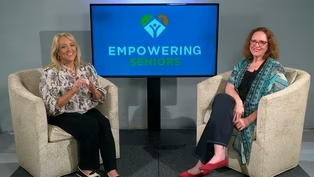
Empowering Seniors Episode 605
Preview: S6 Ep5 | 30s | Empowering Seniors with Katherine Ambrose Fridays at 8:30pm (30s)
Providing Support for PBS.org
Learn Moreabout PBS online sponsorship
- News and Public Affairs

Top journalists deliver compelling original analysis of the hour's headlines.

- News and Public Affairs

FRONTLINE is investigative journalism that questions, explains and changes our world.












Support for PBS provided by:
Empowering Seniors is a local public television program presented by PBS Kansas Channel 8