Empowering Seniors
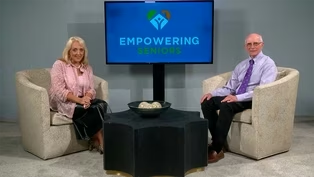
Empowering Seniors Episode 614
Season 6 Episode 14 | 28m 29sVideo has Closed Captions
Empowering Seniors with Katherine Ambrose Fridays at 8:30pm
Empowering Seniors with Katherine Ambrose Fridays at 8:30pm
Problems playing video? | Closed Captioning Feedback
Problems playing video? | Closed Captioning Feedback
Empowering Seniors is a local public television program presented by PBS Kansas Channel 8
Empowering Seniors
Empowering Seniors Episode 614
Season 6 Episode 14 | 28m 29sVideo has Closed Captions
Empowering Seniors with Katherine Ambrose Fridays at 8:30pm
Problems playing video? | Closed Captioning Feedback
Where to Watch Empowering Seniors
Empowering Seniors is available to stream on pbs.org and the PBS app.
Providing Support for PBS.org
Learn Moreabout PBS online sponsorshipFrom the Alvin and Rosalee Sarachek studio PBS Kansas presents Empowering Seniors Welcome to Empowering Seniors.
I'm your host, Katherine Ambrose.
We've talked about Alzheimer's before, but today we're going to start at the very beginning.
And to help us get there.
We have Doctor Sheldon press corn on set.
Doctor, press corn.
Thank you so much for coming to the Empowering Seniors Show.
Well, Kathy, thank you for having me.
It's a pleasure.
I've been looking forward to this for a very long time.
So how did you get into brain research?
You grew up here in Wichita?
Yes, I did.
I went to Wichita North High School and, Wichita State University before medical school at the University of Kansas.
But when I was 12 years old, I was watching a show that was called, I think, the Big Picture.
And it was a kind of a 60 minutes kind of program.
But the one that captured my attention was a person entering a bull fighting ring with only regular street clothes on and in his hand, rather than a sword or a cape.
He had a transmitter.
And then the bull came into the ring, and he hit one button, and the bull charged to him.
And then he hit another button, and the bull turned to start grazing on the grass.
And so right there, I visually saw the brain is related to behavior.
Remember I was 12 years ago.
I was 12 years old.
And so, you know, I hadn't thought about that before.
That's so fascinating.
At 12 years of age, that puts you on this path of interest about the brain and behavior.
Yes.
And so something I've been on for, over 50 years now.
It's amazing.
It's like your life mission was delivered to you through television, through a television story.
Absolutely amazing.
And so that puts you on a quest to learn about the brain?
Yes.
And then what?
Well, so.
So then I thought, you know, obviously I have to go to college.
I have to go.
I thought two different ways.
You could go to a PhD program or you go to an MD program.
I chose the latter because I wanted to make sure that what I was doing was directly related to the lives of patients.
And so what have you spent your lifetime doing in that pursuit?
So I've always been an academic physician, and that means that I have been at a university hospital or medical center.
And right now and for the last 40 years at the Kansas University School of Medicine here in Wichita.
And so I haven't had a practice like maybe most, patients think about most doctors.
I've always been in an academic setting, and I've always been training residents.
That's about 50% of my time.
And the other 50% of my time was doing research on the relationship between the brain and behavior, and what medicines could be used to treat disturbed brain function.
sometimes people's greatest fear is, what if I get Alzheimer's?
What if I get dementia?
And so you're working on that.
That's one of the topics I work on.
So, I'm what you call a clinical psycho pharmacologist.
Clinical patients.
Psychopharmacology.
That's brain and pharmacology.
And so my work has been on a number of different therapeutic areas.
Alzheimer's being one, but not the only one.
But Alzheimer's is certainly a very important component of brain diseases that affect the lives of not only the patient but their loved ones.
it used to be that maybe you couldn't get a diagnosis.
And I think it's still out there in popular thinking that the only way to diagnosis a diagnosis is after you've passed.
Yes.
And that's not correct anymore because now we can actually do images of the brain.
So using MRI's but even more sophisticated positron emission tomography.
And we can see the amount of amyloid plaque that is deposited in the brain.
We can measure the size of the brain and the shrinkage that occurs with Alzheimer's disease.
And then we also have now blood test that can be used.
Essentially tests of abnormal proteins that accumulate in the brain as one develops Alzheimer's disease.
And the viewer right now is looking at a slide.
And on that slide on what we call the x axis, that's the one that's going up.
And on the y axis the x axis is different abnormal proteins and how they accumulate in the brain over time.
And the x axis is the time line.
And what we actually see is 17 years before someone develops a disease we can detect an abnormal protein in the brain and in the blood.
And then as the viewer looks at that slide, there just a number of other colored lines, each one representing a different abnormal protein that accumulates.
And then you see a dashed line.
And that's where the diagnosis occurs.
But actually the disease started many years earlier.
And that leads to the possibility of early detection and treating before you actually ever develop the disease or prolong the time before you develop the disease.
Okay.
So we're going to talk about that.
And I have some specific questions.
But first I want to talk about the beginning.
How when did this come about.
The label of Alzheimer's.
Tell us the history.
Well, so it came from Germany.
And, in Germany, the academic physicians worked and stayed hospitals.
And there was one important, academic physician called Aimo Krupp.
One.
And he was the chair of the department, and he had two labs.
One lab was actually a pathology lab, and the other was a physiological lab.
And he was trying in the early 1900s to study the abnormalities in the brains of patients with different kinds of psychiatric disorders, one of whom was frow d, who came to the hospital, because of pathological jealousy and problems with memory.
His pathologist, Aimo Krupp, was pathologists.
Name was Alois Alzheimer and he was also a psychiatrist as well as a pathologist.
Then he took care of fraud.
When she died, he studied her brain and identified the cornerstones of the abnormality in Alzheimer's disease.
Now, when we say Alzheimer's disease, we're actually studying not what most people talk about Alzheimer's disease today.
Most people talk about senile dementia of the Alzheimer's type.
Senile meaning over the age of 65.
Well, frailty was much younger than that.
And so the original diagnosis was pre senile dementia.
And actually we now know that she had a gene abnormality that led to the production of abnormal proteins.
And those abnormal proteins are what Alois Alzheimer saw when he looked at her brain tissue on a slide.
Wow.
I've never heard that before.
So that's really interesting.
what has been the progression since then?
Well, since then, obviously one was studying how the disease unfolds and the disease unfolds by a gradual loss of brain function in the individual.
This is illustrated actually by a set of slides, paintings that a well-known artist did of himself.
Self-Portraits is the first one the viewer sees is when he was in 1967, about 2030 years later, he began developing memory and cognitive impairment.
And when he took his, drew his own portrait, as the viewer can see, with each passing year or even months, his ability to draw declined.
And that decline was secondary to the loss of brain function.
And so you can actually visually see it, but it's because of those accumulation of abnormal proteins that started 17 years before the disease was ever diagnosed.
Wow.
And and that's why there's so much fear attached to this.
Because you think of yourself as you think today.
And to think that you may lose that over time.
Yes.
And that's a great concern.
And it's actually a physical change in the brain.
That's correct.
Okay.
now I've heard about people asking, that are asked to draw a clock face out.
Yes.
And so what is the purpose of doing that?
Well, that's to show again, kind of like those paintings that we saw, as one develops Alzheimer's disease.
And most of the time it's senile dementia of the Alzheimer's type, the ability to draw, the face of a clock with the numbers in the right position and the right spacing and a circle.
All of that requires considerable brain function to do that.
And as one develops Alzheimer's disease, just like in those paintings, we saw the ability to do that deteriorates.
Wow.
And so there's tasks that people could do if they wanted to, to find out if they may have this in their future.
Yes.
There are a number of simple tests that can be done during an office visit, such as the drawing of a clock.
Now, today, you couldn't do that with, my grandson because he's only used to digital books.
Yeah.
So he wouldn't do so well.
But but but for h a he might get misdiagnosed.
Might get misdiagnosed?
So you always have false positives and false negatives.
So, you have to do age appropriate testing.
Yeah, So if someone wanted a blood test, they could seek that out.
Yes.
Now, this is going to vary, by the because some of this is only at the research stage, and it's not yet in routine clinical practice.
But a number of these tests are in routine clinical practice.
And for the viewers, they need to talk to their physicians about whether they think such tests are appropriate.
And whether the tests that we're talking about is available to them.
And I would imagine that'd be quite the conundrum.
Should I find out, should I not?
Yes.
And that's exactly so, you know, obviously, if we found out that well, first of all, would allow the family to sort of know what's going on.
And it would allow you know somebody it, it's sort of like becoming a child again in a way.
Because now your brain is not evolving.
It's devolving.
And so some of that would aid you in deciding, you know, what kinds of things to keep the person as functional as they can be.
The other is there are some forms of Alzheimer's disease that are purely genetic or close to purely genetic.
So frow de the lady we saw had the illness to begin with.
She had an abnormality and what's called Sunil and Gene.
And that is what we call autosomal dominant.
That means if you have that gene you're going to have the disease.
Well that's a very small percentage of people.
That's, you know, one 2%.
But there are other genetic abnormalities that increase your likelihood.
But you can mitigate those, through, diet, through, staying healthy physically, and through that becomes a target for us to develop treatments to affect that specific gene product or substitute the abnormal gene product for a functional gene product.
So Doctor Prescott and I assume that that this is going on all over the world.
It's not a Western issue.
No, it's not a Western issue.
So it's in every region of the world, all cultures.
Now, it isn't necessarily always exactly the same gene because some genes are more prevalent in certain populations.
And, actually one can now study how these gene abnormalities occurred during the migration out of Africa, which is now the prevailing theory.
And those lineages that went to the Western Hemisphere, particularly north or went to China and Asia.
So there are differences.
But we're beginning to understand that by understanding, the migrations of tribes and the gene abnormalities that occur.
And so you mentioned if you can identify the genes that are causing these issues, that now you have a target.
So explain that process.
Yes.
So it's like hunting if you don't have a target, you know, you don't have a bird.
You haven't flushed the bird.
You don't know what the target is.
And this, you know, is this a male or a female.
Which one is in season?
So you have to have a target in hunting.
That's exact the same thing when you're doing drug development research.
You have to know the target.
And so that when you when you know that a gene abnormality exists, you know the gene codes for proteins.
And so then you can go from the gene to the protein.
Understand that structure, understand what it's supposed to do, and then understand how you can influence it if it's not functioning optimally.
that's fascinating.
I mean, that really is a good explanation.
We have to identify what the problem is so we can start trying to figure out how we're going to hit it, what solutions we're going to come up with.
So when they were doing research at the turn of the century, how did that develop over time?
So over time.
Well, first of all, it was a matter of understand in the brain, which was a tremendous challenge because, it's the most complicated organ in the body, and it's inside a bony cage.
And so it's difficult to observe it.
And the output of the brain is so complex.
I mean, your ability to appreciate music, your ability, to do mathematics, your ability to speak languages, there are all these different functions.
And so the initial stage was just understanding the brain itself.
And also understanding that which people had dementia of the Alzheimer's type.
But at autopsy by studying their brains.
But eventually we've developed technology.
And that technology allowed us to study the brain, remotely by, you know, scans and things of that nature.
So over the decades, this technology and other things that you've identified is really making a difference.
So are we making progress?
We are making progress.
There's still much progress to be made, but we are making progress.
And now there actually are, approved drugs that are on the market to slow the progression of Alzheimer's disease by taking care of the abnormal proteins.
These, you know, require obviously your primary care physician, but eventually also a neurologist to properly examine you determine that this is actually what the problem is.
And then to, think about the options.
But there are now options to treat the illness.
So we're options a number of years ago that are still available can still be helpful that, improve brain function in somebody who has declined brain function.
So there's been progress that's been made particularly over probably about the last 30 years.
And what about like most recently is there any big strides or do you feel like you're close to something.
Well and of course it's not me but but rather mankind who are, you know, pharmaceutical companies, academic physicians.
And yes, there are many, many, advances being made.
Some are still in the laboratory stage.
Some are moving in to human testing.
And some will actually eventually make it to the market.
But as I say, there are already drugs on the market that can be used in, the properly selected patients to slow the progression of Alzheimer's disease.
So there is hope, because first of all, there's different types of dementia.
Yes.
And there's different types of Alzheimer's.
Yes, actually.
So dementia is a large umbrella term.
And under that umbrella there are many different types of dementias.
And many of them are fully treatable because you can have dementia if you look at each letter in the word dementia D for drugs.
So drugs can cause dementia E for endocrine, endocrine logic problems such as thyroid M for metabolic.
So I could go through each letter.
And those are all treatable forms of dementia.
And they can be reversed by supplementation, depending upon what the nature of that cause is, because that's another thing that's kind of out there in popular thinking, is that there's no cure.
There's nothing you can do about it.
And there could be there could be hope.
Why would it be important to try to assess what's going on and have an understanding of what might be happening?
Well, you're correct.
And actually, I'm going to go away from Alzheimer's disease.
But just to show you what, advancements that can be made and has been made in the early 1900s, about 20% to 25% of all people admitted to psychiatric, hospitals were for illnesses that no longer exist.
They've been a radical, hated.
And one was due to an infectious agent and another one was due to a vitamin deficiency.
And once those saints were identified, then you could stop the person from having the disease.
Wow.
That's another thing in Popular thinking is that we don't have these hospitals anymore.
So people are just out there suffering with these things that maybe a lot has been addressed.
So 20% of all, admissions in the early 1900s were for illnesses that no longer exist.
Wow.
who would a family go to or someone go to to try to, get some answers about what might be going on with their cognitive processes?
Well, most people are going to start with their primary care physician.
And the primary care physician can, for example, evaluate for those what we call treatable causes set dementia by blood test.
Simple blood test.
And so if it turns out that the problem is a low thyroid gland that can be detected, it can be confirmed by a laboratory test.
And then, thyroid supplement can be given, just as one small example, if it is more complicated than the primary care physician may want to have brain imaging studies done such as CT scans, MRI's, and even now, more advanced positron emission tomography.
And they may want to involve two other specialists, a neurologist and neuropsychologist that can help to assess specifically what the abnormalities are in functioning.
So you are you're solely going to start with your primary care physician.
And then they will bring in other test, imaging and other specialists as needed.
So a neurologist, what do they specialize in?
Well, they specialize in the brain.
They specialize particularly in motor systems and strokes and things of that nature, although they also treat migraine headaches.
But they are an MD who's also specialized in certain kinds of brain disorders.
And a neuropsychologist is not a medical doctor is a psychologist, but he's they specialize in giving functional test to see where the abnormalities in function are and how severe they are.
So we began the episode with the graph showing there could be a 17 year head start towards this.
Yes.
What could people do to maybe not squander this 17 years and hedge their bets?
Well, so, again, there are, blood tests that can be made of these proteins.
Now, they may not be available in this community because are, specialized, laboratory tests that are still somewhat investigational.
But you start with your primary care physician.
You see whether or not these tests would be appropriate for you.
And then there are a lot of good healthy living, that can aid in the process and also stay in tune with what's developing in research so that you may want to participate in a research study, where they're doing work to test new treatments that may work and help diagnose you.
And so there are a number of things that people can do.
And certainly living healthy in terms of diet, in terms of exercise, in terms of rest, are all going to aid in slowing down disease process, whether it's Alzheimer's disease or other.
Those are just huge factors.
The the exercise sleep stress.
They're probably also purpose making sure that you're plugged into passion.
Yes.
It keeps you future focused and keeps your brain, really alive.
Well you do need to keep your brain functioning because if you put it to sleep, it deteriorates.
You know, not not during normal sleep, but talking about living an inactive life.
There you go.
And maybe, you know, isolating.
Sometimes as people age they become very isolated in their home.
And so they're not getting that socialization.
Yeah.
So there is what's referred to your brain needs stimulation.
And if it doesn't get that stimulation then that region of the brain begins to atrophy or get smaller and get less functional.
And so for example, there are studies that show that using hearing aids, if you have a hearing deficit, because if you have a hearing deficit, the brain is not getting that stimulation.
And so that deficit tends to get worse.
chair.
Doctor.
Pressman.
Have you been tested or would you get a test like that?
Would you want to know?
I would want to know if I had a strong family history.
So you can look at your family history.
And if your family has a number of people who've developed dementia, because it does tend to run in families.
And again, dementia is a broad term.
And so if you have a strong family history, that would be more reason, just like, strong family history of cancer would be a reason to get tested for those diseases.
And again, this would be through a conversation with your primary care physician about, you know, what your risk is.
Again, that physician may bring in other specialists, depending upon the nature of the question and depending upon, you know, what is your family history?
Wow.
You've really laid out the groundwork for us so that we can have a better understanding of the beginning and that there's hope out there.
So I really appreciate you being on the show and all the work that you and your colleagues are doing around the world.
It's incredible.
It is amazing.
And, thank you for having me here.
And I hope your viewers have found something in these comments that are useful for them.
I think just knowing that there's hope out there and, just knowing that there might be a lot of myths out there and, you were doing some myth busting.
So thank you for being here.
And thank you so much for watching.
If you have questions about this topic or anything else that we cover, you can reach out to us at EmpoweringSeniors@kpts.org I'm Katherine Ambrose, and I'll see you on the next Empowering Seniors.
Empowering Seniors Episode 614
Preview: S6 Ep14 | 30s | Empowering Seniors with Katherine Ambrose Fridays at 8:30pm (30s)
Providing Support for PBS.org
Learn Moreabout PBS online sponsorship New Episode
- News and Public Affairs

Top journalists deliver compelling original analysis of the hour's headlines.
 New Episode
- News and Public Affairs

Today's top journalists discuss Washington's current political events and public affairs.
 New Episode
 New Episode
 New Episode
 New Episode
 New Episode
 New Episode

 New Episode
Support for PBS provided by:
Empowering Seniors is a local public television program presented by PBS Kansas Channel 8