Empowering Seniors
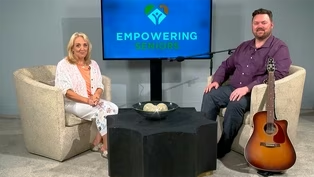
Empowering Seniors Episode 616
Season 6 Episode 16 | 28m 29sVideo has Closed Captions
Empowering Seniors with Katherine Ambrose Fridays at 8:30pm
Empowering Seniors with Katherine Ambrose Fridays at 8:30pm
Problems playing video? | Closed Captioning Feedback
Problems playing video? | Closed Captioning Feedback
Empowering Seniors is a local public television program presented by PBS Kansas Channel 8
Empowering Seniors
Empowering Seniors Episode 616
Season 6 Episode 16 | 28m 29sVideo has Closed Captions
Empowering Seniors with Katherine Ambrose Fridays at 8:30pm
Problems playing video? | Closed Captioning Feedback
Where to Watch Empowering Seniors
Empowering Seniors is available to stream on pbs.org and the PBS app.
Providing Support for PBS.org
Learn Moreabout PBS online sponsorshipFrom the Alvin and Rosalie Sarachek studio PBS Kansas presents Empowering Seniors Welcome to Empowering Seniors.
I'm your host, Katherine Ambrose.
Today we're talking about music therapy.
I'd like you to meet Wyatt Sheeder.
He's the new executive director of seniors services of Wichita.
And I got to meet him recently during a music therapy session for empowered Senior.
Why thank you so much for being here.
Thanks for having me, Katherine.
So I recently got to see you do a 15 minute music therapy session for a crowd at Botanica for Empowered Senior Seminar, which inspired the show.
And I thought, I've got to get you here to the TV show.
So thank you for being here.
Well, thank you for asking.
I really enjoyed that and got a lot out of seeing the reactions of the seniors in the room.
They were really engaged and asked great questions and frankly, I could have gone on and on.
So this is perfect.
To segue and we get to spend more time.
Absolutely.
So tell us first what is music therapy?
Music therapy is the intentional use of music by a certified professional to achieve therapeutic goals.
Now that sounds like a mouthful, but really the key components are that there's someone that's certified as a board certified music therapist, and then they basically assess the person in this situation to try to achieve whatever outcomes are necessary.
And so when do people use music therapy, in school systems.
In fact, in Atlanta, y'know, you've been spending some time down there filming.
There's a lot of music therapists in the school systems.
In Chicago where I first worked, there's a lot of music therapists in the health care environment and hospitals and hospice, so basically wherever they can get work.
But there are lots of applications across lots of populations.
The prison system, mental health rehabilitation, education, early intervention, autism, lots of applications.
So tell us about the power of music.
Why is music so effective reaching people?
Well, it's for most people, mostly non-threatening.
Right.
So you think of music in a mostly positive way.
So it gets us in the door.
Right?
So it's also very structured.
So there's elements of music that you can use that are predictable.
So for example, if I were to start singing a song songs have a structure.
So if I were to start singing you are my sunshine, my only sunshine.
So you know what's coming next, right?
Songs also have, a chorus and, verse structure.
So, you know, we might sing the verse to, to a song, you know, home on the range, for example.
And then people might not know that part, but we all can come in on home, home on the range.
So you're using these elements of music, right.
The structure, their predictability, the container of the music to achieve whatever the therapeutic goal is.
So an example in hospice when I worked in hospice would be, you know, letting them make choices, because when we're in a health care environment, we don't always get to make lots of choices for ourselves.
And a lot of seniors, end up in environments where they're having tests and they're being held for observation or rehab.
And so coming into that environment where you can then offer them some choices that are tailored to their preferences, that's another really important part of why music is powerful, because we try to do what the client prefers.
Right?
So if I was working with Katherine as a client, I might ask you, well, what kind of music do you like?
And you would say, I liked that first song.
I mean, I'm very familiar with both of those songs.
And so you might.
Do you like country music?
Do you like a little bit?
Maybe some music?
I grew up in the 1980s because I like the 1980s, so I might be doing like eye of the Tiger might be doing, you know, it just kind of depends.
And that was kind of the fun thing about working with so many diverse clients is learning the music that they loved, and that was important to them, and then tailoring it to fit the therapeutic need, whatever that might have been.
What a match for empowering seniors, empowering people and giving them choices so they have agency over something that's going on and and it really can.
Music can take you back to your childhood.
It can take you back to any time in your life.
And so what does that do for the brain when you're connecting emotionally to music?
Yeah, that's such a good point.
And we saw that that day in the room.
Remember we played I played a couple of different things and I kind of thought, well, what's your reaction to this song or that song?
And people have different memories that are associated with different songs.
So if you think of like maybe your song that was played at your prom, right.
And I think about my prom song, they're different, but they will hearken similar memories to that time.
And you don't really have to work very hard to get back to that place.
So for that reason, music is a powerful tool.
It's perceived in a different area of the brain than just speech, and it's connected to the limbic system, which is like the memory center of our brain.
And so that's why for a lot of folks that have maybe Alzheimer's, dementia, any sort of organic brain disease, music can really get in and connect some of those, memories, connect some of those experiences that are otherwise inaccessible to that person.
And sometimes they can even kind of spark back a little bit, too.
Oh, yeah.
Absolutely.
You know, sitting down and asking somebody, you know, tell me about your childhood, right.
Versus, you know, what kind of music were your parents listening to when you were growing up?
Oh, you know, my mom used to always listen to the radio.
We used to listen to gospel music.
So, amazing grace, totally different conversation happening now.
Different experience, different memories.
Again, it it's a safe place for people.
And that's the music therapist's job is to make it safe, comfortable, tailor to that person.
And I'm just singing comforting too.
Like, how comforting would that be to hear amazing Grace when you're struggling with something?
Yeah, a lot of my work in hospice, was that, you know, maybe they're not having the best day.
Maybe they're.
They just got bad news.
Maybe they're in pain that day.
So using music as a tool to achieve the outcome of relaxation, spiritual support, decreased pain through, some different techniques.
Music therapists are trained to use.
Exactly.
Paints that picture of using music in a therapeutic way to achieve an outcome.
And that's that's the gist of what music therapists do.
So you did this, through hospice.
And what are some of your other experiences using music therapy?
So I also worked, with a cancer center in Chicago, with people that were getting chemotherapy infusions.
And so imagine that environment is also already kind of, no one wants to be there.
Right.
Kind of sterile.
And so I would go around to all the folks in their treatment chairs, hooked up to their, their IVs and engage in conversation, much like you and I are doing, and just say, hey, you know, can I sit with you for a few minutes?
And then, you know, play music that's important to them.
Relaxing.
You can kind of tell, you know, part of music therapy is assessing.
So if they're kind of grimacing or just eyes closed, I might say, can I just play some background music for you?
What do you like if they're maybe having a better day, give them some choices and let them pick something.
And so got a lot of positive feedback from them regarding it making that experience better.
And then if they had family members with them, that gave them something to do.
Absolutely.
A way to connect with each other.
Sometimes people think that it's just going to be depressing dealing with an illness or with hospice, that some of your most important moments in life can happen.
And I can see how music could help bring that out.
Yeah, absolutely.
I worked with a client in Chicago that unfortunately was rather young and passing away, and she had two young children.
And, you can learn a lot from someone by asking the question, what are you most concerned about?
I think that's a good thing for caregivers and seniors in general or anybody to to remember, because it's not always what Katherine and why I think the answer might be.
And so this this woman said, well, I'm really worried that my kids are going to forget about me when I'm gone, which is heartbreaking.
But also, you and I might think, well, that's never going to happen, you know?
But to her that was a real concern.
So we discussed that a little bit.
And then we ended up writing a song for her children for when she passed away.
And, and then we were able to record it, I recorded it, and then she had input on the contents of the song, and then we were able to give them a recording, and then I ended up, playing the song at her memorial service.
And so I don't know where those kids are now.
They're out there somewhere.
Right.
And so I hope that that's a comforting to them that they can look back on that, and have that legacy.
And it meant a lot to that patient to be able to communicate some of that stuff.
Yeah.
To her children that she frankly wasn't going to be around to talk to them about so she could create a memory that, that maybe they could really hang on to and left them a gift.
As part of her legacy, there had to not be a dry eye in that memorial service.
Yeah, yeah.
Including mine.
That's kind of something that I got asked a lot.
And you mentioned before, like, it's kind of depressing and in a way, I think.
But we all meet the world with our talents, with what our talents are and the needs of the world.
Like that's where, like, really intersects.
And that's why working with, hospice, working with seniors, my whole life has really been around that, you know, where where do my ability meet the needs of other folks, and not everybody can or should do that job that I was doing?
I couldn't do other jobs.
I couldn't be a bank president.
I couldn't, be an accountant.
Right.
So I think, yeah, people have different levels of comfort for, whatever that is.
And, and I think that's fine and natural and.
Okay.
And all the more reason why and injecting music into that environment, you know, it's kind of a social encourager.
You know, maybe there's family around the bedside that don't know what to say or do, but the music therapists can give them that outlet to me.
I really can't think of anything more wonderful than having music in that time.
I just think that would be the most amazing thing.
And, I think you're right that it's important that people use the gifts that they have because we all have different gifts.
No one would want me to sing a song.
And, and our seniors are that right that you you interact with all these, you meeting all these amazing people and these professionals and seniors have such great stories to tell and such a message for all of us, you know, resilience, hope.
Perseverance.
I mean, it's such a an encouraging thing.
And I think that's why what you're doing and is so important, just the fact that there's programing geared toward a senior population, that is, you know, sometimes, frankly, they do feel a little unseen and unheard.
And that's kind of why I'm so happy that I've ended up now at senior services, because it's kind of a culmination of much of what I've already done in the work that I've, that I've been passionate about.
It sounds like you are perfectly equipped for this role, because senior services of Wichita have been around for a long time.
It's a charitable organization.
How long have they been around?
it'll be 60 years, in 2028.
So 58 years.
And they had the most delightful executive director that just retired.
Laurel is, is, was and continues to be a treasure.
And I still, when I'm out in the community, hear great stories about her and I'm happy to listen to them.
And I'm honored to carry on her legacy of her work there.
Well, just knowing what senior services Wichita does and what great leadership they've had, that's quite an honor for you to come into that role.
And man, I think they did a great job finding you.
Thanks.
Yeah, I appreciate that.
And I don't take that lightly.
It wasn't something that I was seeking out necessarily.
But it the opportunity came up.
And the more I thought about it and how my experiences and my goals and frankly, you know, what the agency needed at the time really, overlapped.
And so it's been a great experience.
And, you know, for those that might not know, Senior Services of Wichita has Meals on Wheels program for homebound seniors.
So they get meals during the week.
We have community meal sites for folks to go eat.
We have a senior employment program and, for senior centers across the city.
And all of that feeds the senior population in different ways.
And not just them, but, you know, everyone that's involved volunteers, intergenerational programs.
All that I know volunteers are greatly touched by what they do and it doesn't mean volunteering all the time.
You might be on a rotation or you might help with a special event.
But I do run across volunteers that just tell me how much it's touched them.
And it's so interactive.
All the all the services that you have.
What do you think is the biggest misconception that maybe some of our viewers might have about what senior services is or what a senior center is?
I think people believe that we are a state or government funded agency, and that we are kind of set it and forget it in a way, and we're fine.
That's not true.
We have to raise, over a third of our annual operating expenses for our programs.
We do get some funding from those sources, but we are an independent local nonprofit.
And so that would be the first thing I would say is lean in, find out more.
If you can volunteer, great.
If you can contribute financially, great.
Learn more about what we have, share our programs with other folks.
And here are the programs for how would you describe, what the senior centers are for sure.
So anybody that's 55 and older that wants to do educational activities wants to play pickleball, wants to play cards, wants to meet people, wants to do special events.
All the trips, create programs, crafting, technology classes.
Anybody that wants to lean in and just get out in the community, we've got four senior centers that, people can, register to be members.
It's $35 a year, which is very, you know, I think reasonable for most folks.
And, they get access to all four of the senior centers.
That's the main activities.
Yeah.
It's amazing all the things that are available for $35 a year.
Yeah.
and I think, too, that when you have people plug in and participate too, that encourages everybody and it just makes it more energetic and fun for every.
Yeah.
You know, somebody might have said when I my first week, I went to like a craft class at our Lynwood Senior Center and I'll tell you, Katherine, crafts were happening, but support was happening.
Connection was happening, validation was happening.
Sharing of resources.
I mean, you get people around a table doing an activity and they just start to open up and engage.
And, you know, we've heard over and over and you talk a lot at your empowered senior events.
Socialization is so vital and important.
It has mental health implications, physical health implications.
So yeah, get out in the community and find out, what's available.
We have a website, SeniorServices@wichita.org.
It's all on there.
Easy process, lots of information that people can flip through and see what they might be interested in.
I would say you never know when you might meet your next best friend 100%.
So get out there and, connect plus share your skills.
Because I know that ladies are teaching each other how to quilt.
Yes, people are helping each other figure out how to declutter.
I mean, people are really working together to help each other and and using their talents.
Yeah, that's another point.
That's great.
People can get involved by reaching out to, senior services and say, hey, you know, I, I do this, I would love to come talk to a group about it, or I took a trip and I'd love to come talk about it, or I know how to do this kind of craft or activity, you know, do you have space for me to come?
And we would love to have people come and engage in that way.
So that's really cool.
So that's a great idea for viewers.
Like you can use your stories, you can use the gifts that you've developed over your whole life and figure out a way to plug in to the community.
So it's uplifting for you and you're doing good for others.
That's the best way to tell.
The best about yourself, too, is to get out.
Don't you feel good when you, you know, go and do something and engage and volunteer time?
And not only just here in Wichita.
I know folks all over the country see your show and find out what's in your community and find out you know what is available, how you can get involved.
Share those resources with people.
I think especially if you have musical talents, I want you to plug in.
So and so how did music therapy start with with you and maybe this love of senior start with you?
my mother, was a social worker, and from a very young age, I was very attuned to the fact that we're not getting the whole story about everybody all the time.
And leaning in and and being inquisitive and being a good listener and asking questions and so she helped, folks with intellectual disabilities engage in work in whatever environments they were able to do.
And so that really imprinted on me.
I actually lost her when I was ten years old.
And so that definitely impacted the trajectory of my career in junior high, I wrote a research paper about hospice, which I don't know that that was normal, but it was what I was interested in, frankly, what I had kind of been exposed to.
And so, and she she always fostered my love of music, as did my father.
He bought me my first guitar.
But yeah, just kind of being around supportive folks that really felt like, hey, you know, Wyatt likes to sing.
He likes to do this.
I got involved with a children's choir that was kind of above and beyond just the school stuff, and that was really impactful.
And then in college, I sang and we got to travel and meet people, and it's just doing music is just a very good way to move about the world and to get to meet people and frankly, creates opportunities to, you know, present on, a program or do things like this.
It's a good way to get in the door, like I said.
And, it's just passionate.
And I actually took an interest inventory in, in high school.
I don't know if you used to do that or meet with your guidance counselor.
And this music therapy thing came up and I thought, well, what is this?
And so that kind of started my, my quest to learn more.
And like I said before, it really was a good fit for, you know, my abilities.
And, you know, I think a lot of young people say, well, I want to help people.
And so that's vague.
But this was a way that I could do that.
And that was very specific.
Yeah.
That's the thing to do when children are exposed to situations, they can really be impacted, end up serving for the rest of their life and, you know, kind of find their path that way.
Yeah.
And speaking of musicians, too, I think people that have a love of music and they want to perform, you know, we have musicians here in Wichita that are keeping the live music scene alive, and many of them are retirement age.
And so that's the cool thing said music timing your talent or monetize on it, you know, don't you know, give it away if you can, you know, earn some extra income.
And, I sing with the Wichita Chamber Chorale, which is a, community music group, and that's how I stay engaged.
And the other thing that's great about music, Kathryn, is you can do it your whole life.
I mean, if people do have vocal issues or, you know, motor issues if they're instrumentalists later on, but it's really something that you can do a lot longer than a lot of other, you know, activities, maybe sports or things like that, and maybe people that aren't like music families might not know to encourage children and grandchildren to think about joining choir in junior high and high school, because the best people teach choir, and there's so much opportunity that can come out of that.
My daughter had a full scholarship, for choir for college, and then she got to go be an intern at Disney.
That came from saying yes to doing choir.
Listen, I'm from a very small town in Iowa, about 1500 people.
My county has no stoplights in it still.
And the doors that music open for me, inclusive of travel, inclusive of career opportunities, educational endeavors, meeting people.
I mean, there's no substitute for it.
I can't imagine my life without music.
I feel I feel that way about seniors also.
Just always have been around, and appreciated that population.
And I think the fact that I approach it not as, something to be overcome, but as, an asset and a joy, you know, to work with seniors and to to learn from them and to engage with them, because they know.
They know when people aren't coming from that place.
Absolutely.
So, and and really people that work with seniors, they're doing it for a reason that usually does go back to family, and they're very passionate and serious about it.
Otherwise they went at last.
They wouldn't stay in it.
True.
Another thing I want to say about, that is I have a my grandmother on my dad's side is still living.
She's 96.
She lives in the house that she's lived in for 70 years.
Her farmhouse and with some help.
she it's always come to my music concerts, and, she wasn't necessarily hard of hearing, but, I was always really over enunciating when I would sing.
And that's something that I, I learned from being around older people or people that maybe don't hear as well.
And, I thought that was normal.
But so to this day, whenever I'm singing something, I always think, well, you want it people to understand it.
So.
And I always have her, you know, voice in the back of my head.
So nice.
Yeah.
what are some of your.
You've shared some of your stories.
What if you think back, like, what's one of your most touching stories?
For music therapy.
Yeah.
I had a gentleman that, had dementia, and he lived with his wife in an assisted living apartment, and it's such a sweet couple, on the West side of Chicago.
And they were kind of just getting by every day, and she was helping care for him, but not a lot of interaction or, like, substance was happening.
And, one day I said, what if I try?
You know, just to see if we can play some songs that he knows and likes and see what happens.
And she was kind of like, okay, you know, she kind of thought she knew what was going on, but nothing would really happen.
But I, you know, I was like, pardon me for that.
The Chattanooga Choo Choo choo.
And he started singing track 29.
Boy, you can give me a and I would live a little pause, shine.
Well.
Her face lit up and he was smiling and engaging.
The music had gotten through some of that organic brain disease, and he was able to engage in the music.
And then following the session, he would talk with her a little bit, oh my.
Whereas he wasn't before.
So we created this.
They call it a legacy project and music therapy fields, where we recorded some of his, singing along with me, and he chatted with me a little bit, and I tried to kind of capitalize on that.
And so now they had this recording, and I think he had many children.
It was a big family.
And so they all got a CD back in the days when we made CDs, Katherine, they all got a CD and we even did like the cover art.
We took a picture of the family with him.
And so yeah, they have that there.
Hopefully.
Maybe.
So listening to that and just so the legacy of it, but also the experience like, you know, the music therapy gave his wife a gift of her husband again for however many minutes.
That's amazing.
And then the children were able to I think we even did some liner notes and the kids contributed some anecdotes to some of the songs.
Well, dad used to sing this in the the Chevy when we would drive to vacation in Michigan and or, you know, this was a song that he, you know, sang when he was, you know, in the service or whatever the case might be.
And so, yeah, all those opportunities, those little nuggets that, that the music therapy unlocked.
And so I would just encourage people, even if it's not official music therapy context, you know, tell your family what music you like.
What do you want to hear if you are in a situation where you can't communicate, what do you want them to put on the playlist?
What do you want them to play at your service?
Maybe something good to talk about because in my experience, as much as people drag their feet about those conversations, it's always better to know because you know, things happen.
And then if the family doesn't know, you know, it's like you have a lot of these conversations with folks about, you know, your living situation or your your care situation or whatever it might be.
It's like, have the conversations.
And on the other side of that is going to be so much great, so much more and great gifts for everyone involved.
I think having that conversation, there'd be laughter and surprise and like, oh, I didn't know that.
And so much easier conversation.
You know, a lot of the other ones you might have.
Yeah.
Kind of planning.
Absolutely.
So music seems like an easy entry into a great conversation and laughter and creating some memories.
Yeah.
My dad told me, one time it just astonished me.
He said, if I could have done anything in life, I would have been a singer.
And my dad was like a big macho businessman, and I was bored.
And so you just never know you down.
And so have those conversations and just the memories when it opens up with folks.
And, there's some really cool stuff out there now with like, legacy, you know, you can get like an app and it prompts your loved one to answer a question every week, and then they make a book or just just sitting down and have the conversations.
I mean, but I think, a takeaway for, for everybody watching is use music to your advantage to have those conversations.
If you want to know about something, just start with, you know what?
What music did you remember what your wedding song was?
What was your prom theme?
What did your parents listen to when you were growing up?
folks generally gravitate toward those songs that they knew when they were in their late teens or early 20s because, frankly, we didn't all have a lot of problems and responsibilities.
And that just kind of what sticks and so.
Right.
Yeah, it's the the world opens up and so yeah, use use that to your advantage, for yourself, but also when you're trying to engage with, with your friends and your family, a great way to change somebody smooth.
Oh, yeah.
Or make sure they're having a little more fun.
We had my mom and a friend, for a week of family vacation, and we listened to the BGS all week, because that's what he.
When try to have a bad time listening to.
And you know what?
We're still listening at the lake to the BGS.
Yeah.
Because they're really great week time.
You listen to that, it's going to transport you back to the lake, right?
Yeah.
And and thinking about him.
So yeah, that's that's great.
And have those music experiences and lean into them and treasure them and, Yeah.
Just, appreciate the folks that you have because they won't be here forever.
So, you know, I think, when I got this position, it was a big deal for me.
And, I had a couple people call me and said your mom would be very proud, and, when you've had a loss like that, it every milestone of your life, you kind of experience it over again.
again, just, you know, being honest and vulnerable and having those conversations is just really what it all comes back down to for me.
And and it really connects my work in music therapy.
And then where I am now is senior services is we're all trying to do the best for the seniors that get our services that we can.
And, make their lives better.
Yeah.
You know, and I can't think of anything better than adding music to it.
Yeah.
So why I thank you so much for being on our program.
Thanks for having me.
My pleasure.
And thank you for watching.
If you have questions about music therapy or anything else that we cover, reach out to us at EmpoweringSeniors@kpts.org you can email us.
We'd be happy to see your comments.
Until next time, I'm Katherine Ambrose and this is empowering seniors.
Empowering Seniors Episode 616
Preview: S6 Ep16 | 30s | Empowering Seniors with Katherine Ambrose Fridays at 8:30pm (30s)
Providing Support for PBS.org
Learn Moreabout PBS online sponsorship New Episode
- News and Public Affairs

Top journalists deliver compelling original analysis of the hour's headlines.
 New Episode
- News and Public Affairs

Today's top journalists discuss Washington's current political events and public affairs.
 New Season
 New Episode
 New Episode
 New Episode
 New Episode



 New Episode
 New Episode
Support for PBS provided by:
Empowering Seniors is a local public television program presented by PBS Kansas Channel 8