
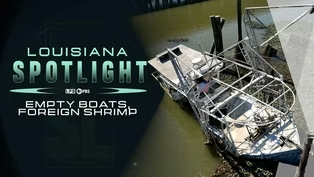
Empty Boats, Foreign Shrimp
Episode 13 | 58m 24sVideo has Closed Captions
The viability of Louisiana shrimping is at its tipping point.
The distinct flavors of Louisiana’s Gulf shrimp make them a favorite for families, but the industry that’s been putting these shellfish on tables is facing challenges that have been mounting for decades.
Problems playing video? | Closed Captioning Feedback
Problems playing video? | Closed Captioning Feedback
Louisiana Spotlight is a local public television program presented by LPB
Empty Boats, Foreign Shrimp
Episode 13 | 58m 24sVideo has Closed Captions
The distinct flavors of Louisiana’s Gulf shrimp make them a favorite for families, but the industry that’s been putting these shellfish on tables is facing challenges that have been mounting for decades.
Problems playing video? | Closed Captioning Feedback
Where to Watch Louisiana Spotlight
Louisiana Spotlight is available to stream on pbs.org and the PBS app.
Providing Support for PBS.org
Learn Moreabout PBS online sponsorshipSupport for this program is provided by the Foundation for Excellence in Louisiana Public Broadcasting.
And from viewers like you.
And welcome to Louisiana Spotlight.
I'm Christina Jensen, your host for tonight's show.
Louisiana's shrimpers, once a thriving community, are now struggling to stay viable as an industry.
Tonight, we take a close look at the problems in the shrimping industry and how they have trickled down into every aspect of Louisiana's favorite seafood.
We are exploring everything from increasing foreign imports, flooding markets to restaurants and shrimpers attempts to keep up with new rules and regulations.
Gulf coast shrimping has been around since before Louisiana was born.
What started with handheld casting nets in the 1700s grew into a multi-million dollar industry, one that provided fresh shrimp to southern states and can shrimp across the nation.
But in the past few decades, foreign shrimping companies have mastered farming, processing and shipping in a way unmatched by local efforts.
With the rising scarcity of local shrimp, scientists and lawmakers across the South are looking for solutions from labeling to DNA testing.
In just a few minutes, we will show you a live demonstration of shrimp DNA testing, one of the most powerful tools currently aiding the shrimp community.
But first, we talked to three pillars of the shrimping community for their take on shrimping.
Unstable situation.
My name is Dana Hahn.
I am a chef restaurateur here in New Orleans, and I work with a number of different organizations.
Those include Louisiana Shrimp Festival and Shrimp Aid.
This is Nikki Izakaya, where a bar restaurant, essentially.
One of the things that we're always trying to do is to build relationships with our local fishers.
Part of that process involves being able to develop relationships and come up with dishes and just ways of preparing seafood in a way that's accessible.
One of the the big issues is imports, specifically farmed imports from a handful of countries.
One reason that folks do use imported shrimp is because they can get what we call IKF or individually frozen shrimp tail on, but peel easily and, you know, say $7 a pound.
That same shrimp is available in Louisiana, but it's not a product that is as common maybe, as it should be.
Our processing prowess isn't as modernize and as nimble maybe as it should be.
Do you need anything else that imported farm shrimp is being peeled by hand, often in a labor force which is being forced to to peel that shrimp?
We can't and won't compete against slave labor.
A lot of times it depends on the circumstance.
For example, we do Jazz Fest, so I'm looking at several thousand pounds of shrimp.
I can't have enough peelers out of Jazz Fest to produce that much.
And peel shrimp.
I have to get hand peeled plate frozen shrimp that is exceptional in order for that to work.
So there's obvious pressure on our fishers be able to kind of break even.
It's like as a shrimper, how can you afford to pay for the fuel on your boat, let alone, you know, a crew?
If you're getting $0.60 a pound at the dock, it's just not possible.
So consequently, especially over the last few years, we've seen folks just not taking the boats out.
The reality is that without the shrimpers, we really don't have an anchor for our seafood industry, because a lot of the processing, a lot of the infrastructure is built around shrimping.
So many of the people who came and inhabited our coasts and created these, these coastal communities, they came from all over the world.
You can you can talk about Croatia, the Philippine, China.
And the fact is that each of them had skin in the game on the coast.
We owe them for the culture that they've helped to create.
My name is Katrina Williams, and on my business card it does say special Programs coordinator, although I definitely wear many hats.
Coastal Communities Consulting is a nonprofit located in Gretna, Louisiana.
The short of it is we help shrimpers sustain their businesses, their livelihoods with the myriad of services that goes along with maintaining a business everything from licensing to permitting to safety examinations, translating.
We like to fashion ourselves as the wives of thousands of commercial fishermen.
The demographics majority are Asian, in particular Vietnamese.
So 79% of roughly our 2300 client base are Vietnamese.
I would say the age range between 50 to 60 years old.
They're struggling with competition from overseas in ports, regulations, a lot of red tape.
And I'm saying that also domestically as well as internationally.
It's hard to compete when other countries aren't playing fair, even if imports were to go away.
They are still dealing with domestic issues in particular, like for example, licensing.
The cost of having a license have tripled over the years, and many shrimpers need multiple licenses.
Most of these licenses are only good for a year.
It's very hard to keep up with those rules and regulations, especially with how do these fishermen get that information right?
Because a lot of them are not tech savvy.
They're not going online.
They're not checking emails.
A lot of the information they get either comes from us or from family, friends or other fishermen.
Unfortunately, a lot of shrimpers mistakenly thought that the tariffs would be an immediate solution to fix the problem of them not being able to sustain their businesses having to compete with imports.
A lot of information that's coming down is not in their languages, and having to rely on other people to interpret for them.
We are in this office.
We try to be a political in that sense, but we do try to educate our clients the best way we can in regards to how government processes work and how they'll impact them directly.
Also, just the economy, the cost of doing business, the the prices of their equipment going up, the price of diesel skyrockets compared to what they're getting at the dock for their catch.
They are hard workers.
They know what they're doing.
These men and women do not want a handout.
My name is George.
I'm third generation commercial fisherman.
60 years ago, I was ten years old.
I go out every summer with my dad.
There was hundreds of shrimp boats on his bayou.
Now there's ten.
That goes to show you how bad it was.
There was 30,000 of us in Louisiana.
Now we're down to 2500 productions.
A bit about the same.
Okay, but the price is so low for the shrimp product that we sell at the dock.
Not necessarily to individuals, because we get a fair price for that, but it's just not enough.
About 14 years ago, the influx of imported shrimp just skyrocketed.
The more they supplied, the less I was able to sell of mine.
So my price had to go down for me to sell a little bit more.
So now we only sell about 6% 9,394% is imported truck.
But you don't know that because when you see on that package you see processing USA product of Indonesia on things.
Back in 8086, I was getting 210 to 20 year pound for the shrimp.
I'm getting $0.60 a pound for.
Now you do the math.
It don't work.
I do feel hopeful about Trump Tower because it actually worked before he even got elected.
From last year to this year, my price doubled, but I was only getting $0.60 a pound in double dollar 20 1980 I got 210, so we've still got a long way to go.
It's just getting smaller and smaller and smaller.
People just can't make it.
Jahrhunderts.
Particular boat.
Right now it's anywhere from 4 to 4, 50 to 500, depending on how many days I'm going to be going.
And that's just to run it.
That's fuel, ice and groceries.
That's not maintenance.
That's not everything that it takes to keep going.
And I can't pay enough.
Even if I get a deckhands more, I can't keep a good deckhand.
So it's all it's all about money, you know, it's not about it's not about the product.
We have the product.
We have the best product in the world.
After the passing of Senate Bill 166 in 2020 for restaurants and grocery stores that sell imported shrimp started labeling their menus and packages with big and bold imported labels.
But not all food suppliers have been completely honest.
That's where David Williams and Seed Consulting.
Right test come in.
David, thank you for being here tonight.
And also joining us is seafood testing technician Hannah Brown.
Thank you guys so much for being here.
Thank you for having us.
So in front of us we got the right test which analyzes the DNA of shrimp.
And it will tell us where it came from, if it's been imported or if it's from the Gulf.
Talk to me a little bit about how you guys came across this test.
We've been doing technology associated with DNA testing for about four years.
It started with Covid, and basically there was a large grocery chain that wanted to know whether or not their group was grouper, their snapper was snapper.
And we did work for that.
And we developed the basics of the right test.
And then we started to see huge problems in the shrimp industry.
So what we did is we knew that 90% of the shrimp sold was imported farm race shrimp, which is a species called shrimp.
And what we did is we developed this test, which is an infield test, to actually identify whether or not the shrimp being served on the plate in a restaurant or anywhere else is that farm race shrimp, which is generally imported, or the Gulf shrimp, which is wild caught.
The all have really become like undercover detectives going into all these restaurants.
Can you talk a little bit more about that?
Yeah.
What we do is to me, it's very, very important to maintain the brand is American wild caught shrimp because if you have a friend coming in to Louisiana, most of the time, one of the reasons they say they're coming to Louisiana is to eat fresh Gulf shrimp or fresh Louisiana seafood.
And a lot of the times they believe they're getting it and they're not getting it.
And that basically is a huge expense and a problem for the seafood industry.
It's also like a tax on restaurants doing the right thing, because if you're serving Gulf seafood, it's more expensive to buy.
And the people who serve imported shrimp and say it's Gulf shrimp basically charge the same amount of money.
Exactly.
So let's try out the right test.
Right?
We have two shrimp in front of us from nearby restaurants.
And now we're going to test the DNA to see if they're from Louisiana or imported.
So what is the first step in this process Hannah.
All right.
So the first step what we're going to do is we have our full shrimp sample.
Whenever they're ready to start being tested they are usually for shrimp and a zip lock bag just like this.
These samples are are known samples just to validate the test and make sure that everything is working well whenever we're testing unknown samples.
Okay.
So the first step that we're going to do is I'm just kind of kind of take back all of the breading and everything and get towards the middle to get more of a cleaner piece of tissue.
And in here I have a license buffer that's going to begin the breakdown of the DNA.
And whenever we grab our DNA we just use a single use toothpick.
So it's very cost effective.
Yeah pretty simple.
And I'm just going to stick the clean in into the bag here.
So from there I'm going to put it in my tube that already has my license buffer okay.
And it's clearly portable.
It's small enough to be portable.
Yeah absolutely.
It's designed basically for infield use.
Its most probably about 1 or 2 days training to get technically proficient at carrying the test out and being successful with it, but once you've done that, it's a very, very solid test.
It has almost zero chance of having a false positive or a false negative.
And you can test the shrimp, whether it's raw, whether it's coated, whether it's smothered sauce.
Yeah, we've actually boiled shrimp in tomato ketchup for 40 minutes and still been able to I.D.
it because obviously in Louisiana you have things like gumbo and other things like that to cook for a long period of time.
Yeah.
So our test is very, very rigorous.
You guys are going into restaurants.
Are people emailing you which restaurants to go into?
Are you just doing it yourself?
How do you select the places you go to?
Okay.
What we're doing is we're actually quite involved in presenting technical information to people like the International Trade Commission, the Federal Trade Commission and state agencies.
So what we do is our protocol means that we select our restaurants that imply that they're serving Gulf shrimp.
And we'll select, say, in Baton Rouge, maybe 60 or 70 restaurants.
And then we'll use a random number generator to select the restaurants we're going to be testing.
And actually, what happens if somebody tells us that we should go to a restaurant.
That's the restaurant we want to go to.
Okay.
So now that I have my shrimp tissue in my license buffer, that's going to start breaking down my DNA that I need for my PCR reaction.
Okay.
And I'm just going to open this.
And this is a centrifuge.
So basically it's going to spin at a strong enough force that is going to bring all the contents down to make sure that my tissue is sitting nice within my lysis puffer.
And then from here.
So this machine serves multiple purposes.
It is used for our PCR reaction and also for our incubation, the PCR reaction.
It's going to go through a sequence of heating and cooling.
And what that's going to do is going to break down the DNA.
And then with our PCR reaction mix, we have our target DNA, which is Banham.
So whenever that DNA breaks down, that reaction mix is going to come in and implement itself into the DNA that we have.
And so if it is able to make copies of our target DNA, then we will be able to run a lateral flow.
And from that lateral flow we'll get either a positive or negative.
And this will heat up for 30 minutes.
Okay.
So now there are 30 minutes is up.
I'm going to go ahead and stop this machine.
Open it up.
And so after this our cell membrane has opened up and released the DNA of our sample.
And what we're going to do is just spin this down for five minutes in the centrifuge.
And that's going to bring the big chunk of tissue all the way down.
And then the DNA of our sample is going to sit at the top of this liquid that we have here.
Interesting.
And this is already has a set for the timer for five minutes.
So I'm going to let that run.
And after that I will put it in a dilution buffer.
And then from there I will add it to our PCR reaction mix.
I want to ask you a question just about are you guys planning to give this to the government?
What's the long term distribution plan?
A long term goal is this is a fully portable test.
It's inexpensive and it can be used to ensure authenticity in manual labeling, which is absolutely essential to save our industry.
So we would love for agencies to take on this particular test.
It's very inexpensive, $22 for consumables.
The overall equipment cost is around about $3,000, and it's fully portable and it's very, very accurate.
So we would love for that to happen.
And that is our goal because obviously when we start doing that, we start having a very substantial effect.
Any momentum with that so far?
Yeah, we've got a lot of momentum.
We're actually going through AOC certification right now, which means that it can be used in a court of law as well.
And when we get that type of certification, not only will it most probably be used by agencies, but I can foresee legal organizations starting to utilize this test to ensure that what people assume they're eating is what they're getting.
Yeah, you can kind of see in our sample after it, heat it up, you see a little bit of that tissue right there.
And so what I'm just going to do is take a little bit from the top and add it to our dilution buffer right here okay.
So I'm going to mix my dilution with my DNA that I just collected from our incubation step.
And then I'm going to add it to our reaction mix.
And then this will take about an hour of 20 minutes to go through its heating and cooling cycles to replicate our DNA.
And from there we will be able to do our lateral flow assay and analyze our results.
All right.
Well, looks like we got some waiting to do before we get those results.
So stay tuned until the end of our show.
Coming up, we are talking to two scientists who are providing information to shrimpers and processors in need.
But first, we followed a shrimper out into the Gulf for a firsthand look at what it's like living life on the water.
Here.
I got one season under my bill for five months of 18 leases where I spent that last season.
I know me personally.
I got thrown to the Wolves Ferry thing that I know.
I was just a kid walking the side of the room with my fishing pole, and dude pulled over in this trip.
See, you want to go fishing, said.
Yet 21 years later, I am on the old boat.
You don't have any ice factories here.
And in order for us to go stripping, they have to go buy ice in town.
All that by trailer, transfer it to our boat and then go shrimper.
And then I sit back up when we get back in.
So the factory and here in them, they all shut down.
That's what it was.
All in a few boats.
It's the look around.
All the boats are tied up, the boats brand new to me, and I'm still working a lot of the bugs out.
I'm using some old raggedy friggin nets.
The boat's not set up the way I'm used to it.
It's not commercialized enough.
I guess I should say.
Commercial fishermen used to be able to make a living.
That's why now you don't see new moves being made.
You don't see brand new char books.
You don't see brand new skimmer boats.
It's a dying industry.
Back in the day, price of fuel was the next to nothing.
$0.30.
You know, everything was independence, the dollar.
They had no experience.
You can go out there any piece for your shrimp.
They want to charge us $25 a block of ice.
They want this $12 a second.
So the Orioles are hurt.
Something that a bucket.
By the time you pick your fuel, your expenses, your deckhands and you breakdowns, you're either stupid or you gotta love it.
If anything was ever happened to me because I had a deck in my first thing, I always said that game is how to get home, how to get a little bit.
Something happens to me because I don't hear, you know, you don't ever know if you ever coming home to your family again.
On the side, the shrimp that's eggs.
We simply eggs come out of the face when they first get pregnant.
That's how they lived, was everything dies.
Deficiency.
I mean, the the sick.
And if it's a fluke, they just spoke them out like a dead fish in the aquarium.
For me, it's giving back.
When I was a teenager, I used to cause problems.
I didn't have a dad figure, so I acted out.
This is my way of giving back to the community.
Personally, I live by the saying you teach a man how to fish was lead the rest of his life.
All.
I teach people how to fish, and I wish the older generation would have felt the same way, because they ain't got people that can make nets in the war, the ones that you see doing it, or 67 or 8 years old, you know, they, they, they don't want they can barely do it anymore.
I say, I'm tired.
I can scream, holler, cry, complain, yell, throw stuff.
I'll be back tomorrow or I'll be back the same day later.
I just gotta catch a breakfast times because it's very stressful.
Job support your local shepherds, make commercial fisheries and go buy imports.
And if you go to that restaurant and he's a hypocrite shrimp, give him my number ten to buy local.
At Louisiana Public Broadcasting, we strive to include all sides of the conversation.
We reached out to several lawmakers to appear on this panel, but they are all currently in session working on new legislation regarding shrimp policies in their respective parishes.
Today, though, we have a panel of two scientists who work for different departments within Louisiana Sea Grant.
Jeffrey Plumlee is a fisheries specialist for sea Grant and provides information on shrimping and fishing.
Thomas email is the executive director of the Iberia Research Station working on new shrimp processing technology.
Thank you guys so much for being here.
Glad to be here.
And you guys know one another.
So this is great.
Yes, we're we're colleagues and we like the same stuff.
So.
Well let's talk about the shrimping industry, the Noah report that recently came out.
It's in a dire state.
The shipping industry.
Total revenue loss $489 million to 221.
That's over half what goes through mind when you hear this.
Well it lets you know that our Louisiana shrimping industry is hanging on by a thread.
And so and it's been that way not just that's not a recent development that's been going on for quite a while.
So we've got some serious problems that need to be resolved and we hope they can be resolved.
So how do we convince people to even get into the industry?
Well, the people that are in the industry now are people that have family in the industry.
If you look at you look at the coast of Louisiana, all these, these coastal communities like Delta and Intracoastal City and Dulac and all the way across the to Mississippi, that's what people made a living doing.
But a lot of people have left the industry because of the lack of profitability.
So it's now.
Jeffrey any thoughts?
No.
It's just to echo what Thomas said.
It's it's very hard to convince somebody to go out and pick up where their parents or their grandparents left off when there's really no profitability in it for them.
We've got an aging shrimping population, aging fishing population that the it's kind of a dying breed.
And it's tough to convince somebody to pick up that mantle when it's it's not not profitable anymore.
And the revenue loss due to imported shrimp just in the United States alone, it's drastic.
Well, that's that's the big thing.
It's all about imports.
It's all about market share.
And over 90% of the shrimp that we eat in this country actually come from somewhere else, from most of us imported from Asia or from Mexico or from from Ecuador in South America.
But in these, these tropical areas where they grow these shrimp and ponds.
You mentioned you've been to one of the ponds.
Well, I've been if you go down to Ecuador, that's where a lot of this has grown.
And what they do there, they grow them.
They grow them in the mangrove areas along the coast where they've cleared out mangroves and they built ponds.
And that's a huge industry.
I was down there just a couple of years ago working with some commercial fishermen, and you see it everywhere you go.
Shrimp farming is big down there.
That can't be healthy though.
These coastal marshes do we know do we have information on that?
We don't know.
We don't point fingers at where the shrimp are grown necessarily because.
But we do know that in the United States, specifically with our wild harvest fisheries, we've got a lot of regulation that goes into making sure that the fish or the shrimp and how they're collected and how they're harvested and and how the fishermen are required to avoid other organisms and avoid destroying the environment.
Those are very strict laws.
And so we've got a lot of regulations that goes into our fisheries specifically, but we can't speak to what happens elsewhere.
But that is concerning because a lot of people don't know what they're consuming in their body.
Well, a lot of that's true.
And we test very little of the product that comes to the United States.
So just around 1%, I think that's the latest number I heard of, of what is actually tested when it comes here.
And then a lot of what comes in is, is often sold as domestic product when it's not.
And that's, that's so that's two thing.
Number one is domestic.
It's imported.
Number two it's sold as domestic.
So when you go to a lot of restaurants and you'll see that that's been going on lately with the DNA testing that restaurants in coastal areas, tourist areas all around the Gulf and up the East coast, Florida and all that, a lot of these, a lot of the shrimp that's being sold when you go and you think you're eating domestic shrimp because it tells you that, or there's or you insinuate that because you're in a in a port town, you see shrimp boats out there in the harbor, and yet you're not getting that.
You're getting something else.
It's very hard to distinguish between the two products that you're getting for a, you know, sophisticated palate that's eaten Gulf seafood their whole life.
They would probably be able to tell the difference.
But for your normal everyday consumer, when they're going out and and purchasing shrimp from a vendor, it's hard to tell the difference.
It's it's actually a different species that they they aquaculture abroad.
They aquaculture a Pacific white leg shrimp which is not a species that we even have here in the Gulf.
So that's the way that we're able to identify them through our DNA testing.
How were they raised differently than domestic?
Well, they're put into either.
They're grown a couple of different ways.
They're put into intensive aquaculture pods where they have aeration, they're adding feed and all of that, or they're in an extensive aquaculture situation where they just pump in seawater and they eat the normal.
They eat whatever comes in with, with the change of water.
So those are two different ways.
So one where they put a lot of input and others where they don't put much and they let nature feed them, but they have them corralled in a pond.
So that's really the different ways that they grow it.
How long is that land viable?
Do you know, Jeffrey?
I mean, that's hard to say.
There's a lot of the agriculture practices are not well tracked.
They're not well monitored.
When especially when you're talking about using the the pond setup and the the natural processes that exist on the coast as far as feeding the shrimp, it could.
It's hard to say.
And one of the big challenges because in intensive aquaculture, where they've got a high number of of shrimp per unit area and they're feeding them a lot of times.
And what they find is that they go ahead and add an antibiotic in there as a prophylactic to keep them from getting sick.
And so they can live in that.
And that's not a good that's not a good practice.
And that's what they look for when they're checking on, on the the shrimp that are being imported.
What's in them.
What are you what are you actually eating.
And there's a flavor difference too.
So an example I had some shrimp, a shrimp grower meet me several years ago who was from Ecuador, and we went out to eat in a restaurant and he said, oh my gosh.
He said, the flavor of a wild trip.
He said, we don't get this in Ecuador.
So it just shows you there's a lot of difference.
Like if you eat a Vermilion Bay, sweet white shrimp, Vermilion Bay white shrimp, it's sweet and delicious.
And whereas if you would eat an imported farm raised shrimp, they don't have near the flavor because they're not eating all the good stuff that a wild shrimp is.
So that's that makes it a top world class product.
A wild, wild seafood is just an incredible.
And wild shrimp is at the top of that.
Now the antibiotics used overseas are those allowed in the United States.
The ones that you hear about all the time are typically are typically veterinary antibiotics used in that.
But at the level that they find them it's not a good thing.
So what we don't we don't we're not able to test because of there's so much that's coming in.
It's like an unreal amount of shrimp.
So they test what they can, but they're getting better at it.
They're wanting people want to know about our shrimp and our food supply.
What is it?
What's in it?
How good is it?
What do we need to look out for as a consumer?
It's very difficult, especially when we're considering that we are importing 93% of the shrimp that's eaten in the United States to to be able to sample it efficiently and effectively for all the all the products that's coming in.
But that process is getting better for the consumers.
I mean, consumers look at if you're going to the grocery store, look at the bag, look and see the country of origin is all of if if you go to a restaurant, ask where it came from and all this so that you know what you're eating.
And so that's, that's the way being informed consumer.
But what is concerning is we have a lack of processing facilities here and overseas.
They do not.
And they have cheaper labor cost.
There's a lot more people.
They're willing to work and do that kind of work.
It's hard to get labor here in the United States to work and see food processing plants of any kind.
So that's why that the folks here are upgrading to mechanized more and more mechanization in the shrimp plants to, to, to help overcome the labor.
A lot of people this year are not getting their labor because a lot of the labor we use is is HTB foreign guest workers from Mexico.
And they didn't get there.
They didn't get the the number of workers that they needed this year.
It's just it's a real challenge.
Well, Thomas, you have some new innovations.
We actually took a trip to your seafood demonstration lab in general and got a walk through.
Let's take a look at that right now.
Welcome to the Iberia Research Station, LSU AG Center, and to our seafood processing demonstration lab.
We're all about economic development in the shrimp sector of our seafood industry and all the others as well.
So we're going to go ahead and demonstrate this machine.
Now this machine is called a pronto shrimp splitter.
And what it does, it'll take a head on shrimp or a trip with the shell on it, and you can run it through here and it'll split it to different depths.
This is a real time saver.
These machine has capacity to do different types of sealing.
You can just take this tray and just put a seal off fill on it.
Or you can actually do a vacuum.
So let's go ahead and do that.
We have some peel shrimp here.
And.
So you have a high quality product and a really appealing packing.
This is our seafood quality training lab.
We brought this all around the state to shrimpers meetings to shrimpers events, seafood events.
This this trailer has a generator so we can bring it anywhere.
It has a brine freezer on it.
So we can teach how to do proper brine freezing like the offshore boat shoes.
And that's how they go offshore for weeks at a time.
Then we when we're doing plate freezing, we also have chillers so we can preach heal all of our shrimp so that when it goes into the freezer, it freezes really quickly and gives you the best quality.
This is a contact plate freezer here.
And what's nice about this is that these these are the evaporator plates here that are very, very cold.
Shrimp freezes very fast.
But they'll pack that in.
That shrimp will freeze and look just like that.
So this this shrimp is just out of the water just frozen.
And you throw them out.
They look like they came out of a cast net.
So it's really, really high quality top shelf in the marketplace.
Well thank you so much for that tool, such innovative technology.
We're going to get to buy products and what you do with that in just a second.
But first, I did want to ask Jeffrey just about you toward a plant in Missouri.
The both of you together, actually.
Yeah.
So one of the the great benefits of having something like the seafood processing demo Lab is that we it's it's innovating technologies and innovating the use of non-target species.
So the species that we went to go look at a processing plant for was for Asian carp.
An Asian carp are an invasive species in the United States.
They're kind of clogging the waterways.
They're taking up a lot of food resources that other native fishes would typically eat.
And the the processing plant that we went to go visit was looking at how they can use these invasive species that are not traditionally eaten and create food products out of them.
So they're creating a food products that was related to their minced flesh that they would use in things like me, which is your fake crab meat.
They were creating patties out of it.
They were using the swim bladders, which is how fish stay in the water and exporting them to Asia.
And that type of innovation and utility of a non-target species is exactly what's getting done at the Seafood Demo Lab.
And you're doing you're making some of those byproducts.
We are we're making we're using the bride products from the seafood processing industry, and we're turning them into things that are delicious and good looking, tasty things that you'd want to eat.
Have you tried a Jeffrey when you've been, I don't believe, hungry whenever.
What are some of the products can you tell us?
Well, for an example we can take we can take take a buffalo fish.
Okay.
What.
The buffalo fish.
And so it doesn't have horns.
Most people don't know it exists.
But we catch a lot of that in Louisiana.
Fresh waters.
We take those fish after the process of taking the fleshy ribs out of them and sold those.
The rest of the meat in that fish is full of little tiny bones.
We'll pass that through our our boater machine, and it makes a nice it looks like ground meat.
And we can take that and make fish tacos, enchiladas.
We've even made we've even made buffalo fish hot dogs out of that.
Wow.
So and it's just incredible.
So have you tried that?
I haven't, but I'm excited to see you laughing there.
I'm excited too.
So we and we take for example, after a catfish has been filled, you look at the bones.
There's a bunch of meat left on there.
We can snag all that back and put it so we can take 100 pounds of catfish bones that have already been filled and take, and we're going to get about 35 pounds of flesh off of that.
We can take that and do all kinds of things with it.
We can make catfish, hot dogs.
We can make, you know, make you make chili, you make gumbo, you make all kinds of things with that.
And one of our favorites.
Of course, is blue crab, the, the meat that comes out of blue crab after it's been hand process.
They take all the lump meat and the claw meat.
We get all the rest of it.
So 100 pounds of that gives you about 40 pounds of blue crab mince.
And the things that chefs are doing with that will just blow you away.
So we're trying to do is help build value added products from our Louisiana industry by doing things with things that go into landfills and dumpsters.
So that's what we're doing.
And we've got our freezers are full of all kinds of things that we make.
We make bullets, garfish meatballs, we make stolen.
It just yeah, yeah.
It does it in and so in there and they're all delicious.
And so that's what we're doing at the lab.
Those are some of the things that's interesting I want to talk about the future of the shrimping industry.
Jeffrey, let's start with you.
Where do we go from here?
Well, you know, we've had a little bit of a couple of rough years, specifically in 2023 and 2024.
But 2025 was a little bit of an uptick.
We're starting to see a higher price per pound of the dock.
We're starting to see more value, more revenue entering the pockets of our shrimpers.
But that's not quite enough.
We need to continue to support our processing plants, our eyes, plants, the infrastructure that our shrimpers are relying on.
We need to make sure that our shrimpers are getting a good quality price per pound when they're coming to the docks and being able to sell their harvest, their catch.
And we need to support our shrimpers by making sure that we're asking for Gulf shrimp and we're asking for locally caught seafood.
Well, thank you guys so much for joining me.
And thank you for your insights.
And we'll continue our discussion shortly.
But first, let's hear from two New Orleans restaurants who are doing their best to form long lasting connections with shrimpers.
My name is Ryan Pruitt with restaurant we've had for a little over 12 years.
I've been working in New Orleans for a little over 20 years.
The goal of the restaurant has always been to shine a light on the Gulf seafood, and work with all of the fishers and shrimpers that were able to to try to present what they do in the best possible light.
Shrimp is a big selling dish.
Shrimp and tuna and salmon are the three highest selling seafood items in the country, so it's a big part of our menu.
It's a big part of the identity of seafood in South.
We have bought since the day we opened all of our jumbo and sort of medium shrimp that we use in all of our presentation dishes and our gumbo from one guy from a shrimper named Dino.
Every night we place an order with Dino, and every morning that order shows up at our back door.
And the magic that happens between those two moments is him being out in the boat with his brother catching the shrimp.
We pay Dino probably more than we would pay a wholesaler for a similar quality shrimp, but what we've done is that we've created a supply chain that works both directions, so we get fresh shrimp whenever we want it, and Dino makes enough money to continue shrimping.
Being able to represent our region to all of the people that travel here from around the world is very important, you know, and I think it it does the quality of products that we have down here a disservice to misrepresent where it came from and sell people products as Louisiana seafood that aren't.
I feel like I'm just in Canada.
I'm the general manager of Parkway, Baker and Tavern, one of the oldest po'boy shops here in the city of New Orleans.
Parkway bakeries number one seller is Louisiana fried shrimp.
I mean, we're batter and frying over 2,000 pounds a week, and that's a five day workweek.
When I was a boy, there was more seafood houses you can go to and buy fresh local fish and crab on oysters.
There was more plants around.
You'd go down to the harbor and buy shrimp, you know, off the boat.
And my dad and my uncles and parents used to tell me back then when that was going on, that it ain't nothing like it used to be.
And that's when I was a kid.
I had family members who were fishermen.
I have a families who work on shrimp boats and fix up the holes.
Even today at Parkway Bakery, all my shrimp comes from the Gulf.
But it is brought in the Biloxi, Mississippi and packed and sent the parkway.
There's only a few packers left.
Anybody in a shrimping town can tell you that's probably the same story.
I know one thing, and you can talk about money.
You can talk about stability.
Take all the variables out.
What I stick to is that it's right to buy local SQL.
Why are you going to be in the Mecca of local local Gulf shrimp and go buy somewhere else?
You know you can't beat the smell of a fresh Gulf trail.
It's like the best smell in the world for me, you know?
And when you see that fresh shrimp, especially the big ones, the colors are so vibrant to that local Gulf white shrimp.
Gulf seafood is a part of the culture.
It's outlasted generation.
It was the base of financial stability for many families.
And that's the big ingredient, right?
That's the big secret.
Yeah.
We flour it up, we batter it up, we fry it like everybody else.
What are we doing different?
We're putting it on the same bread, you know.
But what's the difference is, is it's that local fresh Gulf shrimp.
Well, we are back with a new panel of experts, this time from different areas within the shrimp industry.
We got Paul Medina, co-owner of Cullen's Barbecue, whose restaurant is pushing to use local shrimp despite the rising costs.
Kim Chauvin, owner of Kim Chauvin's Seafood Company, a seafood processor serving fresh shrimp out of Dulac and Grand Isle, Louisiana.
Thank you guys so much for joining me.
So this is an important topic we're talking about.
Paul, I want to start with you.
We just saw on that video that one of the owners in New Orleans is having to go and get his shrimp packaged in Biloxi.
You have several restaurants here.
Are you running into the same issue, same issues?
Yeah.
You know, the there's just not the processing needed in Louisiana anymore.
So the shrimp that we're using, like you said, it is Gulf shrimp, but it's being sent into Biloxi to be processed and then goes to our distributors.
And that's where we get it.
Is it due to the lack of infrastructure?
Kim.
Some of it is.
And then some of it's who you use it as a distributor, like if you're using the bigger distributors, I think that they do have contracts with bigger possible companies.
But a lot of what we do, and it is probably about 25 million pounds between the docks and it goes out of state.
Some of it stays in state, but some of the taxes, some of it will go to Alabama, some of it goes to the East Coast.
A lot of it goes to Mississippi, probably using our shrimp.
So it's good.
Yeah, it goes good.
So I want to talk about labeling seafood and restaurants though as well.
Is that something as a restaurant owner, do you think that this is going to help the industry?
Yeah, I think so.
And you know, but what you start to wonder is, you know, how many of your consumers, you know, how does it matter to you?
Especially with people that we see out of state and the younger generations we have found in our restaurants that while it's really important to us, and while it's important for us to serve that Gulf shrimp because we think it's the best, you know, we wonder, you know, as time goes on, how important that's going to stay.
It really is best.
Kim.
Any response?
So I would think in that part it was the the law was made so that people would have a choice.
They would know because a lot of people were told and probably, you know, your restaurant is serving our Gulf shrimp.
But then a lot of people were told that they were serving Gulf shrimp, and now they have the DNA testing and they got caught, which made it an unfair advantage for people like that are using Gulf seafood and have to have that higher price.
It made it unfair to them because these people were buying imported shrimp and they were they were, I guess, lighten that, that price.
But they were not being honest with their consumers.
And I think that at the end of this, does it help the industry.
There's a certain part of it that will help the industry, but on the whole, it made it for the customers that we have that we distribute to.
They feel like they are now at at an advantage because those guys who are using imports have to they have to label that and people are stepping away from it.
And we're watching more restaurants come into the to the Gulf shrimp mode of getting it and putting it on that restaurant.
When you say people are stepping away from it, can you explain more meaning consumers, consumers that go and look in Grand Isle?
I have people that come from all over and they're coming down and purchasing Trump, and they're specifically asking where the shrimp is from.
Is it from here?
And I'm like, yep, right out of the waters right here, you know.
So it's great showing them that.
But even in do like it's the same thing.
People want to know where food is coming from.
This movement has moved people like I have never seen.
I've been doing stuff for 30, 36 years differently.
But I'm telling you, it's opening people's eyes to see what is out there and what's coming into our country.
Yeah, well, I want to also talk about, you know, we have a flood of imported shrimp.
And as a restaurant owner, it has to be concerning that one day there's not going to be enough local shrimp and you're going to have to go to import it.
I want to get your take on this first.
Yeah.
We ask ourselves that question all the time.
I mean, we see the prices going up.
We see the availability going down.
And we have said before, you know, we're starting to see the writing on the wall and we don't want that to be the case.
We want to continue to support, you know, our these shrimpers that are in the Gulf doing what so few are doing anymore.
But, you know, so many, so much of the shrimp that is used in the United States now is imported.
You know, as I said earlier, you know, you wonder how many, you know, how much the consumers are concerned about it.
Kim, is that a concern for you saying you sell a lot at this point?
Not at this point.
I see the same amount of poundage that we're throwing down each year.
I don't see us trickling away from anything at this point, especially in my lifetime.
But even even on the hereafter will depend who comes into the industry to take our places.
I'm sure.
I'm sure that it will.
But I don't see that at this point, because I see a lot of different sizes coming in.
I know what I'm sending out is still the amount that I that I had, like last year and the amount before that, so I don't see that as a problem.
Your family has been in the business for generations.
Anybody in your family is looking at just how drastic the industry is now.
So when I came into it in the 80s, late 80s, things had changed due to government regulations, those same government regulations that the that, you know, the government just gave a broad stroke to the oil and gas industry to not have to follow certain regulations where we're the most regulated industry that there is right now.
So you've taken a lot of people out of it.
Just do the regulations, people that would gladly come back into this industry as long as it is profitable, we can't work for what they're paying people overseas.
That that will not work.
You know, I can't get away with paying a decade, a dollar a day.
He'd starve to death.
So there has to be a level of listen, I think that there's a balance.
The restaurants need to make money.
They need to be able to buy at a certain price.
We need to be able to purchase it at a certain price for that boat to be able to make it.
I'm a firm believer, just to follow up, when you say consumers will pay for the good stuff, you know, and I have been an advocate from day one in my restaurants, is that I would much rather go up on the price than sacrifice quality.
And if there's one area of my menu that we stick hard to that it's it's our goal shrimp.
And so I completely agree.
How do we convince these young people to come into the industry?
We were talking about that off camera.
That's well, it's going to have to be that they're getting a fair price for it.
And look, they're going to have to be they're going to have to be trained.
You don't.
I've watched a number of people come into this industry, you know, and and in that they had no training in it.
You cannot go buy a boat and jump into this industry that is not going to work for you.
You don't have to be born and bred into it.
But if you go as a deckhand on a boat.
Pay attention.
It's just like any other job.
You can't just say, hey, I'm an electrician, hey, I'm a plumber.
You know, it's one of those things where you have to learn it.
So some of it is, is working to to mentor people into that industry.
Well, we're running out of time.
But last thoughts on where you think the future of this industry is going.
Well, while I'm hopeful, you know, as I said earlier, you know, the writing is on the wall.
And I think that there as time passes on, there is going to be less available fresh Gulf shrimp and seafood out of the Gulf, and I hope that that's not the case.
I hope we found some, some, some fishermen and get some new boats out there.
But until it becomes profitable and more affordable to do business, and we find some good young men with some great work ethic, men and women with some great work ethic, it's going to be really tough.
Your thoughts?
Kim, I think that some of the things that we're working on in DC will prove to maybe open up some doors to get younger folks into the industry, and that is one of the acts that they just pass.
And I think it's the American Seafood Act, where we are going to be opening things to where we can go in and get loans that the agriculture people have access to, where we didn't have access in that part.
So I can go in and get a loan and upgrade equipment that I really feel that needs to be upgraded.
There are those things, and then there are the parts where just teaching people how to, you know, how to do this job, mentoring people, opening up the business side of it because it's not just getting on a boat and going get Trump that they need to be taught.
It is the business part of this, so that you are always on the up and up with the people that you're doing business with.
Look, my whole restaurant division that I deal with, that I distribute to, knew exactly what was going on for this spill, the 2026 loop spill.
They knew what was happening, where it was, what was going on.
We let them know right away what we were going to be doing.
That's important.
Communication.
Thank you so much for joining us to talk about this very important topic.
Well, it looks like our test results are ready.
Let's go back to our portable lab and see what David's got for us.
So our results are ready.
What did you discover.
So we found that our two unknown samples tested negative for imported shrimp.
But our two known samples are controls did test as expected.
So that means that the test is working and it is accurate.
So how does it show a positive.
Can you pull up the strip.
And so a positive result for being imported from our positive control here we have two bands.
So the top band is our control band which is going to come up on all the tests just to show that the test and strip itself is working.
And right here is our target band, which means you have your target DNA, which is our venomous shrimp.
So if you have our two bands, then it is a positive result.
Are you surprised that this is not imported?
I am actually surprised because the actual restaurant indicated that it was an imported tramp.
They had had a menu statement saying we do serve imported tramp.
However, because it is a peeled small peel shrimp, the cheapest product comes from the Gulf anyway.
So this is most probably Gulf shrimp, which they've used because of inexpensive costs.
And other items on the menu might have been imported shrimp.
So both of these shrimp are American wild caught shrimp.
And we appreciate the restaurants for buying products to save our industry.
And we appreciate you guys for doing what you're doing across the state and for showing us this test.
Thank you guys so much.
Thank you.
Allowing us to pull out the story further.
Of course, I'm afraid we have run out of time for our discussion, and I want to thank all of our guests for sharing their perspectives on this critical issue facing our state and the entire Gulf Coast.
So what do you, our viewers, think?
We encourage you to comment on tonight's show by visiting LPB.
Spotlight and clicking on the Join the Conversation.
We'd love to hear your thoughts on the future of our once thriving shrimp industry.
Thank you for watching.
And remember that when generational careers seem to be at their end, they can get a lift with a push in the right direction.
For a copy of this program, call 1-800-973-7246 or go online to.
Empty Boats, Foreign Shrimp | Preview
Video has Closed Captions
Preview: Ep13 | 30s | The viability of Louisiana shrimping is at its tipping point. (30s)
Providing Support for PBS.org
Learn Moreabout PBS online sponsorship New Episode
- News and Public Affairs

Top journalists deliver compelling original analysis of the hour's headlines.

- News and Public Affairs

FRONTLINE is investigative journalism that questions, explains and changes our world.
 New Episode
 New Episode
 New Episode
 New Episode
 New Episode
 New Episode
 New Episode
 New Episode

Support for PBS provided by:
Louisiana Spotlight is a local public television program presented by LPB