VPM News Focal Point
Environmental Stewardship | October 13, 2022
Season 1 Episode 11 | 26m 46sVideo has Closed Captions
Tribe protects its land; school threatened by landfill; elder activists oppose pipeline.
The Rappahannock Tribe continues the fight to protect its land; some in rural Cumberland County support a proposed mega landfill, others say it threatens a historic Black school; elder activists oppose further work on the Mountain Valley Pipeline.
Problems playing video? | Closed Captioning Feedback
Problems playing video? | Closed Captioning Feedback
VPM News Focal Point is a local public television program presented by VPM
The Estate of Mrs. Ann Lee Saunders Brown & Dominion Energy
VPM News Focal Point
Environmental Stewardship | October 13, 2022
Season 1 Episode 11 | 26m 46sVideo has Closed Captions
The Rappahannock Tribe continues the fight to protect its land; some in rural Cumberland County support a proposed mega landfill, others say it threatens a historic Black school; elder activists oppose further work on the Mountain Valley Pipeline.
Problems playing video? | Closed Captioning Feedback
How to Watch VPM News Focal Point
VPM News Focal Point is available to stream on pbs.org and the free PBS App, available on iPhone, Apple TV, Android TV, Android smartphones, Amazon Fire TV, Amazon Fire Tablet, Roku, Samsung Smart TV, and Vizio.
Providing Support for PBS.org
Learn Moreabout PBS online sponsorshipANGIE MILES: The health of the planet is naturally a global concern.
As more people become active in protecting the earth's land, air, and water, how are Virginians making an impact?
From Indigenous-led conservation to the environmental interest of historic preservation, from a fight to preserve what's been to a battle to stop what could be, meet Virginians at work as environmental stewards.
"VPM News Focal Point" begins now.
ANGIE MILES: Welcome to "VPM News Focal Point", I'm Angie Miles.
In this edition of our program, we focus on Virginians and the environment.
We'll meet those who consider themselves caretakers of our natural resources, examining how tribal nations throughout the country, historic preservationists in Central Virginia and seniors in southwest Virginia are aiming to safeguard the planet.
But first, Keyris Manzanares takes a look at a national news story through a Virginia lens.
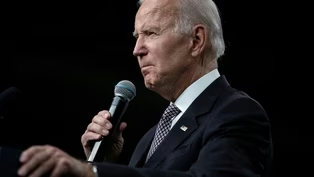
PRESIDENT JOE BIDEN: I'm announcing a pardon.
KEYRIS MANZANARES: President Joe Biden announced last week that he would grant pardons to anyone with a federal conviction for simple possession of marijuana.
He also initiated a review of how marijuana is classified.
PRESIDENT JOE BIDEN: The federal government currently classifies marijuana as a Schedule I substance, the same as heroin and LSD, and more serious than fentanyl.
It makes no sense.
KEYRIS MANZANARES: But what does that mean for Virginians?
CHELSEA HIGGS WISE: It means that more people that are curious about using marijuana, consuming marijuana, or understanding that this is not something that should be criminalized can now come out and participate in this movement.
KEYRIS MANZANARES: Chelsea Higgs Wise with Marijuana Justice says the President's decision allows Virginians to move forward dispelling the taboos around marijuana.
In Virginia, reclassification of marijuana could mean the first step towards wider legalization, resulting in changes for Virginians and law enforcement.
Chesterfield Police Chief, Jeff Katz, says what's concerning at a local level is.
JEFF KATZ: It becomes confusing for members of our community to determine whether or not they're following the law.
It becomes confusing as well for those of us who are responsible for enforcing the law.
KEYRIS MANZANARES: Higgs Wise says reclassification is one of the most progressive moves and a way to ensure that.
CHELSEA HIGGS WISE: These criminal penalties that are coming from small amounts of marijuana aren't going to continue to impact those that are Black, Latino, Indigenous, poor people as we've seen marijuana crimes do for the last 50 years.
ANGIE MILES: We reached out to Virginia Governor Glenn Youngkin's office for comment regarding the presidential pardons.
They said the governor is reviewing Biden's executive action.
ANGIE MILES: A recent Pew Research poll of 10,000 Americans yielded mixed reviews for President Joe Biden's environmental policies.
Regarding climate change, 49% say Biden is moving in the right direction but 47% disagree.
This summer a Supreme Court ruling put limits on the power of the Environmental Protection Agency to determine rules affecting air quality, and a case involving the regulation of clean water is before the court currently.
Who should be leading the way in protecting the environment?
We asked a diverse group of Virginians their point of view.
The government need to put in place incentives for businesses.
They need to galvanize the people, they need to in the younger years, when you're young, even in elementary school, they need to talk to young kids about environment.
and what they can do.
Some of these people, like younger people, have good ideas and opinions and really, really, like older people should really be able like should be listening to them.
Not only the politicians, but also the federal government and the state governments should take a huge role in that, you know?
They're the ones that know really what's in their their area and what they can do to protect it.
I think each individual person has to take the lead in protecting the environment, not one group or organization.
ANGIE MILES: A crucial aspect of environmental health is conservation of natural resources.
In 2021, more than 75% of Virginians surveyed said that even when the state budget is tight, significant money should be allocated for conservation.
In Virginia and throughout the country, there is one group of people coming to the forefront as leaders in protecting our environment.
(drums thumping) SPEAKER 1: (inaudible) (tribe members chanting) ANGIE MILES: When native tribes gather for powwow, it's like a family reunion and spiritual revival.
(tribe member chanting) A reminder of who they are as a people and an embrace of culture, language, and heritage.
It's also an educational opportunity for the public, which is often invited to see just how much the natural world is part of tribal identity today, as it has been for centuries.
BETH ROACH: It's all rooted.
It's all together.
And you see in our many of our regalia, you see leather, you see shells, you see things that are from the natural world, our feathers.
So it's really shows up in every way of our life.
LYNETTE ALLSTON: As indigenous people, we are concerned about our environment.
We see how Mother Earth is beginning to rebel.
We are having more floods, more droughts, more fires, and that's a sign that we have abused our world.
And if we don't take care of the world, where are we going?
SPEAKER 2: We will hear from three indigenous experts.
ANGIE MILES: When native tribes gather to discuss policy, like they did at this annual sovereignty event, the environment is often the focal point.
Indigenous environmental experts from all over the country spoke here in Virginia on the seriousness of what they deem a global crisis, as well as their unique ability as a people to lead the way to a healthier planet.
DR. CASEY THORNBURGH: Areas of, that are, that were dry land where our ancestors are, are now under water in many places.
We know this because of our stories.
Our stories tell of these changes.
ANGIE MILES: There appears to be a shift occurring throughout the country.
Indigenous people who were cheated or forced away from their tribal lands during European colonization are now reacquiring some of what was lost.
The Rappahannock, for example, announced in April, the tribe had regained 465 acres at Fones Cliffs, ancestral homeland that is culturally and spiritually significant to the tribe.
Soon, they plan to invite the public to visit and to learn.
ANNE RICHARDSON: My dad used to take me hunting, he would call it and I was just a young kid, probably nine or 10 years old and he would say, "Well, let's, we're going hunting."
And we'd go out in the woods and he would take the gun, never used it and we would sit and just watch the show that nature would put on for us.
And he would teach me to watch the animals because he said the animals had the wisdom of the ages and we could learn from them.
ANGIE MILES: It was federal recognition, federal monies, and partnerships with a host of conservation agencies and private interests that enabled the reclamation of the cliffs.
The tribe is, once again, guardian to hundreds of species of plants and animals.
Rather than owning the land, the Indigenous way is less about ownership and more about mutual belonging.
ANNE RICHARDSON: In the Western world, we're taught that everything is about, you know, human beings.
I, I, I, me, me, me, and we relegate animals and plants and water and the sun, the elements, the trees.
We relegate them to things when they really aren't.
And we are really connected to all of them.
We just don't know it because we've been taught differently.
And so, you know, my goal is to teach the truth about who we are and how we interact and are connected to all those things for the sake of all humanity and for the survival of the planet.
ANGIE MILES: In November, nearly 1,000 additional acres at Fones Cliffs will be up for auction.
Developers had planned a massive riverside resort there, but they filed for bankruptcy.
Rappahannock tribal leaders plan to participate in the bidding, hoping to place more of their ancestral property under conservation protection.
VPM News Focal Point is interested in the points of view of Virginians.
To hear more from your Virginia neighbors, and to share your own thoughts and story ideas, find us online at vpm.org/focalpoint.
ANGIE MILES: Virginia is home to more than 200 landfills that process 22 million tons of waste every year.
Some of that trash may soon be dumped in a landfill proposed for Cumberland County.
Developers say it will boost the county's economy by tens of millions of dollars.
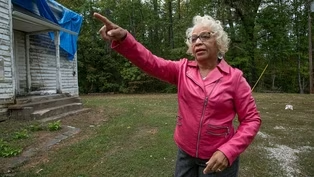
Others say the landfill will hamper the preservation of Pinegrove School, founded in 1917 as one of 380 Rosenwald Schools in Virginia.
These schools were dubbed the most important initiative to advance Black education in the early 20th century.
MURIEL MILLER BRANCH: My connection to the Pine Grove community is spiritual.
This is the place that gave me that sense of being, of who I am, and a sense of purpose.
I am determined to preserve that legacy as much as the legacy of Pine Grove School.
This is more than a building.
Welcome to Pine Grove School.
This school was founded in 1917.
This was the room that we had our studies in.
Mrs. Gillum would stand here at the blackboard.
Attending Pine Grove School was an adventure.
My siblings and I walked three and a half miles one way and we picked up our cousins and friends along the way.
When we got here, we usually lingered outside unless it was really cold and waited for Mrs. Gillum to ring the bell.
And then you came in.
We had a stove right here NIYA BATES: I think the Pine Grove School And similar, Tuskegee Rosenwald Schools are so critically important because they are some of the first institutions that newly freed African Americans created.
Fresh out of slavery, the first thing our communities did was to pool their resources together and build schools where their families could go and learn to read.
Literacy was the goal.
And so the Rosenwald Schools in particular represent a moment in American history when Booker T. Washington and Tuskegee University came together to create a vision for black rural America, a vision of uplift rooted in education for everybody.
MURIEL MILLER BRANCH: I wanted to save the school, I think before I realized it was in jeopardy.
A family member cousin called and said, "Muriel, did you know that Pine Grove is being auctioned?"
No, I didn't.
But guess what?
We're going to do something about that.
Within a week, family had delivered and we were able to pay close to $2,000 in back taxes.
A month after that, we got a certified letter from Green Ridge saying that they were going to be installing a landfill adjacent to the school.
And so our focus changed from preservation to preservation and environmental justice.
That was intolerable for us.
We started going to the hearings that they had, first with the planning commission and then with the Cumberland County Board of Supervisors and raised lots of questions.
The Cumberland County Planning Commission did not think it was a good idea, but the board of supervisors overrode the citizens, the taxpayers, the recommendation of the planning commission and that's where we are.
SHELLEY MAYS-COUCH: We are celebrating Juneteenth here in Cumberland, Virginia.
SPEAKER 1: Up from the past, rooted in pain, I rise.
SHELLEY MAYS-COUCH: I love that the community does get together.
I love that we are learning to support one another.
We know that we're stronger together than we are apart.
SUE ROWDON: When you're dealing with a landfill, that is beyond development.
It is something that is going to affect this area and the people that live in it for generations for hundreds of years, that's not going away.
MICHAEL SCALES: Juneteenth, National Independence Day... ready go.
AUDIENCE: Juneteenth, National Independence Day.
MICHAEL SCALES: It's definitely going to be detrimental to the community.
For one thing, the road is being rerouted so it won't even come in front of the school anymore which, it's hard for me to even imagine.
The school is named after that road.
How can that road not go in front of it?
ROSE MCCLINTON: I think the impact is going to be hundreds of trucks coming in every day bringing trash and I just think it's something that they need to move on with and not come here.
SPEAKER 2: So we are glad that you are able to come down and to share with us.
JERRY CIFOR: Put yourself in the shoes of anyone that would be near the landfill.
You probably wouldn't want it near you.
And I understand that, and I think we all understand that.
But the truth is we all throw out our trash every day and it needs a place to go.
And right now, landfills are the primary technology that the United States has.
We looked at many sites and we took that circle of where we do business, and we tried to stay as close to the middle, and we approached many, many communities and many, many communities said, "No, we're not willing to host a landfill."
And Cumberland County said, "Yes."
I actually picked the wealthiest part of the county and the demographics in our area are about 18% African American, which is about the average for all of Virginia.
Environmental justice means you're not disproportionately picking on a community because they're at a disadvantage.
And to tell you the truth, most landfills, most waste energy plants, most nuclear plants, that's how they were sited.
And I can tell you with a pure heart in this situation, that's not what we did.
NIYA BATES: Today, we're at the Bright Hope Community Center in Cumberland County, and we are hearing from descendants and alumni and community members of the Pine Grove community about what we can do to save these important pieces of our Black heritage in the state.
SPEAKER 3: This school is important because it shows the generational legal barriers that were put up to not give us a separate but equal education.
SPEAKER 4: That was how African Americans, by and large in the rural areas were educated by Rosenwald Schools.
So we can't let that be disappear and be covered over.
It did happen.
NIYA BATES: As we heard from many of the participants today, these schools were the anchor of the community, right?
We had churches, cemeteries, and then these school buildings, and they really are the place where everyone came together.
Everyone touched these places.
The teachers influenced so many lives.
And so for me, it's an opportunity to honor that tradition but also to make sure that future generations get to learn from these stories.
SPEAKER 5: It represents so much more than this building.
It represents all the qualities of people.
KELSON WILSON: Like I learned about Rosenwald Schools back when I was in fourth grade, and when I expressed to my parents what I learned about, that's when I found out that my grandmother actually went to one of the schools and that was just amazing.
It just piqued my interest for history even more and more and more.
Would definitely like to see a museum, you know, them have pictures all over the place and make sure people actually learn about it.
SPEAKER 6: As a unit, when we stand together, we are stronger together.
(members applauding) MURIEL MILLER BRANCH: The lessons that we learned here at Pine Grove are being applied right now as we come up against Green Ridge and the county.
Powers that certainly are in position of authority over what we are doing.
But we will find a way to change things for the better.
ANGIE MILES: Pine Grove School, one of America's most endangered historic places, this summer won $290,000 in federal grant funds to preserve its history.
The history of Southwest Virginia is, in many ways, synonymous with coal mining.
Generations of Appalachian families have earned a living from the grueling and often dangerous work of mining.
Today some companies say they're mining more safely and responsibly.
Some environmental stewards are working to repair decades of damage caused by coal extraction.
Still, others are working to help Southwest Virginia retool for a green energy future.
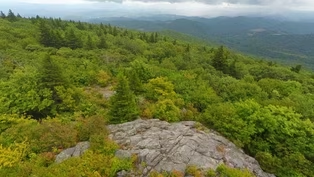
Secure Futures is a green energy company.
We spoke with CEO Ryan McAllister.
Talk about that apprenticeship program, if you will, in southwest Virginia.
How did that get started and what does that entail?
Sure, yeah, as we're seeing such an explosion in demand for solar across the commonwealth, we're seeing obviously an increase in the demand and the need for the skilled tradesmen and laborers to to build these projects.
As part of that, we have partnered with Lee and Wise County Public Schools, again on a unique partnership with their career in technical education schools to provide apprentices and workers to assist in building solar on their own schools.
Interesting.
I imagine being in southwest Virginia, that a lot of the people who might come to you as apprentices have a family legacy in coal mining.
What we're seeking to do is honor that tradition and that legacy and that culture while also acknowledging that a transition is underway.
You can watch the full interview on our website.
ANGIE MILES: Energy and jobs versus protecting the environment, that's the bottom line and the debate over the Mountain Valley Pipeline, which relies on natural gas fracking.
The battle happening in the halls of Congress hits hard in the small town of Elliston in Southwest Virginia.
We traveled there this summer and found some unlikely activists.
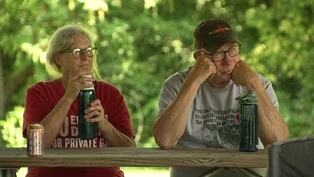
(crowd chattering) (inspirational music) RUSSELL CHISHOLM: We are gathering here today for something we call the Circle of Protection.
(inspirational music continues) DEBORAH KUSHNER: We're here to celebrate each other and this incredible resistance community that's here.
♪ I was standing by the window RUSSELL CHISHOLM: Mountain Valley Pipeline has effectively carved a 300 mile sacrifice zone across the landscape from Northern West Virginia down to where the mainline project would end in Southern Virginia.
DEBORAH KUSHNER: Fossil fuel infrastructure, specifically the Mountain Valley Pipeline is dangerous in numerous ways.
MAURY JOHNSON: I firmly believe they have impacted my water.
I actually don't even have the water turned on in my house anymore.
DEBORAH KUSHNER: The emissions are dangerous.
MAURY JOHNSON: It hasn't been turned on since last August.
DEBORAH KUSHNER: Pipeline infrastructure itself is dangerous.
MAURY JOHNSON: I am afraid of the toxic stuff, too.
DEBORAH KUSHNER: The pipe itself is thinner in rural areas than it is in urban areas.
MAURY JOHNSON: I've had terrible water problems ever since then.
RUSSELL CHISHOLM: Folks are looking for ways to engage on climate and environmental justice across generations.
DEBORAH KUSHNER: Third Act stands for justice.
RUSSELL CHISHOLM: Deborah, and I go back aways.
DEBORAH KUSHNER: I am 67 and a half.
(laughing) RUSSELL CHISHOLM: That elder leadership has always been there.
DEBORAH KUSHNER: Third Act is Bill McKibben's latest environmental organization for elder activists.
♪ For this body RUSSELL CHISHOLM: What Third Act is doing is a natural extension of that.
They make a good partner for climate and environmental justice organizers everywhere.
DEBORAH KUSHNER: I retired five years ago as early as I possibly could, because although I loved my job, I felt there was so much more I needed to do for the planet.
RUSSELL CHISHOLM: I think Deborah has really helped raise the visibility of the MVP fight.
DEBORAH KUSHNER: People are seeing that we're all called to do something.
RUSSELL CHISHOLM: Long before all of this heightened awareness of what's been happening down here, Deborah was out there organizing against some of the banks involved.
DEBORAH KUSHNER: Because these banks have the ability to change the course of the future.
Fossil fuels depend on lending.
RUSSELL CHISHOLM: That generation knows they have something to contribute, absolutely.
Especially when other folks, younger folks, might have all of these other pressures on them.
DEBORAH KUSHNER: Many people of elder age feel discounted, and many elders feel like they're just on the downhill side of their life.
RUSSELL CHISHOLM: People who are in retirement probably would like to just be enjoying retirement, but recognizing that this climate crisis affects all of us and is actually affecting all of us right now.
DEBORAH KUSHNER: It makes perfect sense for us to gear it up into motion, because we've got the time.
Many of us have the energy.
RUSSELL CHISHOLM: It's inspiring to see elder generations stepping in in that way.
DEBORAH KUSHNER: We also have the wherewithal, because people 60 and up in this country control 70% of its wealth, which is a shocking figure, but it also lends credence to the fact that we have clout.
(inspirational music continues) >>Chorus again.
DEBORAH KUSHNER: We have this clout, not only with our money and our power and our energy, but we have this, I call it a gray superpower that we've got, that because we are of a certain age that we make people do double takes.
RUSSELL CHISHOLM: The cancellation of Atlantic Coast Pipeline signified that people can fight back and can win.
DEBORAH KUSHNER: We won't be dismissed as elders.
♪ In the sky (crowd cheering) (crowd applauding) >>Thanks so much for having us here.
>>Bravo!
ANGIE MILES: Mountain Valley Pipeline, LLC reports on its website that it takes measures to protect the environment during and after pipeline construction.
We do hope you've enjoyed our coverage of key environmental stewardship news in Virginia.
Be sure to watch our full interview with two experts addressing green energy and the evolving coal industry at vpm.org/focalpoint.
You can share your feedback on our show and your story ideas as well.
We'll see you next time.
Biden’s federal action dispels ‘taboo’ around marijuana
Video has Closed Captions
Clip: S1 Ep11 | 1m 34s | Local advocate says Biden’s federal action dispels ‘taboo’ around marijuana. (1m 34s)
Gray Superpower: retirees become environmental activists
Video has Closed Captions
Clip: S1 Ep11 | 4m 13s | Virginian elder activists fight construction of the natural gas Mountain Valley Pipeline. (4m 13s)

Indigenous tribes are urging environmental stewardship
Video has Closed Captions
Clip: S1 Ep11 | 3m 52s | Native people are reacquiring ancestral land and taking the lead in conservation education (3m 52s)
In Focus | Ryan McAllister & Daniel Kestner
Video has Closed Captions
Clip: S1 Ep11 | 15m 23s | What does the future look like for energy production and job opportunities in SW Virginia (15m 23s)
Will a new landfill impact this historic Black school?
Video has Closed Captions
Clip: S1 Ep11 | 8m 31s | Will a new landfill affect a historic Black school in Cumberland? (8m 31s)
Providing Support for PBS.org
Learn Moreabout PBS online sponsorship
- News and Public Affairs

Top journalists deliver compelling original analysis of the hour's headlines.

- News and Public Affairs

FRONTLINE is investigative journalism that questions, explains and changes our world.












Support for PBS provided by:
VPM News Focal Point is a local public television program presented by VPM
The Estate of Mrs. Ann Lee Saunders Brown & Dominion Energy