Ken Kramer's About San Diego
Episode 100 - Celebrate Ken's 100th Episode
Season 2025 Episode 100 | 26m 46sVideo has Closed Captions
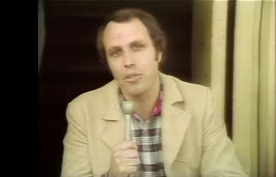
We’ll celebrate Ken's 100th episode by looking back at some of the first broadcasts of the show.
We’ll celebrate Ken's 100th episode by looking back at some of the first broadcasts of the show that has become a KPBS favorite over the years. Plus some memorable stories and recollections from the program's nearly half century on San Diego radio and TV.
Problems playing video? | Closed Captioning Feedback
Problems playing video? | Closed Captioning Feedback
Ken Kramer's About San Diego is a local public television program presented by KPBS
Ken Kramer's About San Diego
Episode 100 - Celebrate Ken's 100th Episode
Season 2025 Episode 100 | 26m 46sVideo has Closed Captions
We’ll celebrate Ken's 100th episode by looking back at some of the first broadcasts of the show that has become a KPBS favorite over the years. Plus some memorable stories and recollections from the program's nearly half century on San Diego radio and TV.
Problems playing video? | Closed Captioning Feedback
How to Watch Ken Kramer's About San Diego
Ken Kramer's About San Diego is available to stream on pbs.org and the free PBS App, available on iPhone, Apple TV, Android TV, Android smartphones, Amazon Fire TV, Amazon Fire Tablet, Roku, Samsung Smart TV, and Vizio.
Providing Support for PBS.org
Learn Moreabout PBS online sponsorshipKen Kramer: You know what this is?
It's believed to be the first motion picture ever: a few people walking around in circles or dancing, I don't know, in Roundhay Garden in Yorkshire, England in 1888.
Here's the first ever radio broadcast in the United States, KDKA in Pittsburgh, 2nd of November 1920. speaker: We'd appreciate it if anyone hearing this broadcast would communicate with us, as we are very anxious to know how far the broadcast is reaching and how it is being received.
Ken: Here's the first TV ad, 1941, just a picture of a clock, the announcer saying-- speaker: America runs on Bulova time.
Ken: First telephone call, first automobile, the first few anythings are not always the best, but they are interesting to look back on when you turn, oh, let's just say, 100.
Ken: Hello, I'm Ken Kramer, and we welcome you again to another program about San Diego.
Ken: Yeah, this is the 100th episode of the current run of "About San Diego," but there's some history going way back into the late 1970s, and with your permission, we'll jump in the time machine.
Ken: An absolutely beautiful mural at the City Rescue Mission in the dining area, and it's interesting to know that this before it became a religious mural was actually a mirror for a bar.
This used to be called the Bloody Bucket Saloon.
Ken: And in 100 episodes, is there one story that viewers seem to remember the most?
Plus, photos from you and another thing or two about San Diego.
announcer: "Ken Kramer's About San Diego," the history and people of the area we call home.
Here's Ken Kramer.
Ken: Hi, and welcome to the 100th episode of "Ken Kramer's About San Diego" on KPBS in its current incarnation, and I'll explain what I mean by that coming up in just a bit here, but I do want to say at the beginning that I've never thought about this show as being about me, but about the stories.
Having said that, I will say that we are gonna try to answer some personal questions about how the show all comes together, beginning with, how did it get started in the first place?
Ken: San Diego in the 1960s, our friend Pea Hicks discovered this video of what was then the nation's 16th largest city, not even half what it is today, 640,000 people, but still a pretty tiny television market.
Well, the local stations did great, but I wanna show you something.
Can you see television antennas?
Before cable or satellite, seemed like every roof had one, and with them you could also see television from LA.
speaker: Channel 2, KNXT Los Angeles.
Ken: And Channel 2 had an on-air personality.
Ralph Story was his name.
Longtime TV guy, one-time host of "The $64,000 Question," and creator of an iconic LA TV show.
Ralph Story: You know, there are always the timid among us who want to keep things the way they are because any change might be for the worse.
Their warning used to be, "Don't rock the boat."
Ken: For a storyteller, Ralph Story had the perfect name.
He told stories about history and local people, and for an aspiring kid from Pasadena who wanted to do the same thing one day, he made a big and very lasting impression.
While at the San Diego State, working at the KPBS radio station.
speaker: Brighten up your mornings with Ken Kramer, and contact 89 on your information station FM 89.
Ken: Fundraising on TV.
Ken: Please now, if you can, join with your family to help support this kind of television here in San Diego.
Ken: There was a lot of that, but then 1978, the station said, "Okay, we'll try this 'About San Diego' thing."
I remember that first episode on KPBS-TV frame within a frame, a guy throwing a frisbee in Horton Plaza Park as it looked in 1978.
Russ Hamnett was the announcer.
Russ Hamnett: "About San Diego," the feature magazine of San Diego Public Television.
Ken: And then I came on, didn't know who would be watching.
It was still a kind of experiment.
Ken: Hello, I'm Ken Kramer, and this is a program about San Diego, a program that is put together with the help of a lot of people in the community, and also with the assistance of some very skilled people from KPBS TV.
We will try to be different in the types of stories that we tell you about, stories that we hope you will find to be of interest, stories about San Diego, and we'll introduce you to some personalities that we think you will find equally fascinating.
Ken: Okay, that first couple of those demonstration episodes were about downtown.
There was a story about the Fifth Avenue Boxing Club and Joe Lopez, who was director.
Joe Lopez: Well, you, first of all, you've got to love the sport.
That's the thing right there.
You've got to love it.
Ken: One of the old hotels downtown was supposedly haunted.
Oh, we had to go check that out.
Ken: The manager of the hotel is Eddie Gummer, and Eddie, have you ever seen or heard anything that in your own mind might have been a ghost?
Edwin Gummer: Yes, I've seen a man coming down the stairs with a green shirt, sun-tan pants.
He goes down the stairs and walks across the landing and disappears.
Ken: In those first episodes, we profiled legendary San Diego tattoo artist Doc Webb.
Doc Webb: Okay, you can put your foot right up there.
Ken: Went to sea on a small fishing boat whose owner was trying to earn a living 100 miles off the coast.
speaker: It's a big risk.
I guess there's not many people willing to take that risk.
speaker: People that really are devoutly Christian, they long for the old hymn: "Amazing Grace," "Near the Cross."
Ken: Met a church musician who brought everything of her talent and energy to Sunday service.
speaker: Spiritually and physically, you're drained, really, but it's rewarding.
Ken: What happens in a downtown rescue mission.
Checked in for the night to see.
Ken: It's a firm rule: every man will shower before bed, and all of his clothing is checked.
It assures that no needles, no pills can get into the dormitory.
Ken: And ended with a kind of mission statement.
Ken: This program we call "About San Diego" is a community scrapbook filled with pictures of your friends and neighbors.
Along with us, you'll meet some of the people with whom we share our city and county: a gold miner, a gambler, artists, children.
Some will make you smile, others may disturb you, but it is our hope that none will bore you, and if they do, if we become pompous or stuffy, or if you're pleased, please let us know, because after all, this is your program.
Ken: It all looked so different from what the show would become.
It really was an experiment with help from Marc Charon and Marty Zimmerman and Michael McKeever and Gayle Perryman.
And of those first few pretty serious-minded test shows, the stories that got the best reaction, the ones we liked the most, were based on local people and history.
It was the Ralph Story thing again.
Ken: It was the 1880s.
It was boom time, and Barney Campling built his grand hotel to be a part of it.
Ken: Well, then they seemed to be received enthusiastically enough.
There were some nice reviews.
A few more brief stories were underwritten by Solar Turbines employees, like this, a tribute to legendary operatic contralto Ernestine Schumann-Heink, who had a home in the artists's colony of Grossmont where she used to practice singing in the backyard.
Ken: It's been 50 years since Ernestine Schumann-Heink passed away.
There's no more singing up here on Grossmont.
The sounds are different now, more modern sounds, more urban ones.
Ken: But in truth, back then the station didn't have much money to undertake a lot of local production, and in 1984 we left, left beloved KPBS, took the stories to radio, and did hundreds and hundreds of radio stories for years on KSDO, then over to NBC 7, where they were on the news every Friday night for years.
Ken: The Chicken Pie Shop.
You know the place on El Cajon Boulevard?
Ken: And 77 half-hour episodes aired.
Ken: It's "About San Diego," and I'm Ken Kramer.
We are here every week with stories about our county from one end to the other.
Ken: From the gates of Kensington-- Ken: They became landmarks.
Parents in the neighborhood would tell their kids, "You can go play, but don't go beyond the gates."
Ken: To a hidden message in the sand dunes that only pilots can see, every week until 2010 and a homecoming, and the show we always wanted to do, what we now count as KPBS episode number one.
Ken: Hi, and welcome to the show.
If you haven't seen an "About San Diego" show before, what we do is discover all kinds of little things that maybe you didn't know about San Diego.
It's that simple.
Ken: So that's a little personal background.
Thank you for allowing me that.
It brings us to the point where we're beginning the 100 shows that we're celebrating here at the kitchen table.
So many different circumstances we found ourselves in.
Remember the COVID shows when we were out on the front porch and we were joined mysteriously every once in a while by this particular fellow and his little brother?
Well, yeah, we all lived through it, right?
Spring of 2020, things started shutting down, and we couldn't go into a studio to do the show, nothing was open, so in that summer and fall, we did episodes from the front porch.
Because no one comes close to anybody, that's the way things are as we do this show.
One entire episode was made up just of things you sent in: photographs, newspaper articles, memories.
Here's a lovely sunny day a century ago when Carl Ackerman on his handmade surfboard at Mission Beach, when there was a wooden boardwalk there before the big storm of 1924 washed it away.
Lisa Eppert sent this.
It's her grandparents back then when you could rent a swimsuit, dressing room, and shower for a dime, or just hang out on the boardwalk.
I love this picture, and I always wonder at how well-dressed everybody was.
Here's another: a March day in 1932 on the sand at Oceanside from Paula Southwick.
The kid on the left would grow up to be her dad, with her granddad to be on the right.
So we're doing these episodes, and one time just decided for no particular reason to put a stuffed animal, a little dog onto the porch, move him around here and there, and he stayed through several weeks, and what was surprising was how much that was noticed.
Got emails, messages, some from kids, wanting to know what's up with the dog.
It's a stuffed nipper dog.
If you know the RCA Victor logo, you find it on old phonograph records, a dog is looking into the horn of a very old phonograph, and with it are the words "His Master's Voice," right?
Well, a century or so ago, that trademarked dog had a name, and the name was Nipper, so this stuffed animal Nipper showed up all over on several COVID episodes and in YouTube stories.
I thank you, Nipper thanks you.
So that was Nipper, but if you go back, this fine canine has had other notable moments.
Here in 1900, it was decided to pose a living Nipper with one of those record machines to look just like in that logo and film it.
[dog barking] ♪♪♪ [dog barking] [dog growling] Ken: Well done, Nipper, well done.
♪♪♪ Ken: One hundred episodes of "Ken Kramer's About San Diego," and we're having a little celebration here.
We're gonna show you now what we believe to be the three most popular stories through the years, the ones that we get the most mail about, or that people will come up and say, "Oh, I remember that story."
Wanna know what they are?
Top three, okay, here we go.
Number three has to do with a North County Highway landmark.
Okay, we're coming up on it right now, see it?
It's a bridge, the Lilac Road Bridge.
Considering how little traffic there is, you might wonder why they even built it, but if you've ever driven Interstate 15 north of Escondido, you sure know it, you've seen it.
It's a dramatic, iconic, something from a picture book bridge, 745 feet across.
That is pretty breathtaking.
At his home in San Marcos, we found John Metlin, who knew a lot about it.
John Metlin: I basically oversaw all of the construction of the bridge from day one.
Ken: And it is an amazing engineering feat.
That whole valley you see here was dug out of solid granite.
The land used to be up there to the level of the bridge where it is today, and the other thing, that sweeping arch over Interstate 15 is hollow.
There are some utility lines, but otherwise you could walk in there if you could walk in there, so why did Caltrans build it for the maybe 25 cars an hour up there on Lilac Road?
It was a conscious decision to build something aesthetically pleasing purely for its own sake, just so drivers moving along I-15 might look at it, and for a moment or two be impressed or inspired or pleased.
John: That's exactly what the thinking was.
Ken: Number two, oh, it has to be our look back at Aquarius Roller-Skating Arena, described as one of those San Diego things that happens for a while, and it's magic.
["Aquarius" by The 5th Dimension] ♪ This is the dawning of the age of Aquarius, ♪ ♪ Age of Aquarius.
♪♪ Ken: Little tear-off tickets is all it was, but for more than a generation of San Diego kids, it opened the door to true liberation.
Randy Strunk: We, on a Friday night, we could have 600 to 800 kids there on a Friday night.
We skated 12,000 plus a month.
Ken: It's been closed more than 20 years now, but if you skated here, that song and the sweet memory of this place called Aquarius can even now bring some very grown-up tears, for here is where you might have met the dearest friends of your young life.
Grown up now, those skating friends still reminisce online.
Randy Strunk worked there.
His brother Jeff used to repair skates at Aquarius.
His parents, Ruth and Al, were the owners.
That story, that one touched so many people.
We got so many comments about how times changed and the Age of Aquarius ended, how you just wanted for their sake that it might go on forever.
Ruth, one of the owners, was in her 90s when we talked with her.
Ruth Strunk: I do miss those days.
I sometimes--when I hear certain songs, it just does bring back memories.
Ken: Just every once in a while on the radio or someplace, there's that song.
Randy: "The Age of Aquarius" was played at every session.
Ruth: The kids would go crazy.
They'd go skating onto the floor no matter where they were when that song came on.
♪ Age of Aquarius.
♪♪ Ken: So we're gonna give this a try.
Have to say, honorable mention goes to Haven's Caves, a sensational digging project undertaken by the late Glenn Havens in the 1940s and '50s, who allegedly was digging out a barbecue pit one day and just got carried away.
The kids would sit here, and they'd look out into this large room area here, and it was like a little bunch of bleacher seats.
There's more rooms up this way.
You'd come from one room, slide right down into this room.
He hired neighborhood kids to dig out the earth 60 feet beneath his home in Kensington, and when it was over, he had created 700 feet of tunnels and seven rooms large enough to play ping pong in.
And number one, well, it is just one of those things that happens.
It came over to be a part of the KPBS series after it was created at NBC in 1996, and to this day, it gets more comments.
People mention it.
It is remembered even yet as a favorite.
So it all goes back to when the Republican National Convention was held in San Diego at the convention center, but the story wasn't about that.
It was the aftermath, and a single blue balloon that was supposed to fall down onto the crowd during the celebration, but it got hung up in the netting.
It was such a great show when they finally let go those balloons.
Who could ever forget when they pulled on the line.
Each one got to shine as they happily fell from the net.
While the party is done, the cleanup's begun, the convention is history, friends.
The workers are packing and wrapping and stacking and tying up all the loose ends.
Dozens of men time and again walked under and never did see the saddest of sights up there by the lights: one balloon that couldn't get free.
It seemed such a pity that something so pretty should have missed out on all of the glee.
It struggled and fought, but was hopelessly caught, the balloon that couldn't get free.
It was really too bad, it looked to be sad.
It seemed to say, "What about me?"
The rest went away, they all got to play.
Poor balloon that couldn't get free.
No one seemed to care.
It was hanging up there, so lonely and blue as could be.
Then the man came around to take the net down 'round the balloon that couldn't get free.
As the net moved about, it finally slipped out, but its glory nobody could see.
It fell to the ground with no one around, the balloon that couldn't get free.
Will this be my story, no cheering, no glory?
What's to become of poor me?
Just to bounce on the floor and a couple times more, the balloon that couldn't get free.
So did our blue friend have an unhappy end with no home and no reason to be?
No, I couldn't ignore that balloon on the floor.
I decided to take it with me.
No, we got notes from kids, even the suggestion that that story might make an interesting children's book, I don't know, but I can tell you that I kept that balloon for a very long time, well after it was done ballooning.
♪♪♪ Ken: The 100th episode of our show, and so we are looking back at some stories and at some of the people we are very grateful for.
Ken: Where do the stories come from?
Well, maybe a third of them from viewer ideas, your suggestions.
You know our city and county, you've lived here, your personal photographs and video and memories.
The rest, just from curiosity, mostly.
How does a place get its name?
Why are things the way they are?
Somebody knows, and they help out every episode: historians, researchers, authors, curators of our history.
We've come to know them, and you may have too over the years.
They're so generous with their time and their storytelling.
Dr.
Seth Mallios has written and done whole segments around his specialty.
Seth Mallios: Made it!
Ken: San Diego State history, from Hardy Memorial Tower to Snapdragon.
Seth: And look at these teeth, they're terrifying!
Ken: Absolutely could not do "About San Diego" without them or thank them enough.
Or Ron Stein, who skillfully edited the shows for a while at KPBS, and my co-producer and colleague going back 30 years to NBC days, Suzanne Bartole, multi-Emmy Award winner and Silver Circle recipient from the National Academy of Television Arts and Sciences, brilliant and tireless videographer and editor, and with an eye for the little things that benefit every segment in every episode.
Her talent and her patience is a wonder.
In the end, I think it comes down to this: just about everybody loves a good story, like the story of Claire Tavares, the Claire for whom Clairemont was named.
Claire Tavares: Ever since it's been built, people have come up to me and thanked me for Clairemont.
Ken: Her husband Carlos Tavares was a home builder and developer of Clairemont.
San Carlos is named for him.
Little stories like that from all over our county that show us our home in a different way, like the community of Burlingame a century ago that wanted to do something different, so they created pink sidewalks.
Well, sort of pink anyway.
speaker: The actual old color used to be called a Davis brick red color.
Ken: Stories about what's up there, or down there?
Is the ceiling okay here?
Are we safe?
speaker: If you don't touch it.
Ken: Or under there?
Stories that surprise.
speaker: They come in here and they say, "Look at what you're doing!"
They hadn't ever seen anybody do that.
Ken: Stories that inspire.
speaker: Hey, look at all I have, you know?
I have marlins, horses, cows, donkeys.
Ken: Stories that amaze.
Bernell Hopkins: Uh-oh, it's a whole city down there!
Ken: And who would be the mayor of the City of Bonita Drive?
Well-- Bernell: I guess I'm the mayor.
I'm the mayor.
I'm the giant of the city, so yeah, you know?
Carmen Castaneda: And I learned how to solder the wires and build the harnesses.
Ken: Stories that remember who we were.
Carmen: And I always was proud of my work, you know, and the good it was doing.
Ken: And who was here before any of us.
Stories that pay tribute to San Diegans who were once among us but no longer are.
♪ Where have all the young men gone?
♪ ♪ Long time ago.
♪♪ Ken: Stories that show us our past.
speaker: It was just something unforgettable, really unforgettable.
Ken: And present.
speaker: I will spend the rest of my life devoted to this town and its restoration.
Ken: Stories that are just so much fun to do, to say, "Come along, let's go, let's experience this incredible thing."
♪♪♪ These moments, they are the stories of our home that honor our elders.
speaker: I feel wonderful.
Ken: And thrill in the moments of young discovery from one end of the county to the other.
♪♪♪ ♪♪♪ And sure, they may make us a little proud to be here, not because of our climate or the beaches, but because our hometown has character and history and shared humanity that taken together sort of define who we are, and together, we just might find we like who we are.
That is a wonderful thing to be a part of, and after 100 episodes, that is the story-- Ken: About San Diego.
Ken: About San Diego.
children: About San Diego.
Ken: And that's it for this time and this episode of "About San Diego," our 100th episode here on KPBS TV.
Guess I've gotten a little bit older through the years, but you have taken this journey with me, and I really very much appreciate it.
With your kind permission, I'll get to work on episode number 101 and 102, and so it will go.
Meantime, if you want to see these stories again or find out more information about the stories you do see here, just go to my website.
That's KenKramerTV.com, KenKramerTV.com.
Until next time, and as always, I am Ken Kramer.
Thank you for watching and for caring so much about San Diego, bye-bye.
♪♪♪ ♪♪♪ ♪♪♪ ♪♪♪ ♪♪♪ Ken: San Diego, as you know, is the city where we come from.
That's an interesting presentation.
You know, I would never put anything above me but the city of San Diego, and that I'm happy to do.
[applause] announcer: Support for this program comes from the KPBS Explore Local Content fund, supporting new ideas and programs for San Diego.
Video has Closed Captions
Preview: S2025 Ep100 | 30s | 2/19 - celebrate Ken's 100th episode by looking back at some of the first broadcasts of the show (30s)
Providing Support for PBS.org
Learn Moreabout PBS online sponsorship















Support for PBS provided by:
Ken Kramer's About San Diego is a local public television program presented by KPBS