WEDU Arts Plus
Episode 1002
Season 10 Episode 2 | 26m 45sVideo has Closed Captions
Glenyse Thompson, PUSH Physical Theatre, Music Program, Lauren Semivan
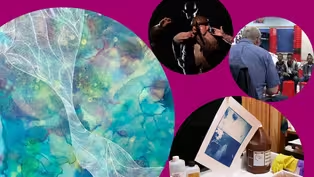
For St. Petersburg artist and designer Glenyse Thompson, every work of art is a conversation. PUSH Physical Theatre uses the power of movement and physical expression to tell powerful stories. A free music program is changing the lives of inner-city kids. Photographer Lauren Semivan uses an antique camera and traditional developing techniques to create eerie, visually interesting prints.
Problems playing video? | Closed Captioning Feedback
Problems playing video? | Closed Captioning Feedback
WEDU Arts Plus is a local public television program presented by WEDU
Major funding for WEDU Arts Plus is provided through the generosity of Charles Rosenblum, The State of Florida and Division of Arts and Culture and the National Endowment for the Arts, and the Hillsborough County Board of County Commissioners.
WEDU Arts Plus
Episode 1002
Season 10 Episode 2 | 26m 45sVideo has Closed Captions
For St. Petersburg artist and designer Glenyse Thompson, every work of art is a conversation. PUSH Physical Theatre uses the power of movement and physical expression to tell powerful stories. A free music program is changing the lives of inner-city kids. Photographer Lauren Semivan uses an antique camera and traditional developing techniques to create eerie, visually interesting prints.
Problems playing video? | Closed Captioning Feedback
How to Watch WEDU Arts Plus
WEDU Arts Plus is available to stream on pbs.org and the free PBS App, available on iPhone, Apple TV, Android TV, Android smartphones, Amazon Fire TV, Amazon Fire Tablet, Roku, Samsung Smart TV, and Vizio.
Providing Support for PBS.org
Learn Moreabout PBS online sponsorship- [Narrator] This is a production of WEDU PBS.
Tampa, St.Petersburg, Sarasota.
Major funding for WEDU Arts Plus, is provided through The Greater Cincinnati Foundation, by an arts-loving donor who encourages others to support your PBS station, WEDU, and by the Pinellas Community Foundation, Giving Humanity a Hand Since 1969.
- [Dalia] In this edition of "WEDU Arts Plus", a local artist who believes that an abstract picture really is worth a thousand words.
- [Amanda] It's about conversations between people.
The washes of color in the background is about the general ebb and flow of a conversation, but then the detailed lines on top of it is the actual words that you're saying in the conversation.
- [Dalia] Powerful stories through physical expression.
- [Daren] When we're doing our job, the best, you, as an audience member, should become almost unaware that you're watching a movement.
- [Dalia] Building success through music.
- [Camille] What makes OrchKids special is its intensity.
It really gives them a sense of self-worth.
- [Dalia] And art in the dark room.
- [Lauren] So that always really interested in me that I was sort of creating a totally new space that didn't exist in reality and that could only exist through the camera.
- It's all coming up next on WEDU Arts Plus.
(bright jazz music) Hello, I'm Dalia Colon and this is "WEDU Arts Plus".
You're about to meet a St.Petersburg woman who gives new meaning to the art of conversation.
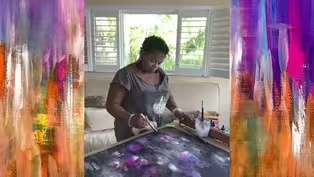
Glenyse Thompson is an abstract artist and home decor designer whose work captures the complexities of everyday verbal exchanges.
- I, way back when, as a kid, was a creative and didn't know what that meant.
I thought I was gonna be a journalist and then I thought I was gonna be a photographer.
Put that away and had a kid.
(laughs) Got on with life, and then, I'd say about 2014, 2015, I started having difficulties at work, communicating with couple of people and took a break and went on vacation.
It was my grandmother who said, you know, why don't you sit down and start really thinking about what you wanna do next and try something different.
And I picked up some watercolors and started drawing again.
Hey, I'm Glenyse.
Welcome to my studio.
My name is Glenyse Thompson.
I am a visual abstract artist from St.Petersburg, Florida.
And I also am a designer.
- When you speak to her about her work it's not just about lines and color and form, but it's about conversations between people.
And she says that the washes of color in the background is about the general ebb and flow of a conversation.
But then the detail lines on top of it is the actual words that you're saying in the conversation.
And the color she chooses and the lines that she makes have to do with a specific conversation.
Maybe it's an intense conversation.
Maybe it's a friendly conversation.
- We have to understand that conversations are so important to who we are.
We're nothing without each other.
We're meeting each other and the lines represent that.
It could be a party.
It could be a zoom call.
It could be a grocery store run.
You're always thinking or having to speak with someone to get something done, and we need to pay more attention to what that means day to day.
- Well, first I encountered Glenyse herself before I encountered her work.
We were in France of all places, and just happened to run into Glenyse and started having a conversation.
- [Glenyse] We decided to keep in touch.
It was me and my guy, and him and his lady friend, when we met.
And then we get back to the States, we decided to get in touch with them and realized they live right in Miami, live in our backyard.
- And my fiance and I happened to be in the Tampa Bay area.
So we looked them up and got together and got to finding out a little bit more about art.
We got a chance to actually see some of it and I was smitten.
- I had created a piece about our burgeoning friendship and that was the piece they ended up purchasing.
(laughs) It's in the blues and golds but it's got a lot of lines on it in comparison to some of the other pieces just because who would have thought a continental meet would have turned into such amazing friendship.
- I think Glenyse as a person is special and that's what makes Glenyse as an artist special.
I was reticent to participate in the social justice movement with my art only because I didn't know what to do.
And I was approached by a curator.
And I said, I wanna make that part of my studio practice, at least twice a year, creating a piece of art for a charity.
- Citizens in another major city were angered by the death of an African-American woman at the hands of police.
- [Man] Somebody kicked in the door and shot my girlfriend.
- Say her name!
- [Glenyse] Say her name is about black women and depending on who you support, trans and lesbian women, that have been assaulted or killed by the police or another person because of who they are.
We're always first to support and always last to get supporting.
So we need more recognition.
We need more pay equity.
We don't get enough.
And we give so much.
I have two different focuses in my artwork at this time.
I am working on the "Conversations" pieces and then "Big shoulders".
The conversations are inks and inks, and it's liquid ink that, layer upon layer, put on paper or a panel and it's usually between five and 20 layers of ink.
So each layer dries into itself and that takes seven to 10 days because each layer has to dry.
And then I come in and I add the lines.
The big shoulders pieces are the largely colored bright pieces.
And big shoulders is all about the fact that we stand on each other's shoulders to move about the world.
And all the colors represent all the different shapes and sizes of people we have to interact with to move into our next... Whatever we're gonna do next.
And it all goes back to conversations at the same time by saying we can't function without one another.
- [Dalia] You can see more of Glenyse Thompson's work at glenyse.com PUSH, a physical theater based in Rochester, New York, has taken storytelling to new levels.
They're able to tell rich powerful stories through physical expression and movement.
(intense contemporary music) - [Daren] There's something really primal about movement.
The stories of our lives are locked up inside of our muscles and we move and we set those stories free.
- Movement is a very powerful art form and there are things you can say in movement that words can't describe.
What people come to us to see are their lives played out on the stage in a way that they can't describe in words.
Darren and I have been performing together for a number of years.
We moved to Rochester, New York, and decided to redefine how we wanted to present theater.
And so we established PUSH Physical Theater.
- [Daren] What we do isn't really like something else.
So you can't say, well, you should...
If you liked this you'll love this because we are inventing as we go.
We are dancers, we're acrobats, we're actors, but when you're watching the performance, it's none of those things.
In fact, when we're doing our job, the best, you, as an audience member, should become almost unaware that you're watching movement.
- The unique thing about PUSH is their ability to tell a story physically, without words, and find the emotional core in their stories where you become part of these stories that they tell.
- What makes PUSH unique is our relationship to each other, as performers, and also our relationship with audiences.
We like to view it as an invitation.
So instead of putting the show upon an audience, you let them sit back and you gently invite them to come into the world that you're creating.
- The wonderful thing about PUSH is their ability to focus on the work and allow that stuff to happen while allowing everyone to have a voice without any ego getting in the way of, this has to be mine or we have to do it this way.
It's all about what suits the work the best.
How can we tell the story in the most exciting or the best way, with all of us invested?
- We are a democracy that turns into a dictatorship.
So early in the creative process, it's all about, tell me your thoughts, tell me your feelings.
Or what's your opinion?
Should we try this way?
She would try that way?
Everybody's idea is valid.
And then as we pare down more and more, it turns into whoever is taking the lead on that particular piece of choreography.
Saying, no, no, no, it's not gonna be here, it's gonna be here.
- Jekyll and Hyde is a new work for PUSH Physical Theatre.
It's an evening length production.
We are in collaboration with Blackfriars Theatre, from Rochester, New York, and we're excited about this.
- There are a lot of people that haven't seen them in the Rochester community that don't know about them.
So one of the big things I hope, and why I brought them to Blackfriars, is I wanted to expose the Blackfriars audience to their work.
You're right up next to them.
You're on the same level with them.
You're you're in the same space with them.
You're no more than 10, 20 feet from them.
You see every nuance, you catch every minutiae of the performance.
And their work is so focused and so intense and personal that you feel that energy, you feel that vibe and being this close to it, you can't turn away from it.
You can't get away from it.
You have to be enveloped by it.
- In our retelling of the story there are things that you can tell physically, very efficiently.
At the same time there are some things that movement is really awful at expressing.
And so what we try to do is tell as much of the story as is necessary and no more than that, to get people to where they need to be.
Blackfriars, in particular, is a great space for us to try a work like this for the first time.
It's a fairly small house.
We're dealing with 150 seats.
So those audience members are really close to us and we are really close to them.
There's an intimacy about that that enables us to be a little more naturalistic in our acting.
We don't have the answers.
What artists excel at is asking the question in a way that other people can answer that question in a very personal way for them.
I want people that come into the theater to leave changed in some way.
I want them to go out to a coffee shop and sit and have a conversation for a couple hours.
- [Dalia] To learn more, visit pushtheatre.org.
See how one program is changing the lives of inner city students in Baltimore, Maryland, through a free school music program, OrchKids.
(kids playing instruments) - I seen it I was like, wow, like music is fun.
And so I thought to myself like how can I become one of them or do what they're doing.
- We're using music, more as a vehicle, to create a future filled with possibility for these kids.
And we started an afterschool program with 30 kids.
We're well over 1000 kids now.
We serve them meals every day.
When they've needed help with homework and help with reading, we've brought in mentors and tutors.
- I have four kids now, currently, in the OrchKids program.
It's music, music, music, every day.
It shows them leadership skills.
It helps them academic-wise.
- [Keith] They taught me how to play music also, they showed me through hard times they'll be there and they'll always have my back and I wanna do that for other kids too.
- Keith Fleming has been here since day one.
He was accepted to Baltimore School for the Arts and he'll be attending there this fall in 2016.
The kids see him and they see when he was corrected by his teachers, he didn't get defeated.
He didn't shut down.
He tried harder and he did better.
What makes OrchKids special is its intensity.
It really gives them a sense of self-worth at a very early age, that they're important and if they stick to something and they dedicate themselves to something, they can really open some doors.
Their environment already is intense.
You know, we're living in high poverty areas and broken family homes and so to combat that the intensity of what we're offering them, I think, is very special and unique.
♪ Rainbows are visions ♪ ♪ Without the illusions ♪ ♪ Rainbows have nothing to hide ♪ ♪ What's so amazing ♪ ♪ That keeps us stargazing ♪ ♪ And what do we think we might see ♪ ♪ Someday we'll find it ♪ ♪ A rainbow collection ♪ ♪ The lovers the dreamers and me ♪ - OrchKids is a beautiful program.
The music makes me feel free and everything.
I learned how to play with my heart, read music.
(speaking in foreign language) - This is Daphne's third year in the program.
She's really focused.
She's also a leader.
She likes to work with her peers.
The parents can really see the progression in how the kids start to internalize what it means to perform on stage, what it means to take care of your instrument and make sure that's safe.
- Now that I'm 10, I probably don't like twining performances and sometimes I say to myself, wow, I have done that much music.
I can't believe it.
(kids singing together) - And music is an incredible tool to use because music is non-judgemental.
When you play a phrase on the tuba, on the violin, you're always right.
There are a lot of things that we're combating in these communities and serious stuff but we have something that we can heal them with through music.
- We give them a place to go and something incredible to do.
We open this whole world up to them that they can really pull all of their energy, all of their emotion and all of their mind and soul into.
OrchKids rest position.
One, two, moving it around.
- [All] Move it, move it, moving it around.
(kids drumming) - Just like this.
(kids drumming).
That's starting to sound like something, do you hear it?
Then when we get to a performance and they are so happy and so proud of what they're doing, and I'm incredibly proud.
- I'm in the back, like wiping away tears, like, you know, I'm so proud of them.
- You played beautifully and I'm so proud of you, and I love that stuff.
(kids performing music together) - [Marin] When you grow up feeling successful you live a successful life and a life that feels fulfilled.
- [Dalia] For more information visit orchkids.org.
Detroit, Michigan born artists, Lauren Semivan uses a camera that dates back to the model T era to capture some very interesting prints and some lesser known techniques to develop them.
(soft contemporary music) - The photographer, Jeff Wall, talks about photographers as being either hunters or gatherers.
And I definitely identify with a gatherer rather than a hunter.
The large format view camera that I use dates from the early 20th century.
And it's a very simple kind of primitive camera which...
It's basically a box with a lens and a ground glass on the other end.
So I have a large piece of black vail that I use as a dark cloth to block out the light so that I can see the image that I'm photographing.
And the camera takes eight by 10 negatives.
So the negative is much larger than say, a 35 millimeter or even medium format negative and so as a result, there's much more capacity for detail.
Often what I'm looking for as I'm photographing is a way to kind of suspend time itself or to be able to say something that can't be said without the film and the act of photographing.
Sometimes I'll start with an idea based on literature and then the composition evolves from there.
All my photographs are made in the same studio and they're incorporating painting and drawing and found objects and sometimes the figure as a narrative tool.
The set sort of evolves until it sort of devolves into the next picture.
And so I kind of, I really enjoy how the process is this continuous organic moment from one image to the next.
This is an example of a set that was really pretty precariously constructed.
So these are individual little sticks that were kind of pressed into the backdrop against the tool fabric.
I kind of enjoy the element of it could all fall apart at any moment.
As I'm working, my concept of time is a little bit different in that everything is much slower pace and there's a really intense kind of element of composition in working with the large format camera.
You can sort of go under this black cloth and then see what you're photographing upside down and backwards.
So it's sort of transposed, in a way, and removed from reality even further.
So that always really interested in me that I was sort of creating a totally new space that didn't exist in reality and that could only exist through the camera.
And then that the finished product is not something that is really visible or even...
I'm conscious of what's going to happen until I can see the final print or the negative.
I have two sizes.
One is 40 by 50.
That size is quite large and it's almost a one-to-one scale relationship with the viewer.
And then the other way that I work is by contact printing the eight by 10 negative to make a cyanotype.
So the cyanotypes are made on, basically, a watercolor paper and the emulsion is a mixture of two different light sensitive chemicals.
So I mix them together and then you hand coat the paper with the emulsion, and then you allow the paper to dry in the total darkness.
When the paper's dry, you can print the negative directly in contact with the paper in the sunlight.
You leave the print in the sun for your exposure and then you can wash it in water and then you have your cyanotype.
The show that I recently had at David Klein Gallery was titled, Door into the dark.
And to me, this idea is more about the creative process as a pursuit of the unknown.
The creative process is something that kind of connects people through time and space and also I think that as artists are making things we don't necessarily always know what we're doing or what we're looking for, but we feel the need to create the thing and to keep making it.
So I feel the process is sort of the door into the dark.
The painter, Pierre Soulages, talks about his black paintings as being more just representative of the forms that are in the paintings rather than about other ideas or, you know, they're non representational.
So they really can't be described in language.
And I think a lot of artists that way and that's the strength of art is that we can't necessarily always explain or identify what may be happening when we look at a painting or any kind of image.
So I would say that I hope that my viewer is able to kind of enter the photograph and have questions and things to think about and want to be in that space, but maybe not necessarily have a way out of the space.
So that they can relate to it enough to sort of understand but then maybe their questions are what keep them there, keep them looking at the piece.
Maybe some people are more comfortable knowing the answers and others are comfortable with not understanding exactly what is happening but being engaged in it at the same time.
- [Dalia] For more of her work, visit laurensemivan.com And that wraps it up for this edition of WEDU Arts Plus.
For more arts and culture visit wedu.org/artsplus.
Until next time, I'm Dalia Colon.
Thanks for watching.
(intense upbeat music) - [Narrator] Major funding for WEDU Arts Plus is provided through The Greater Cincinnati Foundation by an arts-loving donor who encourages others to support your PBS station, WEDU, and by the Pinellas Community Foundation, Giving Humanity a Hand Since 1969.
(gentle music)
Preview: S10 Ep2 | 29s | Glenyse Thompson, PUSH Physical Theatre, Music Program, Lauren Semivan (29s)
Video has Closed Captions
Clip: S10 Ep2 | 6m 36s | St. Petersburg artist Glenyse Thompson creates abstract works symbolic of conversation. (6m 36s)
Providing Support for PBS.org
Learn Moreabout PBS online sponsorship

- Arts and Music
The Best of the Joy of Painting with Bob Ross
A pop icon, Bob Ross offers soothing words of wisdom as he paints captivating landscapes.












Support for PBS provided by:
WEDU Arts Plus is a local public television program presented by WEDU
Major funding for WEDU Arts Plus is provided through the generosity of Charles Rosenblum, The State of Florida and Division of Arts and Culture and the National Endowment for the Arts, and the Hillsborough County Board of County Commissioners.