WEDU Arts Plus
Episode 1007
Season 10 Episode 7 | 26m 45sVideo has Closed Captions
Replay Museum, Helen Cordero, Abel, Community Arts Connection
An interactive museum in Tarpon Springs aims to keep the experience of arcades and vintage video games alive. Helen Cordero's renowned figurines reflect her culture's emphasis on oral tradition. Abel Alejandre explores themes of masculinity and vulnerability in his intricate pencil drawings. A program is working to ensure that everyone has the opportunity to express themselves.
Problems playing video? | Closed Captioning Feedback
Problems playing video? | Closed Captioning Feedback
WEDU Arts Plus is a local public television program presented by WEDU
Major funding for WEDU Arts Plus is provided through the generosity of Charles Rosenblum, The State of Florida and Division of Arts and Culture and the National Endowment for the Arts, and the Hillsborough County Board of County Commissioners.
WEDU Arts Plus
Episode 1007
Season 10 Episode 7 | 26m 45sVideo has Closed Captions
An interactive museum in Tarpon Springs aims to keep the experience of arcades and vintage video games alive. Helen Cordero's renowned figurines reflect her culture's emphasis on oral tradition. Abel Alejandre explores themes of masculinity and vulnerability in his intricate pencil drawings. A program is working to ensure that everyone has the opportunity to express themselves.
Problems playing video? | Closed Captioning Feedback
How to Watch WEDU Arts Plus
WEDU Arts Plus is available to stream on pbs.org and the free PBS App, available on iPhone, Apple TV, Android TV, Android smartphones, Amazon Fire TV, Amazon Fire Tablet, Roku, Samsung Smart TV, and Vizio.
Providing Support for PBS.org
Learn Moreabout PBS online sponsorship- [Announcer] This is a production of WEDU PBS.
(gentle upbeat music) Tampa, St.Petersburg, Sarasota.
Major funding for WEDU Arts Plus is provided through the Greater Cincinnati Foundation by an arts loving donor, who encourages others to support your PBS station WEDU and by the Pinellas Community Foundation, giving humanity a hand since 1969.
- [Announcer] In this edition of WEDU Arts Plus, no quarters required for this fun interactive museum.
- To me, it's gaming therapy it's very relaxing, getting to hit the flippers to see how much the game has evolved over the years.
- Pottery that conveys history.
- She thought of her grandfather, she said, "you know I'm gonna make a piece for my grandfather and he's, he'll be telling a story."
- [Announcer] An exploration of masculinity, and vulnerability through an artist's drawings.
- [Narrator] I paint, I've done some sculpture, some film work.
That's why I prefer going by artists because it gives me the freedom to basically do whatever I want.
- [Announcer] And a special place where creativity is front and center.
- I think by giving them this opportunity we're tapping into something that a lot of people have either been told they can't do.
Or people might have a curiosity about, can I do this?
Am I a dancer?
What do I look like dancing?
- It's all coming up next on WEDU Arts Plus.
(upbeat jazz music) (gentle upbeat music) - Hello, I'm Dalia Colon, and this is WEDU Arts Plus.
This first segment was produced by students at St. Petersburg college in partnership with WEDU.
The Replay Museum preserves the experience of retro arcade games for generations to enjoy.
Check out this hands-on experience located in Tarpon Springs.
(soft rhythmic music) (upbeat gaming music) - My name is Bobbi.
I work the front desk and help handle our event calendar, try to plan some fun events for people to come out and play for.
I worked here for four years.
I love it.
My husband and I actually had our, our wedding here.
So I love it like it's mine, even though I just work here.
Brian and Becky are just big gamers themselves.
They love amusements, they love playing games.
So I think that they amassed this collection, and kind of felt selfish, just keeping it all to themselves and wanted to share it with the rest of the world.
- A place like replay is like a test ground for these games.
We see things break that nobody else sees.
We have problems that nobody else will encounter because of the amount of plays that these games get on them.
You know longevity is always the goal.
I wanna make sure each repair is something that's gonna make the game last a lot longer, hopefully as opposed to like continually going back in and fixing something.
But yeah, there's sort of a checklist as far as like looking for bad connectors because that can just cause things to overheat, if there's not good signal going through - [Narrator] Just cleaning the pin balls so that the game will play properly is a big part of it.
- [Announcer] A lot of the older games we'll switch out to different style of light bulbs and put LEDs inside of them.
So just to take away the heat, it draws less power.
So, there's, there's certain things like that to keep in mind.
The designers of the game would put notes in the game that a well lit game is going to be played more.
And at that matter, a clean well lit game.
So it's more like, you know we've got people that come in for the first time and they, they kinda just start walking around and it's kind of hard to say what makes them go and put their hands on that first game especially if it's one they haven't seen before.
But I think it always comes down to some part of like what they've been through in their life.
Some part of their history, whether they're into cars or like if there's some kind of movie that they're into.
It could be a band that's, that's highlighted in one of these games.
A lot of it will, will definitely be like the artwork.
I feel like if you're able to see the game, it's going to be the artwork.
(gaming machine noises) - Who knows if it's the colors, if it's the imagination.
I mean the older pinball machines from the seventies they definitely pop are trying to be eye-catching sometimes maybe slightly suggestive in a sexual manner.
But, these were back in my days when it was, you know a room full of guys playing pinball, where there weren't really children involved, maybe not women around.
So you can see the kind of development and change of art kind of moving back from risque art pieces and being more family-friendly.
- [Announcer] I mean, you can find out a lot about yourself just by playing games, whether it's just by yourself you can kind of tell like how competitive of a person you are and how well you deal with stressful situations.
- To me, it's gaming therapy, just very relaxing, getting to hit the flippers, just to see how much the game has evolved over the years.
I just love it.
(Ryan laughing) - In a place like Replay with the games that we have here this style of gaming is something where even if you're playing by yourself, you still have like a social connection with people.
Whether you hear somebody yelling out of frustration because they just lost the ball, or somebody is like cheering because they just got to replay or an insanely high score.
We definitely have people coming in that are trying to set high scores.
Um, Replay is known for having scores that are just like super hard to beat because of how many people come in and play the games.
- [Narrator] I had a number three, number four, for a little bit, and I've, I've been surpassed.
So I got to have to go chase it again.
- My best high score here is gonna be my GC on Tales of Arabian Nights.
It's 44 million, I got to the wizard mode, and rescued the princess.
Part of my, like high score chase isn't even technically the score.
It's more beating the game and reaching that wizard mode whatever that final objective is.
- My son is in the Navy now he's up in South Carolina, I'll send him like a text message real quick and say, "look at the score I just put up."
And he'll do the same thing.
If he goes out in the community and he's able to play pinball or any of the video games, he'll send me a score back.
So, it's a way for us to stay in contact with each other and connect, even though we're hundreds of miles apart.
- Seeing the generations actually come together, enjoy, and love these games, is why I do what I do.
I know we're doing the right thing.
I know we're here for the right reasons.
And we are sharing all this fun with generations to come because we need the younger kids to be interested in this.
If there's any history or future for arcades we got to get kids playing.
We got to get kids playing pinball.
We got to get kids playing the retro games because someone's got to be interested once we're gone.
(gentle upbeat music) - [Dalia] For more information, visit replaymuseum.org - In new Mexico's Cochiti Pueblo, Potter Helen Cordero renowned figurines showcase her culture's emphasis on oral tradition and storytelling.
It was her grandfather's stories that helped inspire her clay sculptures.
(native music playing) - She put her, her life breath and her soul her spirit into every piece.
You know, it goes back to, you know working with the clay and bringing it out from mother earth.
You know, you offer the cornmeal and then when you start to work with the clay, you put your spirit into it by breathing on it and you know, working with it and putting your soul into the, into the piece.
- What Helen did was she taught the outside world the non-Cochiti world, that these figures all had stories or what we'd say with narratives.
And by telling us that story, she personalized pottery for the non-native world and what Helen kept alive throughout her life, through her smile.
And her willingness to talk to people was the story of her family and her life at Cochiti.
- She was almost like a hero to me, a heroine to me.
Helen Cordero was not only a famous Potter who invented the storyteller, but she was also my grandmother and grandmother to a lot of other kids in the Pueblo.
She cared about family she cared about culture.
She was very big on traditions.
She can remember, you know sitting around with the other children listening to her grandfather, tell stories (native American chanting music) Not only is the, the story being told, you know, from, from visions.
But the children are also envisioning that same story in their minds.
And that goes hand in hand with Pueblo life.
We don't write down our stories they're told, you know by word of mouth and we teach, you know verbally and you have to be a good listener if you're gonna, if you're gonna learn.
I think her biggest struggle was that she started so late in life.
She didn't start till her kids were grown and they had kids of their own.
And she kind of had that free time or that idle time.
She started off with pots and she just, you know she couldn't make them symmetrical and it didn't it wasn't flowing for her.
It wasn't something that she enjoyed doing.
And she made, I think some animals at first and she thought of her grandfather.
She said, you know, I'm, I'm gonna make a piece for my grandfather and he's he'll be telling a story.
When we create the figurine the eyes are closed because he's really envisioning the story as he's telling it.
And his mouth is open because he's narrating the story.
And she always said, you know, make him make him handsome or (foreign language) And the children that are climbing around, you know she said, "look, look at the children now and see how they sit or see how they lay.
And that's how you place them on the Grandfather."
And she always said, "and, and make them look kinda chubby."
You know, she liked to see chubby children.
That was her idea of healthy, healthy children.
(gentle upbeat music) - Social commentary in the Pueblo is a longstanding tradition.
And Cochiti is well-known for that, for that social commentary through clay.
There is figures that the latter part of the 19th century, 1880s perhaps 1890s of circus figures, of Spaniards, of Anglos, they appear to be bureaucrats and other officials.
(upbeat music) Helen grew up in a world that was quiet of other inventions, other places that she grew up farming and and taking care of the family, taking care of the traditions in the village.
Following that, that period of World War II there was this rapid increase of, of things that happened.
Part of it is maybe radio or television that comes to the village.
Part of it is electricity that comes to the village in the 1950s.
So Helen, is one of those people who, who are between those era's.
Helen telling the story of her grandfather is reminding people that to listen to these stories that your elders are telling you.
That they still have relevance, even the day of TVs and cars and the things that, that Helen enjoyed having around her.
That these stories that her grandfather told her still had a day to day relevance to her were still important to her.
- [Elizabeth] When she was creating, she was in her, you know, her happy place, that was, that was her joy and that was what she, she really liked to do.
- Helen's work is, like any other great aesthetically minded person.
Somehow they anticipate the coming era and people's appreciation of things.
She had that ability to to see the world, understand the world, digest it, and put it back in front of us through her clay.
Her ability as a visionary is seeing the world and showing us what the world looks like.
- You know, I'm proud of her.
She really, I wanna say broke the ground for everybody else.
(native music) Working on the storyteller, that was kind of a way for her to put a special time in her life when she was growing up into something that she was creating.
I think that's, you know, so special.
(bright upbeat music) - [Dalia] To learn more, visit adobegallery.com and search "Helen Cordero."
- Hyper realist artists, Abel Alejandre, is best known for his exploration of masculinity and vulnerability through his intricate pencil drawings.
Up next, Alejandre shares his thoughts with young artists attending Fullerton College in California.
(bright upbeat music) - My name is Abel Alejandre and I am in artists.
I do printmaking, I draw, I, I paint, I've done some sculpture, some film work, and some performance work.
And that's why I, I prefer going by artist because it gives me the freedom to basically do whatever I want.
(laughing) I feel that it's a privilege and I feel honored to be able to do what I do.
And generally, and people are very supportive.
And so I feel blessed by that.
(fast paced, upbeat music) I just kind of go with what I'm feeling about, you know, like like what I think would work best.
And so it was like, like just, I just want this this line where to look nervous.
I may do like a, you know, like not such a clean lines like kinda like a little, a little wavy just it has some nervous energy to it.
But like I'm more interested in in relaxing and having fun with it and just trying to make a better piece.
And I don't like I don't have any rules as to how to do anything.
And I'm always, I'm always trying to experiment and just see where things go.
And I, I, can I consider him up here.
(upbeat music) Well, in this case, (throat clearing) that piece is about, is it's called it's a tale of two birds, but it's a play on a tale of two cities.
It's about the widest El Paso border and all the death and violence that, that meant that stays there.
Most of it orchestrated by men.
The people which is a central figure on the hands of people.
They were appealing to the heavens be liberated and so that's what, like the telephone lines that resemble, all these crosses, you know, reaching to the heavens.
They're, they're calling God and that they, they want to be rescued, but they're not being rescued and they're just, they're just living in chaos and death.
And the roosters represent the men who they, they put their faith in they're are not getting them out.
Yeah, they're flightless birds.
(laughing) And so, so you know, sometimes, you know, I'll use the rooster to, to just advance like other, other narratives that, you know, that I've been working on for the work.
(cheerful instrumental music) - I wanted to really just educate them about what I do and what the art world is like you know, to the, to the extent that I've experienced it.
And, hopefully they do get some sort of idea that they can then put into action and, you know or not get burned or not get too hung up on what people think.
And, you know, just to be mentally healthy and just create the work, regardless of what other people say that you know, your work should be.
So that, that, that's, that's what I, I, I'm hoping that I did here.
And if I didn't, I, I'm I'm still glad that I came here and that I tried.
(Soft upbeat music) - [Narrator] To find out more, check out abelalejandre.com.
- What do you get when you mix art and what's called day habilitation?
You get creativity, happiness, opportunity, and confidence.
You also get Rochester, New York's Arc of Monroe Program where they're working to ensure that everyone has the opportunity to express themselves.
- Thank you.
(cheery piano music playing) I knew somebody would take the bait.
- [Announcer] Dance and human being is one of the very first things that humans ever started to do.
It's so, it's so evolutionarily built into us.
It's one of the key elements that connects the right and the left side of your brain.
So naturally people are dancers.
- [Instructor] As a human race, we are creative people.
And, I think everybody has a need and a want, even if they don't realize it to create and to make art.
And it enhances the individual's lives and I think it's just an outlet to just be who you are.
(loud saxophone music) - [Announcer] I have always looked at my students as music students.
Music education itself, hasn't changed in 3000 years.
And I believe everybody can do music of some kind regardless of any background, any physical or supposed limitation.
(gentle upbeat music) - Community Arts Connection is day habilitation program that supports people with intellectual and developmental disabilities.
They're served by the Arc of Monroe County.
- [Narrator] And they get "Oh, good.
And then when you get down..." - [Kim] Community Arts Connection, we actually have two programs.
We have the job readiness program, and then we have the Artspace program.
And we utilize visual arts dance theater, and music, fiber arts, literary arts to allow the individuals could come either professional artists within the community or for them to take hobbies or interests that they have and learn skills that will either get them employment or they've had employment and now they're ready to just, have fun.
- So, there's white snow back here.
- Yeah.
- And there's snow back here, and... - I'm in charge of the art studio.
So I teach ten different classes a week and it ranges from jewelry making, ceramics, to painting and working with recycled objects.
They pretty much have a wide range of classes.
I think art in itself is good for anyone.
- I enjoy working with fiber arts.
I like, like working things with my hands like drawing pictures and painting.
After I was coming here, I feel like I'm being creative.
It makes me feel more relaxed, and more enjoyable doing things.
- As with any, any individual, they might not be able to have the creative outlet at home.
They might not have the materials at home or have the support to create art or make music or dance.
So kind of give them the opportunity more here and coming to a program like this.
And it's teaching them the skills that they might not have learned in school.
(upbeat music) - You want to be meaningful, all right.
So do your best possible dancing, be creative.
You can copy your neighbor, but don't follow them around.
- [Instructor] A lot of people who were disabled grow up being told a lot that they can't do something or they can't do lots of things.
I try to do the opposite.
What more can you do?
Show me, sometimes there isn't anything more, but a lot of times there is.
- My name is Brenna Glan and I'm an artist and in dance troupe.
(unintelligible) I think by giving them this opportunity we're tapping into something that a lot of people have either been told they can't do or people might have a curiosity about, can I do this?
Am I a dancer?
What do I look like dancing?
Will people still like me, if I get out there and do my groove thing?
And then the recognition that comes with the skills you learn when you become a dancer?
Okay, well, now I know my right from my left.
Now I can identify music skills, like tempo, and beat, and pulse.
And everyone can do the same dance at the same time.
If they want to.
Does it look like a dance you might pay $55 to go see at a big theater?
No, but it is dance.
And that person is dancing.
And that person might be doing a dance they've never done before.
So it might not look like much, but to that person, that could be everything.
- Good job (fast paced music) - I started doing music for 13 years I play Trombone.
I like all music.
I like Jazz, Standard, Blues, Rock, Classic Rock, and Motown.
(gentle upbeat music) - when they're playing, they, they're to a very professional level now in terms of performance and in terms of playing with each other.
So I think socially it's added a dimension, intellectually it's added dimension.
And to me, the bottom line is fun.
(music playing and singing) - Art benefits anyone, whether you have a disability or not.
Everyone has the ability, and having a creative outlet in life, enriches one's life.
So when they have found an interest whether it's an art, dance, music, or theater, we're helping them own those skills so that they can share their love of their hobby with other people, with their families, with themselves.
And it just, it gives that creative outlet that I think all human beings want to have the opportunity to partake in.
- [Narrator] Learn more at arcmonroe.org.
- And that wraps it up for this edition of WEDU Arts Plus.
For more arts and culture, visit wedu.org/artsplus Until next time I'm Dalia Colon.
Thanks for watching.
(dramatic upbeat music) - [Announcer] Major funding for WEDU Arts Plus is provided through the greater Cincinnati Foundation by an arts loving donor who encourages others to support your PBS station WEDU and by the Pinellas community foundation giving humanity a hand since 1969.
(gentle upbeat music)
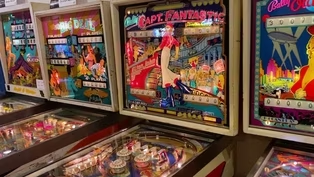
Video has Closed Captions
Clip: S10 Ep7 | 5m 38s | No quarters required for this fun, interactive museum! (5m 38s)
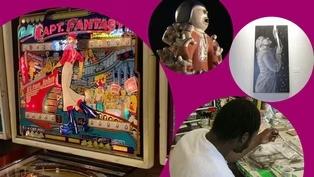
Preview: S10 Ep7 | 29s | Replay Museum, Helen Cordero, Abel, Community Arts Connection (29s)
Providing Support for PBS.org
Learn Moreabout PBS online sponsorship

- Arts and Music
The Best of the Joy of Painting with Bob Ross
A pop icon, Bob Ross offers soothing words of wisdom as he paints captivating landscapes.












Support for PBS provided by:
WEDU Arts Plus is a local public television program presented by WEDU
Major funding for WEDU Arts Plus is provided through the generosity of Charles Rosenblum, The State of Florida and Division of Arts and Culture and the National Endowment for the Arts, and the Hillsborough County Board of County Commissioners.