WEDU Arts Plus
Episode 1008
Season 10 Episode 8 | 26m 45sVideo has Closed Captions
Painter Jake Fernandez, Musician Justin Echols, Painter Tania Dibbs, Jewelry in Columbus.
Fine art painter Jake Fernandez finds influence in the beauty of Myakka, police officer Justin Echols finds a second life with music, painting to save the planet, and a shape shifter performance space.
Problems playing video? | Closed Captioning Feedback
Problems playing video? | Closed Captioning Feedback
WEDU Arts Plus is a local public television program presented by WEDU
Major funding for WEDU Arts Plus is provided through the generosity of Charles Rosenblum, The State of Florida and Division of Arts and Culture and the National Endowment for the Arts, and the Hillsborough County Board of County Commissioners.
WEDU Arts Plus
Episode 1008
Season 10 Episode 8 | 26m 45sVideo has Closed Captions
Fine art painter Jake Fernandez finds influence in the beauty of Myakka, police officer Justin Echols finds a second life with music, painting to save the planet, and a shape shifter performance space.
Problems playing video? | Closed Captioning Feedback
How to Watch WEDU Arts Plus
WEDU Arts Plus is available to stream on pbs.org and the free PBS App, available on iPhone, Apple TV, Android TV, Android smartphones, Amazon Fire TV, Amazon Fire Tablet, Roku, Samsung Smart TV, and Vizio.
Providing Support for PBS.org
Learn Moreabout PBS online sponsorship- [Narrator] This is a production of WEDU PBS, Tampa, St. Petersburg, Sarasota.
Major funding for WEDU Arts Plus is provided through The Greater Cincinnati Foundation by an arts loving donor who encourages others to support your PBS station, WEDU and by the Pinellas Community Foundation.
Giving humanity a hand since 1969.
- [Dalia] In this edition of WEDU Arts Plus, fine art painter, Jake Fernandez is influenced by the beauty of Myakka.
- My attention is grabbed by something I come across.
I start to investigate like a detective.
- [Dalia] Finding a second life after an accident.
- You are always gonna fall back on your natural strength.
So music was the natural gift and I fell back on that.
Fell into it.
- [Dalia] Painting to save the planet.
- How could it have sustained us and and be such a beautiful thing and we treat it like this?
I'm trying to shine a light on our soulless attitude towards our planet.
- [Dalia] And a minimalist approach to jewelry making.
- [Claire] We like to make things that people can wear every day so they don't feel like "I have to save this for a special occasion."
- It's all coming up next on WEDU Arts Plus.
(bright music) (upbeat music) Hello, I'm Dalia Colon and this is WEDU Arts Plus.
This first segment was produced by students at St. Petersburg College in partnership with WEDU.
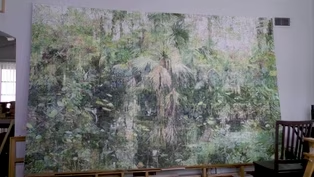
Bradenton resident and fine arts painter, Jake Fernandez, has been featured in exhibitions around the country.
But it wasn't until he visited the Myakka wilderness that he began to paint his masterpiece.
- The purpose of my art, it's hard to pin down but I think that I like the idea of putting something that gives you a window into a different form of reality or experience.
My name is Jake Fernandez and I am an artist.
The Myakka Fork project is one that could be classified as durational.
I'd moved back to Florida from New York City and was incredibly taken by the nature.
The sheer intensity of the color.
The greens almost hurt my eyes.
- My name is Linda Chapman and I'm an artist.
I thought Jake Fernandez was the best artist I'd ever seen.
His work was very unusual and we were undergraduates but he never followed the rules.
The Myakka Fork project has been going on for so many years.
I don't remember when it started.
He has thousands of photographs.
He visits a specific site very often and has reported the changes in the environment since his first photographs there in the 1980s.
- [Jake] So I did a lot of hiking and going around, not looking for anything in particular.
And in one of my walks, this particular place caught my attention.
And I decided to focus on that work.
And in my head I planed to do three large paintings based on that place.
It differs from project to project but the more complex projects start with an idea and that idea comes from maybe just walking around and my attention is grabbed by something I come across and I start to investigate like a detective.
- The most interesting thing to me about Jake's artwork is it has so many different levels of visual information.
It's abstract, it's real.
There are things that are imaginary.
It looks like a map.
It looks like a forest.
It's endlessly entertaining.
- The complexity of painting is something that I'm drawn to.
Something that I've worked for a long, long time to try to take small steps into perfecting and there is no end to it.
It's the kind of medium that offers immense possibilities and opportunities.
You're involving the senses, you're involving a narrative even in abstract paintings.
I'm not into, even though it's tempting to do, you know depressing subject matter.
Many think that depressing, an angst written subject matter makes your work heavy and important.
I disagree.
There's enough ugliness out there.
I don't need to be producing any more.
I remember I took my son to a location one time to just sort of hold rulers and stuff that I had because I was doing some calculations and he was six years old.
He's now 32.
So to show you, and I'm two paintings down and still working on the third Myakka painting.
- My name is Dixie Resnick and I am the CEO of Crowley Museum and Nature Center.
I met Mr. Fernandez one day when I was working in the welcome center and he and a friend came in just to hike and look around.
And he introduced himself to me.
He was a very nice man.
My first thought on Jake Fernandez Myakka Fork pieces were how interesting it was to see him represent true old world Florida the way that he did with its wildness, its imperfections.
All of that was encompassed in this artwork.
And so many people are unfamiliar with Myakka that I just thought it was great that he saw it and he decided to represent it even though it might not be the typical popular views of what Florida is.
- I don't set out to change the world or deal in politics or commerce.
But I do believe that if somebody can walk away seeing things in a slightly different way because of what they experienced then that's more than I need.
- For more information, visit jakefernandezart.com.
Justin Echols is an accomplished jazz musician who has played with the greats in America and Europe.
But that wasn't always the case.
A serious car accident led this Oklahoma city police officer to his purpose.
- Thank you.
My name is Justin Echols.
I am a jazz pianist and a blues guitarist and an Oklahoma City police officer.
Testing, one, two.
How are you all doing?
- [Audience] Good.
- Oh, you're doing better than that.
How are you doing?
- [Audience] Good.
- [Narrator] Justin Echols is working his day job.
- I am a policeman and I am a musician.
So I do both.
And so part of your career day was I got to expose you both to police work and to music.
So I'm going to a little bit of piano and we'll see where we go from there, all right?
- [Narrator] He's a 17 year veteran of the Oklahoma City Police Department.
And for most of that career, he has worked with children as a community relations officer.
♪ Yeah the one night long for all I work for ♪ I've done it long enough.
I'm seeing them all grown up now.
They're in college and saying, "Did you teach my Dare class in the fifth grade?"
What do you think about that guys?
(audience applauding) - [Narrator] But Justin didn't always work with children.
At the beginning of his tenure, he patrolled the streets.
But a tragedy drastically changed his life and his work.
- I was a soldier with the US Army Reserve.
I was activated during Operation Iraqi Freedom.
During that I was in a head on collision and had a severe injury to my spine that ended up with me discharged from the military.
So I was dealing with who I was as a person, as a man, as a police officer, now that I had serious physical limitations.
♪ Only you ♪ - [Narrator] As it turned out, Harry Connick Jr. had the answers to Justin's problems.
- I remember watching Harry Connick Jr. play a concert called The Other Hours.
And I said to myself, I remember sitting on the couch saying to myself if I can't be a police officer anymore then I want to do that.
And I knew after I watched him play that that was going to be my next journey.
Because I think realistically, when you are in a state of exigence you are always going to fall back on your natural strength.
It's all you have.
And so music was the natural gift and I fell back on that.
I fell into it.
♪ I'm glad that I'm the one who found you ♪ - [Narrator] Justin taught himself how to play piano, practicing three to five hours a day.
- I would practice before work, I practiced after I got off work.
On my days off I would practice, holidays, if I was going out of town.
- [Narrator] He found teachers to help him improve.
(lively upbeat music) - I spent a year forcing myself to study classical.
I went from, you know "Mary Had a Little Lamb" quickly to Farley's and Bach and Berg Mueller and some of that stuff.
And then quickly transitioned into playing jazz.
♪ Do I love you oh my good heart ♪ - [Narrator] After the accident led him to Harry Connick Jr. and Harry Connick Jr. led him to jazz, Justin's passion led him to take another seminal step.
He decided to record a demo CD.
Having no idea that just days later that CD would change his life again.
- That CD ended up in the hands of Wynton Marsalis in New York city at Lincoln Center.
I think it was probably a day or two after it was sent to him I got a phone call telling me that I needed to be in New York City in a month.
And that was the beginning of five years of studying with Antonio Ciacca, Italian pianist, jazz composer.
♪ Chase your dreams ♪ And now I was playing with members of Harry Connick's band in New York city at different jazz venues.
- [Narrator] In 2012 Justin was inducted into the Oklahoma Jazz Hall of Fame with the Legacy Tribute Award.
Today at the age of 39, two years away from retirement, this jazz musician slash police officer is taking stock and he's preparing to pivot yet again.
- My family still owns the property that my ancestors were slaves on.
We still own it.
So my folks are from Mississippi, from Byhalia, Mississippi and Memphis.
And I went to my grandmother's funeral and my aunt's funeral just after that in Memphis and was able to travel to Byhalia.
This was during the time I was just kind of bending my ear to blues guitar.
And blues kind of evolved out of me being in Mississippi.
♪ Aint no sunshine when she's gone ♪ ♪ This just can't go on ♪ So there's this chapter of my life that's connected to Delta Blue.
It's in my blood and so I'm exploring that.
- [Narrator] Throughout his musical journey, Justin has been a fixture with children in Oklahoma City public schools.
They are his other passion.
He credits the police department for supporting his artistic gift encouraging him to use it in his community outreach.
Besides general presentations at schools, Justin also works with at-risk youth, something he also might never have done if not for that catastrophic accident 20 years ago.
Justin will live with pain and complications for the rest of his life.
But he says from where he's sitting, he can't help but believe it was all meant to be.
- If you engage in your area of greatest giftedness, your area of your greatest strength, it's something we all do, that's better.
We do it a little bit better than the person next to us.
If you engage in that, I think it puts you on the road to your purpose.
And I think that's what I did.
I was kind of forced to use what I was gifted at and it allowed me to journey down the road to my purpose and destiny.
- To find out more check out facebook.com/justinecholsjazz.
Science and nature are areas that artist, Tania Dibbs explores in her work.
Dibbs is especially interested in humanity's complicated relationship with nature as she works in her Aspen, Colorado studio.
- Every day it's awkward at the beginning.
Especially if you're starting with a white canvas.
There's nobody saying, "Oh you're doing the right thing now."
You've just got to go, "Am I, am I not?
"Is it good?
Is it not good?
"Let's see how this goes.
"I'm not liking now.
"Why don't I like that?
"I'm not sure."
And then finally the voices quiet down.
But it's really satisfying when you're not wondering where you're going.
You're just doing.
I use a mirror to kind of get an idea what it looks like to somebody else cause it's flipped around and it's given me double the distance.
It gives me a fresh view.
I like it because when I look this way, it's very familiar.
I'm already starting to categorize the shapes and I go like this and it's completely new to me.
I thought, well, why am I painting a landscape?
Why don't I just use a photo?
And I really honestly think that the act of putting all that work and care into it and then scribbling over it means something.
It really does.
It's almost analogous to how we treat our planet.
How could it have sustained us and be such a beautiful thing and we treat it like this?
I'm trying to shine a light on our soulless attitude towards our planet.
When I started with landscapes, I was obsessed by the idea of the horizon and I did these big skies.
And I always felt like we are a speck of dust on the skin of creature earth.
I found comfort in the idea that we're just a cog in this biological process.
Times have changed a lot.
It's definitely more of a threat out there in terms of the environments.
Pretty critical now.
It's worthy of addressing.
Never used fluorescent paint before on a painting cause it just seems so wrong.
But it also kind of goes cause it's a landscape and I want the viewer to still see the painting.
But they're going to have to really look through all this stuff and wonder what it's about.
And wonder why it's there.
Trying to put it into words what exactly it means sort of it makes it a lot more literal than what it is.
I think in my mind it vaguely represents humanity, human construct, the things that we build, the things that we do that don't quite mesh.
I'm trying to address something uncomfortable.
Human beings have a relationship to nature but we also have an anthropocentric existence and I want to point that out.
And if you just do something that's really didactic or finger-wagging or terribly ugly, nobody really wants to hear it or look at it.
So I want my paintings to be beautiful and I want the viewer to want to look more so that they stop and really understand what it's about.
Why are there these fluorescent green lines obliterating this landscape?
Why can't I see it clearly?
That's a little bit uncomfortable.
I'm trying to make them disarming enough that people will look and be drawn in by the beauty.
People are like, "Oh wait.
"Wow, that's cool.
"That's so true."
And people usually do really relate because I think a lot of people kind of feel that in this day and age.
Like, wow we're at a really interesting point in human development in terms of our relationship with the world but nobody knows how to put their finger on it.
And I think almost putting your finger on it in abstract way like this is more direct than talking about it.
I feel like I'm helping you express something that you know and feel and are aware of but don't know how to express or talk about or bring into the conversation.
It's really an interesting time in human history.
I don't think people dreamed it would get like this.
I try to give a title that is a clue as to what the meaning of the painting is.
So all of the first ones that I did in this series had the name Anthropocene.
This is a geographical epic that's been completely shaped by humans.
Biology is not incompatible with art.
Biology has informed my sculpture.
The sculptures are all based in the book of Invertebrate Zoology.
And I do a lot of work that addresses survival strategies in the changing physical world.
You know, pieces with spikes, spores, a proboscis for feeding, creatures that may be sort of horrifying but beautiful, I kind of ride that line.
A little bit of that with a little bit of the miracle of what something can do to survive, it just goes on and on.
I love that regenerative concept.
It's a lot of power in that for me.
I think it inspires me.
I did study biology so I always kind of think of us as a species and it's hard for me to not do that.
But things start to seem ridiculous.
You know, I was a ski instructor and I'm like, "Wow I'm spending all this energy teaching a creature "how to strap things on it's legs and slide downhill for fun.
I always think of things that way and it starts to seem silly.
Culture is very interesting but underneath culture is nature.
Underneath it all we are human beings that are a part of the physical biological world and we separate ourselves from that but we really can't.
I mean, I think we pay the price for doing that.
Biology led me down this path and I think that for a long time I was happy doing the landscapes but after a while they seem kind of pointless.
So it's a pretty picture.
What is it?
A diorama from the past in a museum?
Why am I painting this?
It's not even what I feel.
There's always a little bit of tension in me when I'm traveling and seeing beautiful things and worrying about what's happening.
I think if you study biology or environmental science or anything like that, you end up with a real depth of understanding of the interconnectedness of things and the fragility of things.
Art can put a certain conversation on the table in a way that other things can't.
And so do I think art, you know, changes the world?
Not one piece by itself but I think as the conversation moves forward the world slowly does change.
So I think it's really important to bring up that conversation.
And I think it's really important to continue the dialogue and get people comfortable talking about it.
To have it be an issue.
Because when something is not an issue it's never going to be addressed.
- Learn more about her work at taniadibbs.com.
Two jewelry designers in Columbus, Ohio are taking a minimalist approach to modern jewelry to create offbeat classics.
Made with precious materials but simplistic designs, each handmade bobble is a work of art.
(upbeat music) - We are in our sweet little lifestyle shop, we call it, in Clintonville right on High Street.
- So when people come in we kind of like to tell them like we make all the jewelry in the back half and we can customize stuff.
And if you need a different size we can make it while you wait, which people love.
- [Kaleigh] We met working at a boutique in the Short North when I was in college, studying jewelry.
She worked there full time.
- So I went to college for psychology.
And my last quarter in school, I took a textiles class and absolutely loved it.
And was like why wasn't I doing this the whole time?
But obviously I wasn't going to change my major in my last quarter.
So I finished up and then ended up working for a year and going back and getting a master's in textiles.
- I was graduating and kind of wanting to move on from working there.
Just move on, do my own thing.
And I think she was kind of feeling like her time was at an end there.
And we were both just like ready to do something like let's just do it.
Let's start a business.
It was named after my mom's home address, which is in Delaware.
She has since moved and it was just kind of an important house for us.
She didn't actually live there that long.
It was only five years.
It was right after my parents divorced.
And it was kind of when her and I became really close was in that house.
And I just wanted the brand to be kind of a nod to her but I didn't want to name it Angie Shrigley.
- We like to make things that people can wear every day so they don't feel like "I have to save this for a special occasion."
Like we want people to wear this stuff all the time and not have to take it off.
And that's why we use the high quality materials so that you don't have to feel like, "Oh, I'm taking a shower, I have to take those off.
"I'm going to work out."
Like we want it to just be like a part of your body.
Like just as an extension.
And then also we do try to do a quirky take on like a regular thing.
Like for example, these earrings, they're like a hoop shape but they have the little, you know, waviness to them.
Which I think is really cool.
It makes it a little bit unique.
- There's always hot new trends in the jewelry world.
And when we first started, it was all about rings.
Tiny little sequin is what everybody wanted.
And now it's going toward earrings and bigger, bigger bigger, bigger, bigger earrings every season.
We always watch the fashion shows in New York.
You know, those are always over the top extravagant.
Like they have earrings that are the size of dinner plates.
So we take those kinds of ideas and bring them down to the everyday consumer.
The new collection has some acrylic.
Which is a new material for us.
We just have always been wanting to introduce color into the collection because obviously our brand is so colorful and so lively.
We wanted to translate that to the jewelry.
So this spring, summer you will be seeing some colorful pieces.
- You can see more of these designs at hello-gilbert.com.
And that wraps it up for this edition of WEDU Arts Plus.
For more arts and culture, visit wedu.org/artsplus.
Until next time, I'm Dalia Colon.
Thanks for watching.
(upbeat music) - [Narrator] Major funding for WEDU Arts Plus is provided through The Greater Cincinnati Foundation by an arts loving donor who encourages others to support your PBS station, WEDU and by the Pinellas Community Foundation.
Giving humanity a hand since 1969.
Video has Closed Captions
Clip: S10 Ep8 | 6m 24s | Jake Fernandez has spent years on a project that focuses on the beauty of Myakka. (6m 24s)
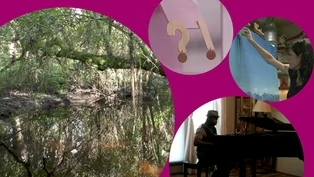
Preview: S10 Ep8 | 29s | Painter Jake Fernandez, Musician Justin Echols, Painter Tania Dibbs, Jewelry in Columbus. (29s)
Providing Support for PBS.org
Learn Moreabout PBS online sponsorship

- Arts and Music
The Best of the Joy of Painting with Bob Ross
A pop icon, Bob Ross offers soothing words of wisdom as he paints captivating landscapes.













Support for PBS provided by:
WEDU Arts Plus is a local public television program presented by WEDU
Major funding for WEDU Arts Plus is provided through the generosity of Charles Rosenblum, The State of Florida and Division of Arts and Culture and the National Endowment for the Arts, and the Hillsborough County Board of County Commissioners.