WEDU Arts Plus
Episode 1009
Season 10 Episode 9 | 26m 45sVideo has Closed Captions
Tampa artist “Liasi” Martin Smallwood, paper artist Kristi Abbott, painter David Horton.
Tampa artist Lisa “Liasi” Martin Smallwood creates Impressionistic works of art inspired by iconic jazz singers and musicians. Paper artist Kristi Abbott uses vibrant colors and designs in the creation of her complex, multilayered collages. Baton Rouge, Louisiana, painter David Horton sits for an interview to discuss why he fills his canvases with colorful, symbolic icons and fantastical creatures
Problems playing video? | Closed Captioning Feedback
Problems playing video? | Closed Captioning Feedback
WEDU Arts Plus is a local public television program presented by WEDU
Major funding for WEDU Arts Plus is provided through the generosity of Charles Rosenblum, The State of Florida and Division of Arts and Culture and the National Endowment for the Arts, and the Hillsborough County Board of County Commissioners.
WEDU Arts Plus
Episode 1009
Season 10 Episode 9 | 26m 45sVideo has Closed Captions
Tampa artist Lisa “Liasi” Martin Smallwood creates Impressionistic works of art inspired by iconic jazz singers and musicians. Paper artist Kristi Abbott uses vibrant colors and designs in the creation of her complex, multilayered collages. Baton Rouge, Louisiana, painter David Horton sits for an interview to discuss why he fills his canvases with colorful, symbolic icons and fantastical creatures
Problems playing video? | Closed Captioning Feedback
How to Watch WEDU Arts Plus
WEDU Arts Plus is available to stream on pbs.org and the free PBS App, available on iPhone, Apple TV, Android TV, Android smartphones, Amazon Fire TV, Amazon Fire Tablet, Roku, Samsung Smart TV, and Vizio.
Providing Support for PBS.org
Learn Moreabout PBS online sponsorship- [Man] This is a production of WEDU PBS, Tampa, St. Petersburg, Sarasota.
Major funding for "WEDU Arts Plus" is provided through the Greater Cincinnati Foundation by an arts loving donor who encourages others to support your PBS station WEDU, and by the Pinellas Community Foundation Giving Humanity a Hand Since 1969.
- [Dalia] In this edition of "WEDU Arts Plus", a Tampa Bay artists creates complex works of art inspired by iconic jazz singers and musicians.
- The style is more like impressionistic.
It's like I'm making a suggestion, okay.
And I'm gonna give a little bit of detail but I'm not going to go into it.
- [Dalia] An artist's keen eye toward colorful and complex collages.
- It's really trying to gather a lot of stories and messages in one piece.
- [Dalia] Brush strokes that create worlds of color in magical realism.
- My opinion is kind of an offshoot of that trying to present a situation or an image that would tell an underlying story.
- [Dalia] And a 19th century architectural gem.
- There's some richly carved woodwork with lots of organic motifs carved throughout.
You'll see acorns, and grapes, and vines, and birds, all in the carvings.
- It's all coming up next on "WEDU Arts Plus".
(upbeat music) ("Relaxing Bells" by Bobby Cole) Hello I'm Dalia Colon.
And this is "WEDU Arts Plus".
For Philadelphia native Lisa Liasi Martin Smallwood, music plays an integral role in her life.
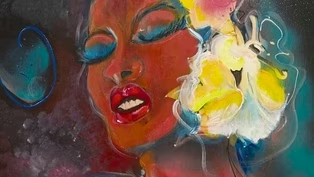
See how the mixed media artist uses an impressionistic style to pay tribute to her late musician father and the iconic jazz singers and musicians from days of old.
(upbeat music) - My name is Lisa Martin Smallwood AKA Liasi.
I'm originally from Philadelphia.
Currently, I'm living out here in Tampa Bay and I'm a visual artist.
I work with different mediums such as ink, pastel, and acrylic.
The style is more like impressionistic.
It's like I'm making a suggestion, okay.
And I'm gonna give a little bit of detail but I'm not going to go into it completely.
I'm going to create an illusion to the brain of like, okay, wow.
You know, oh, he's really blowing that sax, or that trumpet, or, you know, playing that piano.
Like my Nina Simone, I love Nina, you know.
And the shades that I use suggests that is abstract but at the same time it has a surreal feel to it.
(gentle jazz music) I can paint a painting and make it look like a photograph but I like to experiment and to project, you know, the feeling that it gives me.
(gentle jazz music) - I think what really separates Lisa from other artists is that she really adds depth and passion into her artwork.
And I think also the use of colors to capture the ambience and give the viewer that in-depth expression so that they feel like that they're actually a part of that piece.
- Is Jason here?
- [Jason] Hey I'm in here in the studio.
- Hey Jerri.
- Hey, how are you, Lisa?
- I'm good, I got my Aretha Franklin piece.
Jason, how's it going?
- Excellent, how are you?
- I'm good.
- Oh, this looks magnificent.
- Thank you.
My favorite art piece is one of my favorite places.
I love that piece.
- You and me both.
(Lisa laughs) I wish she was singing to us right now.
- Well, you know, I will sing but I don't do that.
(laughs) They have welcomed me into this establishment.
I mean, to see the whole production is like to me a class trip.
And they work on my art, they treat it great, they do my reproductions.
Now, why are you rotating it?
- Basically so the highlights from the shiny inks, of the metallic inks.
- Right.
- I first met Lisa while she was doing a live painting exercise in our gallery in St. Petersburg.
We had a musician playing there and she was painting him live as he played.
And I was just blown away by what she did.
So we talked to her into coming here.
- She showed me some of her artwork which I fell in love with immediately.
And we just kept talking about artwork.
We hit it off right away.
She ran into a situation where she needed a framer to have a piece fixed up.
And she came out to visit us, and met the team, and saw our operation, and was very impressed.
- [Lisa] Oh, that looks good.
- Yeah, we should save this and then we'll get a shot.
So once we get the artwork captured and the color correct, then we can spread it out onto a myriad of things depending on the venue of where the artwork is gonna be sold at or displayed.
♪ R-E-S-P-E-C-T ♪ I knew we'd get her singing.
(Lisa laughs) - The music actually, I don't know it's just like in me.
You know, every guitar, natural pluck, or whatever, it's like every stroke for me, you know.
And that's how the two come, you know, together.
- Lisa is from Philadelphia.
And Philadelphia has a music scene unlike any others.
And her father was in the music world.
And you can just tell that it's in her blood.
So when she paints musicians and performances and that type of stuff, it just, the paintings sings.
You can see the music, you can feel the energy, you can feel the emotion that comes out.
And I think that that's one of the things that makes her such a successful artist and makes her paintings of musicians so popular.
(gentle jazz music) - So my father Dowell Smallwood Jr, he was a drummer, a native from Philadelphia.
And he played with Johnny Stiles and the Manhattans which was a jazz group back in the 1950s into the 60s.
My father was a great guy and he has really inspired me.
And he always encouraged me to continue to paint.
Just the memories and the stories that he would tell me, I try to put myself there for that moment.
Some of the paintings that I have painted, a lot of times are memories.
It could be his memories that he shared with me and I'm just painting it out and laying out, you know, everything in my mind, in my heart that I felt during that thought process of, you know, processing his story.
- I think Lisa's artwork really has a very poetic vibe to it.
And she's actually able to capture those poetic expressions which creates a real synergy with her work.
You can just look at it and begin to just talk about it in a very poetic manner.
Oh my, oh, this is so beautiful.
- I hope that my artwork can hatch a memory.
Art is very therapeutic and I just want people to enjoy what they're looking at and, you know, open that box of memories.
- To see more of Liasi's artwork, visit liasicreations.com.
Kristi Abbott's work controls the eye with its vibrant colors and patterns.
Upon closer study, her paper collages revealed their complexity.
Built layer upon layer, Abbott depicts beloved icons and landscapes.
(upbeat music) - Where is this paper from?
This is just beautiful.
This is a must.
I like this one.
That really looks three-dimensional.
All right, let's keep going.
This is good.
My paper collection started actually about seven years ago in Sydney.
The right paper can make or break a piece.
Oh, I like that one.
This one's beautiful.
I'm going to start like a Dundee pile.
(laughs) And it's really growing into something.
I now have big paper, you know, printed drawers full of paper.
I'm like a kid in a candy store.
I'm like aww.
(upbeat music) Within my latest body of work, I've really tried to push the typical idea of collage as an art form.
Crocodiles actually do feel kind of leathery and rough like this.
Not that I felt too many crocodiles.
(laughs) The biggest surprise people have when they see my work is realizing that it's made from paper.
You're gonna to have to stop me from going over the top.
(laughs) (upbeat music) When I was younger I used to do a lot of jigsaw puzzles and spot the different puzzles trying to find hidden imagery in artwork which was children storybooks.
(upbeat music) I guess the way that I would describe my work it is really a combination of multiple layers of imagery and papers.
It's really trying to gather a lot of stories and messages in one piece.
(bright guitar music) My father's a native Minnesotan and my sisters and I were all raised in Sydney, Australia.
There was a decade there that I worked side-by-side my parents.
And we ran a very successful training business but the artist in me was very much crying to get out.
And so I decided to leave that role to move to Minnesota and follow the dream which was to become a full time artist.
This here is my latest studio find that I use for my large pieces of handmade papers.
Sometimes I'll pick up a paper and it'll be in my drawer for, you know, six years.
I won't know when I'm gonna use it.
And then a perfect project will come along and I will be like, "Yeah, this is the one."
(laughs) I'm going to show you a few of my favorites styles.
In here, we've got my reds and oranges.
And this is one of my absolute favorites.
This is a beautiful handmade paper from Japan.
The reason I use papers, I found with paint I could never really get the fine, beautiful lines that I wanted.
And it was when I started working with papers, using a scalpel and a blade, I got these beautiful fine edges.
I have almost an unlimited scope of what I can play with.
Some more Indian papers and then some more beautiful papers used in my foliage and trees.
I think the biggest step in my development as an artist was actually really moving into the Lowertown Lofts Artist Cooperative and being around other artists that I could get feedback from.
And actually that's how I moved into collage.
I decided to do some studies that were all in paper.
And I brought them into my studio and I brought in two of the ladies and I said, "Guys, what do you think?"
And they just looked at me and they said, "You should be working in paper.
"You can do stuff with paper that, you know, "I can't even dream of."
(gentle guitar music) At the moment, I am working on two pieces.
I really decided to look at who are two standout characters that tell a bit of a story of Australia.
You know, Ned Kelly and the "Crocodile Dundee".
One talking about historical Australia and one talking about modern Australia.
My series as well kind of developed very organically.
For example, I'd been working on my pin-up series as a subject matter.
I was very comfortable with and I have a background in fashion and theater design.
So the costuming element was great.
I was showing at a few different fairs and I had a lot of people coming out to me and saying, "Oh, wow, you know this is beautiful "but, you know, have you done Marilyn," "or have you done Audrey or Sophia?"
And so there were all of these fabulous women that they were hoping to see in it.
And it really got me thinking that's a whole another area.
So I went back and I decided to pick a Audrey Hepburn.
And then I embed all of these other fabulous women that have done great stuff for girl power over the last century within that piece.
And so that was really the beginning of this new style of work that I'm doing.
(bright guitar music) I feel I'm creating something much more than the popular culture images.
How I feel I guess I'm really adding to the art world in my way is by weaving in this fabric of papers and also this fabric of hidden imagery.
I could maybe use the two of these and then maybe use this.
I think that could look pretty cool.
I get these feeling sometimes when I'm driving, I've left the studio and I'm on my way somewhere and it's almost like a tingle all over.
I can tell you it's the most unbelievable happy feeling in the world.
To think that I took a chance, you know, it's scary sometimes.
Actually it is scary not just sometimes but it is scary to put that kind of faith in yourself to be out and make it work and to be able to now write when I go back to Australia in the customs card "I am an artist, that is my occupation," is a very cool thing.
I pinch myself often.
But I'm very happy.
(laughs) - For more about her work visit kristiabbott.com.
Baton Rouge, Louisiana painter David Horton, is inspired by his surroundings.
His style is described as narrative magical realism evident in his canvases filled with colorful symbolic icons and fantastic creatures.
- You were born in New York but raised in Louisiana and an artist really from the very word go receiving your first commission at the age of 13.
Then you had your formal training at LSU but it really was an uncle who fan the flame.
- I was very close to him from an early age.
He was my mother's youngest brother and one of the most preeminent watercolorist in Mississippi.
His name is Bob Dunaway and he gave me materials and encouragement and overall made me feel that artists had a special place in the world.
- Now, you describe your style as narrative magical realism and you don't mind being labeled a narrative painter.
Can you talk about your style and how it evolved?
- Very early on I was attracted to satire, cartooning, political cartooning, and storytelling.
For a long time I wanted to be a author, short stories.
Never really cared much about novels but poetry and short stories I wrote for many years.
And so my painting is kind of an offshoot of that trying to present a situation or an image that would tell an underlying story.
- Foreign travel was a key influence, wasn't it?
You spent a good bit of time in Paris in the early 80s, and then also in Spain.
Please talk a little about how that foreign travel experience has made your work change.
- The French experience, I was able to have studios in Paris and in Provence over several years.
And it was a new world for me in terms of seeing how people interact in a different culture than ours.
The French influence lasted many years and it resulted in mostly interior and a little bit dark interaction among the figures in the paintings.
However, in 1990, I had the opportunity to take a studio in Spain, Southern Spain, on the coast, right around the Costa Blanca.
And the colors, and the people, and the culture was so radically different from anything I'd experienced in Paris.
I always thought of Paris in terms of monochrome.
And of course, Spain was completely polychromed everywhere.
The blues, the purples, and the brilliant whites.
And my technique evolved by looking at the murals.
Even in the small town had many murals painted on the sides of these white stucco buildings.
And that was something that I had never experienced before.
- There are many stories to tell here.
How have the stories that you tell evolved over the years?
- When I first got back from Spain, most of the stories were borderline mythological.
They contained icons, and creatures, and figures, and objects that I gleaned from learning about ancient symbols.
I began to look around me to find out how I could use symbols or create my own symbol structure to express or kind of explain concepts of what happens either in society or among groups of people or between two people.
And so using new icons gathered from South Louisiana and other places, that's where my work has been going for a number of years.
- Fish, rabbits, boats, flowers that shed petals, icons and symbols appear on your work over and over again, strange fantastical creatures.
How has the symbolism in your work hold the key to understanding the world those creatures inhabit?
- Well, I think a lot of who we are are the things that are imprinted on us early in our lives as children.
I was always out in the field, in the woods, in around the bayous.
These creatures are things I just became very familiar with.
They were just part of my daily existence.
And so knowing what they meant to our culture, particularly in Louisiana, I was able to attach certain meanings to these things that some of the meanings had origins going back couple of thousand years.
Some of them were origins that in what I experienced of the icon.
One example might be the rabbit.
And we've always heard the term wild hare.
Well, it's spelled H-A-R-E and it's meant to imply the kind of insanity that rabbits have in the field.
When we observe them, I mean, they tend to run for to and fro.
And then coming back to the literature, the March hare.
So I attached a meaning to that of kind of an impulsive small insanity.
And now use it in that context within the paintings.
- How about Louisiana?
How has the landscape and environment of your homeland manifested in your work?
- The culture is unique as we know the United States.
And as a result, we have a lot of things that can be translated into art.
Things that we feel are important here such as food, joy of living, and through dance, music.
And taking that kind of attitude and try and infuse that in the painting, I found that people find it something they can relate to.
- They are rich in magical worlds that are available to the viewer that deeper that they look into your painting.
And it's been such a pleasure to be able to experience a little of what we see through your eyes.
Thank you so much.
- Thank you.
- See more at batonrougegallery.org/david-horton.
The Eustis mansion in Milton, Massachusetts, is going through a painstaking renovation almost 150 years after this architectural treasure was built.
When the house was constructed in the 1880s, it was state of the art with no expense spared.
- [Jared] This is as close to America's landed gentry as one can get it.
- [Elyse] A country estate, wide open spaces, the rolling blue hills behind us.
So it's really a sort of idyllic space to be.
- [Jared] For 140 years this has been the grand house on the hill in Milton, Massachusetts.
An 18,500 square foot home enveloped in green.
For nearly all that time, it's been the pride and joy of the Eustis family, starting with newlyweds, W.E.C.
and Edith.
They were in their 20s when her parents built the home as a wedding present.
- Their twin sons were born in 1877 and they moved in here about 1879.
So just a young family of four living in this magnificent huge house as their starter home.
- [Jared] The Eustises we're very early practitioners of sustainable living.
In its earliest days, the home was run as a gentleman's farm.
- They only purchased fish and a few other things outside of their estate.
They wanted to grow everything here and truly live off of their own resources as best they could.
- [Jared Voiceover] Elyse Werling is a Curatorial Assistant with Historic New England, which purchased the home in 2012 with an eye toward preservation.
Until then, the property had always remained in the Eustis family.
Do you have a favorite part of the property?
- [Elyse Voiceover] Well, inside the house, the parlour is my favorite room.
It's a really nice, warm room.
- [Jared] Historic New England has spent the last five years and more than $5 million restoring and improving the home and estate which had been built with essentially no expense spared.
- [Elyse] They went for the high-end and the most well-known artisans and the most connected artisans.
- There's richly carved woodwork with lots of organic motifs carved throughout.
You'll see acorns, and grapes, and vines, and birds, all in the carvings.
Everywhere you look there's something, a floral, even the stained glass windows are another great example of that.
- [Jared] The mansion was designed by William Ralph Emerson, a starchitect favored by Boston Brahmin types.
Historic New England's Peter Gittleman says the home is a rare surviving example of the Victorian era's Aesthetic Movement that swept through the United States.
- It's rallying cry was art for art's sake.
And what that really is is saying is that there is value in art.
And it simply was a love of deep, saturated, colors, patterns throughout.
- A team of restoration artists methodically worked their way through the mansion restoring fixtures, removing layers of paint, and restoring original colors, like the dining room which features green walls flecked with hints of gold.
How extensive was the restoration effort here?
- [Peter] Probably the largest aspect of the restoration was the the paint work that we did.
Because our goal was to try to bring the paint colors back to the way that they were in the 1870s and early 1880s when they were first done.
- [Jared] When it was built, the mansion was state-of-the-art with an elevator, a high-end kitchen including this stove which has always remained.
And these.
Speaking tubes.
- Before electricity, speaking tubes is how you basically communicated with your servant.
One end of the tube you would blow into and it would produce a whistle which would alert a servant to come over to the tube that ended in the kitchen.
And then the person calling would basically speak through the tube and you could pick up what they were saying.
- [Jared] So one step up from cans and string it sounds like.
- It is and it was better than yelling down the staircase which is one of the things that Victorian households absolutely insisted on.
You simply could not bellow through the house.
- [Jared] With the exception of just a couple of rooms including the dining room and the master bedroom furnished just as the Eustises designed them, the home is now filled with less precious period appropriate furniture.
So visitors can walk throughout the home without a guide and even sit down in rooms like they own the place.
- [Peter] It's an opportunity for people to have a historic house experience that they really want, not the one that we are forcing them to have.
- [Jared] And one that gives an even stronger impression of house beautiful.
- To learn more, visit historicnewengland.org and search Eustis Estate Museum.
And that wraps it up for this edition of "WEDU Arts Plus".
For more arts and culture, visit wedu.org/artsplus.
Until next time, I'm Dalia Colon.
Thanks for watching.
(dramatic music) - [Man] Major funding for "WEDU Arts Plus" is provided through the Greater Cincinnati Foundation by an arts loving donor who encourages others to support your PBS station WEDU, and by the Pinellas Community Foundation Giving Humanity a Hand Since 1969.
Video has Closed Captions
Clip: S10 Ep9 | 6m 28s | Tampa artist Lisa Martin Smallwood, or "Liasi", creates impressionistic works of art. (6m 28s)
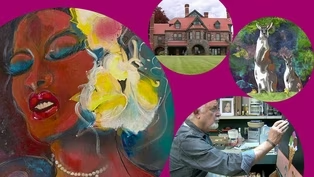
Preview: S10 Ep9 | 29s | Tampa artist “Liasi” Martin Smallwood, paper artist Kristi Abbott, painter David Horton. (29s)
Providing Support for PBS.org
Learn Moreabout PBS online sponsorship

- Arts and Music
The Best of the Joy of Painting with Bob Ross
A pop icon, Bob Ross offers soothing words of wisdom as he paints captivating landscapes.













Support for PBS provided by:
WEDU Arts Plus is a local public television program presented by WEDU
Major funding for WEDU Arts Plus is provided through the generosity of Charles Rosenblum, The State of Florida and Division of Arts and Culture and the National Endowment for the Arts, and the Hillsborough County Board of County Commissioners.