WEDU Arts Plus
Episode 1010
Season 10 Episode 10 | 26m 45sVideo has Closed Captions
Liz Prisley, Trephonos, MSQC, Sidekick No More
Poet, performer and educator Liz Prisley of Citrus Park uses spoken word poetry to tackle uncomfortable subjects. A group of artists transform payphones into works of art in a historic Houston, Texas, neighborhood. A family has built a quilting Mecca in the small town of Hamilton, Missouri. Comic book artists make Native American characters the heroes of their graphic novels.
Problems playing video? | Closed Captioning Feedback
Problems playing video? | Closed Captioning Feedback
WEDU Arts Plus is a local public television program presented by WEDU
Major funding for WEDU Arts Plus is provided through the generosity of Charles Rosenblum, The State of Florida and Division of Arts and Culture and the National Endowment for the Arts, and the Hillsborough County Board of County Commissioners.
WEDU Arts Plus
Episode 1010
Season 10 Episode 10 | 26m 45sVideo has Closed Captions
Poet, performer and educator Liz Prisley of Citrus Park uses spoken word poetry to tackle uncomfortable subjects. A group of artists transform payphones into works of art in a historic Houston, Texas, neighborhood. A family has built a quilting Mecca in the small town of Hamilton, Missouri. Comic book artists make Native American characters the heroes of their graphic novels.
Problems playing video? | Closed Captioning Feedback
How to Watch WEDU Arts Plus
WEDU Arts Plus is available to stream on pbs.org and the free PBS App, available on iPhone, Apple TV, Android TV, Android smartphones, Amazon Fire TV, Amazon Fire Tablet, Roku, Samsung Smart TV, and Vizio.
Providing Support for PBS.org
Learn Moreabout PBS online sponsorship- [Announcer] This is a production of WEDU-PBS, Tampa, St. Petersburg, Sarasota.
Major funding for "WEDU Arts Plus" is provided through the Greater Cincinnati Foundation by an arts-loving donor who encourages others to support your PBS station, WEDU, and by the Pinellas Community Foundation, giving humanity a hand since 1969.
- [Dalia] In this edition of "WEDU Arts Plus," a Tampa poet demonstrates the power of word.
- I've always enjoyed poetry, but it wasn't until I found spoken word that it resonated more.
- [Dalia] Artists transform payphones into time capsules.
- [Jeanette] They're repurposed payphones that have been hacked and programmed to feature audio that is from the Third Ward.
- [Cashier] May I take your order, please?
- [Dalia] An economic revival through a community of quilters.
- And YouTube catapulted us into being familiar to people.
People were looking online for easy and quick ways to do things, and then they're like, "Well, I could just buy one of those packs" you know - [Dalia] And Native American superheroes.
- [Lee] I think they give a place to explore in a way that is a beautiful wed of image and word, image and story.
I think it builds the brain.
- It's all coming up next on "WEDU Arts Plus."
(upbeat jazzy music) (contemplative music) Hello, I'm Dalia Colon, and this is "WEDU Arts Plus."
For Liz Prisley, finding her voice meant learning the rules of poetry and then unlearning them.
The Citrus Park resident is part of Tampa Bay's spoken-word community, a group of performance poets using the power of words to speak truth on their own terms.
- I wrote my first suicide note at the age of 13.
By 15, I'd composed an entire notebook.
My 10th grade English teacher thought that I was troubled, but no number of parent-teacher conferences could find a solution.
See, I was mourning a loss I hadn't yet identified, struggling with an identity I didn't yet understand.
Tell me, what does it mean to be a woman?
So I have a poem called "Suicide Note."
I was looking back at middle school, high school creative writing that I found in a folder when I was cleaning out a drawer and was trying to remember it, 'cause nothing was that hard in my life.
My parents were still happily married.
We had a happy home.
See, when I was six, I measured my self worth in fireflies, blanket forts, and kisses from my dad.
And I was like, "What was I so upset about at 13?"
And so I was trying to think what was going on.
And the more I dug, the more I realized that I was grappling with being found physically attractive for the first time and being sexualized as a middle and high school girl.
And it just weighed really heavily on me, trying to figure out how to navigate the world as a person.
See, by 16 I'd exchanged fireflies for desire shining in boys' eyes, blanket forts for some spindly teenage arms and daddy kisses for foreign lips of approval, where satisfaction is found in the meeting of lips, the pressing of hips, the probing of somebody else's fingertips into places that I didn't know were ever mine to begin with.
And so I think some of the lines in that poem resonate with a lot of women who've had similar experiences.
My name's Liz Prisley.
I'm a spoken-word poet and the executive director of Heard Em Say Youth Arts Collective, a non-profit that empowers young people through creative arts and spoken-word poetry.
I've always enjoyed poetry, but it wasn't until I found spoken word that it resonated more.
A lot of academic poetry spaces made me feel like I couldn't talk about my lived experiences, or I feel passionately about kind of this social justice lens to talking about poetry, and that was really absent from a lot of my college and high school poetry spaces.
And so it wasn't until that element was there in the spoken-word community that it just really connected for me, I think.
- One of the things that I love the most about this community is the diversity of the art forms and the number of young emerging artists, and I guess I would put Liz in that category, that are kind of bubbling up.
Especially as we're coming out of this pandemic, to be able to give voice to your fears, to the anxiety we've experienced, to the isolation, to everything, what a wonderful role for poets to play in this, and this is kind of Liz's thing.
She really wants to kind of bridge those gaps and open up more people.
And, of course, her work with Heard Em Say, working with youth, has been great.
- I've been an educator of some kind since grad school.
So I thought I was gonna study to teach college English and essay writing, and then I'd always loved poetry, and I got into spoken word.
And so I thought, okay, let me use my educator teaching abilities in this space too, and I think some of those degrees helped me get in the door in spaces where the community wanted to teach spoken word, but that educator background helped open that door.
And so then I started working with Wally B, who founded Heard Em Say back in 2007, and I joined him in 2012, and it's been magic ever since.
- Liz comes from the kind of traditional academic side of poetry, whereas, with people like myself, I'm from the contemporary spoken-word art side.
And so one of the areas that I've worked on as a teaching artist is helping to bridge that gap.
And so meeting Liz was really a great revelation and opportunity to really understand the inner workings of the academic side.
- 'Cause since the age of 13, I have been slowly killing myself with these beauty magazines as blades dragged up my wrists, or push-up bra straps wrapped around my neck, fumes of perfume and synthetic desire choking my breath.
My manifesto became my poetry.
It is the only suicide note that I have ever left, and with my own hand on the trigger, holding this gun to my temple, will somebody tell me, is this what it means to be a woman?
- The thing that I really love is she is fearless in all areas.
She's not afraid to hold herself accountable, and she's not afraid to hold you accountable.
No matter who you are, she will check your privilege because she's not afraid to check her privilege.
She's not afraid to utilize her privilege and position and the things that she has at her advantage in a way to advocate and serve as an ally for other groups and individuals.
- An internal memorandum to all white people, myself included.
I love the audience reaction of snaps when a line resonates.
Nobody needs our tears or our guilt or our ignorance or our disbelief.
Making racism all about us is only harming the very people we are claiming to help.
So I find I do that in my life now, just when I'm listening to something, I'm like, (fingers snapping) "Oh, yeah, tell me more about that" with snaps, which is maybe weird for a non-poetry audience.
We have to stop hiding our hatred behind self-defense.
We have to stop pretending like we don't know the rules when we wrote them.
We have to stop painting God in our own image.
You just can't replicate the vibe of an audience who's supporting you and cheering you on and clapping for you, and then walking into that crowd afterwards and having people say, "Oh, that was so great.
"Thank you so much for that," or the conversations that get sparked afterwards are just so fulfilling and so affirming, and it's really hard to replicate that on Zoom.
But gone is the glow of fireflies, and if I could only find that blanket to cover this skin, if daddy ever knew where this mouth has been, well, it's probably why he stopped giving kisses years ago.
My advice for creatives would be to just trust yourself.
I think if you're a creative, you're going to create if you give yourself space.
Often times we're just over-scheduled and drained and exhausted, and that is not ideal creative time.
And so I think carving out as much of your day as possible to be creative and then just believe in whatever you create, even if you think it's awful at the time, because I think everything sounds funny until it doesn't, and it sounds awful until it hits.
And I think just trusting yourself and giving yourself the space to write terribly until it's good, because it will be.
'Cause since the age of 13, I have been mourning the loss of my ability to ever be a woman, and now at 34, I am struggling to decide if I could ever just be.
(wistful piano music) - See more at lizprisley.com.
A group of Houston, Texas artists collaborated on an interactive project that uses decommissioned payphones to tell the story of an historic neighborhood.
(jazzy music) - I personally consider Third Ward the cultural epicenter of Houston.
It's a predominantly African American area.
I look at Third Ward as the Harlem of Texas or the Brooklyn of Texas.
It's a place where everybody comes.
Either you eat, you go to school, you meet people, and that sort of thing.
There's all kind of cool things to do on the Almeda Strip and Emancipation Corridor Strip, a lot of thriving businesses and that sort of thing, and a lot of artists live here.
- So the "TrePhonos" project is a collaboration of 24 artists and residents in the Third Ward.
They're repurposed payphones that had been hacked and programmed to feature audio that is from the Third Ward.
- [Man] That's C to the I to the N. - [Cashier] Welcome to Frenchy's.
May I take your order, please?
- [Man] It is beautiful dream realized.
- [Jeanette] There's three visual artists.
There's three ambassadors who also curate the payphone.
- [Kofi] My name is Kofi Taharka.
I have the privilege, the honor, and responsibility- - And then we worked with 18 residents that are historically relative to the area based on history, (trombone playing) or local musicians that have been in the community for years.
(hip hop music) - All right, how many hip-hop heads I got in here?
- All of the ambassadors or curators, we all live in the community.
So this is not a news story or something that goes off.
We live it.
(siren blaring) - There's three phones.
One of them's got songs from Third Ward musicians.
Another one's got spoken stories of history from Third Ward residents, and the third one has field recordings of the neighborhood at significant locations.
(marching band playing) So as soon as you pick it up, it gives you instructions and an introduction, a brief one, from all the three ambassadors for each phone.
And whenever you push one of the buttons, one through nine, it'll play you either a song or a story or a sound, depending on which phone you're at.
- Listening to?
- So I'm listening to the Jack Gates family right now, and I know them, but I'm learning some stuff I didn't know.
- Yeah, that's interesting.
- It's real interesting.
- [Matt] And whenever you hold star, it records your voice onto the handset.
- You do this.
- Oh, now I hear it.
- [Matt] When you hit zero, it'll play back your recording.
So you can leave a message for the next user.
- [Woman's Recording] Yeah, I think this is so great!
(screaming and laughing) - [Matt] Whenever you hit the change-release button, it'll play you another little Easter egg.
- [Man's Recorded Voice] The change you're looking for starts with you.
- And if you hold down the coin-release switch at the top of the phone, it'll play through an external speaker so you can hear it with multiple people.
- And there's something about pushing a button also, that's very satisfying, at least it is for me, as opposed to these fake buttons that we use on a phone on interfaces, right?
It's fun.
(screaming and laughing) - Well, it's quite funny.
I'm a pretty hardcore activist dealing with issues that confront people of African ancestry.
And when I was invited into the project I didn't know how that was going to work out, but it worked out tremendously because they allow me an opportunity to put forward the stories, the foundation of the Third Ward community.
And they did the artistic part, which has been a beautiful marriage.
- [Marc] My particular phone is called the "TreSonik Sounds Project."
- [Man's Recorded Voice] What do I love about Third Ward?
What's not to love about Third Ward?
- And it's really cool.
I also have haikus on there.
I did some haikus on gentrification and how I feel about that.
It's vintage, but it's also futuristic at this point 'cause a lot of people haven't seen a payphone.
- I think there's this sense of uncanny, and I think that's really exciting.
- [Man's Recorded Voice] Today, I'm speaking with the founder and executive- - It opens up something inside you, like what is that?
I'm interested.
- [Man] When you invest in the people, salvation is in line.
- I was privileged to have been around when payphones were pretty much everywhere, and now they're not.
Now you'd have to really dig to find a payphone.
So here we have these time capsules with our own spin on them, own unique, creative spin on them, and they're really cool.
They look great.
They're wonderfully crafted, and they're for anybody to enjoy out in public, and you don't have to even put a quarter in it.
- So this phone, when we talk about Third Ward, it's talking about major institutions like Texas Southern University, Emancipation Park, and many others, and it's coming from people who actually lived, have worked this particular history, and there's no filter between the people who pick up that payphone and hear the stories, our story told from our own perspective.
Being in the artistic realm has helped expand my horizons and the way I look at the world and how we can change things.
- We are phenomenal people.
Forward ever, backward never.
- You're in Third Ward, and this is the history, and this is a way to ingest that history and know.
- [Woman In Hat's Recorded Voice] We are phenomenal people.
Forward ever, backward never.
(wistful piano music) - To find out more, visit projectrowhouses.org.
It's known as the birthplace of J.C. Penney, but that isn't why downtown Hamilton is bustling.
The town has become practically a vision quest for quilters, thanks to the Missouri Star Quilt Company.
See how fabric and family are building a quilt empire in rural Missouri.
(mournful music) - [Reporter] Like many of America's great small towns, Hamilton, Missouri had seen its glory days come and go.
But that all began to change in 2008 when the fates of a family and this town of less than 1800 became entwined, turning something very bad into something very good.
- In 2008, there was a major crash.
We lost all of our retirement, my husband and I, and the children started thinking about what we could do in our retirement that would keep us out of their basement.
- [Reporter] The path to their ultimate success would be lit by a simple question.
- One day I was going to pick up a quilt that had been quilted, and my son said, "Well, what quilt is this?"
And I said, "I don't even know."
And he says, "What do you mean you don't know?"
And I said, "I can't remember what it was.
"I took it there over a year ago."
And so he starts thinking about this, and finally he says to me, "Is this a thing?
"I mean, this long-arm quilting, "is this something you could do?
"Because if these people are backed up a year, "there's a market for that."
And so they decided to buy me a quilt machine.
- [Reporter] A quilt machine that was too big for the house and cost more than the building they'd bought to house it.
- You have this little 1000-square-foot shop, and you could open the door and peek in and see nothing and be like, "Okay, I'm good."
We're like, "Oh no, you've got to come in."
We decided that we should start doing YouTube videos to tell people about quilting, 'cause we looked online, and there just wasn't a lot of great video content there.
And I was like, "Hey Ma, you want to do tutorials?"
- "Okay, I'm game, but what's a tutorial?"
- [Reporter] Let's just say she got the gist quickly, and soon they were racking up viewers on YouTube, a growing group who not only wanted to quilt with Jenny, but quilt what Jenny quilted.
- People started calling us, and they would say, "Hey, you know that fabric you used in that video?
"I'd like to buy some of that."
And I was like, "Well, that's my fabric."
And they were like, "Well, I want some."
And I'm like, "But it's mine."
And they'd be like, "Well, where did you get it?"
And I'd be like, "Oh," I'd think back, and I'd think, oh, 1984, Ben Franklin.
I had no idea where I'd got that fabric, so I said to the kids, "Maybe we should think about selling fabric."
So we check into it.
We couldn't afford it.
- [Reporter] But help was on the way.
Enter the newly minted Moda precuts.
- So it was one square of every fabric in the line, and they were in these little packets.
So I would make a project out of the packet, and we'd buy one bolt.
So we started doing that, and that and YouTube is what catapulted us into being familiar to people.
People were looking online for easy and quick ways to do things, and then they're like, "Well, I could just buy one of those packs" you know And so that's really kind of when things started getting a little bigger for us.
- [Reporter] Being catapulted into familiarity has its perks, but growth has its demands.
That's where the Doans were uniquely positioned to succeed.
- And thankfully, we've got, there's seven kids in the family, and we're all willing to work for free for several years before we got a paycheck.
And by doing that we were able to pivot and iterate and iterate and try and do things, and then we finally found stuff that stuck.
- We are a normal family.
We all are very strong, opinionated people.
We all don't have any problems sharing our opinion.
But the reason we have owners is because the buck has to stop with somewhere.
Now in the beginning, the kids said, "Mom, do you want to be one of the owners?"
And I don't, I don't.
I'm a really good worker.
I'm a really good face for the company, but I don't own the company.
And there has to be somebody in charge.
- [Reporter] Of Jenny and Ron's seven children, five work for MSQC, and two are owners.
Sarah is in charge of the customer's experience in town.
- How we've decided to do it is kind of get different styles of fabric per shop.
There was a bunch of buildings available that were kind of just sitting that hadn't really been rented out.
And so we just kind of purchased one at a time, and we've been able to bring them back to life, essentially.
First we were worried.
Would people want to walk from store to store?
It's outside, and we have, I mean, it's Missouri.
So we have freezing weather, and we have hot weather, you know and really, I tease that it cleanses your palette, right?
From each little walk you're like, "Okay (exhaling), I'm ready to see more."
One of Alan's longtime friends, Dave Mifsud, tends the finances, while Al oversees the customer experience online.
- Quilters are sort of this group that they don't get enough credit, right?
They're like the happiest, most cheerful most supportive, most loving people.
I built the website, right?
I built it from scratch.
And then we launch it, and it breaks.
And you get these people that'd be like, "Hey, just so you know, things aren't working so good "on the, I'll hold my order.
"Don't worry about a thing.
"I'll be back.
"I know it's probably hard today.
"It's a big day."
I'm like , "Really?
"Oh, thanks guys, 'cause it's really hard over here."
And I'm like, "I am stressing out."
And they're like, "Don't worry about a thing.
"It's quilting, right?
"It's been around forever," and it's like, "Yeah, yeah, but this isn't your mom's quilt shop, right?"
This is a new way of doing it.
We're kind of reinvigorating this industry.
What we saw was that moms and my grandma, they love to quilt, but Sarah, my sister, she doesn't have three months to put in to making a quilt.
So we had to simplify.
We had to make it easier.
And so we had to come up with these ideas to be able to let people make a quilt in a day.
We're just trying to figure out ways with letting people experience success and have a good interaction with the hobby and the art of quilting, and then circle back.
And you'll do your bigger, crazier, more intense stuff as you get more and more confident.
- [Reporter] What started with a single long-arm quilt machine has ballooned to 13 stores, over 400 employees, a massive new warehouse, and a National Small Business Award.
The Missouri Star Quilt Company is still steaming ahead.
But for this family, success has come in both tangible and intangible forms.
- What I didn't realize in the beginning was, for me, this was all about sewing, and I really thought I was sewing.
Now these letters start coming, and they come from women who are handicapped, women who have MS, a man with agoraphobia, who, he says, "I know I'm in a prison of my own making, "but for the first time in my life," he says, "I feel like I am doing something that matters."
Who gets to have those kind of stories told to them?
Who gets to do that?
It's been more than anything I ever dreamt of.
(wistful piano music) - Learn more about the company by visiting missouriquiltco.com.
A modern and more accurate look at Native Americans is what's featured by the comic-book artists in our next segment.
Often seen as relics of the past, troubled individuals, and sidekicks, today's Native American is revealed through this popular graphic art form.
(upbeat music) - What I see is that Native folks are very historicized.
And there's a period that we study in history where it's Native folks all the way through, and then they stop being mentioned, as if we cease to exist.
And so our idea is that we want to write stuff where the Native doesn't just show up in the Western anymore, but they show up in all genres, and not as a sidekick or an added-on character.
- With that broader goal in mind, Lee Francis is starting with one genre in particular as a means to share stories of Native Americans, the comic book.
What is the reality of the Native today, and how are you focusing on that in comic books?
- The primary Native reality today is that the majority of Native people live in cities.
It's about 75 to 80% of the population that lives in urban metropolitan areas, and they continue on with their traditions as best as possible.
Some of them are learning where they come from.
They know that they have a specific Native background, Choctaw or Comanche or whatever, and trying to determine what that is.
And what that looks like when you live in an urban setting, what's missed is the historicization to Native people because we can't sort of take that into effect.
We either put them in history, or we put them in tragedy, which is that they're either drunks, or everything is horrible on the reservation, and it's infested with all these problems.
- [Carrie] As a member of the Kickapoo tribe, Arigon Starr said she too was tired of seeing Native Americans portrayed as relics of the past, villains, and sidekicks.
- As Native people, we have been stuck in the 18th, 19th century.
We're considered by many defeated, extinct, non-existent, don't matter, invisible.
- [Carrie] Starr hopes her comic-book character Super Indian becomes highly visible.
- My goal ultimately is to, a, have Native kids come to these cons dressed up as Super Indian.
I would love that, I'd love that, love it, to be part of the cosplay.
- [Carrie] And beyond the Native American community, Starr wants her comic book and the handful of others like them to become a bridge to understanding for non-Native audiences.
- So they can kind of creep into our world a little bit, see that Natives are humorous.
They love their families.
They love their communities, just like everybody else does.
And that, yeah, we're different, but we're still part of the contemporary, part of now.
- [Carrie] Given that contemporary thrust, "Code Talkers," a book focused on past military experiences, could seem counter to its mission, but Lee Francis disagreed.
- I don't think so, because as I've talked with folks, it's historicized, but we're a superhero company too.
All I could think of was, so it's marginalized people that are using a special ability to save the world.
I can't think of a better description of a superhero than a Code Talker.
- [Carrie] And while the instances of Native American protagonists in comic books is increasing, Francis says there's still work to be done before "Super Indian" and "Code Talkers" are as popular and mainstream as comics like "Superman" and "Spider-Man."
- There has not been a Native main character that's solely Native.
You get a lot of half folks, and the half is a plot device, so that they have to wrestle with their Anglo half versus their Native half.
And so it becomes more of a "Dances With Wolves" caricature than an actual exploration of Native identity and what that means.
It's a comic book, I understand.
The complexities don't always surface in one or two issues, but we definitely want to try and move that, so we want to try and move the needle.
So we want to at least have the discussion.
- What do you think that comic books afford our society?
- [Lee] I think they give a place to explore in a way that is a beautiful wed of image and word, image and story.
I think it builds the brain.
You have to create the space in between the panels.
You have to visualize these worlds and what's taking place and how the action is, and when a comic book gets it right, it's just amazing.
(wistful piano music) - For more, visit superindiancomics.com.
And that wraps it up for this edition of "WEDU Arts Plus."
For more arts and culture, visit wedu.org/artsplus.
Until next time, I'm Dalia Colon.
Thanks for watching.
(upbeat music) - [Announcer] Major funding for "WEDU Arts Plus" is provided through the Greater Cincinnati Foundation by an arts-loving donor who encourages others to support your PBS station, WEDU, and by the Pinellas Community Foundation, giving humanity a hand since 1969.
(peaceful melody)
Video has Closed Captions
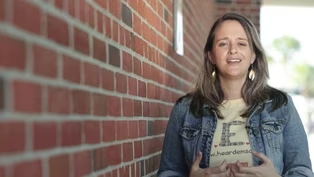
Clip: S10 Ep10 | 7m 31s | Liz Prisley, Tampa poet, performer and educator uses her experiences in her spoken word. (7m 31s)
Providing Support for PBS.org
Learn Moreabout PBS online sponsorship

- Arts and Music
The Best of the Joy of Painting with Bob Ross
A pop icon, Bob Ross offers soothing words of wisdom as he paints captivating landscapes.












Support for PBS provided by:
WEDU Arts Plus is a local public television program presented by WEDU
Major funding for WEDU Arts Plus is provided through the generosity of Charles Rosenblum, The State of Florida and Division of Arts and Culture and the National Endowment for the Arts, and the Hillsborough County Board of County Commissioners.