WEDU Arts Plus
Episode 1011
Season 10 Episode 11 | 26m 45sVideo has Closed Captions
Ogrefairy, Jose Salazar, Robert Freeman, Jackie Weatherly
Digital artist Michaela "Ogrefairy" Oteri of Hudson, Florida, depicts diversity by exploring themes related to disability and the LGBTQ+ community. Chef Jose Salazar explores his Colombian heritage through food. Artist Robert Freeman creates powerful, figurative paintings on canvas that depict color and culture. Textile artist Jackie Weatherly shares her passion from working with fabrics in Ohio.
Problems playing video? | Closed Captioning Feedback
Problems playing video? | Closed Captioning Feedback
WEDU Arts Plus is a local public television program presented by WEDU
Major funding for WEDU Arts Plus is provided through the generosity of Charles Rosenblum, The State of Florida and Division of Arts and Culture and the National Endowment for the Arts, and the Hillsborough County Board of County Commissioners.
WEDU Arts Plus
Episode 1011
Season 10 Episode 11 | 26m 45sVideo has Closed Captions
Digital artist Michaela "Ogrefairy" Oteri of Hudson, Florida, depicts diversity by exploring themes related to disability and the LGBTQ+ community. Chef Jose Salazar explores his Colombian heritage through food. Artist Robert Freeman creates powerful, figurative paintings on canvas that depict color and culture. Textile artist Jackie Weatherly shares her passion from working with fabrics in Ohio.
Problems playing video? | Closed Captioning Feedback
How to Watch WEDU Arts Plus
WEDU Arts Plus is available to stream on pbs.org and the free PBS App, available on iPhone, Apple TV, Android TV, Android smartphones, Amazon Fire TV, Amazon Fire Tablet, Roku, Samsung Smart TV, and Vizio.
Providing Support for PBS.org
Learn Moreabout PBS online sponsorship- This is a production of WEDU PBS Tampa, St. Petersburg, Sarasota.
Major funding for WEDU Arts Plus is provided through The Greater Cincinnati Foundation by an arts-loving donor who encourages others to support your PBS station, WEDU and by the Pinellas Community Foundation, giving humanity a hand since 1969.
- In this edition of WEDU Arts Plus, a local digital artist shines a light on the disability and LGBTQ plus communities.
- I gather as many reference images as I can so I can properly display the person that I'm drawing.
And then I set to work on the sketch, which takes probably the most amount of time of the entire process - Exploring heritage through food.
- Mita's is really a Latin American Spanish restaurant focused around tapas or small plates.
It was a way for me to tap into my South American ethnicity.
- A painter on parade.
- The characters have to tell you who they are.
You can't force them to your will.
They have to arrive.
- And a fiber artist gaining fans one silk dye at a time.
- Textile art for me is it's all about the visual part, as well as the tactile part, being able to actually feel the material and the cloth and painting with a dye on silk.
- It's all coming up next on WEDU Arts Plus.
(cheerful music) Hello, I'm Dalia Colon and this is WEDU Arts Plus.
From Michaela Oteri, representation matters.
Through her digital works of art, the Tampa Bay artist depicts diverse people of all kinds with a strong focus on the disability and LGBTQ plus communities.
- My name is Michaela Oteri and I'm a disabled digital artist.
I started getting into digital art really in 2009 I believe.
I was starting to learn to draw traditionally with pencil and paper, but I injured my hands and I was told by an occupational therapist that I needed to stop drawing.
I didn't really take that advice though.
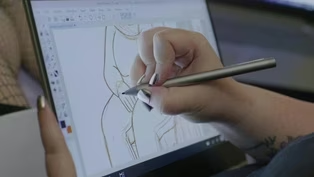
Instead, I started learning to draw digitally where I could change the sensitivity for the pen tablet and it was a lot easier on my hands and I was able to learn to draw the way I wanted to.
It was really great.
- When she's told no, most often she finds a way around that.
She'll follow the letter of the law, but will find a way that works to accomplish what she feels needs to be done.
- When I start to draw a portrait I gather as many reference images as I can so I can properly display the person that I'm drawing.
And then I set to work on the sketch which takes probably the most amount of time out of the entire process.
But then I get to work on the line art which is my favorite part.
I love to work with some really bright fun colors to make sure that the piece really pops.
- When I first saw Michaela's portrait of me, I was like wow, this is so different because when you usually see disabled art it's not empowering, but to see this, like I look so powerful.
Like I look like I could be a god.
It's amazing.
Just the strength that she portrays in her portraits is so important.
- So the reason behind the username ogrefairy actually comes from when I was a teenager.
And I just was really struggling to see myself as something that I deemed special and beautiful like a fairy because of being, you know disabled and fat and queer.
I kind of identified more with being like an ogre.
So I created the username ogrefairy.
I do draw a lot of fantasy.
That's what got me started to begin with is drawing things like fairies and mermaids.
And these days I try to tie my disability art into the fantasy art where I can.
- So I know Michaela actually had an opportunity to be connected with her through a project that my firm is working on Crip Camp, which is a Netflix documentary that is executive produced by President Barack and Mrs. Michelle Obama.
Being with the film is really about activism but also engaging with the disability community.
My role as impact producer and leading the impact team is to connect with leaders of today.
It was specifically disabled creatives and those that are really involved in the movement.
- I've been a big fan of Michaela's art for a long time on social media.
And just from other people in community who had shared her work or that I had seen some portraits that she had done and followed her on social media and was instantly attracted to the style that she had and the ways that she incorporated people's disability but also the things that they really cared about or were passionate about into her artwork.
- I love how she can take what was likely just a portrait or a regular photograph perhaps, and bring it to life.
One project that she did for us, my colleague and dear friend, Stacy Park Melbourne who was a co-impact producer with me on the project.
She passed away in May of 2020 and Michaela created this beautiful rendering of Stacy around these bright flowers.
I basically told her her favorite color and she just took that and brought a photo of Stacy to life in such a way that, you know really all you can do is just smile.
- I think that we couldn't think of anyone better to do that than Michaela.
- Her artwork is beautiful.
It's inspiring to see her glow when she feels like she's really accomplished what she set out to do in a certain piece.
And when it's received the way she put out into the world that's just the most amazing thing for a mom to see.
- I really hope that the takeaway from my art is that disabled people are individuals who are beautiful, who are strong in their own ways and just are their own individual people.
I really want to continue making this bigger, displaying more people of all different backgrounds who don't get to see themselves in art very often.
Every time I hear from someone who sees my artwork and messages me, like I just saw myself like I've never seen myself in art before.
It just always means so much to me that I'm able to do that.
- To see more of Michaela's artwork visit ogrefairy.com.
- Inspired by his Colombian heritage, chef Jose Salazar opened Mita's Restaurant in Cincinnati, Ohio in 2015.
Mita's eclectic menu features traditional and modern dishes of Spain and Latin America and pays tribute to the food created by his grandmother.
(somber music) - When you're here early, there isn't all the commotion.
You have a chance to gather your thoughts.
Most of the time a dish is born based on an ingredient.
You have a foundation, you know, maybe it's, you know maybe it's a type of fish that the fishmonger called up and said that they have, and you start to think, okay so what's the texture of the fish?
What's the flavor of the fish?
I sort of just use my memory, you know my palate, my what I remember something that tasting like or the texture of something and let that sort of guide me.
If you overthink it and you make it too scientific you lose some of the soul and that's, you know at its heart, what cooking is all about.
It's soulful, it's meant to be from the heart.
Mita's is really a Latin American Spanish restaurant focused around tapas or small plates.
It was a way for me to tap into my South American ethnicity.
This restaurant is it's named after my grandmother.
We called her Mamita, which is sort of a word for grandma.
And then we shortened it even more to Mita.
I had to incorporate some of her style of cooking and a lot of it is comfort food.
You know, it's those things that, you know, the rice and and the empanadas and the arepa and things that are just kind of Colombian soul food.
The menu is purposely encompassing a huge swath, like it's Spanish and Latin America.
The empanadas are probably our number one seller, probably our signature dish.
So it's a cornmeal crust as opposed to a wheat base, you know, or wheat dough that you get in some other countries.
And then they come with this really wonderful sauce called Aji o pique, which translates to chili in Spanish.
I took some of the inspiration from the Colombian traditional foods.
And maybe just kind of give it a little tiny twist.
I think acid is probably one of those ingredients that a seasoned chef, somebody who's been doing it for a while, tell you that behind salt, it's probably the next most important item in a dish.
The aroma, the brightness, the balance that you get versus that like, you know, grilled, smoky flavor.
It's I think what rounds out a dish.
Vegetables are very versatile.
And I like the texture of a vegetable in different ways sometimes.
You take a parsnip and you puree it, you add a little bit of cream a little bit of butter or olive oil and it's just really delicious, creamy, you know almost kind of a sauce in its own right, right.
And it's sweet, but it's full of flavor but then you take that same parsnip and maybe you roast it.
And then you take the same parsnip and slice it real thin and deep fry it.
And all of a sudden you have three different textures but also three very distinct flavors of that same vegetable.
And that's always a good way to highlight an ingredient and showcase it in a few different ways.
- Jose Salazar and I have been working together for about two and a half years.
He likes to play with textures and using ingredients in multiple different ways.
On the national level we've been nominated semi-finalists for the James Beard Foundation the past two years.
Here locally, you know we've been named in the top 10 of the Cincinnati Magazine.
It's a blessing to get a chance to work that closely with someone who is being recognized on a national level.
- The team's everything.
I think that they respect me and know that I'm willing to roll up my sleeves and do just about anything it takes to get the job done.
I'm really nothing without them.
And that sounds cliche, but it's a reality.
We just got some beautiful lamb in from a farm in Kentucky and really are focusing on how can we use every part of the animal in different and interesting ways.
I'm thinking I want to do empanadas with the lamb neck.
So we're going to braise the lamb neck and do a really nice baked empanada in a kind of a puff pastry crust, and maybe a sauce with a little bit of ginger and herbs and something that plays off the slight gaminess of the lamb.
I love the way our menu is structured.
I really do.
Now.
It feels more cohesive, fits with the overall theme of the restaurant and the guests have really loved it.
- There are very few places where you can have a tapas experience of authentic Spanish.
Cheese, meat, paella.
It's one of the only options in the city and it's top notch.
- I started working in restaurants when I was about 18 'cause I didn't know what I wanted to do with my life.
I thought, okay, I'll work in restaurants for a little bit until I figure it out.
Ultimately, I found myself kind of cooking at home and wanting to explore foods And again, I didn't grow up eating or going out to experience gastronomy, but it just took hold.
And I said, all right, this is kind of it.
And so it's more of a sense.
I don't know that you can really say, you know I do it for this or that other than you just end up falling in love with it.
- For more information about eating at Mita's, go to Mitas.co.
- Known for his powerful figurative paintings, artist Robert Freeman's newest body of work takes us to the colorful parades of the Mardi Gras Indians in New Orleans.
As he's done for decades in front of a canvas, he lets the brush guide him.
- As a kid I used to take a piece of paper and I'd scribble on it with a pencil to a point where you couldn't see anything on the paper.
- Robert Freeman has always been an artist.
It's how he's made his living and how he's seen the world.
He depicts the African-American experience, examines the face of race in American society.
And in his most recent work, he absorbs the pageantry and spirit of Mardi Gras Indians in New Orleans.
- People were coming out of their doorways to join the parade.
And you can't walk.
You have to just dance with the music.
- Freeman was invited to New Orleans by his friend, photographer Max Stern.
His pictures capture black Indians parading in their festive fury of elaborately beaded and feathered suits and how they subsume neighborhoods with an intoxicating lure of dancing, drumming and music making.
- It just stirred the soul and the heart.
And I remember coming back to the studio and trying to duplicate that experience.
- Freeman's paintings of Mardi Gras Indians, along with the Max Stern photographs that inspired them are now on view at Roxbury's Museum of the National Center of Afro-American Artists in Roxbury.
- We celebrate the visual arts heritage of the global black world.
- Edmund Barry Gaither is the museum's director and curator.
Here he finds himself drawn into the parades just as Freeman was.
- You're brought into this moment.
And you come into that with all of your own personal baggage and hopefully you step out of it with some of that released into the fervor of the moment.
Because part of what masquerades do is they free you of the weight of your own identity.
- The characters have to tell you who they are.
You can't force them to your will.
They have to arrive.
- We met Freeman in his studio a month before the show opened as he was finishing one last piece.
He approaches his canvas as a novelist might the page, forming characters with full-blown personalities.
- The figures communicate to me who they are.
Then they become much more real and I have to work at making them real.
So that they're interesting to me as I'm developing them and interesting to anyone who's going to look at them.
- In college Freeman's teachers included famed painter, Phillip Gustin and John Wilson, whose bronze of Martin Luther King Jr. inspired a moment of reflection for President Barack Obama before his second inauguration.
It was a piece Wilson created as much from his impressions of King as from actual images.
- I remember when we were all drawing and thought we kind of had it down pretty good.
He would say, all right, now I've given you that vocabulary, now say something with it.
- Freeman had a lot to say in his black tie series, a commentary on African-Americans in the middle class.
- I think in the beginning, the satire was about the rejection or the voting process as to whether you were good enough for that group and what the criteria was to join that group.
As I got older I realized, hey, it's hard to be a member of the middle class and have some response and be a responsible citizen.
And I began to admire my group an awful lot more than in the beginning.
- Today Freeman's work appears in exhibitions, gallery shows and museum collections, but in the beginning as an up-and-coming artist, especially one of color, he couldn't get a foothold in Boston's art scene.
- I would take the paintings out of the U-Haul van and take them into the galleries and one gallery after the next would say something like, well, you know, we don't have clientele that would be interested in paintings of these African-Americans.
- That changed with just one review in the Boston Globe and the supportive early champions like Gaither.
- I have followed Robert Freeman's work for a long time and have been very fascinated with the topics that have been exciting to him because they have been topics which dance at the edge of social ideas.
- I'm not sure where I'm going with this now.
Just need to draw back on it just a little bit.
- Freeman says he has trouble stepping away from his paintings.
He always has the urge to add another brush stroke here or there, regardless of whether his works are in his studio or seemingly finished on gallery walls.
So the best sense of an ending he says, the audience.
- If I can get people to stand in front of a painting and absorb that compositional power, not knowing what they're looking at or why they can't move away from that particular piece, that's success for me.
- Learn more at RobertFreemanart.com.
- Up next, meet textile artist Jackie Weatherly of Dayton, Ohio.
Weatherly is trying to make her mark on the art scene, one silk dye at a time.
(soothing music) - I went to school at Meredith College in Raleigh, North Carolina, and did studio art.
One of the classes there was this silk painting class that they offered and I was hooked at that point.
Textile art for me is it's all about the visual part as well as the tactile part.
Being able to actually feel the material and the cloth and painting with a dye on silk and watching it travel across the material is very fascinating for me.
You can add salt for texture.
You can use Resist to make it Tightline.
You can use all kinds of different diffusants so it can either travel or not travel.
And it's just, it's a versatile material and it's just a lot of fun to work with.
It can be very challenging if you're looking to do something perfect, like with oil painting or acrylic, you're not going to get that with dye because dye tends to travel all over the material.
And if you use a Resist which is a kind of a Gouda type of thing where you draw on the silk to keep the dye from flowing, then you can do a little more with that.
Otherwise it's its own animal.
(soothing music) Usually I have an idea in mind what I want to paint.
I'll have my own photograph of a flower or an animal or something.
And I'll transfer that by drawing it on with a Resist.
And then I'm painting with the dye and if you put salt on for texture effect and then same for the Resist, you have to wait for that to dry, or you can iron set it.
The dyes that I use are Jaquard Red Label dyes.
And they require to be steam set so that they don't run when they get wet and that type of thing.
You wrap it up in newsprint and stick it in a steamer for about an hour and 45 minutes and then pull it out and then rinse it.
And then heat set it with an iron after that and it should be good for wearable art.
I do make scarves and ties and I've hand painted silk that I'd made into a pendant or a pin.
(soothing music) My favorite piece was the green sea turtles that I had made for a show at Meredith College.
We used to live at the beach back in the '90s, and the sea art art is a lot of what I focus on or nature, flowers.
And I'm just the outdoors Mother Nature mostly.
I do some photography on the side and oftentimes I'll take some photographs of my own flowers and I'll take them to a website called spoonflower.com and I'll upload the imagery to that and do some mirror imaging and printing on either cotton or silk or linen.
And I make yardage from that.
I do some freehand machine embroidery, non-traditional quilting with those fabrics and I've also made handbags.
There was a piece that I had down at the Dayton Visual Arts Center, and it was a silk piece that was attached to the top of the frame, but the sides and the bottom were loose so that when people walked by the air tended to pick it up and pull it away from the actual frame.
And people stopped and turned around and looked at that and they weren't quite sure what to make of it.
And one gentleman actually walked up and pulled the corner up and looked underneath it to see what was going on underneath the piece.
And he's like, okay nothing there, and walked away.
I wanted to be different from everybody else.
And a lot of people do watercolor or oil painting or acrylics.
So fiber arts is just a different art form.
- Find out more at thetextileartisan.com.
- And that wraps it up for this edition of WEDU Arts Plus.
For more arts and culture visit wedu.org/artsplus.
Until next time I'm Dalia Colon.
Thanks for watching.
(upbeat music) Major funding for WEDU Arts Plus is provided through The Greater Cincinnati Foundation by an arts-loving donor who encourages others to support your PBS station WEDU and by the Pinellas Community Foundation giving humanity a hand since 1969.
Video has Closed Captions
Clip: S10 Ep11 | 6m 16s | Local artist Michaela Oteri draws from her own experiences to create works of art. (6m 16s)
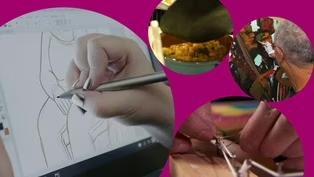
Preview: S10 Ep11 | 29s | Ogrefairy, Jose Salazar, Robert Freeman, Jackie Weatherly (29s)
Providing Support for PBS.org
Learn Moreabout PBS online sponsorship

- Arts and Music
The Best of the Joy of Painting with Bob Ross
A pop icon, Bob Ross offers soothing words of wisdom as he paints captivating landscapes.












Support for PBS provided by:
WEDU Arts Plus is a local public television program presented by WEDU
Major funding for WEDU Arts Plus is provided through the generosity of Charles Rosenblum, The State of Florida and Division of Arts and Culture and the National Endowment for the Arts, and the Hillsborough County Board of County Commissioners.