WEDU Arts Plus
Episode 1012
Season 10 Episode 12 | 26m 45sVideo has Closed Captions
George Harris, Joanie Smith, Amy Sherald, Melissa Michelsen
In this segment produced by students at St. Petersburg College in partnership with WEDU, meet George Harris, a musician and sound engineer who overcame health complications. Choreographer Joanie Smith works with dancers to create pieces that imitate life. Learn the process of award-winning portrait painter, Amy Sherald. Designer Melissa Michelsen uses a marbling technique to create reusable masks.
Problems playing video? | Closed Captioning Feedback
Problems playing video? | Closed Captioning Feedback
WEDU Arts Plus is a local public television program presented by WEDU
Major funding for WEDU Arts Plus is provided through the generosity of Charles Rosenblum, The State of Florida and Division of Arts and Culture and the National Endowment for the Arts, and the Hillsborough County Board of County Commissioners.
WEDU Arts Plus
Episode 1012
Season 10 Episode 12 | 26m 45sVideo has Closed Captions
In this segment produced by students at St. Petersburg College in partnership with WEDU, meet George Harris, a musician and sound engineer who overcame health complications. Choreographer Joanie Smith works with dancers to create pieces that imitate life. Learn the process of award-winning portrait painter, Amy Sherald. Designer Melissa Michelsen uses a marbling technique to create reusable masks.
Problems playing video? | Closed Captioning Feedback
How to Watch WEDU Arts Plus
WEDU Arts Plus is available to stream on pbs.org and the free PBS App, available on iPhone, Apple TV, Android TV, Android smartphones, Amazon Fire TV, Amazon Fire Tablet, Roku, Samsung Smart TV, and Vizio.
Providing Support for PBS.org
Learn Moreabout PBS online sponsorship- [Narrator] This is a production of WEDU PBS Tampa, St. Petersburg, Sarasota.
Major funding for WEDU Arts Plus is provided through The Greater Cincinnati Foundation by an arts loving donor who encourages others to support your PBS station, WEDU.
And by the Pinellas Community Foundation.
Giving humanity a hand since 1969.
- [Gabe] In this edition of WEDU Arts Plus, a local musician gets the chance to live again.
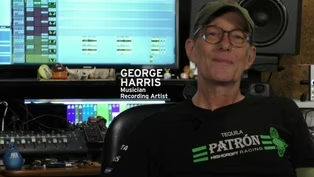
- [George] I spend most of my life in a cave similar to this, if not on a stage as I get older, there's less of that.
- [Gabe] Choreography to imitate life.
- Relationships always seem to have some kind of role in the work that I make, I find that so interesting.
The impact that people have on one another.
- [Gabe] Former First lady, Michelle Obama's award-winning portrait painter.
- [Amy] I don't place my figures within a context because I want the viewer to have a singular experience with the person that's in the portrait.
- [Gabe] And one of a kind masks.
- I mean, we all have to wear them right now, right?
So you mind as well wear one that's kind of fun and colorful.
- It's all coming up next on WEDU Arts Plus.
(upbeat music) Hello, I'm Gabe Ortiz.
And this is WEDU Arts Plus.
This first segment was produced by students at St. Petersburg college in partnership with WEDU.
Largo recording studio co-founder and musician, George Harris was confronted with his mortality when he was diagnosed with kidney disease, surviving this illness helped him reunite with his first love, music.
- How do you make those sounds fit together?
How do you decide what sound you're gonna use?
How do you put together music?
How do you put together the delivery of it?
you know I got real interested in how things work Nick's wise and all the millions of aspects of it and it's a deep dive.
Once you start thinking about stuff like that it's a big rabbit hole.
They tell me I was born in Kansas, Wichita.
Once I started hurting my fingers, playing sports I kind of had to make a choice.
And that's all I've ever been surrounded by really musicians and artists and friends in different businesses.
But for the most part, I spend most of my life in a cave similar to this if not on a stage as I get older, there's less of that.
But in a cave putting together music, putting together audio.
This studio is called Creative World Recording.
I never really thought about it when I was younger.
No, I wanted to do it when I started playing on records.
When I started getting calls to do sessions I had a large studio, really big room which was practical back in the day when there was money in the business.
For years, for a long time, over 20 years.
And I developed a hereditary illness that was kinda life-threatening and ended up not being able to work a whole lot of hours had to close that place between my illness and basically the collapse of the studio industry.
I was kinda forced to downsize.
So I'm here, polycystic kidney disease, PKD, is what that it's known as in the medical field.
I didn't know it until, I don't know, 15, 16 years ago I guess I got diagnosed and I spent eight of those years on dialysis every day.
Well, at first it was I guess, three or four days a week.
And then it became 12 hours a day toward the end and how it was not fun.
And it's not something I recommend to anyone.
Renal failure it's really slow.
At least mine was.
This disease it's really slow.
So you get very, very, very sick and you don't know it.
It's kind of, you know you feel tired all the time.
You get upset easily.
There's a huge amount of pain involved.
So it's kind of, but it happened really slowly.
you know I didn't know how sick I was.
And my doctors kept telling me that, "Son you know you're really sick," and like, "I'm fine.
"Now I'm still working.
"I'm doing my thing."
"No, no, you just don't realize how sick you are."
And then when I was just about to kick the bucket, I had been thrown off the transplant list three or four times because it's so complex and they really try to get you off the list.
It's because there's just too many people.
And too many people waiting for organs, and people die every day waiting for an organ.
That's the reality of it.
What happened for me was I had been started three different times.
So I went back to the back of the line every time in 2015 in December, the law changed to allow, now, when you are on the transplant list, you're credited for the amount of time you've been in treatment.
So I went right to the top of the line.
I had eight years of dialysis behind me.
And within six days I was transplanted and actually started to feel good.
Again, I kind of realized now how far down that I was.
Been lucky enough to work with a lot of my childhood heroes on a fairly intimate basis, making records and writing songs and whatever.
And I've had a lot of those kinds of opportunities in my life.
I'm really lucky about that.
I've worked on Cheap Trick records here.
I've worked on, worked with Brian Johnson from ACDC in this room, done Michael Schenker record.
I've worked on, I dunno, all kinds of stuff.
Joe Perry and more local oriented people, Damon Fowler and Betty Fox, Backtrack Blues Band, I've just finished mixing a record for them here.
And I'm currently mixing Damon Fowler's new record.
Kyle Rody, my cousin.
Who's a great artist.
I'm lucky enough to work with a lot of really, really good people.
You know I've been lucky enough to knock wood, to do this, to do what I've wanted to do since I was a kid, I've never had to never had a day job.
I'm kind of unemployable.
I imagine by now, but in the corporate world but in a lot of ways, it's a happier existence than a lot of people.
I could be wrong.
I'm really enjoying the moment.
Yeah, it's all you can do.
Really, when it comes down to it.
All that other stuff is done.
(upbeat music) - To learn more, visit creativeworldrecording.com.
Based in Minneapolis, Minnesota, Shapiro & Smith Dance showcases performances that imitate life and relationships.
Founder and choreographer, Joanie Smith reflects on the company's iconic piece to have and to hold.
(footsteps creaking) - [Shapiro] Have you noticed?
For you, it's a question of economy.
Where do you buy hay in the city enough for a mattress?
- [Joanie] The gist is interesting.
The way that we used text.
- [Shapiro] Enough to lie down?
- [Joanie] The actual poem is very sparse.
The text has its own imagery.
It has its own rhythm and the dance movement has its own imagery and rhythm.
And every now and then there's an intersection - [Shapiro] An evening, long past.
- They heightened each other.
I use it to sort of explode the imagery.
It lets you know clearly where the relationship is.
This relationship is older and it's probably ending which might have taken a very long time to show you in dance.
And so I think placing it suddenly there, the first word is midnight.
- Midnight.
- [Joanie] Boom, there we are in the middle of the night, obviously something's wrong.
It locates us.
That's important.
- [Shapiro] Why are we eating so late?
- Relationships always seem to have some kind of role in the work that I make.
I find that so interesting.
The impact that people have on one another, or have on whole groups of people, because we all see relationships.
We all see how we fit in the world and how we respond to other people very differently.
(uplifting music) Shapiro and Smith Dance is ever changing.
At first, it was this dream that Danny and I had we wanted to choreograph.
We found somehow together that we could make things.
The first dances were duets and then the possibilities got too small.
So then we expanded and we got more company members.
That was a whole amazing thing to have all these different voices.
Then not just Danny's and mine.
It was like going from a string quartet to an orchestra the relationships, the structures, the harmonies, the dissonance, everything became so much more complex which was exciting.
(soft music) To having to hold bench.
Danny and I made it in 1989.
We had just returned to New York from a year in Finland.
Everything had changed.
It was the time of AIDS.
It just seemed that so many things were different.
It seemed that we couldn't hang on to anything.
So we suddenly started thinking about making a work where people were waiting.
We thought of three unfinished wood benches.
And as we started sort of playing with these benches we got into sliding across them.
And that made sense to us in the imagery because it was sort of like life sliding by and trying to hang on to something.
And you couldn't.
- And it starts out with a feeling of high energy and the desire as a youthful person might to best something and to conquer the world and to pair up, to find a partner.
And by the end of the dance, we find the dancers letting these partners that they've found go.
So the journey from not a care in the world to having to let someone go forever.
- It's about the persistence of memory.
The people beneath the bench reach up and are touching the person above.
To me that image was like, when someone died there you are, and you suddenly smell a piece of their clothing, the memories come back.
(somber music) Danny and I could never figure out why bench works so well, 600 dancers have performed it.
So many companies.
So many schools have asked us to restage it.
It seems to still resonate for people.
Danny added for those, we have loved and lost but not forgotten because so many people had died of AIDS.
Little did we know it would ultimately serve for him?
Danny died in 2006 in October, he died of cancer.
He was diagnosed at age 44 'cause he fought, he managed to stay with us until he was 48.
During that time, he choreographed and toured and he fully intended to perform that November but he left us instead.
We did dance bench at his Memorial at the Joyce.
That was tough.
- [Man] Oh, yeah.
- My relationship with the dancers has really changed since Danny died.
I found it really difficult to just be by myself, making decisions, searching for imagery.
So I have more and more been inviting the dancers to participate in that process.
The height of that energy, where you might go next.
It's an improvisation!
- She sees our unique strengths and the things that really challenge us.
And she always strives to show us in our best light or in a light that challenges us.
- [Joanie] It's fantastic.
- [Woman] Which is a gift as an artist, working for a choreographer.
- What was so great is, it just was like so smooth coming down.
They enjoy that a lot.
They really enjoy contributing.
Sometimes they improvise.
Sometimes they bring it in something that they say, "Oh, look at this, isn't this an interesting idea?"
I love that there's the excitement and the energy in the room.
We also have regular guests all the time.
This year, Sally Roose will be guesting with us.
We've had Judith Howard, Aaron Thompson.
That's an interesting way to sort of expand who the company is to bring in these very particular voices.
We wanna kinda smooth through there.
We're interested in finding the unique gesture.
If I actually pay attention to the weight and the time and the shape of my hand, and if I add to that, the effort of it, now I'm dancing.
And it's different than just this gesture because I paid attention to time, shape, space, force, energy, and that's what dance does.
And it's just with that consciousness 'cause I'm paying attention to the motion.
The emotion is it.
(upbeat music) - Learn more about upcoming performances at shapiroandsmithdance.org.
Amy Sherylls is an award-winning portrait painter who shot to international fame with her commission portrait of former first lady, Michelle Obama.
Sherald describes her work as American realism, a distinctive approach where her subjects gaze directly at the viewer.
(upbeat music) - I paint portraits because growing up it was what I considered art.
I mean, it was what I saw in encyclopedias of what represented art.
So becoming an artist meant being able to render the figure.
I knew that I wanted to be an artist around the time that I was in the second grade.
I'm not sure I knew what that meant but I knew that drawing was something that I liked to do.
And I knew that I would rather do that than be around people.
(upbeat music) It found me.
Yeah, I did not find that style.
That style found me.
I don't really have a descriptor for my style.
I loosely attached to myself to the genre of American realism being that I consider myself mostly self-taught.
It's just how I paint, it's how I see, it's how I paint.
My subjects are people of color because I choose to paint and put out in the world, idealized versions of myself.
Also realizing that if you look at the art historical cannon, there's a lack of representation of people that look like me.
And that was enough reason for me not to wanna paint anybody else, but myself.
I don't place my figures within a context because I want the viewer to have a singular experience with the person that's in the portrait, the person that's in the portrait, they're aware of the viewer.
And they're aware that they're in this painting if you will.
So since my work is a meditation on photography, a lot of the images that were taken of African-Americans at one point in time were anthropological.
So it's also a critique on that frontal position.
It's a soft confrontation.
And I also hang my paintings a little bit lower than they would normally be hung because I want them and the viewer to actually have a real interaction.
(upbeat music) For me Michelle Obama's portrait beyond the professional and the historical aspects of it, I think it changed who I was as a woman, I think it gave me permission to ask for more of myself and ask more of others.
Success has not changed me, it has given me more agency to do things that I want to do in the community.
It's given me social leverage.
I don't consider myself an activist, but I consider myself a humanist and somebody who is aware of what I have and what other people don't have and to share what I have gained with other people.
(upbeat music) I see myself evolving as a painter at this point, mostly because I have a bigger budget.
And so it's gonna be easier for me to make some of these larger paintings that I've been wanting to make for years, but just didn't have the money to make them.
And I'm not putting any pressure on myself to become a different person.
I just, I'm pursuing my practice in the same way that I would but with the ability to fund some of the bigger ideas that I have.
(upbeat music) - To see more, go to amysherald.com.
California designer, Melissa Michelsen has long had a passion for fashion and design.
Now she uses the ancient technique of marbling to render vibrant reusable masks during the pandemic.
(upbeat music) (sewing machine clattering) - My name is Melissa Michelsen.
My brand is Love Mert.
It's a sustainable accessory brand that I started 20 years ago.
I source my materials mostly from secondhand shops.
And then I also source recycled bits of leather from a couple suppliers that get giant amounts of offcuts from other productions.
And then I buy 30, 40, 50 pounds at a time.
My stuff really does well in small independent boutiques 'cause everything's just handmade versus mass produced.
I was always passionate about fashion and wanted to be a designer of some sort.
And I've always been an artist and grew up in a family of artists.
So I guess it just, it was hard to escape.
So I kept making things, and over the years things have evolved aesthetically and I started messing around with screen printing fabrics for awhile and then I fell into marbling and I thought marbling's that an ancient technique they've done for for thousands of years.
And I thought it would translate really well on fabric.
And I started making some really cool pieces of fabric that I was turning into other products like canvas pouches and some really nice home textiles pillows and whatnot.
And then I started making some eye masks and those were doing really well for me just like relaxation eye masks in a heart shape.
And then the pandemic happened.
And so I thought this fabric would be really beautiful to make a mask out of because if you're gonna wear a mask, a lot of people will want to have something unique or that speaks to their individuality, I guess.
I mean, we all have to wear them right now, right?
So you might as well wear one that's kind of fun and colorful.
(upbeat music) The process of me making a mask starts with marbling the fabric.
It's a little bit of a wet process.
It's a messy process.
It's got many steps.
I kind of use the water as my canvas.
You have a tray of water.
The water has a little cellulose in it.
So it makes it a little bit gelatinous.
Then I, when you place the paints on top of the water, the paints float, and you're able to kind of move them around and they disperse with each other.
They push each other around, you layer and layer it.
And then once you get what you think is what you want, you get your fabric and you it down and pull it back up.
And the result on the piece of fabric is amazing.
And you never get the same thing twice, although I can kind of control color combinations and a little bit of technique to do a production run of sorts but everything's always gonna be a little different.
(upbeat music) I wonder to myself when I'm selling them, I'm like, "How much longer will this be going?"
And I think this whole pandemic thing has taken a lot of us by kind of surprised.
And we were all a little bit confused and just trying to make our way through every day.
I was worried that my business was gonna get hurt by it.
And I thought, what can I do in this state of where we're at to prosper and make sure my family's taken care of?
Because the mask thing it took a while to actually happen during this pandemic.
And it wasn't necessarily right then and there like, "Oh make masks."
It's actually been really interesting because it's bringing way more people to my website than I ever used to have traveled to my website.
And people are going there because they found out about my masks, however they did, and then see all my other work.
And so I'm actually trying to design a mask so that when all this is over, because it will be, it can serve another purpose.
So maybe it ends up being like a headband or something.
The sustainability has been there with Love Mert since day one.
And yes, I'm making products, but I'm trying to do it as consciously as possible and artfully as possible.
(upbeat music) - To find out more head to lovemert.com.
And that wraps it up for this edition of WEDU Arts Plus.
For more arts and culture visit wedu.org/artsplus.
Until next time, I'm Gabe Ortiz.
Thanks for watching.
(upbeat music) - [Narrator] Major funding for WEDU Arts Plus is provided through The Greater Cincinnati Foundation by an arts loving donor who encourages others to support your PBS station, WEDU and by the Pinellas Community Foundation.
Giving humanity a hand since 1969.
(upbeat music)
Video has Closed Captions
Clip: S10 Ep12 | 6m 50s | Largo musician and recording artist shares his experience in the music business. (6m 50s)

Preview: S10 Ep12 | 29s | George Harris, Joanie Smith, Amy Sherald, Melissa Michelsen (29s)
Providing Support for PBS.org
Learn Moreabout PBS online sponsorship

- Arts and Music
The Best of the Joy of Painting with Bob Ross
A pop icon, Bob Ross offers soothing words of wisdom as he paints captivating landscapes.













Support for PBS provided by:
WEDU Arts Plus is a local public television program presented by WEDU
Major funding for WEDU Arts Plus is provided through the generosity of Charles Rosenblum, The State of Florida and Division of Arts and Culture and the National Endowment for the Arts, and the Hillsborough County Board of County Commissioners.