WEDU Arts Plus
Episode 1014
Season 10 Episode 14 | 26m 45sVideo has Closed Captions
Living Color, Samantha Gossard, Donna Jackson, Os Botticelli
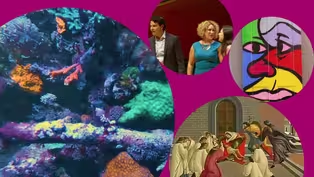
Coral enthusiasts share their passion for keeping corals as they create vibrant pieces of living art. Young opera singers at Lyric Opera of Kansas City build their professional skills. Artist Donna Jackson hopes to strengthen her community through art projects. An exhibition at the Isabella Stewart Gardner Museum in Boston sheds light on some of Botticelli's more complicated works.
Problems playing video? | Closed Captioning Feedback
Problems playing video? | Closed Captioning Feedback
WEDU Arts Plus is a local public television program presented by WEDU
Major funding for WEDU Arts Plus is provided through the generosity of Charles Rosenblum, The State of Florida and Division of Arts and Culture and the National Endowment for the Arts, and the Hillsborough County Board of County Commissioners.
WEDU Arts Plus
Episode 1014
Season 10 Episode 14 | 26m 45sVideo has Closed Captions
Coral enthusiasts share their passion for keeping corals as they create vibrant pieces of living art. Young opera singers at Lyric Opera of Kansas City build their professional skills. Artist Donna Jackson hopes to strengthen her community through art projects. An exhibition at the Isabella Stewart Gardner Museum in Boston sheds light on some of Botticelli's more complicated works.
Problems playing video? | Closed Captioning Feedback
How to Watch WEDU Arts Plus
WEDU Arts Plus is available to stream on pbs.org and the free PBS App, available on iPhone, Apple TV, Android TV, Android smartphones, Amazon Fire TV, Amazon Fire Tablet, Roku, Samsung Smart TV, and Vizio.
Providing Support for PBS.org
Learn Moreabout PBS online sponsorship- [Announcer] This is a production of WEDU PBS Tampa, St. Petersburg, Sarasota.
Major funding for WEDU Arts Plus is provided through the Greater Cincinnati Foundation by an arts-loving donor who encourages others to support your PBS station, WEDU, and by the Pinellas Community Foundation, giving humanity a hand since 1969.
- [Gabe] In this edition of WEDU Arts Plus, take a close look at the color and beauty of corals.
- Every coral has a personality, if you will, depending on the type, some of them branch, some of them cover rocks, some of them plate.
It really just depends on what you're working with, what you have in your tank.
- [Gabe] Next generation opera singers take to the stage.
- The spectacle this, year's sound, the fact that these voices were carrying over the orchestra in this great big hall.
(woman vocalizing scales) - [Gabe] An artist with a vision to beautify her hometown.
- [Donna] I need to create something to make sure people, these voices that I know that are there can be heard.
- [Gabe] And a Renaissance painter's little-known, darker side.
- Botticelli is interpreting stories from ancient Roman times, and contextualizing them in terms of the political struggles of his own day.
- It's all coming up next on WEDU Arts Plus.
(jazz music) Hello, I'm Gabe Ortiz, and this is WEDU Arts Plus.
This first segment was produced by students at St. Petersburg College in partnership with WEDU.
The beauty of the oceans is within reach for those with a passion for keeping corals.
Learn about how these aquatic enthusiasts create vibrant pieces of living art.
(waves crashing) (water bubbling) (peaceful music) - [Orien] Any aquarium in any public space is going to bring ease, it's going to release tension.
It's going to take you to a different world.
We're land mammals, right?
So we don't get the opportunity to be in a different world.
- I would consider reefing an art form by the different types of corals.
Every coral has a personality, if you will, depending on the type, some of them branch, some of them cover rocks, some of them plate.
It really just depends on what you're working with, what you have in your tank.
- The colors are pretty much limitless.
I would say we're discovering new colors every day, and there's always different types of morphs.
We can't breathe under water.
We can't, you know, it's not normal for us to live in water, so when you're able to bring that above ground, it's pretty interesting to be able to see what goes on in the water, underneath the water.
- We have a lot of veterans that come into the shop, and you know, some of them suffer from PTSD.
I think it's more of a relaxing thing, you know?
When you get home from work, you just want to settle down, kick back, open up a beer and, you know, watch the tank.
- Every tank is different.
Some people have one set coral, and they want nothing else.
Some people, like we have a customer that comes in, and she has nothing but anemones.
It's really just all about preference at that point.
Some people have everything.
Some people have hard corals, some people have soft coral, anemones, and then there's also fish only tanks, where there's no coral.
It is a lot of work, but in the end, it is definitely worth it.
Unfortunately with our climate getting worse, the hobby definitely is a good one, because more people we get involved, the more people we can hopefully help save our oceans, and become more aware too.
- It's not so much about what we do.
It's more about the coral.
So we're not giving the coral color.
We're not giving it more color.
We're not injecting colors.
We're not doing anything like that.
We're keeping everything consistent to let the coral promote the best color as it naturally has.
This hobby is a really eye-opener.
It's not, let me get a tank, let me put a fish in it, let me slap some corals in it, I want it now, now, now.
It doesn't happen that way.
You got to have a lot of patience with it, and what we're really trying to do is we're trying to replicate the ocean.
So if we understand that, we will understand how delicate the ocean is, and how delicate the tanks can be.
Here at A Tropical Reef, we are an aquaculture facility.
We're probably, aquaculture, maybe over a thousand new corals every week for our customers that come in and purchase, and we do small aquaculture, and put back into our oceans ourselves as well.
- So aquaculture is when, say I get a frag of some sort of SPS, and that grows in my tank.
I can then take it, clip it, glue it to a frag plug, and now that frag that I gave to my friend is considered to be aquaculture.
It's been in my tank, it grew in my tank, it's in captivity, so we're not taking that from the ocean anymore, and I really think that that kind of practice over time will really help out the oceans as well.
We're learning along the way, but I think it's a much more sustainable approach when it comes to harvesting coral for the hobby.
There's definitely an art to keeping coral for sure.
These are organisms that can't talk to you.
You know, you kind of have a rough idea of what your dog needs, right?
Or your cat, or any kind of domestic animal that we may keep in our house, because there's so much research that's been done on dogs and cats, and your domesticated animals, right?
But there's not a whole lot of research out there on keeping coral in your home aquariums, so you kind of have to, you kind of have to check out your coral, and see how it's doing.
Does it need to be fed more?
Does it need to be fed less?
Does it need more light?
Does it need less light?
These are all kinds of experimentations that the hobbyists ends up doing, and I feel like there's a true art form to that.
I challenge everybody watching this right now to step out of their comfort zone, hop on Netflix, and just search the word coral, and watch one of those documentaries.
I really feel like those are the kinds of series, along with this one, that peak people's interests on a whole new level.
I think that that could really make a difference, and one person at a time, right?
One person at a time, that's all it takes, and eventually we can get there, and I think that the coral reefs will benefit because of it.
- For more information, visit atropicalreef.com.
Lyric opera of Kansas city's resident artists program is a chance for young singers to bridge the gap between their opera schooling, and the professional world.
Samantha Gossard is one of four resident artists who's thrilled by the programs possibilities.
- I remember the first time I saw an opera, I was in college, actually.
It came to me much later in life than a lot of people who are in it.
I was just mesmerized completely at the spectacle, the sheer sound, the fact that these voices were carrying over the orchestra in this great big hall.
(vocalizing scales) A mezzo soprano is a lower female voice, soprano being the highest, mezzo soprano is the middle, and then there are contraltos.
(vocalizing scales) We have a different tessitura, which is the range of voice where we're most comfortable singing for long periods of time.
(singing opera) My teacher always tells me, you have to say hello to your voice every day, even if you're taking 10 minutes to vocalize in the shower, just to see what your voice is doing, because your voice it's its own, it's its own organ, it's its own muscle in, and it, and it grows and changes as your body grows and changes, and you have to know what it's doing.
(singing opera) - [Narrator] For nearly every aspiring opera singer, finding the right teacher is essential, like this man, world-renowned tenor Vincent Cole.
Samantha worked with him during her graduate studies in Cleveland, then followed him to Kansas City, where he now serves on the faculty of his alma mater, the UMKC Conservatory.
- He's so down to earth, and just very nurturing, and has been such a mentor and friend to me for the past six years.
I mean, he's really taught me most of the things that I know.
(singing opera) You don't find many like him.
I mean, he is a master of singing, and he can also teach it.
(Vinson singing opera) - [Samantha] Okay.
- She's a real joy to teach.
You can't make somebody perfect, and you can't do everything, but there are times when there are different things you can do.
When you have somebody who's as agile as she is, and adaptive, you know, you can kind of mold, and say, "Okay, try it this way, try it this way."
It's the little refinement things.
When you take a breath that you know, or when you sing a line, what's behind that, what's the thought behind it?
(Samantha singing opera) As I always tell people, I say, "You have to make sure that the end of the phrase is as good as the beginning of the phrase, because what they're going to hear is the end, and that's what's gonna stick in their ears, so you want to make sure that you've got yourself set up correctly."
(singing opera) - [Narrator] Cole can now have another credit to his already lengthy resume, director of the Lyric's brand new resident artist program, for which Samantha was selected.
(singing opera) That means she and three of her cohorts, seen here at the recent Kaufman Bravo Celebration, will play onstage roles throughout the season, with an opportunity to study others as part of their professional development.
It's the kind of program that Debra Sandler believes will benefit not only young singers, but also the company, and the community.
- We're very excited that we have a wonderful chorus here, and they're local, but for the most part, we bring our principal artists in through international audition, and so this way, if we're at a point in between productions, we have a group of people who are very comfortable setting out and we're doing special programs, and we're even starting a new series this year called the Exploration Series.
- [Narrator] That exploring begins with an unexpected pairing of the Beatles and Schubert, and then on to music by Elvis Costello, and a trip through the American Art Song, with resident artists and a few guests doing the bulk of the vocal work.
It's all part of the Lyric's big push to bring new patrons into the fold.
- It's the people who have never gone that we want to try to reach, to say, "Hey, give it a shot.
Here, let's give you a point of entry that may, you know, ease your journey."
- [Narrator] These days, opera does pop up in commercials, and on film soundtracks, Productions at the Met are streamed live in the movie theaters.
It may be centuries old, but younger singers like Samantha Gossard still feel its power.
- The stories we get to tell are so very human.
I often find that the art form, and really, honestly, like theater in general, gives people permission to feel and think things that they wouldn't otherwise feel or think.
(singing opera) Singers in the opera world today are singing actors.
(singing opera) I've been like, out of breath, running around singing on recent productions, and I love that, I love that it's so active now.
(singing opera) - You know, since I sing less now, it's very interesting to do something with young singers.
It's never the top note, it's what it sets it up.
- You've been telling me that for years.
(laughing) - If any singer gets to enjoy what I got to enjoy all these years, it's the greatest joy of my life.
I want them to have that same kind of feeling when they get to my age and they say, "Okay, I feel like I've really done something worthwhile, something I loved and enjoyed."
(singing opera) - That's what makes it worth that to me, it's communicating the story.
It's telling those stories, keeping that music alive, putting beauty in a world that really needs it.
(singing opera) When I'm having my really down days, and I'm like, "I don't know how much longer I can do this, this is hard."
Like, getting rejection after rejection, or, you know, "I'm not getting this, this music isn't coming easily to me, I'm on a deadline, I've got to get," you know, and when I'm having my really hard days, and I think I kind of want to do something else, and then that's where my mind goes blank, and I can't really think of anything else I'd rather do, so I'm like, "Well, (chuckles) let's get back to it."
(singing opera) - You can find out more by visiting kcopera.org.
Artist Donna Jackson of Detroit, Michigan says her work is the result of what she's learned from womanhood, and what she wants to share from her hometown.
Through her art projects, she hopes to bring a community together to strengthen and beautify it.
(upbeat music) - I never saw myself as a person that was an artist to create art for others to enjoy.
That wasn't the point.
The point was for me to get to know I was.
I was in Houston from '05 to 2010.
I was hearing so much about the insurgence, and the change of Detroit, and I was seeing all of these different faces of who's doing this, these transitions and all that, and none of them looked like me or my friends, or my neighborhood, none of it.
I need to create something to make sure people, these voices that I know that are there are, can be heard, seen, and people are aware of it, and that's what I started doing.
When I was project manager, I wanted to reach out to other artists.
Door of Opportunity is a transition of physical doors into art, and I wanted to make sure that the collection we got was this really good mix of what was really going on in Detroit with artists.
With these doors, you can do a few things.
You get a voice, you get your artwork in the communities where it truly, truly matters, and then you also get to engage with other artists that may feel the same way that you do.
Today we're installing Doors of Opportunity in Bates Academy.
I love that it is a school in a system that I grew up in.
Being able to do that, and bring art to that school was really exciting.
It is a process, and it's one we had to learn.
We learned that we needed team members, we needed movers.
We needed people that understood the delicacy of art.
The theme was Detroit, we all really do see the city in a different way, so it's so important to give someone a chance to show that.
We always go to diversity meetings, skin color or gender, no, I mean, thought process, and experience diversifies us, right?
And we need to really give that more power, or value it more, and I think that's what I try to do with my project.
What I hope the students get from the installation is knowing that you can make a career out of being an artist, that art is something that should be a normal part of your everyday life and space, and seeing art made by people that are from the same city as you, and most likely look like you.
I think those are important.
I think people see me more as that person that develops projects that supports exhibits and support other artists, and I'm good with that title.
It's not until you really get to know me that I may share my art, my personal art.
Colorful Women is my personal art series that I have been doing since 2005.
I am very good at being a human being.
I am very good at being a spiritual being.
I am eh about being a woman.
It's one of those kind of weaknesses that I have that I'm trying to work on, being comfortable in my skin as a woman, and I have nieces and nephews, and I want them to be comfortable in their skin in that same way, whether they're male, female, or whatever they're feeling.
I started drawing women, kind of deconstructing them from what the standard beauty is for America, and constructing it in a way that was more digestible for me.
I almost think I'm trying to make the physical woman into a spiritual one, by the way I draw, and the funny thing is I called it Colorful Women, but when I first started, I only drew in black and white, because color scared the hell out of me.
But as I continue, you know, I think art calls you, and tells you what to do, and so the colors start kinda just phasing into it.
I started seeing small sentences just occurring in my illustrations, and then it went from small sentences to like, paragraphs.
Like, "Oh, maybe I need to, you know, look into just sitting and writing, and seeing what that feels like."
A lot of times, inspiration to writers, listening to other people, their stories of being women, our own experiences in the neighborhood, experience with family, pretty much anything could spark that inspiration.
It is the lifestyle of doing something creative every day.
- [Gabe] To learn more, visit dmjstudio.com.
Renaissance painter Botticelli is a well-known celebrated artist, but an exhibition at the Isabella Stewart Gardner Museum in Boston reveals a much darker side of Botticelli's work as he delved into two devastating stories.
They are fables for his time, and ours.
Sandro Botticelli was a legend, even in his own time.
A leading figure of the Italian Renaissance, he built a name for himself, painting works like Primavera and the Birth of Venus, and taking on the divine, right alongside, or rather underneath Michelangelo.
- Botticelli forged his reputation on the crucible of the Sistine Chapel in the 1480s, when he led a group of Florentine painters to Rome at the Pope's request, and covered the walls of the chapel with the most monumental narrative scenes from the Old Testament.
- [Narrator] Nathaniel Silver is the curator of the collection at the Isabella Stewart Gardner Museum.
Botticelli, he says was the go-to artist for some of Rome's wealthiest patrons, who sometimes commissioned grizzly subject matter, tales of rape and murder, seen here in the story of Lucretia, and the story of Virginia, which had been reunited outside of Italy for the first time since the 16th century.
- Lucretia and Virginia were both ancient Roman noblewomen, renowned for their heroism in the face of violence by men.
Lucretia was raped, and to defend her honor, and that of her family, as she committed suicide.
Virginia was murdered by her father to prevent damage to the honor of the family.
- [Narrator] Their stories are shocking and horrendous examples of abuse by powerful men, but they were meant to be cautionary tales, especially in Florence, which had recently overthrown the tyrannical rulers, the Medici family, says museum director, Peggy Fogelman.
- Botticelli is interpreting stories from ancient Roman times, and contextualizing them in terms of the political struggles of his own day, and so now we can look at Botticelli's work, and interpret them through the lens of the political struggles in our time.
- [Narrator] Part of that contextualization comes through the work of Carl Stevens, a graphic novelist and cartoonist for the New Yorker.
He tells the women's stories just as Botticelli once did.
- Now this is pretty intense.
You take us into the story nearly as Botticelli does.
- Well, what Carl has done by placing these hands here, when we're standing right in front of his cartoon, those become our hands, so he actually places us right in the middle of the action, and there's no way to personalize this story more than feeling like we are actors in this drama.
- [Narrator] The death of Lucretia led to the establishment of the Republic of Rome, and the death of Virginia sparked the restoration of that Republic.
They were violent milestones, although here, Botticelli holds back.
- In the story of Lucretia, he shows Tarquin attacking Lucretia, but he doesn't actually show her rape.
In the subsequent scene, he shows Lucretia fainting in front of her family, but he does not show her actually committing suicide.
There was nothing he could depict and paint that would be anywhere near as disturbing as his viewers could imagine if he gave them the right tools to get there.
- So take me through how this story unfolds.
- So this is a complicated story.
Renaissance viewers didn't read left to right, but we start here at the far left.
We see the king's son, Tarquin threatening Lucretia on her doorstep.
The next day, we see Lucretia, and she's confronting her family.
She's explaining what's just happened, and they're outraged.
It all culminates in this incredible crowd scene in the center.
- [Narrator] Purchased by Isabella Stewart Gardner in 1894, this was the first Botticelli in America.
It's loaded, Silver says with historic and architectural metaphors.
- Above her, you see embedded in this building, a low relief scene depicting a man on horseback, confronting an invading enemy army.
Now, this is a story also from ancient Roman history, the story of a warrior named Horatius Cocles.
Effectively, he was going on a suicide mission, and that's exactly what Lucretia is about to do here, so the heroism of that particular type is exactly the kind of action which Lucretia is about to take in her own story.
- [Narrator] And which persists.
- I think it's actually in the DNA of the Gardner to link the historical past with the contemporary present, and through art to begin these conversations, and really mine the collection for the significance and meaning that it can have in our own lives.
- For more exhibitions, visit gardnermuseum.org.
And that wraps it up for this edition of WEDU Arts Plus.
For more arts and culture, visit wedu.org/artsplus.
Until next time, I'm Gabe Ortiz.
Thanks for watching.
(upbeat music) - [Announcer] Major funding for WEDU Arts Plus is provided through the Greater Cincinnati Foundation by an arts-loving donor who encourages others to support your PBS station, WEDU, and by the Pinellas Community Foundation, giving humanity a hand since 1969.

Video has Closed Captions
Clip: S10 Ep14 | 6m 15s | Learn about the hobby of keeping corals. (6m 15s)
Preview: S10 Ep14 | 29s | Living Color, Samantha Gossard, Donna Jackson, Os Botticelli (29s)
Providing Support for PBS.org
Learn Moreabout PBS online sponsorship

- Arts and Music
The Best of the Joy of Painting with Bob Ross
A pop icon, Bob Ross offers soothing words of wisdom as he paints captivating landscapes.













Support for PBS provided by:
WEDU Arts Plus is a local public television program presented by WEDU
Major funding for WEDU Arts Plus is provided through the generosity of Charles Rosenblum, The State of Florida and Division of Arts and Culture and the National Endowment for the Arts, and the Hillsborough County Board of County Commissioners.