WEDU Arts Plus
Episode 1015
Season 10 Episode 15 | 26m 45sVideo has Closed Captions
Calm in painting, a Pulitzer prize winning playwright, landmark of Jazz, sculpted whimsy.
Artist Angus McCaulay strives for calm and peace in paintings, a Pulitzer prize winning playwright, a legendary Jazz venue, sculpted whimsy.
Problems playing video? | Closed Captioning Feedback
Problems playing video? | Closed Captioning Feedback
WEDU Arts Plus is a local public television program presented by WEDU
Major funding for WEDU Arts Plus is provided through the generosity of Charles Rosenblum, The State of Florida and Division of Arts and Culture and the National Endowment for the Arts, and the Hillsborough County Board of County Commissioners.
WEDU Arts Plus
Episode 1015
Season 10 Episode 15 | 26m 45sVideo has Closed Captions
Artist Angus McCaulay strives for calm and peace in paintings, a Pulitzer prize winning playwright, a legendary Jazz venue, sculpted whimsy.
Problems playing video? | Closed Captioning Feedback
How to Watch WEDU Arts Plus
WEDU Arts Plus is available to stream on pbs.org and the free PBS App, available on iPhone, Apple TV, Android TV, Android smartphones, Amazon Fire TV, Amazon Fire Tablet, Roku, Samsung Smart TV, and Vizio.
Providing Support for PBS.org
Learn Moreabout PBS online sponsorship- [Announcer] This is a production of WEDU PBS Tampa, St. Petersburg, Sarasota.
Major funding for WEDU Arts Plus is provided through the Greater Cincinnati Foundation by an arts loving donor, who encourages others to support your PBS station WEDU, and by the Pinellas Community Foundation, giving humanity a hand since 1969.
- [Gabe] In this edition of WEDU Arts Plus, a local artist aspires to calm in his paintings.
- [Angus] I always say to people, when they say, you know, these are very calming, I'd say, we all can use a little bit of that in our lives.
- [Gabe] A Pulitzer Prize winning playwright shares his creative spark.
- It wasn't that I was trying to tell people about my experience.
It was that I was able to recognize life and what happens between people through the character sets that I had grown up with.
- [Gabe] A legendary Colorado jazz joint.
- [Leah] All of the greats played in Colorado Springs.
She wanted it to rival clubs in Denver, Kansas City, in New York city.
It meant that people in Colorado Springs were seeing cutting edge music.
- [Gabe] And a sculptor shares her passion through her whimsical creations.
- [Leslie] A lot of my work is whimsical as well as serious, and I just love to watch people look at the pieces that are there and giggle.
That's what I want.
I want them to make it part of their daily grin.
- It's all coming up next on WEDU Arts Plus.
(upbeat music) Hello, I'm Gabe Ortiz, and this is WEDU Arts Plus.
This first segment was produced by students at St. Petersburg College in partnership with WEDU.
Angus MaCaulay is an award-winning abstract and expressionistic artist in St. Petersburg, who has overcome challenges with addiction.
His work reflects the calm he aspires to achieve within himself.
(calming music) (paintbrush scratching) - I aspire to calm in my work.
Spiritual calm that you arrive at through struggle.
(paintbrush scratching) Through struggle and difficulty, I've managed to reach enlightenment and calm and reach, get through the struggle to get to a higher level.
I'm in recovery for substance abuse and seven years clean.
Because of the years of turmoil and the struggle that I had with self, in my work I aspire to calm.
Sometimes I have people jokingly, can they come into my space at our show?
And they say, this is like a rest stop.
And they'll just stand there and they'll breathe.
And I just always take that as such a compliment.
Most people feel them right away and they say these are very calming and soothing.
(calming music) What I aspire to in my work is what people feel when they actually see them, and so that's wonderful to me.
I always say to people when they say, you know, these are very calming, I'd say we all can use a little bit of that in our lives.
What more could you ask for in a painting to not only be aesthetically pleasing, but to have a piece that is meditative and calming to you in your space?
I came from a family of artists.
My grandmother went to the Art Institute in San Miguel Allende, Mexico.
She would come back to Rhode Island with a body of work of more impressionistic portraits and would have shows in Newport, Rhode Island.
So my mother also took up painting and studied, and made a success of it herself.
So as a young child, I was exposed to my mother teaching art.
(calming jazz music) What I've been doing for most of these years is juried fine art festivals.
This is the Naples Downtown Art Festival, 2021.
- I'm Nancy Cherney, and my husband, Coke, and I own two of Angus's works.
The first one we bought in Naples, Florida, at an art show, and we walked, came upon a piece of a figure.
I thought it was a woman.
When I spoke to Angus, he said, "Oh, you think it's a woman."
And I'm drawn to this figure, it's just soulful and beautiful.
- You can see complexity in his work.
You can see the layering in his work, but yet, it's so visually delightful and, you know, everything just made us feel good.
Every time we looked at it and everywhere we put them, it's just, it's been terrific.
- At some events that I do where it's a more of a traditional audience, I have people come into my space and they don't understand the work.
Every now and then someone will have the courage to stop and ask me, "What are these about?"
And I always commend people that do that, for having the courage to be open to something that they're not used to.
(upbeat music) (calming piano music) - I get to see it outside.
- Well, it looks better inside.
- Oh, that's lovely.
I met Angus at an art show in Bonita Springs.
And we were walking around, I turned around, and I said, "Oh, I love that painting.
Can we go in there?"
Of course, Tom was like, "All right, okay, we'll do that."
And so, Angus sold us a painting that is actually in our office, which is just warm and beautiful, just so attractive, and it just, everything works together so nicely.
(calming piano music) - [Tom] They're a unique style.
You know, it's attractive, it's warm.
It really, you know, they're paintings that we're gonna live with very comfortably for a long time.
(calming piano music) - There is a common thread that runs through all of my bodies of work.
And I have people that have seen my work and purchased my work way back when, 24 years ago, and still have the same response that they have when they see my abstract expressionistic work now.
And I've always felt like no matter how abstract my work is, it still comes out Angus.
- To learn more, visit angustheartist.com.
Pulitzer Prize winning playwright and author Ayad Akhtar writes about the American experience.
Raised near Milwaukee, Wisconsin, he's partnered with his hometown theater, the Milwaukee Rep, to produce all of his works.
(gentle music) - Language is most compelling to me and also most convincing and most expressive when it is pushed to the limit of its ability to express.
And in a way, I think, for me, the theater is a chance to return to a kind of urgency of language.
My name is Ayad Akhtar, and I am a playwright.
I think it's one of the paradoxes of my work is that I often say I've only been so successful because people are really misinterpreting what I'm writing To me, I'm writing about my experience, my experience, my American experience, I suppose, if one would call it that.
But I think that, you know, in the heyday of identity politics, I've become something of a poster child for Muslim identity within the sort of literary or, you know, I guess, representational area and caused some consternation because of it.
And also caused, you know, and garnered some success because of it.
I had a high school teacher, said, "Write what you know," and for years and years and years, I thought I was doing that.
And then I didn't, it all kind of came together for me in my late, mid-thirties, really, where I started to understand that I was not writing.
I was avoiding my childhood and the community that I grew up in, and I was avoiding writing about that because I did not recognize what other people would find interesting about it.
It wasn't that I was trying to tell people about my experience.
It was that I was able to recognize life and what happens between people through the character sets that I had grown up with.
I'm interested in the complexities of human life.
When you make great work, you cause the audience to think more deeply about and feel more deeply about their own experience.
It's up to them to come to whatever conclusions they wanna come to, you know?
It's not my job to make them think a certain way of thinking or being as right.
I want audiences to become absorbed.
I want them to lose themselves in the experience.
- My name is Mark Clements.
I'm the artistic director of Milwaukee Rep. Milwaukee Rep is a producing theater.
We do 15 productions a year.
Ayad had been raised in Milwaukee.
- I love this city.
I love this state.
I grew up seeing plays here, so it was kind of a thrill to meet the new artistic director.
- We connected immediately, and he seemed to be knowledgeable about what work I'd been doing here at the Rep and was really enthusiastic and said he would, if there was anything he could do, if he could help us in any way, and I was like, huh, well, as you're asking, yes, there is.
So we made a connection and really, that's been about five or six years ago, and what has evolved from that is a connection with the theater where we've produced all of his works.
The very first production that we did of Ayad's was "The Invisible Hand."
And this is the piece about that sort of hedge fund guy who is captured by a terrorist group in the Middle East and is held to ransom.
Basically, when his bank won't pay the ransom, he decides the only way that he can keep himself alive is to actually work for them to create wealth.
And then, after that, we did "Disgrace."
We did "Disgrace" in a three-way co-production with the McCarter Theatre in Princeton, New Jersey, and the Guthrie Theater in Minneapolis.
And that was the play that won the Pulitzer Prize, the sort of dinner party that looks like it's all going well, and all the characters are in the play of people that you kind of wish you kind of look like or had their lifestyle, and then the truths start surfacing to the top and the cracks of the veneer and the friendships.
So it's this very powerful, incendiary piece of drama.
The last one we did was "The Who and the What" about a father and his two daughters from Pakistan.
The girls have grown up in the states and wants the best for his girls and how they, as young people growing up in the states, are kind of trying to assimilate to that and keep dad happy and live their own lives.
- To have memories of shows that I saw, you know, on the Powerhouse stage, and then my shows on the, it's just, there's a kind of weird, again, dilating of time.
And, you know, I don't have that in a show on a New York stage or on a London stage, but it's been special.
It really has been.
It's just really, it's very rewarding to have a presence here.
- This is the first regional premiere of "Junk."
We decided to do it as a natural progression from the work that we'd been producing of his.
"Junk" is about how we've sort of become in servitude to debt in one way or another.
- It takes a lot of work to get inside the play.
Every scene is written in such a way that you can understand the basic human action of the scene.
So even if you don't understand the financial jargon, you understand, okay, somebody's lying to somebody or somebody is trying to do something that they shouldn't be doing, or somebody who's trying to be loyal to somebody or somebody is betraying somebody.
And as long as you understand that part of the story, then you understand the story, I think the audience is smarter than we give them credit for.
It's a value to offer the audience a picture that is more complicated than the one that they are used to seeing.
I think that there's an urgency when we are communicating about what is most terrifying to us, what is most longed for, what is most loved.
And I think that the theater, to me, can have that kind of poignant urgency, can have that kind of concussive urgency.
I think that my work tries to find that.
I think a lot of naturalistic American writing shies away from that in the sense that I think it's often seen as melodramatic to have people say what they really mean and to ask for what they really want.
I think that the theater is the right place to see people doing that.
- Explore more productions at milwaukeerep.com.
Colorado Springs had its own legendary jazz venue.
It was called Cotton Club, and the club's owner, Fannie Mae Duncan, was also a pioneer in the civil rights movement.
- [Narrator] From 1948 until 1975, Fannie Mae Duncan ran The Cotton Club on Colorado Avenue in Colorado Springs.
- The Cotton Club is a legend in Colorado Springs.
Everyone has a story associated with The Cotton Club.
- [Narrator] There, world-class African-American jazz entertainers performed to an integrated audience for the first time in Colorado Springs history.
The club's motto, "Everybody welcome," challenged the era's de facto segregation.
- In a way, it was the catalyst for the peaceful integration of Colorado Springs during the very volatile civil rights movement.
During that time, in other cities, there was violence and there was bloodshed and there were flaming Molotov cocktails being thrown in streets.
If you're in Colorado Springs, Fannie Mae was serving chilled cocktails to people of every ethnicity who would come in because of their mutual love of the arts and sit side by side to enjoy the evening.
- When you walked into the front door from Colorado Avenue, on the right side of the club, there was these big, beautiful leather red booth, and, I mean, you could sit, maybe, six or seven people in a booth because they were huge.
The booth were always full in there.
The jazz band was going.
- [Kathleen] But not just anybody.
She booked what became a music Hall of Fame.
(upbeat jazz music) - [Fannie Mae] Duke Ellington, Count Basie, Horace Henderson, Fats Domino, and there's a number of them.
It's so many, I can't even think of.
(upbeat jazz music) - All of the greats played in Colorado Springs.
She wanted it to rival clubs in Denver, Kansas City, in New York city.
It meant that people in Colorado Springs were seeing cutting edge music that otherwise would have been unavailable.
- She used to have big entertainers from all over the country, they came there.
Like Cab Calloway, and Flip Wilson got his start there.
- [Show Announcer] Now, here's Flip!
(people clapping) - These were Black entertainers, and they were not welcome in the major facilities, so if you wanted to see these amazing talents, the Cotton Club was the only place in town to do that.
- I don't care who you were.
You were welcome at The Cotton Club.
- Oh, it was fun.
It was fun.
And the bands were really, really good.
- The house band was Jimmy Jules.
He was a great musician, and he would have you laughing, but he'd have you rocking more than anything.
- I was hired to perform at The Cotton Club three days a week, three sets a night, three songs per set.
Fannie Mae paid me $75 per week.
The stage was very small, and we had four band members.
I remember Jimmy Jules would be on the B3 organ, Horace Butler would be on lead guitar, Mickey White would be on the bass guitar, and Jimmy Jones was our drummer.
And I would have to fit in front of them onto that small stage and, plus, move around.
So we had some good times at The Cotton Club.
I consider Fannie Mae Duncan a modern day entrepreneur.
She knew what it took to get people in the door, keep people in the door, and prevent them from going out the door.
She had something for everyone.
- On all my cards, I always say it on there, easy to find and hard to leave.
(Fannie Mae laughs) - [Narrator] A bronze statue of Fannie Mae is to be placed outside the Pikes Peak Center for the Performing Arts in downtown Colorado Springs, just a stone's throw from where The Cotton Club once stood.
- To learn more about Colorado Springs arts and culture, head to visitcos.com.
Meet a sculptor in the Detroit area who creates whimsical and functional pieces from clay.
She shares her passion with children and adults through community workshops.
(gentle whimsical music) - I'm just a middle-aged lady doing her thing.
I always had art involved in my life, always had pottery to fall back on as my hobby, and through the years, it's developed into more and more and more of a passion, and now it's my livelihood.
(gentle whimsical music) I opened my own studio in September of 2015.
I was fortunate enough to be one of the first ones through the door when they turned the park into an arts and recreation complex.
When I do my work, it's really fun, and everyone is different.
There are no two pieces alike.
A lot of my work is whimsical as well as serious.
And I just love to watch people look at the pieces that are there and giggle.
That's what I want.
I want them to make it part of their daily grin, have fun with it.
I think we don't get enough grins and giggles because we're always in these times searching for something more.
I gotta do more.
I gotta go more.
I have to be more, so for people to pause and look at a piece that I've created and get a smile from it, I think it's better health, mental health, for everybody.
I find my inspiration for my work in a lot of different places.
I love making high relief tiles, and I also love nature, so the tiles that I make are a series of wildflowers for the Great Lakes.
Fishing.
Fish are kind of my thing.
I like to carve fish and do those on my lanterns.
(upbeat whimsical music) The other functional pieces that I make are big bowls.
I have things called grate plates because you can grate garlic and ginger and nutmeg in these plates, and their oil dipping dishes kind of go along with that.
So the work that goes into my sculptures and functional pieces, almost all of them are thrown at the potter's wheel, and then they're all altered.
The man in the moons that I make, throw those at the wheel, then I will create the face and everyone's done individually.
For the big sculptures and the big carvings, the lanterns that I like to do, those can take up to 20 hours to create.
So it's weeks of work that it takes to go into those.
Then they're, hopefully, dried properly, and then they get fired once, they get glazed, and then fired again.
My favorite thing would be carving lanterns, both tall ones and small ones.
I like to draw on them first, and those drawings can take me four or five hours, then carve them, then embellish them.
So it's just a labor of love.
I've come up with a vase that I haven't seen anywhere else.
And it's, taking into it, part of my carving and part of my cutting away.
So it looks kind of like a lantern, but it's a vase.
There's a lot of people who say that when you're making, you get into a zone, and it's so true with pottery.
You start working and you get in a zone.
It just makes life better for me.
I never thought that I would get here, always knew in the back of my mind that this is what I would eventually like to do, and just didn't ever see it as coming to fruition at this scale.
(gentle whimsical music) I have known for a long time that I wanted to teach and wanted to teach kids, and I just decided it was time to do that.
So we can go right off the seam.
Is that good?
Those that can attend the art camps are anybody from six to 17 years old.
I have different camps for different age groups, and I have different themes for each week.
The theme for this camp was cartoon sculptures, and so, today, they were making a mug, and then they were putting a cartoon character on there.
The kids in camps get the basic instructions of how to put the piece together.
After that, they can do their own thing.
- I wanted to come to this camp because it's fun to play with clay.
- I like that you can sculpt it in any way you want.
If you're thinking of something, you can pretty much do it.
- I like how it feels.
It kind of feels like slime.
And I like to just play with it and kind of make stuff with it.
- I think that you really gain a lot of life skills when you're making art or when you're making.
And in this day and age where a six month old knows how to use a phone, I think that we're getting away from knowing how to use our hands and knowing how to make things.
And that's what art brings to the table.
And it goes back to allowing kids to understand success and allowing kids to make their own mark in the world, through their art.
- I thought it was really fun to do Mickey Mouse for the mug, because I really wanted to make it funny and artistic.
- And the smaller this loop the better, because it gets real fragile.
- If you wanna make something, she really tries to make it happen, and she helps you out with everything.
- Use this part of your hand, and roll it on there.
Get a little smush.
Yes, ma'am.
- [Boy] I made Bill Cipher from "Gravity Falls" and a whistle that's a bird.
- [Girl] I made a sculpture yesterday of Mr. Krabs, and I made a whistle, and it was a fish.
- I'm proud.
I think they turned out pretty good.
So I'm happy with them.
- You can follow Leslie on Instagram @peppertreepottery.
And that wraps it up for this edition of WEDU Arts Plus.
For more arts and culture, visit wedu.org/artsplus.
Until next time, I'm Gabe Ortiz.
Thanks for watching.
(intense drum music) - [Announcer] Major funding for WEDU Arts Plus is provided through the Greater Cincinnati Foundation by an arts loving donor who encourages others to support your PBS station WEDU, and by the Pinellas Community Foundation, giving humanity a hand since 1969.
(triumphant music)
Video has Closed Captions
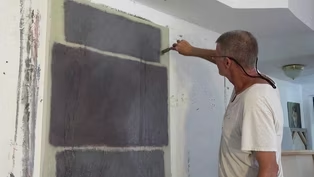
Clip: S10 Ep15 | 6m 26s | Artist Angus McCaulay strives to feel calm and peaceful, and aims to express that feeling (6m 26s)
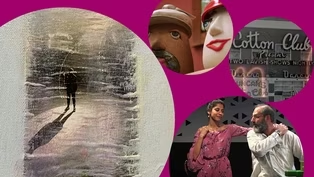
Preview: S10 Ep15 | 29s | Calm in painting, a Pulitzer prize winning playwright, a landmark of Jazz, sculpted whimsy (29s)
Providing Support for PBS.org
Learn Moreabout PBS online sponsorship

- Arts and Music
The Best of the Joy of Painting with Bob Ross
A pop icon, Bob Ross offers soothing words of wisdom as he paints captivating landscapes.













Support for PBS provided by:
WEDU Arts Plus is a local public television program presented by WEDU
Major funding for WEDU Arts Plus is provided through the generosity of Charles Rosenblum, The State of Florida and Division of Arts and Culture and the National Endowment for the Arts, and the Hillsborough County Board of County Commissioners.