WEDU Arts Plus
Episode 1016
Season 10 Episode 16 | 26m 45sVideo has Closed Captions
Kris Porter, Emily Bartelt Juel, Scott Greene, Barbara Glynn Prodaniuk
Kris Porter is a retired zoologist who now runs a nonprofit rehabilitation center for wildlife. Mixed media artist Emily Bartelt Juel creates miniature boxcars from delicate glass. New Mexico artist Scott Greene examines human nature through his detailed paintings. Ceramicist and sculptor Barbara Glynn Prodaniuk is inspired by the flora and fauna of the mountains surrounding her home.
Problems playing video? | Closed Captioning Feedback
Problems playing video? | Closed Captioning Feedback
WEDU Arts Plus is a local public television program presented by WEDU
Major funding for WEDU Arts Plus is provided through the generosity of Charles Rosenblum, The State of Florida and Division of Arts and Culture and the National Endowment for the Arts, and the Hillsborough County Board of County Commissioners.
WEDU Arts Plus
Episode 1016
Season 10 Episode 16 | 26m 45sVideo has Closed Captions
Kris Porter is a retired zoologist who now runs a nonprofit rehabilitation center for wildlife. Mixed media artist Emily Bartelt Juel creates miniature boxcars from delicate glass. New Mexico artist Scott Greene examines human nature through his detailed paintings. Ceramicist and sculptor Barbara Glynn Prodaniuk is inspired by the flora and fauna of the mountains surrounding her home.
Problems playing video? | Closed Captioning Feedback
How to Watch WEDU Arts Plus
WEDU Arts Plus is available to stream on pbs.org and the free PBS App, available on iPhone, Apple TV, Android TV, Android smartphones, Amazon Fire TV, Amazon Fire Tablet, Roku, Samsung Smart TV, and Vizio.
Providing Support for PBS.org
Learn Moreabout PBS online sponsorship- [Narrator] This is a production of WEDU PBS.
Tampa, St. Petersburg, Sarasota.
Major funding for WEDU Arts Plus is provided through the Greater Cincinnati Foundation, by an arts loving donor, who encourages others to support your PBS station, WEDU.
And by the Pinellas Community Foundation, giving humanity a hand since 1969.
(funky intro music) - [Gabe] In this edition of WEDU Arts Plus, learn the art of animal rehabilitation.
- [Veterinarian] You have to figure out if there's a piece of a puzzle that you can put together to actually determine what their initial injury is.
It's almost like creating a piece of art.
- [Gabe] Glass art that reveals visions of America.
- [Glass Artist] The trains are these solid hunks of like steel that are impenetrable.
And I'm using this like completely delicate glass to imitate it.
- [Gabe] Holding a mirror to our society.
- [Artist] There's a lot of artists that will try to eliminate the human element in their landscapes.
- [Gabe] And a look at complex ceramics inspired by mountain flora and fauna.
- [Pottery Artist] I am inspired by the things that end up coming through the yard.
There's a lot of wildlife around here, that's passing through.
- It's all coming up next, on WEDU arts plus.
(intro music) Hello, I'm Gabe Ortiz and this is WEDU Arts Plus.
This first segment was produced by students at St. Petersburg College in partnership with WEDU.
At Owl's Nest Sanctuary for wildlife in Odessa, Florida, founder and director, Kris Porter and volunteers, work closely with sick and injured animals.
Find out why they consider rehabilitation to be an art form.
(calm music) - I'm the director and founder of Owl's Nest Sanctuary.
I'm actually a retired zoologist.
I've worked with animals pretty much my whole life since I was eight years old, one way or another.
Went to college, got a zoology degree.
Interned for Busch Gardens when the pandas were here and pretty much never looked back.
I left college and went to them.
And worked 11 years in the animal nursery.
But left because my first daughter was born was born premature.
She was an emergency C-section and it was either going to be the little four pound munchkin or my career, so I did leave.
And 14 years later, I got conned into, one of my zookeeper friends telling me I was wasting my talent.
Come raise some baby squirrels and bunnies and within three months Owl's Nest was founded.
I had all the permits that you need to do to start this so, that was six years ago now.
- So there's an art to everything, I believe in life.
And when you're treating an injured animal.
When you're looking at them and you're evaluating them, and you're having to get creative in some instances.
Where you have to figure out if there's a piece of a puzzle that you can put together to actually determine what their initial injury is.
It's almost like creating a piece of art where you're doing all of your triaging, you're evaluating the entire animal, and then you're putting the puzzle pieces back together.
It's just like painting a picture.
- [Kris] Yeah, this is a Red-shouldered Hawk that came in yesterday.
I got a large patch of blood on the chest, which usually signifies that somebody possibly shot him.
We have a huge rash of people shooting birds lately.
Not lately ever since I've done this, but in the last couple of months, it has definitely ramped up.
- Medicine in general is an art.
When doctors are going to school, it's the art of medicine.
And when we have to do it, it's the same concept with the wildlife.
It is the art of the medicine and ultimately it's the medicine that's healing them.
- So he'll get all this.
I don't need to wrap the wing.
It's pretty decent in what it looks like, doesn't look like.
So I don't need to wrap anything.
Yeah, you're gonna bite something, bite that.
Thank you.
When I talk about people or they talk about me, you have to have a touch with animals.
In other words, you can't be a nervous wreck, you can't be moving quick.
People that raise and do animals.
They have a way about them.
And while I could never be like my husband in the computer AV world, I could never do what he does.
He could never do what I do.
So, you know, obviously I use syringes and there's so many things bottles, and things like that.
But I think the most important thing that I use is my background and my know-how of what an animal needs by looking at it.
(otter squeals) - So the habitat is all Kris.
She does a fantastic job in that based on her past experience and knowing the animals and the types of environments that they need to be in.
Enrichment is actually very important.
Even for a wildlife that you're rehabbing.
You want it to be as much of a natural setting as it can be for the animal to cause the least amount of stress.
And when Kris envisions the habitat, she thinks back to the days of when she actually cared for these animals prior to starting the sanctuary.
You want it to be as natural as possible yet you want it to be an area that is safe for the animal, where they won't cause any additional harm to themselves.
(melodic music) ♪ Jack and Diane ♪ ♪ Made their first debut ♪ ♪ On 82's.
♪ ♪ American fool.
♪ ♪ You made yours almost 30 years later.
♪ ♪ But this time, I was the fool.
♪ ♪ It was fall ♪ ♪ Spot you had your walls ♪ ♪ So from the side ♪ ♪ We never fit ♪ ♪ But I thought you'd finally ♪ ♪ Give in, and let me in ♪ - Slow down your life to look around, because art is honestly all around you.
There is nothing more inspiring than nature, truly.
(upbeat music) - The main thing is that I like to try to spread the message about, and this is why I'm doing, I do this community outreach is to help educate.
Is the human impact.
And what happens to our wildlife, a lot of it is caused by humans.
A lot of it is caused by trash, car hits, and when that happens, it breaks our hearts because a lot of times, some of those injuries are nonrecoverable for these animals.
So the big message is, you know, everybody please take care of our environment.
We only have one, and we only have so many of these precious animals.
- To learn more Visit owlsnestsanctuaryforwildlife.com Emily Bartelt explores aspects of daily life through glass.
Her creations reveal, visions of American culture, and often challenge assumptions about morals and ethics.
- So everyone wants an engine and everyone wants a caboose.
And I want, I just want a boxcar.
They're a box on wheels, but there's so much more to it.
If you look at a train and you look at the wheels of it and the mechanics of it.
It's just this like marvel.
I just love it.
I love the way it looks.
I imagine being inside of it.
I just think about like all the crazy places we could go.
My name is Emily Bartelt Juel and I'm a mixed media artist.
Trains are these solid hunks of like steel that are impenetrable.
And I'm using this like completely delicate glass to imitate it.
I love people's reaction when they're like it's glass.
It was a medium I was already working in.
Glass, flame work glass, kef glass, and enamel paints.
I always joke that when I lived in Italy, maybe a glass blower pinched my cheek, cause my mom said I used to get that a lot.
And I even got the glass bug.
They say the glass Gods steal your soul as soon as you touch it, and it's 100% true.
The movement, the temperature, everything about it.
You get lost in the material.
I guess none of them in particularly have a specific message, except I'm trying to familiarize people with art on trains.
When you tie in graffiti to trains and box cars, it's like this stream of messaging that's happening.
It's been a thing that's been around forever, but maybe putting it in this context, warms it up a bit.
So that way, when you see it in public, in the real, you're not like vandalism.
You know, maybe in a different eye you're like, oh, this is so beautiful.
This is art.
You know, it's like taking that jump.
This train is a collaboration I did with Leo Tecosky.
It's a cast glass train.
It has copper foil, edges.
It's soldered together.
I use enamel paints to put the decals and illustrations onto here.
A lot of the times I want them to be a recreation of something that I've seen.
I think there's something really cool and interesting about being stuck in traffic and like seeing someone, you knows graffiti.
I can't tell you how many times I think made someone's day better just because they wasted the time instead of complaining, sending me a video of the passing train, which makes me so happy because like they're then connected into my project and they like don't even know it.
I'll reach out to the people through the internet artists that will have like Instagram pages and say, I really love your work.
This is who I am, this is what I do, can we do something together?
(upbeat music) I've had work from Navid, who I collaborated with on Trains of Thought for a really long time.
my friend actually gave me and my husband some of Navid's paintings, and I had them hanging, I loved them.
And I was like, one day, I'm going to meet this guy.
And I'm going to buy a painting from him.
- I first met Emily when she was installing a show.
I later found out that she had followed me on Instagram for a while and had a bunch of my work.
- I was all like, let's be friends.
And then somehow him and I like worked, started working together and now we have this beautiful installation.
- I'm an illustrator.
It's definitely the architecture that I was interested in, creating an environment for her trains to live in.
- He did a show last year using this girl and said, I love her.
Can we put her down a side of a train?
And that's where our collaboration first began.
- In this case, you get so many metaphors for things that you come across later on in life.
Reading a book and then slowly developing throughout the city until like someone older and like more understanding.
♪ The cloud fire, ♪ ♪ Dreaming the unexpected ♪ - The train just kind of floats right on top of the city.
I love it because when kids come in, it's like they're at that level and they're there and they're looking at it.
And then all of a sudden they look up and there's this other kind of world that's taking them to other places.
The fact that glass is already seen as fine art, and it was a way that I could showcase my friends in a fine art gallery as well.
And kind of put it up there and say, you're already going to classify my work as fine art because it's glass.
What I'm pushing this graffiti is a fine art theme in a lot of my work.
Growing up in Pewaukee, Wisconsin, my dad's military, so we moved a lot between Italy and Wisconsin and Virginia.
(music plays) When living with my grandparents, I was really missing my family.
And, you know, there was this train that went by every night and it was awful.
I remember being like, ugh, I'm never going to go to sleep.
I hate this place.
You know, I just wanted any reason to complain.
And it ended up being like the thing that I waited for, for it to like go to sleep.
And so when I hear it now, it makes me think of home, it makes me think of my grandparents, and think it kind of changed my perspective on trains and why I loved them.
I think it's really interesting that when you look in the past of America, trains are such a huge part of like the way we connect as a community and for it to be still so prevalent in our society and it be something that you see every day, especially in our town is really incredible.
I try to think of it as this like beautiful crossover where yes, these things aren't being built for art, but why not put a little piece of art on them?
I just see it as like really beautiful art going past.
I mean, you see this huge thing and you know, it it's beautiful all in itself, but putting a little piece of flair on it, never hurt anyone.
- You can find out more by visiting emilybartelt.com.
New Mexico artist, Scott Greene examines the impact humans have had on the natural world.
His observations of society's rampant consumerism is challenged in his detailed paintings.
(piano music plays) - There's chaos in your work.
Who or what is at the heart of that chaos?
- We are.
We are at the heart of the chaos.
And things have gotten to the point now, that there's a lot more chaos than there ever was.
There's a lot of artists that will try to eliminate the human element in their landscapes.
I kind of go the other way.
I'm painting everything that people do and throw away and human activity as part of the landscape.
And it's a way to make a statement about what we're doing to the land and what we're doing to the environment.
Doesn't seem like a good idea since we're trying to live here, that we totally pollute it.
In day lose the painting.
There's a lot of pink insulation.
I'm thinking about well, insulation from what?
Insulating us from the environment.
We've spent a lot of time insulating ourselves from the environment to protect ourselves, but now it's all exposed.
- Could you tell us about the events or decisions that led you to have this focus on where we're at with the environment.
- Well living in and working in New Mexico for nearly 30 years has greatly influenced my work.
You really see the correlation between poverty and exploitation of the land.
And, you know, we bury the nuclear waste here.
We have the underground plumes of jet fuel and dry cleaning that's going to take over our aquifer and we're trying to do something about it, but it's, but it's very slow.
I think it sticks out in this landscape.
You know, you see it more.
(piano music plays) - What obstacles have you faced in trying to communicate to your audiences?
- Some people see it and, and they see the objects in it, a mountain of computer parts or whatever.
And it's, it's not what they want to see.
It's a beautiful sky, but it's, it's a big pile of crap.
I do try to make the garbage look as beautiful as I can.
So that is the challenge really in, in a lot of ways.
(piano music plays) There's times when life just doesn't seem real.
It's almost as if the paintings have become the reality.
And I think that that does inspire a certain feeling that I have in the studio.
It's beyond what I can accept.
And I'll try to make that a real interpretation or realistic interpretation of this idea of something not being real.
(piano music plays) There was a lot of humor in my work, and I, I hope that that comes through in a way that makes people not turn away from the uglier aspects of it, or the more confrontational aspects.
As a way to get more perspective on it, to get some distance on these issues that are, that we're all facing.
(piano music plays) - Learn more about Scott Greene's work at scottmgreene.com.
In Northern California, a ceramicist and sculptor takes inspiration from the flora and fauna of the surrounding mountains to create intricate works of art.
- I am a potter so I work in clay.
I use mostly porcelain and stoneware clays.
I do both functional and sculptural pieces.
I've been a potter for almost 40 years now.
Functional pieces are designed to be used as like a cup or a bowl or a plate.
They serve a function, and it's nice to do functional pieces because you're a small part of that person's everyday life.
And you can bring out simple joy to them.
This photo piece is their narrative.
I am inspired by the things that ended up coming through the yard.
There's a lot of wildlife around here that's passing through.
I've been in this current studio here in Truckee since 1989.
Outside my house, across the street, is a pond and a meadow.
It's quite beautiful, lovely place to go walk in the morning or in the evening, I'll be on a walk and be inspired by some texture or something.
And then I'll try to figure out how to make that into a piece.
I've worked a lot with ravens, cause there are some ravens that live around here and then they're associated with a lot of myth.
It's real easy to see why so many stories were made up about them.
So there's a lot to play with here.
I work on a potter's wheel and an electric potter's wheel.
So I, the act of throwing and taking the clay and slamming it onto the wheel head and then you form that pot.
It's a process it's not always fully formed before I start.
It develops along the way.
I will decide what I'm going to make.
And then I'll go to the wheel and start throwing.
Throwing is a very meditative place.
The initial act is called centering.
In that, centering yourself is part of that process.
So you need to center your focus on what you're doing in order to control the clay.
I like to experiment with different forms and try to push the limits of what the clay will do.
As far as it will support itself.
I use a sponge and some ribs, which are hard wood or plastic pieces that allow you to shape the clay and then various things to trim back what's not wanted.
And then those pieces dry overnight, and then they're painted on and carved or whatever the design is going to be before they go into the kiln.
It becomes more and more rewarding because of the challenges.
A lot of times you're trying for something and you just can't figure out how to get there.
You have to keep trying.
So once you finally do get there, you feel like you earned something.
I intuitively follow things that catch my imagination.
I think there will always be something new to learn.
The more you learn, the more you realize how much you don't know.
So that's why it continues to be challenging and exciting for me.
- To see more, visit bgppottery.com, And that wraps it up for this edition of WEDU Arts Plus.
For more arts and culture visit wedu.org/Arts Plus.
Until next time, I'm Gabe Ortiz.
Thanks for watching.
(suspenseful music plays) - Major funding for WEDU Arts Plus is provided through the Greater Cincinnati Foundation by an arts loving donor who encourages others to support your PBS station, WEDU and by the Pinellas Community Foundation, giving humanity a hand since 1969.
Video has Closed Captions
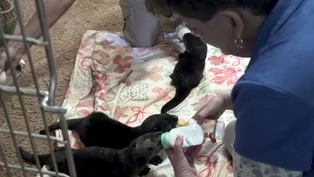
Clip: S10 Ep16 | 7m 15s | Kris Porter shares the art of animal rehabilitation at Owl's Nest Sanctuary. (7m 15s)

Preview: S10 Ep16 | 29s | Kris Porter, Emily Bartelt Juel, Scott Greene, Barbara Glynn Prodaniuk (29s)
Providing Support for PBS.org
Learn Moreabout PBS online sponsorship

- Arts and Music
The Best of the Joy of Painting with Bob Ross
A pop icon, Bob Ross offers soothing words of wisdom as he paints captivating landscapes.












Support for PBS provided by:
WEDU Arts Plus is a local public television program presented by WEDU
Major funding for WEDU Arts Plus is provided through the generosity of Charles Rosenblum, The State of Florida and Division of Arts and Culture and the National Endowment for the Arts, and the Hillsborough County Board of County Commissioners.