WEDU Arts Plus
Episode 1017
Season 10 Episode 17 | 26m 45sVideo has Closed Captions
Roller Skating, Freelance Artists, Stained Glass, Metal Sculptor
Roller skating brings soul with a variety of different dance styles as a form of expression in the Tampa Bay community. A group of freelance artists in Albany, New York, join together to foster creativity. An art exhibition showcases installations made from shards of stained glass from destroyed houses of worship during WWII. Metal sculptor Rod Ford brings metal to life.
Problems playing video? | Closed Captioning Feedback
Problems playing video? | Closed Captioning Feedback
WEDU Arts Plus is a local public television program presented by WEDU
Major funding for WEDU Arts Plus is provided through the generosity of Charles Rosenblum, The State of Florida and Division of Arts and Culture and the National Endowment for the Arts, and the Hillsborough County Board of County Commissioners.
WEDU Arts Plus
Episode 1017
Season 10 Episode 17 | 26m 45sVideo has Closed Captions
Roller skating brings soul with a variety of different dance styles as a form of expression in the Tampa Bay community. A group of freelance artists in Albany, New York, join together to foster creativity. An art exhibition showcases installations made from shards of stained glass from destroyed houses of worship during WWII. Metal sculptor Rod Ford brings metal to life.
Problems playing video? | Closed Captioning Feedback
How to Watch WEDU Arts Plus
WEDU Arts Plus is available to stream on pbs.org and the free PBS App, available on iPhone, Apple TV, Android TV, Android smartphones, Amazon Fire TV, Amazon Fire Tablet, Roku, Samsung Smart TV, and Vizio.
Providing Support for PBS.org
Learn Moreabout PBS online sponsorship- This is a production of WEDU PBS Tampa, St. Petersburg, Sarasota - Major funding for WEDU Arts Plus is provided through the Greater Cincinnati Foundation by an arts-loving donor who encourages others to support your PBS station WEDU and by the Pinellas Community Foundation, giving humanity a hand since 1969.
- In this edition of WEDU Arts Plus: Roller skaters demonstrate their different styles and creativity.
- And I feel like when you watch someone who's skating, no matter what style it is, you can interpret everything that person is, is bringing to the floor at that point.
- Creating change through media.
- Exploring workforce development, housing, food access, and health care, and it's really just an opportunity for us to be able to engage with the community and take the idea of a content channel a next step further.
- Bringing light from the midst of war through stained glass.
- And so it reminds me of how the beaches were all mined and barb-wired.
You couldn't go on the beach following the years of the war.
And so, again, that, that brings that brokenness of that, and the horror of that, and what should be a beautiful venue.
- And meet robot man: the artist welder.
- The trick is trying to put a personality into your metal, and try to make them look like they could just walk off and do it.
- It's all coming up next on WEDU Arts Plus.
(upbeat jazz music playing) - Hello, I'm Gabe Ortiz, and this is WEDU Arts Plus.
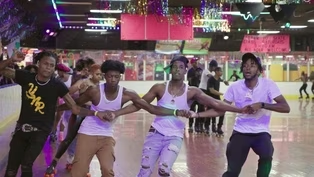
Check out the variety of skate styles represented as roller skaters hit the floor at United Skates, teaching each other moves, bringing the community together and feeling the music flow through their bodies as they dance on skates.
(upbeat percussive music playing) - Skating was my first love before my wife, like, before I got married and had kids, skating was my first love.
I started skating actually downtown at Central Park.
After that I've been skating at United skates for over 30 years.
- So, skating is my happy place.
I think it's so corny to say, but skating saved me.
There is a lot of things that I've gone through in my life, just personally, that I had no outlet for.
And I really didn't know how to express myself any other way.
But when I started skating, it was just freeing for me.
Like not only the music, not only just being able to express myself, but finding people that were just so positive, so caring and just ready to help.
I never experienced that in my life before outside of my family.
- Skating makes me feel alive.
Like when I hit the floor, it's like just me on the floor and the music, everything else inside your reality just melts away.
- Skating puts me on cloud nine.
It's my release on life.
It's my break.
It's my love.
- I think roller skating really isn't art because everything we do, it's just seen in our movement.
Like, there's no talking involved.
I could see a skater rolling around the floor and I can just feel their energy.
And I feel like when you watch someone who's skating, no matter what style it is, you can interpret everything that person is bringing to the floor, at that point.
- With roller skating you put your own twist and flavor to it.
Once you're comfortable on your skates, I just feel like it's endless what you can do.
The skating community in Tampa is, is changing as far as like, there's a lot of different people from a lot of different places.
So we get people from Virginia, people from Chicago, New York, DC.
So it was just starting to be a melting pot of different skaters in Tampa.
Usually you go out of state to see different skaters.
So it's just getting to be where you can see a little bit of everything in the house.
The styles of skating: I'll give you a rundown of them.
Fast backwards is from Philly.
They skate fast, backwards, all the time for some reason, no matter what the song is, fast backward (upbeat percussive music continues) - You have JB, which is out of Chicago, James Brown music.
- A lot of the music that they have, they take samples from James Brown's music and put that in there.
They do remixes and they take the original and mix it also.
My main style would be the fast backwards and JB.
I loved it ever since I got introduced to it.
- The style of that skate is New York, New Jersey style, which is to me, my favorite.
- They do a lot of pivots and turns and spins and stuff like that.
- Trains and trios is a part of New York New Jersey style.
That's when normally trio is three, holding hands would have a movement altogether.
Unison one-on-one trains is, could be from four to 15 people, even 20 to 30 people.
- Then you have sliders, which you have two different kinds of sliders.
You have Chicago slides, where they're doing more of a split like they'll come from halfway off the floor.
And then they'll go into it, get down low on one leg, and then they'll go into a split.
And then you have a slider that comes from Detroit, where they have four wheels on the ground, and they'll be turning sideways and sliding across the floor either with the train of people.
So they do more of the old-school artistic style skating, but I mean, they're very smooth with it.
I don't have a specific style that I do.
I like a little bit of everything.
I just feel like, you know, I want to be diverse and be able to go to Chicago and do a little bit of JB, go to New York and still be able to get on a train.
I just try to stay diverse.
I don't want to just do one style.
Skating inspired me to, I guess just become the man and the husband and the father that I am today, I mean, I met my wife at the skating rink.
My kids are into skating and I want to have a legacy where people from the Tampa Bay area, remember me say, oh, I don't remember a Big Al yeah.
he used to skate at United Skates, or, you know, he used to host a skate party or someone that loves skating and you know, want it to continue in the next generation and the next generation.
I just think it's a real experience in the energy that you get at the skating rink.
You wouldn't see it nowhere else, but at the skating ring.
You wouldn't see it at a hockey event, you don't see it at a ice skating rink.
It's just roller skating just has a different energy.
It just feels like you can light up the whole neighborhood just with the energy that's in the rink.
I don't know.
It makes me smile.
Just thinking about it.
- The Tampa Bay skate community is very much a family.
I've never experienced anything like it.
- I feel like we all have the same passion.
We share the same values and it all just shines through skating.
So it's something that we just can do together to forget about everything else.
- I mean, people are always friendly when you come to skate and because you're, you're here doing the same thing that this other person enjoys, whether they're old, young, you know, intermediate skater, beginner skater, it's just for the love of skating, you know, we're always welcoming anybody that wants to come and try it out and just, you know, enjoy yourself.
And I don't think I would never stop.
Even if I get an older age, I think I'm going to continue to keep skating.
It's a way of life.
- You can skate alongside them and see the United Skates schedule at unitedskates.com.
Be sure to choose the Tampa location.
In Albany, New York, a group of freelance artists has joined together to form a support system.
Through this partnership, they seek to bridge the gap between creativity, community development and business.
(bright pop music playing) - The business of Collectiveffort is community building.
It's we call it's the place where cool is created.
We're artists who also believe very, very dearly in building community.
And so what we've been able to do was be able to work directly with our community.
And that's like everyone, that's like the business community, the lower income community, that's the, you know, fresh out of college community.
We kind of like intersected all of them.
And so we were like, all right, you know, how do we bridge the gap between all these things?
We all think really that's like what the world needs, like more, you know, collaboration amongst everybody.
Collectiveffort as a whole, we do marketing, media production and mentoring through our co-working space.
And we have our own plans for our content channels and software, original content directly from us, as well as servicing our marketing clients as well.
(electronic music playing) Generally, you know, most companies when you think of like doing marketing, you know, you think about doing work with like Nike, Puma, Under Armour, all of which like we've worked with in the past, just producing, you know, video shorts for, you know, some of the designers that they hire and things like that.
But we're trying to figure out how do you take corporate level content and marketing and apply it to the community level.
Today we're in Electric City Barn located in Schenectady, New York.
We're setting up for a shoot for a content channel that we're creating for the Capitol region called Let's Talk About Life.
We're exploring workforce development, housing, food access, and health care.
And really, it's just an opportunity for us to be able to engage with the community and take the idea of a content channel a next step, further to figure out, you know, how can we take the content that we create and have it impact people like at a very local level, (introspective piano music starts) Collective Effort, AKA The Collective, it really started like, I left school and then found out Jamel Mosely was around.
He was in my same program in RPI.
And it kind of just like happened, like, you know, by the grace of the university, someone was like, oh, you should go talk to Jamel, And then I just like, literally just went over his house and sat and watched him video edit as he was starting his entrepreneurial journey.
And that kind of just let me know, it was like, oh, wow, okay.
So it is possible like this, you know, this thing that, like my dad's been telling me to do all my life, just like start a business.
And I was like, that's totally possible here.
Fast forward a couple of years, you know, Jamel, myself, and DeSean Moore who is our director of marketing, we all kind of just worked together.
We all were in the same school together, same program, We just started working together.
We met Jessica Coles and Berta Singleton, and they were just like a burst of energy and life.
They started doing just like group working sessions, you know, mostly with Jamel, And then I started coming around.
We, you know, just have fun and do some work together, post stuff on social media.
And people would just like ask to join.
And that birthed Power Breakfast.
(electronic music playing) Power Breakfast Club is a professional development community that we built just about two years, a little bit over two years now.
And that's solely based off of us just wanting to work together and be around people that, you know, had a similar belief and kind of like lifestyle and where we were trying to go in life and trying to create a support system for it.
- Our mantra and our ethos is do something and with do something it's just like start something, it's like have a lot of people have these ideas and they're brilliant, but they just don't have the, that push to, to really get out there and just take that first step.
- We found an opportunity to work out of the African American Cultural Center from Power Breakfast.
It turned out to be this really great opportunity for us to one, really like lay some roots in an area that really needs a lot of love.
And, you know, we just know that, you know, pretty much like, you know, areas that are kind of downtrodden don't get enough attention because they don't contribute to like, you know, the profitability of the city.
And so we were like, that's like, art is like our whole game is like, you know, trying to build areas.
So we were just like, you know, let's do it.
(electronic music continues) We walked in here and everything was brown.
It didn't have any electrical work done at, you know, the roof was all messed up and like kind of sinking in.
And so, yeah, we were just like, you know, let's make an investment into like making this thing work and it is our pilot so we're not going to be here for forever.
But what we do want to do is make a lasting impression.
The third floor is going to be our coworking space.
Again is designed specifically for creatives.
The fourth floor is going to be our production area.
We have been lucky enough to get some grant funding.
We're investing in good like intermediate level video and audio equipment.
That's really easy to use to make available to our members.
(percussive music starts) - We're here right on the corner of Madison and south Pearl, we're an earshot away from Times Union Center, we're right off the highway, we're easily accessible.
And we really want to teach our community how to speak for themselves.
- We're gonna work out of here, we're going to figure it out.
We're going to build some people.
And hopefully, you know, by the time we're ready to leave, we've made enough impact in this area and telling the stories of this area's past.
Plus, where we're trying to go in the future.
- Do something.
- To find out more, visit collectiveeffort.co Bringing light from the midst of war encapsulates the essence of Remembered Light stained glass art exhibit in Salt Lake City, Utah.
The art installations are created from shards of stained glass from destroyed houses of worship during World War II.
(melancholic piano music playing) - I lived in England by the coast and we lived closest to the European side of the country.
And so it reminds me of how the beaches were all mined and barb-wired, you couldn't go to the beach following the years of the war.
And so again, that, that brings that, the brokenness of that, and the horror of that, and what should be a beautiful venue.
(melancholic piano music continues) - The two sponsors of this exhibit are the Utah District Rotary International and the Salt Lake Interfaith Round Table.
- It's been a joy for us to have them, and of course we are privileged to have them because they are owned by the Interfaith Group at the Presidio in San Francisco.
They're not ours.
We've just had this great privilege and these are exquisite pieces and very, very fragile.
So it's just a remarkable opportunity, but we're very grateful to them for allowing us to have had it this time, and to be able to display it and for their help and supporting how it should be displayed and setting it all up.
And yeah, it's been a great experience.
- The art exhibit originated really with Frederick McDonald, who was a chaplain in the army, traveling around Europe at the end of World War II.
When he was in Coventry, he went to the bombed out cathedral and was moved deeply by the senseless destruction of something of such great beauty and how long it took to build and how quickly it was gone.
And he picked up some shards of the stained glass windows, because he wanted to remember the feelings that he had and the place.
He ended up doing that at 24 other houses of worship throughout several countries in Europe, he mailed the shards home with thoughts that he had about the place.
He always had wanted to do something meaningful with them that would remember and make people aware of the horrors of war and the longing for peace.
And when he was past 90, he was living in a senior facility, and at dinner one night, the conversation turned to stained glass, and he said, I've got some under my bed.
And his dinner companions were intrigued and said, and where did you get these shards?
And when he started telling them the stories of these places, all across Europe, they were deeply moved.
And there was one woman that was particularly insistent that we need to make something happen with these.
Her husband was, he did stained glass as a hobby, and she arranged for him to be put in touch with a French woman, a stained glass artist in Oakland, Armelle Le Roux.
Armelle ended up meeting with chaplain McDonald.
And originally they were thinking about making one big window and incorporating all 300 shards of glass and having something memorable about it.
But the more Armelle talked to him, his memories of each of these places, and of the people, and the human stories was so poignant that she decided we just need to do a piece for each one of these houses of worship.
And she started on that endeavor and engaged the help of 12 other stained glass artists.
So 13 glass artists are the origin of this exhibit.
- It's called Remembered Light obviously because it was remembrances from the second world war.
And I find that particularly interesting for myself because I was born in England.
I was born during the war and remember very clearly the years after the war, going to school with a gas mask and similar activities.
So this was very close to me, and there's particularly one picture in here, or one display in here that is about Coventry cathedral, which of course is embedded in the British memory as being a horrific time when that cathedral was destroyed.
(melancholic piano music continues) Very early in the second world war, it was destroyed by the Germans.
And of course, nothing could be more horrific to British people then seeing one of their buildings, which was probably 500, 600 years old destroyed.
And because of that, the Allies, which of course were Britain and America, they did go over to Germany and do a bombing raid on the city of Dresden, which many people recall from their history.
And the whole city of Dresden was destroyed by fire bombs.
This was the first time they had used in century devices.
And that was strictly in retaliation for the destruction of the cathedral in England.
And so I always point out the futility of war when I talk about that, that it was sort of tit for tat because I, as far as I know, there were no munitions factories in Dresden, it was a very famous historical city in Germany.
And so it was probably one of the most destructive things that could have been done.
- A big part of the motivation was concerned about the division and polarization that has been growing in our country and trying to get people to stop and think about it and to see if there are things we can do to help redirect that to something that's more healthy.
One way is just bringing them into this space because you get all kinds of different people here together.
They experience seeing the same kind of thing as they take time to look at the pieces and to read the messages.
And there's such a deeply human stories here that I think, I think when people are together and are touched by something together, I think that brings some, some kind of unity.
- We have seen people leave here in tears.
They have read everything they've looked at it all and it just is internalized with them that they have to do something.
We all have to do something.
It's not just one person.
We all have to do something.
And it's an overpowering realization.
And I think this exhibit is, has provided that for people.
And we'll never know, you know, they leave, they may sign their name in the book, they may write something very beautiful.
And you don't know, but you hope that after six weeks of this exhibit, that we have changed by allowing people to come and view all these have changed people.
- For more information, visit interfaithroundtable.org.
Meet an artist who has spent his life turning challenges into triumphs.
Rod Ford channels his experiences into one of a kind art pieces, bringing scraps of metal to life.
Some call him Robot Man.
Let's find out why.
- When you came back, you're angry.
And you always had this bird on your shoulder saying, why did you survive?
But I kept on going until, you know, I, somebody said you better get some, some help because you really have a bad attitude, you know, come to find out that PTSD influences you for the rest of your life.
It's the best therapy I ever came across.
You get locked in and time goes away and you're focused.
It's the best therapy in the world.
Absolutely.
(soft guitar music starts) My name's Rod Ford and I work in metal.
I've been doing it for almost 30 years or 40 years, actually.
In elementary school I used to go away by alleys and I'd bring stuff home, stuff I'd collect out of people's trash and do different things with them as a kid.
And for a crisp blue flame right there.
So my imagination was always there and it was actually creating different things out of the junk that I brought home.
Got my draft notice in 68.
When I got back from Vietnam, we were treated pretty much as throwaways.
So 35, 45 years of PTSD, I finally got some help.
From that point, I was driving a semi.
I wanted to see what the country was I had fought for, but I had a wreck up on the pass.
(car wheels squealing) (ambulance sirens wailing) So I'm sitting in a hospital bed and going, well, what do I do now?
And I thought, you know, I've been collecting junk - treasure, excuse me, it's not junk - for a very long time and I thought I'm going to start putting these things together.
And since we walk through life like robots, that is the theme.
And that's sort of where it evolved.
It became good.
I'm going to use that as the hips, and I want to use the spline that's in here the lock it in position.
I built them as things that had happened to me, walking through life, you know, we have our little cage that we walked through life in and all of a sudden something will happen.
That changes that picture.
I had been going through therapy for years and it was, how can I relate that, or I can make a statement there.
They're each standing outside a big plate glass, which has life on it.
And that life is facing him and he's looking at it, but he knows he can't get, he can't get back to where he was.
It's all different now.
And that's come from traumatic experiences.
And all of a sudden your experience has shifted you from the reality used to have where you are now.
(crowd conversing) They love it.
I mean, think about how in the heck did you come up with that?
I'm going, I don't know, but as I was building it, it made sense.
Metal talks to me, I don't know.
A trick is trying to put a personality into your metal and try to make them, make them look like they could just walk off and do it.
So I think I've been successful in doing that.
Find something you love and do it, it doesn't matter what the critics say.
It's for you.
You do it for you.
And if other people love it, hot diggity, it's a good deal.
I'm just going to keep building.
Do what you love to do.
- Learn more about this artist at facebook.com and search "Rod Ford."
And that wraps it up for this edition of WEDU Arts Plus.
For more arts and culture visit wedu.org/artsplus.
Until next time, I'm Gabe Ortiz.
Thanks for watching.
(epic music playing) - Major funding for WEDU Arts Plus is provided through the Greater Cincinnati Foundation by an arts loving donor who encourages others to support your PBS station WEDU, and by the Pinellas Community Foundation, giving humanity a hand since 1969.
Video has Closed Captions
Clip: S10 Ep17 | 6m 25s | Learn about the community of roller skaters in Tampa Bay. (6m 25s)
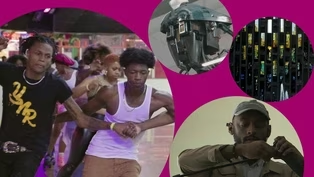
Preview: S10 Ep17 | 29s | Roller Skates, Creating Change, Stained Glass, Robot Man (29s)
Providing Support for PBS.org
Learn Moreabout PBS online sponsorship

- Arts and Music
The Best of the Joy of Painting with Bob Ross
A pop icon, Bob Ross offers soothing words of wisdom as he paints captivating landscapes.












Support for PBS provided by:
WEDU Arts Plus is a local public television program presented by WEDU
Major funding for WEDU Arts Plus is provided through the generosity of Charles Rosenblum, The State of Florida and Division of Arts and Culture and the National Endowment for the Arts, and the Hillsborough County Board of County Commissioners.