WEDU Arts Plus
Episode 1019
Season 10 Episode 19 | 26m 25sVideo has Closed Captions
The arts and culture series tells stories of the individuals and cultural organizations.
Poets face off in the boxing ring to honor Muhammad Ali, the three P's of photography, the artists who picked up where the impressionists left off, and a talented painter of many styles.
Problems playing video? | Closed Captioning Feedback
Problems playing video? | Closed Captioning Feedback
WEDU Arts Plus is a local public television program presented by WEDU
Major funding for WEDU Arts Plus is provided through the generosity of Charles Rosenblum, The State of Florida and Division of Arts and Culture and the National Endowment for the Arts, and the Hillsborough County Board of County Commissioners.
WEDU Arts Plus
Episode 1019
Season 10 Episode 19 | 26m 25sVideo has Closed Captions
Poets face off in the boxing ring to honor Muhammad Ali, the three P's of photography, the artists who picked up where the impressionists left off, and a talented painter of many styles.
Problems playing video? | Closed Captioning Feedback
How to Watch WEDU Arts Plus
WEDU Arts Plus is available to stream on pbs.org and the free PBS App, available on iPhone, Apple TV, Android TV, Android smartphones, Amazon Fire TV, Amazon Fire Tablet, Roku, Samsung Smart TV, and Vizio.
Providing Support for PBS.org
Learn Moreabout PBS online sponsorship- [Announcer] This is a production of WEDU PBS, Tampa, St. Petersburg, Sarasota.
Major funding for "WEDU Arts Plus" is provided through The Greater Cincinnati Foundation, by an arts loving donor who encourages others to support your PBS station, WEDU.
And by the Pinellas Community Foundation, giving humanity a hand since 1969.
- [Dalia] In this edition of "WEDU Arts Plus," poets face off in the boxing ring to honor Muhammad Ali.
- So I focused my poem on resilience and overcoming obstacles.
And so I spin it into just kind of fighting against depression and those everyday things that prevent you from being your best self, from seeing the light.
- [Dalia] Three P's of photography.
- The most important thing about wanting to become a photo journalist is you've got to have total dedication.
- [Dalia] The artists who picked up where the Impressionists left off.
- Neo-Impressionism does grow out of Impressionism.
And you can't have any of these pictures without Monet.
- [Dalia] And a talented painter of many styles.
- [Kenneth] I'm not confined to one particular style.
Maybe that helps me be me, maybe it hurts me, but I'm just in it for the adventure, for the journey.
- It's all coming up next on "WEDU Arts Plus."
(dynamic music) Hello, I'm Dalia Colon.
And this is "WEDU Arts Plus."
Muhammad Ali was poetry in motion.
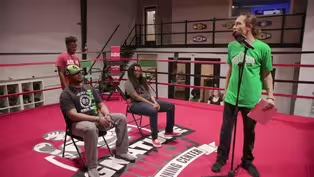
And in this tribute poetry slam, local poets battle with words to honor Ali, and see which spoken word performance is truly the greatest.
(dynamic music) - So tonight is a super combination of athleticism, and also literature and poetry.
We've got four of the best poets in the city, who are gonna be competing head to head.
They wanted a stage to voice their love for Muhammad Ali, and his principles, and things like that.
- [Woman] The way that the entire event is going to be organized, it's almost like a boxing match.
- Please clap it up for your first sacrificial poet, Charles Hines!
(people clapping) - So I focused my poem on resilience and overcoming obstacles.
And so I spin it into just kind of fighting against depression and those everyday things that prevent you from being your best self, from seeing the light.
Every word they say, just stings.
Like, like, like will I ever be all right?
I am not a champion.
In this moment, you may not feel like a champion, or your best self, but always standing up again, and just staying in the ring.
Until one day you look, and you're like, hey, I'm the champion.
- How am I going to put my socks on today?
And walk a mile in everyone else's shoes while I stay stuck in cement, still trying to sooth, I know.
Someone like Muhammad Ali, even he got tired and exhausted on days, I'm sure.
Because it's all just so much sometimes.
So the poem that I wrote is just kind of saying that like, it's okay to have bad days, and it's okay to have days where you focus on yourself, and do things for yourself.
And you're still a great person.
- I miss the days when we pulled out boxing gloves, instead of handguns.
Before fists became semi-automatic pistols and double action revolvers.
- 2017, I started Growhouse because I wanted to do something different.
The idea was to take the elements of slam poetry, and the competition structure, and use it for other forms of art.
- Nosy shipwrecks resurface to watch dolphins ornament black braids with gold.
She pulls Mount Everest out of her breasts, and each nail lines up for its turn at getting even.
- 2019 is when I partnered up with Dennis.
He's an excellent host and he's a great like just people person.
He's a lot more outgoing than I would say I am.
And so we're definitely a great partnership, in that I'm more reserved, and he's great at just being a people person.
- One of the most prolific and profound poets that I personally know, Walter Wally B. Jennings!
- Wally B. is kind of like this tree trunk, right?
And he's kind of brought poetry as spoken word down from Tallahassee.
When he brought it here to Tampa, from that, just blossomed all out of everything that you see today.
- This work was not built by brick and mortar.
What you do may make you important, but why you do it will make you immortal.
The poem that I have is really about the whole aging process.
And how it's important for us to really recognize the totality of our life as one cohesive experience, rather than these fragmented parts.
Where we fall in love with one and we hate the other.
And so with Muhammad Ali, a lot of people kind of are able to segment his life into various sections.
When you talk about him as a young champion.
And then when you talk about the attention that he got as an activist.
And then in his latter years, as he dealt with Parkinson's, and a lot of medical challenges.
So most people, they experience or know him, and they really, his life resonates with them heavily, usually in one of those three areas.
And remind everyone that greatness is always just over the horizon.
- Ali is actually one of the few people that can be like, oh, that is like one of my like superheroes.
- I just look at him as someone who is so dedicated to getting what he wants.
- Just going back and watching old footage of him, and just seeing how he was able to just come out on top against some of the biggest fighters.
And then, of course, outside of the ring, he was just an artistic person overall.
- He was one of the first, I would say, like one of the first like well-known spoken word kind of poets.
- Float like a butterfly and sting like a bee.
Ah, rumble, young man, rumble.
- That's the best type of poetry, to me, is like the authentic genuineness.
And that's like all Muhammad Ali is, you know?
- The fact that he crafted himself as his own character and chose to be true to that, come hell or high water.
With all of the weight that each one of his decisions is made, not just for himself, but as a representative of his people here in America.
- He got something that he had been training for basically his entire life.
And he decided to give it up for the good of other people.
- I loved him as being a Black man who was completely confident in who he was.
At that time, that was very not okay to do that.
- He became the first, in my eyes, the first athlete that was more than his sport.
I wish I would've had the opportunity to actually meet, see, be in the presence of Ali, worthy of all praises, most high.
The poem that I wrote for this event, I was trying to take like some of his core tenants, and expound upon them, and find how I am trying to exemplify them in my life.
Just as a small homage to Muhammad Ali.
And conviction, spirituality, and dedication, he was respect and giving.
- We want Tampa to be a city that people think of when they think of like really dope spoken word poetry.
Like, oh, we've gotta go to Tampa to go to Growhouse.
And we really believe in building community, and working together with other people in the community who have the same goals as us.
- Tampa as a whole, outside even just poetry, is really blossoming in a beautiful way in the art scene.
So, and we wanna be a part of that.
- We're all trying to get to the same place, we all want Tampa to be known as this awesome city.
And there's a whole bunch of talent here.
And Growhouse just wants to like be a platform to show that and put Tampa on the map, basically.
- For more information on the poets featured, visit Black on Black Rhyme and Kitchen Table Literacy Arts on Facebook, and dawsontheartist.com.
For more info on Muhammad Ali, visit the Ken Burns documentary at pbs.org.
For Ian Wright, a fantastic photograph is all about the three P's, patience, politeness and perseverance.
Learn more from this Reno based photographer, who has taken pictures of Johnny Cash, Ella Fitzgerald, Mick Jagger, and The Beatles.
Just to name a few.
(upbeat music) - Name is Ian Wright.
I was born in northeast of England, 1945.
And I'm in my 58th year as a photojournalist.
The mentor that I had was Arthur Soca, my form teacher.
He actually put himself forward with his knowledge of photography and said, is there anybody in the class that would like me to teach them photography?
And I put my hand up, and I was the only one.
It was the best decision I ever made in my whole life.
Because he took this young 14-year-old kid, and showed him all the tricks of the trade.
And I started work the last week of December, of 1960.
And they decided at The Northern Echo in Darlington that they were going to have a new editor, who was coming into revamp the paper, Sir Harold Evans, who was voted the greatest editor of the last century.
He was my second mentor.
Harry said to me, later in years, he said to me, you know, Righty.
Oh, by the way, John Lennon gave me that nickname.
He said, do you know, Righty?
I heard it coming.
I said, what did you hear?
He said, the '60s revolution, I heard it coming.
The Baby Boomers had boomed.
And there were 25 million, 20 million in America, 5 million in Great Britain.
And he realized, they had to have a voice.
And his first ever supplement was the teenage special.
He wanted coverage of everything that was happening in our area.
And so he was the chronicler, and he asked me to be the illustrator, at 16.
And I got the job at that newspaper as a junior darkroom boy.
My duties were to wash the floor, make the chemicals, make the tea, file the negatives.
Literally, I was a runner.
I'd go with senior photographers on assignments, and run back with the plates, and develop them, and print them.
So-and-so, that's how it all began.
All the other photographers that Harry had acquired, inherited with The Northern Echo, were all World War II age.
They had no idea who The Beatles were.
And so he said, do you wanna do it?
And I always put my hand up.
I never put my hand down, I always say yes.
He said that, I can't give you any extra money, I can't give you any overtime.
You won't get any time off, and you can't have any expenses.
Do you still wanna do it?
Yes.
(laughs) So that was how I started.
But the thing was, I was far too young to drive.
So I had to go on my bike, you know.
And I had a huge plate camera.
And inside the bag, it weighed probably about 35 pounds.
And inside of there were 14 plates, glass negatives.
That's what I had to carry.
And also inside of the bag was a flash, it was as big as a Bentley headlight.
So I had to strap that all to the frame of my bike.
And I was out in all weathers, photographing this revolution, the '60s revolution.
We were there at the beginning.
My first ever portrait for the teenage special, I went and photographed Miss Ella Fitzgerald.
Over the years, I've just been so lucky with the assignments I've been given.
I went and photographed every celebrity.
I've done 'em all.
I learned, never be in awe of any of them, because they are looking at you as a professional, and they expect you to be professional.
And if you are, they will sit down, buy you a drink, and they'll talk your hind legs off.
Because they love it.
But if you go in with an LP cover and say, oh, could I have your autograph, please?
I think your last LP was absolutely fantastic.
You've had it, you've lost 'em.
(upbeat music) So I met The Beatles for the first time, February the ninth, 1963.
There couldn't have been more than 200 people in that theater that night, it was a snow storm, in Sunderland County, Durham, England.
I heard this sound, it went... ♪ Wah, wah, wah, wah, wah, wah, wah ♪ ♪ Wah, wah, wah, boom ♪ ♪ Love, love me do ♪ ♪ You know I love you ♪ So I pulled everything off the bike, ran around the front into the auditorium, took this picture.
And that was the beginning of the revolution.
And according to the National Portrait Gallery in London, the picture I took of them onstage, is the earliest known photograph of The Beatles live on stage.
(gentle music) Many of The Beatles pictures I have never saw the light of day because they weren't famous, which is quite remarkable.
I had a whole series of photographs, portraits of them, their reactions backstage, the night that JFK was assassinated.
Again, the only photographer there, November 22nd, 1963.
Not one of those photographs ever saw the light of day until they were published in my book, which came out in 2008.
In all of those assignments, or whatever you want to call them, I never went to work.
I never worked a day in my life.
(jaunty music) For me, it was just an absolute passion.
I look upon the fact that my still photographs are a historical record of things that happened during all of those decades that I worked.
I never saw it as art.
I saw it as a craft, I saw it as a profession.
And I realized what you had to do to beat all the others.
Sometimes there's 20 other photographers there, and you had to get something different.
It was all about decision-making, it was all about being imaginative.
I never went out, as say, a graphic art photographer would do, and go out and create something like a Picasso would.
I never did that.
I was a boots on the ground photographer, and always have been.
And I wouldn't have change anything for a golden cow.
No, never.
I enjoyed every minute of it, and I still am.
- You can find more of Ian Wright's work at morrisonhotelgallery.com.
The end of the 19th century in France was a time of major political unrest and cultural transformation.
Responding to all of this were the so-called Neo-Impressionists, who captured the scenes, and the mood of their country.
Learn more about the work of these avant garde artists, who picked up where the Impressionists left off.
(quirky music) - Beyond Impressionism is an exciting partnership with the Guggenheim Bilbao.
And it has over 100 works in it.
The title is about the fact that this whole show is about that period right after the peak of Impressionism.
Impressionism sort of peaks in the 1870s, and maybe into the early 1880s.
And impression was this breakout moment for Modernism.
While we think about Monet and Renoir, and this whole idea of painting light, literally capturing moments of light.
So this was a huge breakthrough.
I mean, it changes the arc of what happens in Western painting.
But it had sort of a terminus, after you've done that, what do you do with it?
How do you extend that legacy?
How do you extend that revolution, maybe more than legacy, how do you extend that revolution?
So that was a challenge for the original Impressionists like Pissarro, Monet, Renoir.
But it was also a challenge for the artists coming after them.
And so this show is about that real turbulent time of the 1890s.
And the terminus is really sort of the opening of World War I.
It kind of goes from the 1890s into the very first decade of the 20th century.
(jaunty music) Neo-Impression is known for this dot thing, the idea of painting with these little dabs, and these little dots.
It's very much connected to an artist named Seurat.
He was part of a group of artists that wanted to sort of get a hold of Impressionism.
'Cause Impressionism started to get really, sort of amorphous.
They wanted structure and organization.
The other thing you're gonna discover in the exhibition is more about symbolism.
Symbolism, the thing to remember about symbolism, is it was a way of creating more of a subjective response in painting and graphic arts.
This is a great period of printmaking and graphic arts.
There's a wonderful artist called Redon.
He's very much about the dream, the inner-state.
It's all subjective.
It's just the opposite then of Impressionism, in that sense.
He was very interested in not just dreams, but nightmares.
And he's interested, he's fascinated by Edgar Allen Poe.
It almost is like day and night.
He goes from these very kind of dark, dark dreams, dark thoughts, and sort of horror kind of laced things, to these luminous pictures, which are very like sort of transformational in the other sense.
They lift you up.
The third thing that you'll discover is this was the period of the birth of celebrity culture and advertising that we now are the heirs of.
This was a period filled with these La Goulue, Jane Avril, all these characters.
And they would have been as well known to the people of Paris as Beyonce is to us.
(gentle music) Neo-Impressionism does grow out of Impressionism.
And you can't have any of these pictures without Monet.
You can't get to these pictures without going through Monet and Renoir.
And so I think they are the children of the Impressionist revolution.
So this period I think often gets overlooked, but they were fantastic pictures.
- Learn more about this exhibition at columbusmuseum.org.
Kenneth Young is a talented painter that enjoys exploring many different styles.
Visit the artist at his home in Ghent, New York, to see what he's currently working on, and to learn more about his personal journey.
- There's a lot to be said about becoming known for a certain style.
Like someone says, well, you know, you look at that you know it's a Van Gogh.
Or you look at this you know it's a Renoir, because he has a distinctive style about him.
And I really don't think I have a distinctive style.
(funky music) And I think it's because each work, to me, if there's a certain feeling, or a certain mood I'm trying to convey, it has its own style that I need to do to achieve that.
I think the painting I'm working on right now is not really like any other painting because it's another feeling I'm having.
And so, I'm not confined to one particular style.
Maybe that helps me be me, maybe it hurts me.
But I'm just in it for the adventure, for the journey.
When I was in high school, I wasn't present when you have your photo taken for the yearbook.
And they says, well Ken, you can draw.
What do you think about drawing your self portrait?
I did end up getting two scholarships to go to an art class, but I made a decision back then.
There was another fascination that I started to get.
I started to be fascinated with studying the Bible.
And I was getting really religiously inclined.
And I think at that point, I made a decision to go in that direction, instead of taking the scholarships.
I guess I was struggling with the type of artist I wanted to be.
I didn't wanna be in commercial art.
I wanted to be a painter.
And I didn't know, I thought it was risky trying to be a painter, and make a living at it.
I got married, then responsibilities.
We had a child.
And I just had to stop painting for a while 'cause it just wasn't practical.
That span of time when, probably about 15 or 20 years, where I did nothing.
I think another spark started for me when I went to visit the Clark Art Institute in Williamstown.
And to actually be in front of Renoir, or Remington, or Monet, Sargent.
And just see those works in person.
It was, it just blew me away.
The fire was starting all over again now, and I wanted to paint.
(funky music) Here it is in the '90s, 30 years out of high school.
And I did this self portrait, like telling that Ken is still here.
Ken is still painting.
And it's a portrait of myself.
Sort of, it's a take on the Rockwell self-portrait, where he's painting himself, and he's kind of like looking in the mirror at himself while he's painting.
And a friend saw that, and he says, what are you doing?
You know, you've gotta show this stuff.
People just kept encouraging me to continue to paint.
(gentle music) One day I was driving through Hudson.
It was raining, and rainy days didn't appeal to me at all.
Gray, not much color going on.
And, but driving through the city in the rain, I noticed the way the city, and all those buildings, and cars, and people looked like through the wet windshield.
There was all this drizzly color and motion happening.
And then I wanted to duplicate that on the canvas.
And I tried and tried real hard, until I could get to where it looked like it was looking through wet glass.
And so I did a whole series, I think I did about 24 paintings of Warren Street.
And it just transformed all those buildings, and people, and automobiles into the something magical to me.
(funky music) I view art is as not just a nice thing in my life.
To me, it is my life.
And I just wanna continue reaching out to people that can connect with it.
And I would encourage anybody that would like to, it's never too late to even, to try.
My life has been very compartmentalized.
You have certain things that have to be done, and there are priorities in life.
And maybe, I know at that 20 year span, art couldn't be a priority because there were other things.
But don't let that stop you forever.
You could pick it up and you can do it.
And just don't say I can't because that's the worst enemy.
- See more at kennethyoungfineart.com.
And that wraps it up for this edition of "WEDU Arts Plus."
For more arts and culture visit wedu.org/artsplus.
Until next time, I'm Dalia Colon.
Thanks for watching.
(dynamic music) - [Announcer] Major funding for "WEDU Arts Plus" is provided through The Greater Cincinnati Foundation, by an arts loving donor who encourages others to support your PBS station, WEDU.
And by the Pinellas Community Foundation, giving humanity a hand since 1969.
(dynamic music)
Video has Closed Captions
Clip: S10 Ep19 | 6m 45s | Poets face off in a special event in Tampa that honors boxing legend Muhammad Ali. (6m 45s)
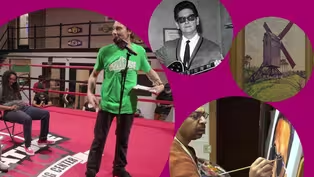
Preview: S10 Ep19 | 29s | Poets, Photography, Artists, Impressionists, Painter (29s)
Providing Support for PBS.org
Learn Moreabout PBS online sponsorship

- Arts and Music
The Best of the Joy of Painting with Bob Ross
A pop icon, Bob Ross offers soothing words of wisdom as he paints captivating landscapes.












Support for PBS provided by:
WEDU Arts Plus is a local public television program presented by WEDU
Major funding for WEDU Arts Plus is provided through the generosity of Charles Rosenblum, The State of Florida and Division of Arts and Culture and the National Endowment for the Arts, and the Hillsborough County Board of County Commissioners.