
Episode 102
Season 1 Episode 102 | 26m 46sVideo has Closed Captions
Visit a peacock farmer and meet a professor who hiked across Iowa to document changes.
Visit a farmer who raises peacocks, meet a professor who hiked across the state to document historical changes in Iowa, and learn how one northeast Iowa organization helps immigrants and refugees.
Problems playing video? | Closed Captioning Feedback
Problems playing video? | Closed Captioning Feedback
Iowa Life is a local public television program presented by Iowa PBS
Episode 102
Season 1 Episode 102 | 26m 46sVideo has Closed Captions
Visit a farmer who raises peacocks, meet a professor who hiked across the state to document historical changes in Iowa, and learn how one northeast Iowa organization helps immigrants and refugees.
Problems playing video? | Closed Captioning Feedback
How to Watch Iowa Life
Iowa Life is available to stream on pbs.org and the free PBS App, available on iPhone, Apple TV, Android TV, Android smartphones, Amazon Fire TV, Amazon Fire Tablet, Roku, Samsung Smart TV, and Vizio.
Providing Support for PBS.org
Learn Moreabout PBS online sponsorshipComing up on this episode of Iowa Life.
Follow along with a history professor who hiked across the state Iowas changed more than perhaps any place on earth.
What if I went and tried to retrace the route of the 1835 Dragoons, meet a couple who raised peacocks near Mendon.
began.
Weve had these birds since 1981 Learn about a Dubuque organization that offers educational opportunities to adult immigrants.
And the friendships that developed between that tutor and then English language learner was life giving.
It's all coming up next on Iowa Life.
Funding for Iowa Life is provided by the Gilchrist Foundation, founded by Jocelyn Gilchrist, furthering the philanthropic interests of the Gilchrist Family in Wildlife and conservation, the arts and Public Broadcasting and Disaster Relief Mark and Kay De Cook Charitable Foundation proud to support programs that highlight the stories about the people and places of Iowa.
The Strickler family in loving memory of Lois Strickler to support programs that highlight the importance of Iowa's natural resources on Iowa PBS and by the Lainey Grimm Fund for Inclusive Programing at the Iowa PBS Foundation [music] [peacock noises] I never had a pet in my life.
And then all of a sudden, Oh, you like to eat them off the ground?
Here, have my hand.
You know how you like those.
And I was mesmerized by these birds.
We've had these birds since probably 1981.
See, when he gets his wings up, that means he's going to fly.
And it's no different than it was then.
I still can sit there and watch them for hours.
And then I was taking notes down while she would say, Are you coming in for supper?
Do you ever want to come to eat?
Yeah.
Producer Off Camera: How did the peacock farm come to be?
You know?
Yes.
He gave me a pig when we were dating, and we called up Charlie.
So when we got married, took a left, and he grew to about 800 pounds, and then he died.
We think he got struck by lightning.
And then he said, What do you want next?
And for some weird reason, I said, Peacocks.
And I'm glad you didn't say elephants.
Well, we didn't know anything about them.
And then we found that when our first Peacock junior died, the vet said, Oh, she had a bad heart.
And I said, she.
He said, Yeah.
And so she I thought we thought it was a boy.
He says, No, I hate to tell you, Junior is a girl.
And I said, I got to study this, but nobody would tell us anything.
So we learned firsthand.
We wrote books.
We wrote books, and I wrote down everything I could.
I took every still shot as the years went on, we got more and more birds.
And then all of a sudden I was substituting because we were out promoting our first Peacock book, which sold out our first thousand copies within the first month.
They're like any other barnyard poultry.
You feed them crack corn.
We have oats and wheat here.
We mix those up together and that's their diet.
And the only bird in the poultry world that does not lay an egg.
And is sexually mature until their second and third year, a male will not have his full tail feathers until his third year.
Now, if you were to have them, you have to make sure you have space for them.
So you have to have a cage that's at least eight foot tall.
I do admit that they are able to withstand the heat better than the cold, but they do well and 25 below zero temperatures which we've experienced over the 37 years.
Like other farmers, Dennis and Deborah Fett feed and water their livestock each morning among the goose and gennies are their pride and joy.
The birds are peacock farmers and this is where it all started.
The first TV we ever were on at the minute the book came out.
It actually started with Goosey Yes.
David Letterman.
Like my left foot, don't you?
In the mall in Council Bluffs.
I went there and they had a TV thing.
I said, Hey, I got a goose that unties Shoes.
David Letterman was going to put us on the show, but he said he'd only pay us $50 and we'd have to get our way to New York.
And I said, Well, we're kind of poor at this time.
And so we didn't go.
And then once we got to this place, peacocks are not as mysterious as everybody is led to.
The big thing happened was Iowa Public TV.
They came back in 1988, the film US four take one series.
So we lost our favorite pet.
And then I was about ready to give it up and I think Deb encouraged me and from then on in, people saw us all over the state and then we were invited to visit Davenport, be on TV and we were invited to Kansas City and we did all the TV stations in Des Moines.
We did stuff.
We we promoted our books at the Iowa State Fair.
The wacky world of Peafowl.
That's what we're going to talk about today.
I went over to the poultry barn this morning at Debra.
That's some place you've been a number of times, right?
Oh, yeah, we used to.
And her all the time.
We got tired of winning, so we quit entering.
Did that both for today's show?
Yeah.
Good morning.
I'm Eric.
Hi, I'm Deborah.
Hi, I'm Dennis Fett We're here on our pick up farm in Mindanao, Iowa.
Good Morning, America.
From the Minden Iowa Peacock Farm, we know what a difference today makes.
It was crazy.
And it was just like constant.
People found us and I promoted, but I could never get that.
It just.
It just no.
Magazines, radio.
Oh, yeah, I, I think we we have a total of perhaps 4 hours of air time of all our peacock stories.
I got a DVD of it.
I was a music teacher.
I started off as a band teacher in South Dakota, then came to Iowa, how I met her and we dated for three years and got married.
Now I'm a good clarinet player.
I I've taught for many years, but I'm not a songwriter.
About 1989, we were at the Iowa State Fair and we saw this gospel group on the Bill Riley stage, and I was so inspired by them, and I went home that night after the fair, and I woke up in the middle of night and heard a song in my head, went down, got my cassette recorder, I hummed it into the recorder and the next morning I woke up, I said, I think I had a dream.
I wrote a peacock song and I said, Can you write words to this song?
She says, Yeah.
And the next day she had words.
And it is the wacky Peacock song, Oh.
One Heart.
And Sunny.
Day.
Our Pet Pig Charlie passed.
Away.
We flew out from Omaha, Nebraska, to the water to the airport with four peacocks.
We did a seven minute segment where we talked about peacocks.
We walked around the cage and we sang our peacock song.
And from then on, then it was crazy.
Oh, yes, we got peacocks.
Lots and lots of peacocks.
We got.
Black shoulder.
White and India blue.
Then I got invited to be on the Animal Planet.
You lie like a dog where I was the peacock expert and the guy next to me wasn't.
But you're on The Tonight Show.
Well, we did The Tonight From Minden Iowa.
Please welcome Dennis Fett.
Dennis, Come on.
I got a call to say, Can you play Jingle Bells on your clarinet and 28 seconds and take it apart where I have it?
Just below the clarinet.
I said, Yeah.
And they flew me up and I did it.
And I talked about peacocks.
They cut it out.
But that's okay.
Here we are.
I'm a YouTube guy now, and I love making videos.
Are you ready?
Yeah.
You just got your clipboard.
Yeah.
You know, we're gonna say no.
Are you okay?
I'll.
I'll be right back.
Mrs. Peacock.
Do you have some questions that our viewers sent from our channel?
Yes, I do.
And the first question is.
When it started off, I didn't know anything about it.
We were videotaping.
I had old fashioned camcorder, VHS, and I was running around.
I went from still pictures, which I love with I books to video.
Maybe I need to go pro you this morning in a screen so I could get a good go for all of you.
I kept making videos and I learned about YouTube.
Didn't know what it was, and I put videos up and had a peacock video that's now almost 2 million views.
Peacock Yellen.
And it's probably my worst video that I think I've ever taken.
But the best part about it is, is Debbie's in the beginning of it, right?
trying to do a standup for one of our DVDs we made and the peacock went to let her talk and hear her speak.
And I put that in.
Apparently she always claims it's because of her.
And I agree.
Welcome to Mr. Peacock and friends.
I wonder what Mr. Peacock will be doing today.
We we average about 29 to 30000 views a month.
I really don't care.
I just make videos.
And like I said, I'm an educator of people find them an interest.
Fine.
If not, who cares?
[clarinet music] I grew up in a concrete jungle, Paterson, New Jersey, and I never thought in my dreams that I'd even have five feet of grass, let alone four acres, is what we have here.
It's peaceful, but it's fun to watch animals.
Animals are so much fun.
They all have personalities.
Its like a connection with the birds and wildlife and animals.
The peacocks never paid the bill.
After the book sales dwindled, that was it.
By looking inside the egg during the incubation process, you can see what's really happening or not have the ball.
That's that's moving.
I'm a teacher.
I want to teach people about peacocks.
I'm just happy to be retired, to be here on the farm and hear the peacocks yelling in the background and enjoying life.
Very interesting.
Pig to a peacock to.
Who.
Never think to songs.
I mean, it's endless.
Kevin Mason is many things.
He's a professor at Waldorf University in Forest City.
He has a Ph.D. in rural and environmental history.
He's a researcher and writer.
A blogger, a documentarian, a camera operator, outdoor enthusiast, and to the core, an Iowan.
Today, he has taken his research to Walnut Wood State Park in West Des Moines.
He's in the middle of a project to document the development and history of all 83 state parks in Iowa.
This is part of a bigger research project for me on public lands where I go through Documenting all of the state parks in Iowa may sound like an ambitious task, but it's nothing new for Kevin.
In 2021, he made his way from Montrose to mini walk on a total of 371 miles all by foot.
I have a better idea of what I'm trying to work on.
Where last summer, it's like, I don't know.
I had no idea what I was doing.
So what compelled this history professor to take his research for a hike.
So the idea for the walk across Iowa started actually during the Iowa State Fair in a garage on the north side of Des Moines, the rural neighborhood at my sister's house where I was talking with her partner, who's a high school social studies teacher, and he because he got to read this book, Albert Lee wrote this journal in 1835 with this military expedition called The Dragoons that went across Iowa.
We should do it.
And it became kind of this running joke.
There's a lot of things like this tend to be.
But in my training as an environmental historian, one of the things stuck out in my mind was that I was changed more than perhaps any place on earth.
98% of Iowa's land surface changed from 1835 through the conversion of agriculture until now.
What if I went and tried to retrace the route of the 1835 Dragoons, which in doing so created this incredible source base that gives us a snapshot of what Iowa looks like in 1835.
At the moment before Americanization and the conversion to agriculture begins.
And so I just decided to go for it.
Hello, Kevin here with notes on Iowa.
And today I'm going to talk to you a little bit about day four of my walk across.
Big things that stood out to me, the series, The Importance of the River was really driven water.
It had been a very hot previous eight days as I made my way from Prairie City For 21 days, Kevin set out along the Des Moines River to retrace the historic route.
Rain, heat and country roads all turned into unique challenges, all while trying to record his observations.
Captured video, fly a drone and log and document the route.
There was a part of this that was about me proving to myself that I could do it and that this was a thing that I was going to be committed to seeing all the way through, no matter what that might look like.
So I made it.
I had a crazy idea.
I started.
After his journey, Kevin found a new appreciation for the changes which define the past, present and future of Iowa, and that appreciation continues to expand.
It's selfish to say, like, it's kind of doing this for me, and then it really became about other people.
A lot of the time.
I remember as done by Eddie Ville on this gravel road, and I just walked up this giant hill, and it was kind of the point where, like all right, I'm just out here walking.
And this guy stopped.
We ended up having this conversation and he kind of turned to me after we're talking.
And yes, I've lived here my whole life and I've never thought about any of those things, but I'm going to go check out the Buxton location where that coal mining town used to be, because you told me it was just over here and opening those doors.
And that's a real conversation in real time.
But opening kind of that up, that's been one of the parts of this that's been something I didn't really expect at all.
People really care about the places they're from and the history that's close to them.
It forces me to really be careful in my research, be respectful of people's viewpoints, people's experiences.
And so it forces me to constantly be keeping in mind that it's not just some abstract thing I'm talking about, that the past is real and it influences the moment we're in and that people remember these things.
And that's where I think like Notes is actually going is I know I want to just keep pushing myself to learn new things, to better understand this place, and then to communicate that to other people.
That could look like a lot of different things in the future.
And I'm sure it will if I'm lucky enough.
For me, was darkness, was totally dark.
I didn't know how to act.
Language was just a great barrier because communication is essential.
So for me, it was totally darkness and I was scared.
Scared to go out with it, scared to talk and make a mistake.
So we'll go ahead and get started with tea time.
All right.
So from but love, you know.
You travel in a foreign country, you can have $1,000,000 in your pocket.
You don't have the language.
You're disadvantaged.
I remember starting out and I had lived in Dubuque for a while, and I was looking for places.
I had a car.
I had a phone in English was my first language and I couldn't find the places.
If the resources are there, but they're hard to find.
Then there's a correction that needs to happen.
We open our doors about 20 years ago.
22 when the Pope in the nineties talked about how there was just an influx of refugees from all over the world that, you know, needed to start over again, needed to rebuild their lives.
I made an appeal to people that we needed to welcome them.
You know, and develop places that could do that and find out what do they need most and how can we meet those needs.
The Lantern Center came out of the decision of the sisters at the presentation saying we wanted to take another step, as in especially with a sensitivity to women and children.
Nothing against men, but oftentimes they're the poorest and hungry people in the cities and on the planet.
And that's.
Understanding English.
And the plan that evolved was one on one tutoring, which was really an important piece because friendship, development and the friendships that developed between that tutor and that English language learner was life giving.
We were lucky.
My husband has a job opportunity, so we came here.
Yeah, he's bilingual.
I wasn't, to be honest.
I was very, very scared just to go out.
And I was scared.
People ask me something like Dr. Subhumans or when you go to the grocery and you act in this way.
What did you gain from coming here?
Confidence.
I came to learn a language and I gained a life.
I learned the language.
I am able to walk.
I am able to help the community.
Now I can express myself.
But also I can be the voice for the ones who are newcomers.
Sometimes we.
We feel alone.
And you come into this feeling to this place.
And you feel so good.
Make me feel like this is my whole, you know.
They call me with my citizenship for my English.
I'm trying to work in my G.E.D., and it is free.
That's amazing.
You know this Amazing.
They do not pay anything.
Everything is free.
We have significant support still from the sisters of the presentation.
And we also have a lot of individual donors.
As time goes on, you see people who were originally students with us often eventually come back and want to give back to the Lantern Center as well.
Whether that's through financial support or often as volunteers too.
And that's really satisfying as well.
This is our annual picnic from for the presentation Center Volunteer Group.
So we're honoring the tutors and we've invited all of our teachers and learners and it's just a fun time to eat greed and meat.
We cannot thank you enough.
Your tutors for all that you do.
Let's give everybody a round.
When the students come in, I also interview them and find out what their education goals.
I do an assessment with them to find out their language level.
Are they wanting to gain English so that they can get a better job?
Or are they ready to apply for citizenship to a tutor to help them?
First of all, Linton said.
It made me an independent and help me.
They realized, what is the purpose of life?
Help me driving banking.
What is the lifestyle and Jewish culture?
Next Wednesday.
Learning a language is kind of like a lifetime process, and I think that they know that we're here for them and different steps of their journey.
They may be completely perfected.
Their English in our eyes, but they want to move on to the next level.
You know, for a lot of people, life is hard and a little bit of kindness and a little bit of help can make a world of difference for us.
This is a place where three things happen.
You're welcomed.
You can learn the language and you have somebody there who's a cultural broker.
This is how the system works.
This is what you need to know.
This is where you go for these resources.
And are you going to be always going to be connected?
Because this interchange my life, I came for English and they changed my life.
Not having a vehicle.
You don't have a car that's hard good things often come in small packages.
But in the case of a collection of books at the University of Iowa, great things here come in small, very small packages.
miniature books, small intricately detailed works of art that come in different shapes, designs, styles and of course sizes.
A miniature book is a book that is typically classified as under three inches at the longest side.
We have over 4000 miniature books, I believe, at this point, which is quite a few, And that's a book.
That's a book.
This one's cool because it's housed in a shoe.
some of them do actually have complete texts within them.
And they were intended to be read.
the initial part of this collection was donated by Charlotte Smith in 1996, So this book here, Book Interlude, is the first book that Charlotte and her husband, Thomas, made So Charlotte started collecting miniature books when she ran out of room in her library because they took up so much less space.
And that's not necessarily the reason that somebody might make a miniature book.
But I think it's one of the reasons why somebody might collect them.
and it's a collection of small, miniature portraits we have things from the 17th century all the way up to the present, A lot of the things that I'm finding on cataloging are works by famous authors that are just produced in a miniature book form.
They rescued this tiny little set of Shakespeare books, which was in this bookcase But this one is really one of my favorites.
so I think it's a great way to get people interested in reading and to get people interested in special collections.
And what we have here at the University of Iowa Libraries, Funding for Iowa Life is provided by the Gilchrist Foundation, founded by Jocelyn Gilchrist, furthering the philanthropic interests of the Gilchrist Family in Wildlife and conservation, the arts and Public Broadcasting and Disaster Relief Mark and Kay De Cook Charitable Foundation proud to support programs that highlight the stories about the people and places of Iowa.
The Strickler family in loving memory of Lois Strickler to support programs that highlight the importance of Iowa's natural resources on Iowa PBS and by the Lainey Grimm Fund for Inclusive Programing at the Iowa PBS Foundation
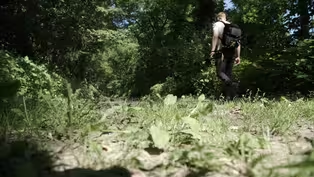
Video has Closed Captions
Clip: S1 Ep102 | 6m 8s | In 2021, Kevin Mason, a history professor, took his research in a new direction. (6m 8s)
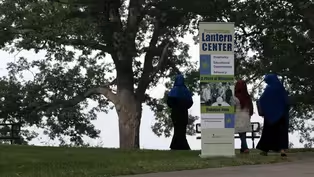
Video has Closed Captions
Clip: S1 Ep102 | 6m 7s | The Sisters of the Presentation opened the Lantern Center in 2002. (6m 7s)
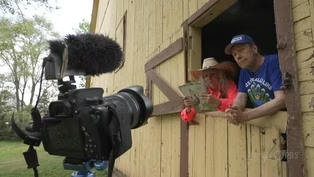
Video has Closed Captions
Clip: S1 Ep102 | 9m 24s | Dennis Fett and Debra Buck live outside of the western Iowa town of Minden. (9m 24s)
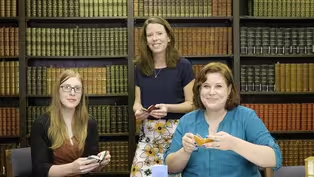
Video has Closed Captions
Clip: S1 Ep102 | 2m 3s | Tiny treasures are hidden in the Special Collections of the University of Iowa Libraries. (2m 3s)
Providing Support for PBS.org
Learn Moreabout PBS online sponsorship













Support for PBS provided by:
Iowa Life is a local public television program presented by Iowa PBS