WEDU Arts Plus
Episode 1020
Season 10 Episode 20 | 26m 45sVideo has Closed Captions
A Lakeland folk artist, a woodturner, an inspirational musical and special effects magic.
Art teacher and folk artist Heidi Wineland celebrates traditional crafts through the work she creates in her Lakeland home. Steve Kolpacke creates sculptures and functional pieces out of fallen trees by woodturning. Go behind the scenes of the musical, As One, which tells the story of the railroad that linked the east and west. Special effects artist Rudy Campos transforms people into otherworldly
Problems playing video? | Closed Captioning Feedback
Problems playing video? | Closed Captioning Feedback
WEDU Arts Plus is a local public television program presented by WEDU
Major funding for WEDU Arts Plus is provided through the generosity of Charles Rosenblum, The State of Florida and Division of Arts and Culture and the National Endowment for the Arts, and the Hillsborough County Board of County Commissioners.
WEDU Arts Plus
Episode 1020
Season 10 Episode 20 | 26m 45sVideo has Closed Captions
Art teacher and folk artist Heidi Wineland celebrates traditional crafts through the work she creates in her Lakeland home. Steve Kolpacke creates sculptures and functional pieces out of fallen trees by woodturning. Go behind the scenes of the musical, As One, which tells the story of the railroad that linked the east and west. Special effects artist Rudy Campos transforms people into otherworldly
Problems playing video? | Closed Captioning Feedback
How to Watch WEDU Arts Plus
WEDU Arts Plus is available to stream on pbs.org and the free PBS App, available on iPhone, Apple TV, Android TV, Android smartphones, Amazon Fire TV, Amazon Fire Tablet, Roku, Samsung Smart TV, and Vizio.
Providing Support for PBS.org
Learn Moreabout PBS online sponsorship- [Announcer] This is a production of WEDU PBS, Tampa, St. Petersburg, Sarasota.
- [Announcer] Major funding for "WEDU Arts Plus" is provided through The Greater Cincinnati Foundation by an arts loving donor who encourages others to support your PBS station, WEDU, and by the Pinellas Community Foundation, giving humanity a hand since 1969.
- [Dalia] In this edition of "WEDU Arts Plus", a Lakeland folk artists celebrates traditional crafts.
- They're strange, they're small.
I make them because they make me happy.
And I really pride myself on using scraps, leftover materials.
- [Dalia] A wood turner find his passion.
- I have always wanted to make stuff.
So I started building furniture probably about 25 years ago, and occasionally I had a need to turn something.
- [Dalia] An inspirational musical about the transcontinental railroad.
- I'm hoping, number one, the children will realize the great achievement that was made by our nation 150 years ago.
- [Dalia] And using special effects to conjure other worldly creatures.
- I started in high school doing just Halloween makeup, but actually doing makeup-makeup since about 2005.
- It's all coming up next on "WEDU Arts Plus".
(gentle music) Hello, I'm Dalia Colon, and this is "WEDU Arts Plus".
Being an artist is about more than having paintings in a museum.
Throughout history, the majority of the world's creatives have worked at home as folk artists.
In this first segment, we'll visit modern day art teacher and folk artist Heidi Wineland in her Lakeland home where she's keeping traditions alive.
(light upbeat music) - [Heidi] My father was a painter and an advertising executive, my mother was a professional seamstress and very much a folk artist and a needle worker herself, and so I grew up just with everything all around all the time that it was just free to use.
And I also had a really good arts program in the school system where I was.
And so now that I'm an art teacher in the public schools, I'm really geared towards making sure my students have as much experience with as many materials as possible.
I'm Heidi Wineland and I am a folk artist.
I make rag baskets.
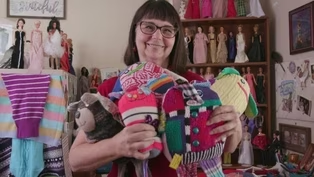
I make something called knitigans, which are little creatures made from recycled sweaters and they were made from knit fabric, so they were knit and now they are knit again.
I make a lot of jewelry.
I do some painting.
I do a lot of embroidery, I'm very much into needle work.
And I'm always experimenting, trying new things.
Years ago, I was doing craft fairs and I've always had a lot of odds and ends and different things, but really struggling to find, you know, the thing.
And there were a lot of people at that time who were knitting and felting.
And that seemed really interesting, but I didn't want to take the time to knit.
So I just (laughs) went to the Goodwill and just bought the sweaters and felted those.
And I was making bags and hats, but then one day, I had a little scrap and I didn't wanna waste it, and I just made it into a little oval and put eyes on it.
And suddenly there was my new friend.
And that took off as soon as I started selling those, I just couldn't keep them in stock.
Even though they all have the same basic shape and they all have these very simple circle eyes, they all have their own personalities, and people are really strangely drawn to them.
- I love seeing kids, adults, families, everyone sees her pieces, they turn a corner and a smile just hits their face.
(upbeat music) - [Heidi] For 30 years I've been working on a project, I call the Academy Award Action Figures, which are miniature replicas of Oscar fashion.
I've always been interested in film history, but I'm also very interested in fashion and the cult of celebrity.
And then one night, I couldn't sleep and I had this idea that I could make these dresses in miniature.
Now, I'm not a doll person, didn't play with the Barbies, didn't have any dolls, the dolls are really just hangers for the clothes.
So I only do the Academy Awards because the Academy Awards is the highest pinnacle of celebrity.
What you wear to the Academy Awards, that photograph is the photograph that's gonna be published over and over again.
It's the dress that people recognize the celebrity.
And so for me, it's both a critical commentary on the cult of celebrity on how we make idols of movie stars and wanna emulate what they wear.
And at the same time, I actually am making idols (laughs) to celebrities, so this I don't sell.
This is just for me.
(acoustic music) So the knitigans and the Oscar dolls are really the two things I spend the most time on, and they seem very different, but they're both examples of, they're strange, they're small, I make them because they make me happy.
And I really pride myself on using scraps, leftover materials.
For instance, for the dolls, other than that first one that I tried, I never buy new dolls.
So if you look closely, a lot of them have chewed on hands, or some of them have stains on them.
It's just a matter of looking at something and seeing new life in it.
I've had the opportunity to have, you know an actual away from home art studio before, and it's always seemed so appealing, but then I think, I would never go there.
I really like to work on my lap, I like to work in small, comfortable spaces, I like to watch television while I work, and I think that's a reflection of how folk art has always been made.
It's always been made while you're rocking the baby, or while dinner is cooking.
- I think folk art is more relevant today than it's ever been.
Because the world is so complex, folk art brings us back to something simple.
It's very simple, it's very nostalgic, it's something that we can process pretty easily and add beauty to our life.
- As an artist and as a teacher, I am really invested in the idea that art is not just painting and drawing.
And I've been teaching, primarily, adults for years.
And I encounter people all the time who say, "Oh, you made that?
I wish I could be an artist."
And I say, "Well, of course you can."
It doesn't have to be oil painting on canvas.
It could be a doll, a basket, a quilt, and to come to realize that they're really doing this already, even if it's cooking or decorating, that there's something in us that wants to make our surroundings nicer, more comfortable, more visually appealing.
And I want people, especially my students, to realize that's within their power.
- [Dalia] See more at heidiwineland.com.
Michigan artist, Steve Kolpacke, recently discovered his passion, wood turning.
We catch up with him in his studio in Metro Detroit.
(gentle music) - [Steve] It matches nature in life, that things aren't perfect, that there's always something different there, and it's just the little hidden surprises, I think you find on the inside.
(gentle music) I like the outdoors.
Working with trees, with wood, is just pleasure for me.
Eight or nine years ago, I started it.
Pretty much all was self-taught.
I have always wanted to make stuff, so I started building furniture probably about 25 years ago.
And occasionally, I had a need to turn something, so I've got a machine lathe in the garage that I use to make stuff.
And then once I started using that for furniture pieces and other functional things, it started turning into art.
To me, it gives a second life to the tree.
It served its primary function, and then it could be either used for construction, for furniture, for fire, but to me, turning it into an object of art is special.
The process is almost all manual, so there's a motor driving the object, but everything, everything is by hand.
You move the tool bit by hand, you do all the sanding by hand, and you do the finishing by hand.
A lot of people are amazed at the object you're starting with.
I start with something that looks like it should be thrown into a fire pit or in a dump, and start taking away from it.
The tool that I use is a lathe.
So lathe is a machine that you attach an object to.
You spin it around.
So you get a general circular form to it, but as you start cutting away at the piece, you start to see more of what's inside.
Today you're gonna see various stages.
You'll see it all the way from the raw material to getting chunks of wood into a shape that you can actually start to cut them.
We'll see some rough turning of the outside to get it to its rough shape.
We'll see some finished cutting on that.
With every piece, it gets attached to more than one, so you'll attach it one direction, you have to turn around to finish the other side.
So we'll see an example of finishing the other side, we'll see an example of some hollowing out, and throughout this we'll see various parts in different stages.
It won't be the same part, 'cause it can take up to weeks to create a part.
Or if you're starting with wet wood, it takes months 'cause you need to dry it out in between some of those.
I look at a piece of wood and I have an idea of what I wanna do, and nine times out of ten, it comes out completely different.
As you start to cut away, you start to see, and instead of you telling the wood what you want it to do, the wood more tells you the shape that it wants to be.
I see what a lot of people look at it that are defects or voids, and to me, it brings out the character of it.
So you start to see the grain inside, you start to see different objects in there, you'll find out that a branch came out of one side so there's additional feature that you start to see.
But you can see, this one's got a lot of character.
There's the pith here, which is the center of the tree, that's got a hole going all the way through it.
We'll try to keep that as much as we can.
And then there's this other one here that appears that maybe there was a branch in here, and we're also trying keep that.
It's addictive.
There's a rhythm of actually doing the cutting in.
I can find that I can stand at the lathe for sometimes six, eight hours a day doing it.
And it's exciting because as you keep cutting away at it, you see something new.
So it's kind of an adventure.
The vast majority of it is art.
So I do vases, I do vessels.
So a vessel is something that has a very small opening at the top of it.
It's hollowed out on the inside.
And of course, a favorite is Christmas ornaments.
And I do functional stuff.
On the functional side, salad bowls, and rolling pins, stuff like that.
I would say 95% of what I use is not only local, but probably within about 50 miles.
I work with just about anything I get my hands on.
I've used walnut, oak, box elder, and ash.
So ash, with the ash borer, again, there's a lot of wood available there.
In a short period of time, probably very little, will be available 'cause there's no more ash trees.
But each species has different texture, different ability to cut.
So some are very easy to cut the grain and the fibers in are easy to cut through but they've may not leave a good finish on the outside and others that are very hard, tougher to cut, but they polish out very well.
I cannot reproduce any piece.
They're all different.
They all start from a different piece of wood.
I can make maybe shapes that are the same, but I can't get the textures the same.
I can't get the same voids and other things like that.
So to me, art is important 'cause it's unique.
The message for people is just to enjoy it.
To enjoy that it's another reuse for the tree, that also it's tactile.
It's something that you can touch and feel.
A common theme I find is people look at it and it fills a void somewhere, either in their life or in their home.
So a lot of people have looked at it and said, "I've got a perfect spot for them."
I learned something new every day.
It's actually a big stress relief.
So as you go through life, there's certain challenges here and there, and to be able to have something that you can go home to and thoroughly enjoy it is great.
(gentle music) - [Dalia] You can find more at kolpackewoodworking.com.
As part of Utah's celebration of the 150th anniversary of the transcontinental railroad, the musical "As One" tells the story of those who constructed this extraordinary railroad that linked the East and the West.
(woman indistinctly speaking) - [Craig] I think the story of the transcontinental railroad is such a compelling story of the people who made it happen.
I'm not talking about the high rollers, not the money people, the Leland Stanford's and the Dodge's, and even President Abraham Lincoln, who put it all in motion with an act that he signed, but the unsung heroes who are largely outcasts of our society.
The Chinese laborers, the Irish immigrants, the freed African slaves, and the Mormon pioneers, they were all outcasts.
And those are the people who did the backbreaking work and made it all happen, and they became as one.
The whole world should hear this story.
(singing) ♪ As one ♪ (clapping) - When this goes off, the girls have to be so fast.
I got a call from Craig Jessop, and he got my name from Mark Dateline as somebody who works with children, I could put this piece together.
And Craig Jessop, being the conductor of the Mormon Tabernacle Choir, to me, he's in my world, in the music world, he's a rockstar.
So when I got a call from him, I was like, "It's Craig Jessop!
", you know Anyway, he called me and he asked me if I would direct this piece.
And then they decided for it to go in a slightly different direction.
Then he said, "We need you to write it."
So that's how I first came on as a director, and then I ended up writing it.
- I felt this should be geared towards children and families.
The reason why is I'm a father of four and a grandfather of 10, and I know my grandchildren don't know anything about this at all.
I wanted to tell the next generation about this story.
And when I presented that to the steering committee, they liked the idea a lot, and so we ran with it.
(actors singing in unison) - [Anjanette] When we started doing the research on this remarkable story, ideas and themes, and the things that we wanted to communicate through the music started coming through.
We started doing some research on composers and film work of stuff that we thought was inspirational.
We listened a little bit to a musical called "Bright Star" that was written by Steve Martin.
We listened to the soundtrack to a movie called "Fievel Goes West", that was part two of "American Tale".
We researched scores like this.
We didn't want the music to feel too overly like boom chucky, and so it would feel cheesy.
We wanted it to really recreate emotion for people when they were listening to this music.
(men singing) - You're just a man I've been waiting to talk to.
This is Grundille Dot.
He's a great engineer as your bear, Dodge, what's the best route for a Pacific railroad to the west?
- This is his vision from the very beginning that it would be about kids and that it would appeal to children, especially like fourth, fifth, sixth, seventh, eighth, that band right in there.
And, and I think the people that he chose, Steven and Anjanette were perfect to write this cause it's really catchy.
And I think kids are gonna listen to it and want to sing with it right away.
So that was kind of our hope and our idea.
This is the educational piece of the entire celebration.
(Men singing in unison) Children and especially children actors, I don't treat them any different than grownups.
I might laugh with them and kid with them a little bit more, but if you, they're professionals, they know what they're doing.
These kids that are out there, I don't have to teach them how to behave.
Like bend a little bit or say, Hey, the next time you do a show like this, but I also am a great believer in them and their ability.
There's a lot of people who think just because they're little they can't hold an audience.
It really has nothing to do with how old you are.
It's a different ability.
A lot of people are just, these kids are born with it, just like a grownup.
I have a great faith in the ability of a child to teach and move people in theater, just the same as a grownup.
- It's good and flat all the way to the Rocky mountains, the other railroad road will start east out of Sacramento, California.
Then they will meet here, somewhere in the middle.
- I really felt this is important because this is a community that didn't really get the coverage that they deserve.
And so it's kind of an emotional experience for me to be able to, to represent them.
- It's been really, really neat to learn about, the Irish immigrants that came and left.
Most of them left their families to come and work on the railroad and to help bring the two railroads together.
It's been fun.
- Hannah is the only woman that saw the completion of the railroad.
So she was there from when it started on the west coast to when it ended at Promontory summit.
And she was kind of this motherly character for all the men.
They would come to her house and she would fix them up.
She cooked them dinner.
She kind of took care of them along the way.
- And so I think it's kind of a cool thing to, recognize the freed slaves.
Because they are a part of our history and they need to be known.
Instead of somebody who's kept under the rug as they were at that time, basically.
And so I think it's great.
And I was all on board because I get to be a part of showing that type of story.
- I'm hoping number one, the children will realize the great achievement that was made by our nation 150 years ago.
That once again, they will see that people from diverse cultures can transcend any differences and come together and achieve something greater than they could ever do alone.
And how people come together.
That's where true greatness is achieved.
- The Mormons, the Irish, the freed slaves, the Chinese, they weren't best friends.
And yet in spite of that, they worked together every day with respect and got the work done because they saw that they were part of something that was bigger than themselves.
We can see that working together, in spite of our differences, we can get so many amazing things done.
- Learn more about this musical at spike.150.org.
Halloween has always been a time for getting into character, but things have come a long way from the days of grease paint and rubber masks.
As we see in this next segment with special effects artist, Rudy Campos.
- We're on the west side of Houston, practically to Katy, where their lives a man who can make your greatest fantasies come to life, or at this time of the year, maybe take your worst nightmares and give them flight.
Here, take a look.
Disguising yourself at Halloween is a longstanding tradition Initially believed that since spirits walk the earth on all Hallows Eve, if we hid our identities, the spirits wouldn't recognize us and thus would leave us be.
Over the years, we've dressed in costumes, put on masks, even hidden our faces using clown makeup and grease paint.
But artist, Rudy Campos, has perfected his own airbrush makeup techniques that truly mask our identities.
- So how long have you been doing this?
- I've been doing this since probably like, I started in high school.
I started in high school doing just Halloween makeups and then I'd watch a lot of monster movies.
So I'd do it off Halloween season, but actually doing makeup makeup since about 2005.
- Early on Rudy used himself as a model, even going so far as to glue prosthetic pieces to his own face.
But when it came time to remove the pieces, he had no idea what to use.
- But I learned a valuable lesson that day.
If you're gonna be gluing something to your face, always know what the remover is gonna be.
- Before you start, exactly.
- As Rudy got older, it looked like college wasn't for him.
But if college wasn't in the cards, his dad told him he needed to get a trade.
- My dad said, I know that you like makeup, and I know that you like special effects and you're into that.
So let's find you a school.
And he found one.
- Rudy completed makeup school and as a graduation gift from his parents, he received his first airbrush.
And that became his tool of choice.
But when it comes to Halloween makeup, most folks don't have an airbrush and ended up having to use sponges and brushes.
But Rudy has a couple of tips for the home creator too.
- Whether it be a sponge or brush, just use two.
One to apply, and then one to blend out.
- And the other tip?
- Stray away from the the Halloween makeup that you'd get it at Halloween stores or Walmart and stuff.
If you want it to look good you want to go to a theatrical store.
- But since we all can't be masters of this art form, Rudy is there to help us become our fantasy selves.
But what is it that keeps Rudy painting on?
- The biggest thing that I get out of doing this is watching people look at themselves in the mirror and seeing the character that they become.
- And thanks to Rudy and his handy airbrush, these transformations just keep coming.
- How do you like it?
- Whoa, I'm a fawn.
- with a little bit of imagination and a whole lot of airbrushing, anything is possible.
- For his latest work visit instagram.com/rcccreations.
And that wraps it up for this edition of W E D U arts plus.
For more arts and culture visit W E D u.org/artsplus.
Until next time I'm Dalia Colon, thanks for watching.
(upbeat music) - Major funding for WEDU arts plus is provided through the Greater Cincinnati Foundation by an arts loving donor, who encourages others to support your PBS station WEDU.
And by the Pinellas Community Foundation, giving humanity a hand since 1969.
Video has Closed Captions
Clip: S10 Ep20 | 6m 29s | Folk artist Heidi Wineland creates whimsy creatures and miniature ballgowns. (6m 29s)
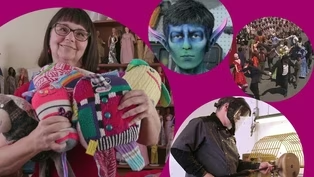
Preview: S10 Ep20 | 29s | A Lakeland folk artist, a woodturner, an inspirational musical and special effects magic. (29s)
Providing Support for PBS.org
Learn Moreabout PBS online sponsorship

- Arts and Music
The Best of the Joy of Painting with Bob Ross
A pop icon, Bob Ross offers soothing words of wisdom as he paints captivating landscapes.












Support for PBS provided by:
WEDU Arts Plus is a local public television program presented by WEDU
Major funding for WEDU Arts Plus is provided through the generosity of Charles Rosenblum, The State of Florida and Division of Arts and Culture and the National Endowment for the Arts, and the Hillsborough County Board of County Commissioners.