WEDU Arts Plus
Episode 1021
Season 10 Episode 21 | 26m 49sVideo has Closed Captions
May-Stringer House, Body Paint Factory, Indian Dance, Historical Figures
Tour the May-Stringer House in Brooksville, where this Victorian era home has undergone a painstaking renovation. The Body Paint Factory in Reno, Nevada, creates art from human canvases. A traditional Indian dance school celebrates diversity through music and dance. A program gives young scholars the opportunity to research important historical figures and perform as them for a live audience.
Problems playing video? | Closed Captioning Feedback
Problems playing video? | Closed Captioning Feedback
WEDU Arts Plus is a local public television program presented by WEDU
Major funding for WEDU Arts Plus is provided through the generosity of Charles Rosenblum, The State of Florida and Division of Arts and Culture and the National Endowment for the Arts, and the Hillsborough County Board of County Commissioners.
WEDU Arts Plus
Episode 1021
Season 10 Episode 21 | 26m 49sVideo has Closed Captions
Tour the May-Stringer House in Brooksville, where this Victorian era home has undergone a painstaking renovation. The Body Paint Factory in Reno, Nevada, creates art from human canvases. A traditional Indian dance school celebrates diversity through music and dance. A program gives young scholars the opportunity to research important historical figures and perform as them for a live audience.
Problems playing video? | Closed Captioning Feedback
How to Watch WEDU Arts Plus
WEDU Arts Plus is available to stream on pbs.org and the free PBS App, available on iPhone, Apple TV, Android TV, Android smartphones, Amazon Fire TV, Amazon Fire Tablet, Roku, Samsung Smart TV, and Vizio.
Providing Support for PBS.org
Learn Moreabout PBS online sponsorship- [Narrator] This is a production of WEDU PBS.
Tampa, St. Petersburg, Sarasota.
Major funding for WEDU Arts Plus is provided through the Greater Cincinnati Foundation by an arts loving donor who encourages others to support your PBS Station WEDU.
And by the Pinellas Community Foundation, giving humanity a hand since 1969.
- [Gabe] In this edition of WEDU Arts Plus experience the art of historical restoration.
- [Mary] I tell people that this building is our largest artifact.
- [Gabe] The challenges of body painting.
- [Lynzie] But when you're painting on human skin, we have temperature.
We have less texture than an actual canvas painting that has pores.
We can sweat.
Some of us are oily than others.
- [Gabe] The traditions of Indian dancing music.
- [Namita] Heritage camp is a place where adoptees can come with their families and learn about the rich heritage they come from, where they're adopted from.
- [Gabe] And traveling through time in character.
- [Christina] The kids have to actually conquer their fears, get on stage and present their character to the public.
And it's a really transformative experience for them.
- It's all coming up next on WEDU Arts Plus.
(upbeat jazz music) Hello, I'm Gabe Ortiz and this is WEDU Arts Plus.
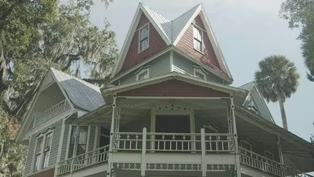
The May-Stringer House in downtown Brooksville is a local gem.
This four story, 14 room, Painted Lady, Victorian era home is full of Southern history.
It also happens to be one of the most haunted houses in Florida.
Join us as we appreciate this piece of historic architecture and learn about it's painstaking renovation.
(gentle piano music) - The May-Stringer House is the oldest restored home in the county.
It was condemned and that was when the museum association was formed, our nonprofit all volunteer group.
And money was raised to purchase the property and begin the restoration.
- Preserving the May-Stringer House has been an act of love.
We have to take care of this place in a way that is a little more detailed than taking care of your home.
(gentle piano music) I tell people that this building is our largest artifact.
- The May-Stringer House is basically a Victorian but it's specifically a Queen Anne Victorian.
It's also in its current state what we call a Painted Lady.
It has more than one color on the building.
The gingerbread was very indicative of the period.
- We try, we try, we try to be historically accurate when we do things.
- Restoration versus renovation.
And because we're on the National Register of Historic Places, that governs how the work is done in the house.
So we still have lath and plaster on the walls and we still have the original floors.
Everything has to be restored to the way it was back in, I think they chose 1890 as the target date.
Some of the artifacts, we've tried to be true to the time period.
So when you walk into the May-Stringer House, you step back to 1890.
(cheerful music) - This building was no doubt built by John May.
He was here in 1856, and the story goes that this house was started out as a four room house and was added onto.
- Around 1880 was when Dr. Sheldon Stringer bought the property and he began to add on to the house.
He added a total of 10 rooms and made it a four story, 14 room house.
But it took several years.
He added it on in pieces.
So the house wasn't really complete until after 1890, which is why that was the target date for the restoration.
We were approached back in about 2004 by a group of paranormal investigators.
They came from Fort Lauderdale, and they had heard that the May-Stringer house was haunted, and they wanted to come in and do an investigation at night.
And we did the first investigation and they got so much evidence that they came back five more times.
They did six investigations.
And they are the ones that told us this is a great fundraiser.
Why aren't you doing ghost tours?
This is a very haunted house.
Basically, we bring groups in and we lock the doors, and they belong to the house for the next two to six hours, depending on which session we're doing.
We have been visited by over 80 different ghost hunting teams in the last 17 years.
And most of them have certified as haunted because they got evidence.
- The May-Stringer House has a special event every October.
It is a haunted house where we turn the actual haunted house into a haunted attraction for our guests.
We have about 30 volunteers that run the haunted house for us.
They live in the community.
They've been sucked into the house like the rest of us have.
And they come back every year.
And our volunteers doing such a fantastic job.
They are acting, they're doing their own makeup, They're building sets.
It is an all-out experience.
- Brooksville is a very old town and there are many historic buildings here, most of which have been renovated into private homes.
But this house, the May-Stringer House, is very special because it's been set back in time to 1890.
There's a big difference.
And the important thing is that we're preserving this for future generations.
- I would say most people that come here, they're very amazed as to how much stuff we have here, how much history we have here.
Because in the house, all of the artifacts that you see in here have been donated.
- [Bonnie] We have over 11,000 artifacts housed in the building.
We have some original artifacts from the Stringer family.
Rooms like the Communications Room, the retired telephone workers who brought the working parts of the original switchboard from 1926.
And I'll tell you, children come in here, they have no idea what that is.
None whatsoever.
- Having people come here and be able to see not just history and things that we used to have or how it used to be, but even just learning a little bit about the history of Brooksville here and how it all started.
- When you're looking at the details of an older house, you will find an intricacy that we don't find today.
And if you can appreciate the artistry, bring children to museums and historic sites, I think it's one of the best things you can do as a parent.
- Learn more at hernandohistoricalmuseumassoc.com/maystringerhouse.
If you think painting on canvas is difficult, try painting on a human body.
This medium offers its own challenges, but the results can be spectacular.
Hear from the Body Paint Factory in Reno, Nevada as they transform human bodies into walking works of art.
(gentle music) - [Lynzie] Body painting is basically taking a human canvas and painting on it.
Whatever interpretation you take from that is what body painting is, which is really cool about it, is that anybody can make it anything they want.
- [Striper] Body painting is unique because there's so much different stuff that you can do with body painting.
I mean, really, you just think about it as the body is the canvas, and what you create with that is limitless.
(upbeat music) - So body painting is usually on nude females.
We do nipple pasties and a panty pasty so that we're legally covered.
And typically it's full body, every inch or it can be just portions, bits and pieces, or just accents.
- So the differences between painting on people and painting on canvas, for me, a big one is the human interaction.
You know, you could sit in your studio and paint on a blank canvas for hours on end, and the canvas doesn't show back any emotion.
It doesn't talk to you, it doesn't hang out with you.
- [Lyndzie] Doing canvas is stationary.
It's rough, it's got texture to the canvas.
So when you're painting on it, there's no real give to it.
But when you're painting on human skin, we have temperature.
We have less texture than an actual canvas painting that has pores.
We can sweat.
Some of us are oily than others.
So sometimes it can hinder the paint and sometimes it can be a good thing, depending on what we end up using for it.
The kind of paint that we use doesn't ever transfer to something else.
So they can get body painted at one location and sit in a car, and then go and transfer to another location and be totally fine for the most part.
We do ask them to bring a towel or something that's not fuzzy, because sometimes the fuzz will stick to the paint.
So now they're walking around with a fuzzy butt or something like that.
So if we paint on their hands or we paint around their face and they take a sip of a drink or something, it'll pretty much stay on for the most part.
- My style is more fantasy art, abstract.
I like the fact that I can do whatever I want.
It's art.
I don't have to do my art any way that somebody thinks is their style of art.
And then the great thing too is if you make a mistake, you can change it.
- [Striper] I would get bored just painting on canvases all the time.
I went and bought some canvases and I sat in my studio, and I tried to think of what I was gonna paint that was gonna to be unique to me and my style and my experiences.
I stared at that blank canvas for a really long time before I decided you know what, my style is body paint.
One thing I love about doing my pinstriping style on the body is that it's so organic and free-flowing.
I'll start with a model and have no clue what the painting is gonna look like.
I just pick a few colors and I'll start pinstriping.
And then when I think the image is done, I'll stop.
And it's fun for me because I don't have to be technical about it.
I don't have to sketch it out.
I don't have to think too hard about it.
I'll just put some music on and start pinstriping and kind of see what I come up with.
- My style is definitely, has a superhero kind of edge to it, a little bit of blood, guts and gore kind of thing.
Typically, I'll go ahead and pick up my model first.
Sometimes it depends on who's available, who's gonna be dependable for that day.
And then I go with the design on top of that.
I usually have a theme of what needs to happen.
And then I cater that to my model, whether she's in A cup or she has double Ds, or maybe she's really sensitive about her stomach area.
Whatever the case may be, I cater to that.
And so I will do slimming lines or I will do different shadows in different places to really accentuate what they're happy about about their body.
- Once I have a pretty good idea of what we're gonna do, that's when I schedule with a model.
You only have the amount of time a model is willing to stand there and get painted, or until your deadline.
- I've worked on anything from like 20 minutes up to 10 hours, depending on what it was.
- It takes all day to do the painting and then we do the photo shoot and that's it.
And it washes off.
- [Lyndzie] When we do a body paint, it's temporary because this person is human, and they wanna go wash off at some point.
- Part of it can be a little bit of a bummer that it has to be washed off right away, but it's also a cool, unique aspect of the medium.
- [Britt] It just means that you can do it all over again but something different, especially if you have a good canvas.
- [Lynzie] All three of us put together, we are the Body Paint Factory.
- [Striper] The Body Paint Factory is a group of artists with the specific aim of being able to handle large scale body paint jobs.
- Because our community is such a small community and there's not a lot of body paint gigs, so instead of competing against one another, we decided to work together to pool our resources.
Because it's really hard to be an artist and a business.
- [Striper] We could probably we do our artist community a lot of good by coming together and forming one group.
- And then we are able to do a lot more than we could on our own, just doing our own style, you know Because some people want realism, some people want abstract, some people want gore.
I actually like painting a person much better than painting a canvas because for me, sometimes when I'm painting a canvas or drawing on a paper or something like that, I get distracted or bored halfway through.
But on a person, they're standing there.
Even if I get bored, I have to finish it.
Otherwise the person's looking at me like, hello, can we finish this right here?
- I love being able to paint on something that's alive.
To me that's just the ultimate artistic kind of canvas.
Because not only are you interpreting what's coming out of your brain onto something, you're interpreting what that person feels.
And you can kind of go with their emotion.
Maybe somebody is a little bit upset that day, and I can kind of feel that kind of emotion.
Maybe blue will come to mind or something like that.
(gentle music) Everybody's a little bit more excited and capable of understanding the body paint.
In other words, they're not just gonna stare at her as if it's something wrong.
They're going to look at the art.
And that's what we've been trying to get people to see more so than just a naked body, for instance.
- We're like a family.
We argue and bicker sometimes just like families do.
- We have very essential pieces and parts that make us a whole and I absolutely love my Body Paint Factory.
- See more at bodypaintfactory.com.
A Denver-based, traditional Indian dance school is on a mission to celebrate diversity through the universal language of dance and music.
Let's check out the people, costumes, and moves that combine to create the Mudra Dance Experience.
(soft instrumental Indian music) - [Child] Mudra dance is my life.
- [Woman] It's a connection to my culture and roots.
- [Woman 2] Support and safety.
- [Man] A happy place to be.
- [Child] Playing with friends.
- [Boy] Mudra dance to me is a way to express myself with amazing people.
- [Woman 3] To me is love and connection.
- [Woman 4] Mudra dance to me is family.
- [Woman 5] Family.
- [Man] Family.
- [Girl] Mudra dance to me is family.
(gentle keyboard music) (dancers chuckling) - And can we get Sonali up and going?
The mission of Mudra Dance Studio is to celebrate diversity through the universal language of dance and music.
And to expose the world to the beautiful cultural fabric that India brings to our culture here.
(audience cheering) - Are we ready to immerse ourselves in everything that is so beautiful and wonderful about this camp?
(audience cheering) Heritage Camp is a place where adoptees can come with their families and learn about the rich heritage they come from, where they're adopted from.
20 years ago, I was brought in to do an adult dance class and they invited me back to take over dancing for the whole camp from that time on.
(drumming) So we meet once a year for three days.
And it's so special because a lot of these kids and families come from all over the country.
So we don't get to see them for the whole year.
And it's just so special to see them still feeling that connection, wanting to be there.
That is that same feeling that we bring into our cabin when all our volunteers, they come together and we sit in the cabin and work out different ingredients to put together workshops.
We're creating dupattas, which are scarves.
So somebody can cut in the middle and I'll start off.
The next day, when you have those children walk in and they see the beautiful activities waiting for them, they're just so overjoyed.
And it's the most priceless experience you can have.
- It's 6:15 to 7.
- We just have a lot of fun.
Like it's just nice cause it's like we're not in our daily routine of work and everything.
We just get to all come together and we all love camp.
So although we're like, "Okay, we gotta learn this dance," and then we stay up late and all that.
We just have so much fun together cause we know we're gonna enjoy every single minute we're here.
And the kids are the best.
- I'm Joelle, and this is Shweta, and I've been involved with Mudra Dance for 14 years, and she has now been involved with Mudra Dance for about two and a half years.
She went to our first Mudra event one week to the day after landing in America.
For a long time I've always known I wanted to adopt, and being a part of Mudra and coming to Heritage Camp for 13 years now, that had a huge influence on me wanting to adopt from India.
In August of '14, we were matched.
And then in November of 2015, I was able to take full time custody and we came home December 4th, 2015.
- We are so lucky that Joelle brought this beautiful young lady, Shweta, back.
Shweta had special needs, but has the most amazing heart and desire to succeed and do whatever is necessary.
And she actually inspires us.
- Outside.
- [Namita] In the past, the five years before we joined, the kids all learned dancing as groups.
But I was brought in to do an adult dance class and the parents came in and joined.
Again, every minute I think you.
So that is what today's class was about and that adult class has kept increasing in number.
And today you saw 40 people dancing so it was quite special.
(upbeat Indian music) To see the children, watch them perform, was just so amazing.
Some of them were embarrassed.
Some of them were overjoyed and some had tears in their eyes.
And at the same time, the parents felt closer to their kids because they were taking a little piece of culture with them.
- I can't imagine my world without Mudra, I mean, to be honest.
- If there was no Mudra than I would take videos of me dancing and stuff.
And then once I grow up and I'm older and I'm a grown up, then I would make a Mudra.
- You would make your own mudra?
- Uh-huh.
That's what I would do if there was no Mudra.
What is a world without dancing and singing?
I would grow up and make it happen!
(Joelle laughs) - I cry all the time and that is one of the things, the emotional aspect, that connection that we have.
I just hope that the diversity that we have within our studio is able to extend beyond not just the camp, but the world.
So that we can all be happy to see different colors, different races, different sizes, shapes, whatever it is and feel that connection because we're humans.
And that is what Mudra is about.
Mudra is about making this world just fantastically celebratory.
(uplifting music) - For more, visit mudradancestudio.us.
A nationally recognized program gives young scholars a special opportunity.
Students have the chance to research important figures from the past, and perform as them for a live audience.
(soft exciting music) (audience applauding) - Now that I'm president, let me tell you a little about how I got here.
In my childhood, nobody would have thought that I would become president.
- Young Chautauqua comes from the Chautauqua experience, where one takes a historical character and researches that figure, and performs in character, in costume, reenacting the life and experiences of that historical character.
(audience applauding) - Hello, I'm Johnny Cash.
♪ I hear the train a-comin ♪ ♪ It's rollin' 'round the bend ♪ - The wonderful thing about this program is that any kid can be a Young Chautauqua scholar.
They just have to have the will and the desire to do it.
And it's available to everyone.
- I was traveling in Africa in early 1912.
Madame will be in a the very grave accident.
I love acting and I love studying history.
And I heard about Chautauqua through a friend.
And once we learned more about it, I knew that it was something I wanted to try, and I have been doing it for three years now.
And it is a very, very fun experience.
- [Christina] They are performing at venues around the region, including the Washoe County Library System at various library locations.
And the scholars also perform at their schools and in their community groups and church groups to really hone their craft.
One of the things that our scholars enjoy the most is sort of finding the right costume, the period appropriate outfits, the eyeglasses.
Maybe a little bit of talcum powder in the hair if they're portraying an older character.
And they might work on a certain accent or a certain pose or comportment to really embody the character they're portraying.
- I've just returned from my very first space mission.
I am indeed the first American woman into space.
- This year I researched Edith Rosenbaum.
She survived the sinking of the RMS Titanic, and she was also a fashion designer.
And she had a very, very interesting life.
- [Christina] One of the great things about Chautauqua that happens for the kids is that they do all this research.
And then they also get to speak as a scholar at the end of their performance.
So they give this monologue and character, then they break character and the audience has an opportunity to both ask the character questions, and then ask the scholar questions about their own research.
And the program is really transformative for kids.
We have kids come into our program that are incredibly shy.
So an important part of the program is to learn how to speak publicly and to deliver a monologue performance.
And so the kids have to actually conquer their fears, get on stage and present their character to the public.
And it's a really transformative experience for them.
So it has this kind of twin purpose.
The research, cultivating a love of history, and a sense of empathy for people who have lived before them and who have done important things in our world.
- Just finding somebody interesting, who lived on this earth and being able to become them in a way is a very interesting experience.
- I learned that his life wasn't perfect at all.
And there were a lot of misfortunes and a lot of hardships that he went through that kind of made him who he was.
And that kind of reflects on me to make me think about what I want to do and what choices I'm gonna make.
- [Clara] Researching with kids who share your same interests is definitely a big thing that makes Young Chautauqua a fun experience.
- [Christina] It's a learning opportunity for everybody.
Not only the kids who go through the program, but also the audience members who get to see the performances that the children do and it's also fun.
- To find out more, visit nevadahumanities.org.
And that wraps it up for this edition of WEDU Arts Plus.
For more arts and culture, visit wedu.org/artsplus.
Until next time, I'm Gabe Ortiz.
Thanks for watching.
(intense drum music) - [Narrator] Major funding for WEDU Arts Plus is provided through the Greater Cincinnati Foundation by an arts loving donor who encourages others to support your PBS Station, WEDU.
And by the Pinellas Community Foundation, giving humanity a hand since 1969.
(instrumental theme)
Video has Closed Captions
Clip: S10 Ep21 | 7m 8s | Tour the May-Stringer House in downtown Brooksville. (7m 8s)
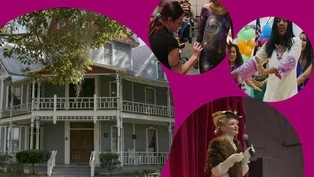
Preview: S10 Ep21 | 29s | May-Stringer House, Body Paint Factory, Indian Dance, Historical Figures (29s)
Providing Support for PBS.org
Learn Moreabout PBS online sponsorship

- Arts and Music
The Best of the Joy of Painting with Bob Ross
A pop icon, Bob Ross offers soothing words of wisdom as he paints captivating landscapes.












Support for PBS provided by:
WEDU Arts Plus is a local public television program presented by WEDU
Major funding for WEDU Arts Plus is provided through the generosity of Charles Rosenblum, The State of Florida and Division of Arts and Culture and the National Endowment for the Arts, and the Hillsborough County Board of County Commissioners.