WEDU Arts Plus
Episode 1023
Season 10 Episode 23 | 26m 45sVideo has Closed Captions
Tampa Breakfast Club morning radio, artist Katherine Reynolds, Row Houses and folklore.
The Tampa Bay Breakfast Club morning radio; Oklahoma artist Katherine Reynolds; Art installation Project Row Houses transforms neighborhoods in Houston, Texas; In Columbus, Ohio, a young girl celebrates her Mexican heritage through folklore dance.
Problems playing video? | Closed Captioning Feedback
Problems playing video? | Closed Captioning Feedback
WEDU Arts Plus is a local public television program presented by WEDU
Major funding for WEDU Arts Plus is provided through the generosity of Charles Rosenblum, The State of Florida and Division of Arts and Culture and the National Endowment for the Arts, and the Hillsborough County Board of County Commissioners.
WEDU Arts Plus
Episode 1023
Season 10 Episode 23 | 26m 45sVideo has Closed Captions
The Tampa Bay Breakfast Club morning radio; Oklahoma artist Katherine Reynolds; Art installation Project Row Houses transforms neighborhoods in Houston, Texas; In Columbus, Ohio, a young girl celebrates her Mexican heritage through folklore dance.
Problems playing video? | Closed Captioning Feedback
How to Watch WEDU Arts Plus
WEDU Arts Plus is available to stream on pbs.org and the free PBS App, available on iPhone, Apple TV, Android TV, Android smartphones, Amazon Fire TV, Amazon Fire Tablet, Roku, Samsung Smart TV, and Vizio.
Providing Support for PBS.org
Learn Moreabout PBS online sponsorship{\an2}- [Announcer] This is a production of WEDU PBS, {\an2}Tampa, St. Petersburg, Sarasota.
{\an2}Major funding for WEDU Arts Plus is provided {\an2}through the Greater Cincinnati Foundation {\an2}by an arts loving donor who encourages others {\an2}to support your PBS station WEDU {\an2}and by the Pinellas Community Foundation, {\an2}giving humanity a hand since 1969.
{\an2}- [Host] In this edition of WEDU Arts Plus, {\an2}local talents use radio to inform and entertain.
{\an2}- I look at it almost like a band and the instruments, {\an2}but it's just the instrument that we're using is our voices.
{\an2}- [Host] The bright lights of neon art.
{\an2}- Neon's harder than it looks, putting glass tubing {\an2}and fire, and it doesn't wanna behave, okay, so you have {\an2}to learn to control the glass at its melting point.
{\an2}- [Host] The transformation of a community through art.
{\an2}- [Woman 1] So, they were able to acquire {\an2}what was 22 shotguns style row houses.
{\an2}Work with the community, brings some life {\an2}back into these houses.
{\an2}- [Host] And sharing cultural heritage {\an2}through traditional folklore dances.
{\an2}(speaking Spanish) {\an2}- It's all coming up next on WEDU Arts Plus.
{\an2}(jazz music) {\an2}Hello, I'm Gabe Ortiz and this is WEDU Arts Plus.
{\an2}Based out of St. Pete, the Tampa Bay Breakfast Club {\an2}is a morning radio show about hip hop life {\an2}and urban culture.
{\an2}Meet the hosts who inform and empower their listeners.
{\an2}(gentle music) {\an2}- I'm Jabaar Edmond, I go by Mr. Edmond.
(chuckling) {\an2}My role, I'm a host and I'm co-founder.
{\an2}- My name is brother John Muhammad, {\an2}your brother John, yourbrotherjohn.com.
{\an2}And my role on the Tampa Bay Breakfast Club is host {\an2}or co-host.
{\an2}- I'll just go by Qiana.
{\an2}Sometime you may hear the guys call me Q, {\an2}I may say Q just depending on my personality that day, {\an2}and I'm the female of the crew.
{\an2}I think I keep balance.
{\an2}When you look at the Tampa Bay Breakfast Club.
{\an2}So that's my role.
{\an2}- And I'm Bruce Moor Junior, a lot {\an2}of people do know Bruce Moor Junior obviously being born {\an2}and raised here and going to school here, {\an2}but there's many more people that know Reno.
{\an2}St. Pete is small and so the good things and bad things {\an2}that come with a small city, you know, {\an2}everybody knowing each other, of course, {\an2}we'll be one of the pluses.
{\an2}- [Woman 2] My neighbors were not only just my neighbors, {\an2}they became my family.
{\an2}- [Reno] Trying to put that back now, {\an2}like really getting back to a place {\an2}where we know our neighbors and we look out for each other.
{\an2}It was a St. Pete that existed, you know, south of central.
{\an2}And then there was another St. Pete {\an2}that existed north of central and downtown.
{\an2}It was a struggled in, and I think it's still, {\an2}you know, somewhat a struggle {\an2}for black people in the city of St. Pete.
{\an2}- Even with every step of progress {\an2}we make is still a struggle to implement that progress.
{\an2}Did y'all hear about the weed college, {\an2}the first cannabis college.
{\an2}- In Orlando?
{\an2}- First total size- - For itself.
{\an2}- [Qiana] No, no, yeah, I've been looking at it.
{\an2}- This is, this is serious y'all.
{\an2}- [Qiana] Over a year ago.
{\an2}- If you got the charges, go and get the degrees king, {\an2}you got years of experience, man.
{\an2}It ain't like you come into a classroom with no data.
{\an2}- Elon Musk said that a drug dealer knows how {\an2}to manage and run a business better- {\an2}- I can't believe that.
{\an2}- I'm all about education, but what I'm saying is {\an2}that we carried this industry on our backs.
{\an2}- The way we started the Tampa Bay Breakfast Club, {\an2}Jabaar approached me about what could we do, {\an2}how can we do something together?
{\an2}And then an opportunity to promote Amendment Four.
{\an2}Amendment Four is the, you know, {\an2}voting rights restoration to returning citizens.
{\an2}We were able to negotiate a deal where we got {\an2}like 30 minutes on the radio at 99 Jams {\an2}to talk about, you know, Amendment Four {\an2}and other local policies and politics.
{\an2}Enjoyed it, so we started doing it on Sundays {\an2}as like a podcast with at the time Janet Michelle, {\an2}she was our co-host and she filled that role {\an2}until she moved and then we had Carla Bristol, {\an2}Carla B, she came in for a season {\an2}and then Reno was behind the scenes.
{\an2}He was always present cause we did organizing together, {\an2}so he'd come and hang out and then, {\an2}the things that he was saying off camera was like, {\an2}man, we might as well have you on the show.
{\an2}- The negative thought that you is thinking about right now, {\an2}or any particular subject, y'all, just flip it.
{\an2}- Turn your problems into opportunities.
{\an2}- Problems are opportunities, man {\an2}- You got a deal, man.
{\an2}- We on the jump board together right now.
(laughing) {\an2}- Just being around people and clearly always talking, {\an2}I just felt like they at least learn something.
{\an2}So as you see that you're not gonna shut up, {\an2}You can have substance to your conversation {\an2}and not just be labeled as somebody who just love to talk.
{\an2}- Really being informative, looking to give the information {\an2}that isn't readily available in our community.
{\an2}- [Guest] Multiple meteorologists can look at the same data {\an2}and come up with a different forecast.
{\an2}- And so now you take those models, take that data and say, {\an2}"Okay, based upon all of that."
{\an2}- [Guest] Absolutely.
{\an2}- You might be in between here and there.
{\an2}And that's my know what I'm saying speech.
{\an2}Most recently, after Carla B's, you know, {\an2}transitioned out and went to do other things as well, {\an2}Qiana, we invited Qiana.
{\an2}- I've been working with the guys for awhile {\an2}outside of this and they called me to interview.
{\an2}And when I came in to interview that Sunday, after the show, {\an2}they was like, "Hey, you need to be a part of the show."
{\an2}And I was like, "Okay."
{\an2}- I look at it almost like a band and the instruments, {\an2}but it's just the instrument that we're using is our voices.
{\an2}- My voice is already kind of squeaky.
{\an2}I know I can get, my voice can get squeaky-er.
{\an2}- You have to have your, your radio voice on.
{\an2}And have that vocal control.
{\an2}- I talk lower when I need to calm it down.
{\an2}And when I'm very passionate about it, I slow it down.
{\an2}And because I want you to understand what I'm saying.
{\an2}What's good for the geese is good for the gander.
{\an2}So if you keep it secrets, just know that she can, too.
{\an2}- [Radio co-host] Oh- oh.
{\an2}- [Caller] Okay, ask you, you know why, see Q, {\an2}that's why you being on the Tampa Bay Breakfast Club, {\an2}(all laughing) {\an2}so you're gonna even things out, you know what I'm saying, {\an2}I was just joking, no.
{\an2}(all laughing) {\an2}- We just understand power, you know?
{\an2}And in terms of people's attention, you know, {\an2}cause it costs, people's attention costs, {\an2}that's why it's called pay attention.
{\an2}- We wanna present local information right up there {\an2}with, you know, the trending topics.
{\an2}- One thing and that's a common denominator with all {\an2}of us is that we're all passionate about our people.
{\an2}- For me, what you take from me is that I'm real {\an2}and I'm passionate about the growth of our people.
{\an2}- The overall goal I would say is {\an2}to have a more informed community.
{\an2}Around electoral politics, around health, around equity.
{\an2}- It's about the mission of connecting the dots {\an2}and closing the gaps, inspiring people {\an2}to see what's possible, you know, {\an2}and trying to be an example, you know, {\an2}I don't know if that's a good thing or a bad thing sometime, {\an2}but you know, you do the best that you can {\an2}with what you have and you pray {\an2}that others will be inspired to join in.
{\an2}(gentle music) {\an2}- For more info, {\an2}visit cdatcenter.org/tampa-bay-breakfast -club.
{\an2}Katherine Reynolds is an Oklahoma artist {\an2}who began work with stained glass, but the lure {\an2}of neon glow beckoned and in 1984, she answered its call.
{\an2}Today, she's an established neon artist and sign producer.
{\an2}Some say she's neon nobility.
{\an2}(dog barking) {\an2}(birds chirping) {\an2}(gentle music) {\an2}- My name's Katherine Reynolds.
{\an2}I'm the founder of Reynolds and Son Neon Incorporated {\an2}in Oklahoma city.
{\an2}We, I started glass bending in 1984 {\an2}as Reynolds Neon and my son joined me in '96 {\an2}and we became Reynolds and Son Neon Incorporated.
{\an2}(machine starting) {\an2}So I'm gonna start bending.
{\an2}(machine going) {\an2}I'm gonna move pretty quickly.
{\an2}I found out I was an artist in Eureka Springs, Arkansas, {\an2}when we lived up there in the seventies {\an2}and I started making things out of found objects.
{\an2}Then I got a job in a stained glass studio {\an2}up there and I was pretty good at it.
{\an2}In 1978, my husband and my son and I came back {\an2}from Eureka Springs, Arkansas and I had been working {\an2}in a stained glass studio in Eureka Springs {\an2}and February, 1980 my husband passed away, suddenly.
{\an2}And so my son and I were on our own.
{\an2}(gentle music) {\an2}And did stained glass for years, probably till about '83.
{\an2}Did the festivals, worked the festival {\an2}of the arts, sale festival, I did a lot {\an2}of commission work mostly.
{\an2}And I'd been fascinated by neon, you know, {\an2}it's the excitement of neon and it's sexy {\an2}and it's kind of dangerous, you know?
{\an2}And I think that that was the draw and I'd wanted {\an2}to make some neon art and the rest was history.
{\an2}I started on my pursuit to find someone to teach me.
{\an2}In 1984, when I started, there were no women.
{\an2}It was the good old boys club, kind of like the union, {\an2}although it wasn't a union, it was old glass benders {\an2}that had worked in sign companies forever.
{\an2}And I wanted to learn neon, so I had heard {\an2}that there was somebody, or there was a place {\an2}in Florida that had a class.
{\an2}So, I went down there and they said, wait a minute, {\an2}there's a guy here in town that wants to teach somebody.
{\an2}He'd like, he wants the money to teach somebody.
{\an2}And he looked at me and he shook his head {\an2}and he's like, "No, it's not gonna happen."
{\an2}And so I left and I was kind of discouraged, {\an2}but I persevered and I called him and I called him {\an2}and I pretty much spent a whole summer trying {\an2}to get this guy to take my, you know, to teach me neon.
{\an2}So I went over there and finally again in a miniskirt {\an2}and a hundred dollar bills and I waved the cash in his face {\an2}and he's like, "Okay, if you wanna learn {\an2}that bad, I'll take your money."
{\an2}And I started taking classes with him.
{\an2}Neon's harder than it looks.
{\an2}You have to, you're putting glass tubing and fire {\an2}and it doesn't wanna behave, okay, {\an2}so you have to learn to control the glass {\an2}at its melting point, right before it completely melts.
{\an2}And you have to blow it back out {\an2}because it does melt to some extent.
{\an2}So you have to learn to manipulate that glass {\an2}and to control that glass and that's the hard part.
{\an2}It's kind of meditative also while you're bending glass, {\an2}because you're in the zone, you stand there {\an2}over your fire with your glass and you have {\an2}to concentrate on what you're doing.
{\an2}(upbeat music) {\an2}There are five rare gases that come out of our atmosphere.
{\an2}And that's neon, argon, xenon, krypton and helium.
{\an2}Neon gas is red when it's lit, {\an2}argon gas is a very soft blue when it's lit, {\an2}when it's electrified, I should say.
{\an2}The molecules inside of the tube itself, {\an2}bounce back and forth from the electricity {\an2}and that bouncing back and forth charges {\an2}those molecules and actually creates the color.
{\an2}We have a clear tubing that actually you see the color {\an2}of the gas, either the red or the blue, {\an2}or we have a phosphorous coated tube, {\an2}which say we get a white phosphorus coated tube, {\an2}if we put argon in that tube, we have white.
{\an2}If we put neon in that tube, we have pink.
{\an2}So we have two options {\an2}with each phosphorus coated tube also.
{\an2}Okay, see, we have a clear, clear tube.
{\an2}It has neon in it that gives us the color.
{\an2}This is a white phosphorous coated tube.
{\an2}We put argon in this one and it gives us the white.
{\an2}If we put neon in this tube, it would be pink.
{\an2}Here's an example.
{\an2}This is a turquoise tube here, {\an2}has a turquoise phosphorus coating inside of it {\an2}and it's got argon in it and you can see here, {\an2}if you look at these electrodes {\an2}where the phosphorus coating ends {\an2}and the clear glass begins, you could actually see neon {\an2}and argon and that's the color the gas puts off {\an2}when the molecules are charged {\an2}from the transformer on the electrodes.
{\an2}So that bouncing back and forth in there creates a color.
{\an2}- [Woman] How do you make purple?
{\an2}- Purple is a purple, it's a clear tube, {\an2}with the purple phosphor in it and we add argon.
{\an2}- [Woman] How do you make green?
{\an2}- Green is a clear tube with a green phosphor {\an2}and we add argon, but now you also have the classic colors {\an2}where the glass itself is actually that color.
{\an2}So we'll have a Ruby red tube with a phosphor in it, {\an2}or without, it's still gonna be Ruby red, {\an2}cause the tube we would put neon {\an2}in there and we'd have a red tube.
{\an2}These ones are off, see the glasses.
{\an2}That's a double coated green, and that's an unusual color.
{\an2}We don't see much of that around, but it's pretty, {\an2}it's kind of a lime, limey green.
{\an2}You can see the corners started to chip off {\an2}on these old things, but they're hard to find anymore, {\an2}the rounded corners, they're beautiful little signs.
{\an2}Now I showed you those sculptures a little bit ago {\an2}and we had the blue, classic blue tube {\an2}and then the classic blue tube {\an2}that had the phosphorus coating on the inside {\an2}and you could really see the difference {\an2}in the saturation of color.
{\an2}(gentle music) {\an2}Neon has to have a background.
{\an2}Otherwise we call, what we call a skeleton neon, {\an2}but you still have to mount it to the wall.
{\an2}You know, it's got to, it's just a tube {\an2}that is free-floating otherwise.
{\an2}So, what I like to do with neon is I, and I have a design.
{\an2}You can use metal, you can use a plastic, {\an2}just really kind of anything that, {\an2}any kind of media to hold the neon together, {\an2}or to hide the hardware and use the neon {\an2}as either an accent piece or as the piece itself.
{\an2}We have to do repairs every day.
{\an2}We have at least a couple that we do every morning.
{\an2}That's what we start our day off, {\an2}getting the service checks back out on the road.
{\an2}And then we go to our jobs.
{\an2}So some days, you know, if we have a hailstorm, {\an2}we call that job security around here.
{\an2}Inside that sign can, is all the hardware, all the wiring, {\an2}everything that it takes to power the neon.
{\an2}We plug everything up ourselves.
{\an2}Yeah, it all has to be, it all has {\an2}to have an electrical source of some kind.
{\an2}And that's what charges those molecules {\an2}that create the color.
{\an2}I had no idea I was getting ready {\an2}to have to learn all this stuff {\an2}when I went and saw that little old man in Dell city, {\an2}(laughing) I wanted to make the pretty art {\an2}and then I ended up learning all this also.
{\an2}But I learned this by myself, I had {\an2}to figure it all out myself because he was gone by then.
{\an2}- We're getting the humidity out.
{\an2}We're cleaning all the impurities out of the inside {\an2}of this thing so it'll have a long life.
{\an2}- So really you have to be part artist, part scientist, {\an2}part glass bender, part electrician, {\an2}part mechanic, to do this job.
{\an2}(uplifting music) {\an2}I've been really lucky because I wanted to do this {\an2}as an art, but I've had a great commercial end {\an2}of my art, which I wasn't expecting in the beginning.
{\an2}So, I was instantly in business.
{\an2}A lot of people know about me {\an2}because I've been here a long time.
{\an2}So really we don't have the sign out front {\an2}because it's kind of like one of those things, {\an2}you either know it or you don't, you know, {\an2}and we can only handle so much business {\an2}because there's just the two of us here.
{\an2}I absolutely love it, I absolutely love it.
{\an2}And you know, everybody has a passion {\an2}for something, and this is mine.
{\an2}It's been good to me, you know, I, it has been my passion {\an2}and it has treated me very well over the years.
{\an2}(uplifting music) {\an2}- Find out more by visiting reynoldsneon.com.
{\an2}Since its inception, Project Row Houses {\an2}in Houston, Texas has had a positive impact on the lives {\an2}of people in the city's third ward.
{\an2}The arts organization has transformed {\an2}and celebrated the neighborhood's African-American culture {\an2}through the exhibition of contemporary installation art.
{\an2}(dramatic music) {\an2}- Twenty-five years ago, you couldn't even walk {\an2}down this street if you didn't live in the neighborhood {\an2}without some threat of physical violence.
{\an2}It was considered one of the most dangerous neighborhoods {\an2}in the city of Houston.
{\an2}What the city saw as poverty, blight crime, {\an2}and all the social ills that come along with that, {\an2}the artists saw as an opportunity to showcase their work {\an2}and use their work in a way to enrich the community.
{\an2}Project Row Houses is a twenty-five year old arts {\an2}and culture organization, based {\an2}in Houston's Northern third ward.
{\an2}We're located approximately three blocks {\an2}from Emancipation Park, a 10 acre park bought {\an2}by freed slaves to celebrate their freedom.
{\an2}We walk on the grounds of freed slaves {\an2}here every day, and that's not lost on us.
{\an2}When our most well-known founder, {\an2}Rick Lowe stumbled upon these houses {\an2}and he discovered this site, he saw it {\an2}and the other founders thought as {\an2}this unique opportunity, right?
{\an2}So, they were able to acquire {\an2}what was 22 shotgun style row houses.
{\an2}They were able to acquire this site and really work {\an2}with the community, renovate {\an2}and bring some life back into these houses.
{\an2}And that is how the concept of Project Row Houses started.
{\an2}We fostered the creation and exhibition of art {\an2}in several ways, one's through our artists rounds {\an2}that we have in the fall and the spring of each year, {\an2}and what the rounds do they address, {\an2}whether it's a social, political, economic, {\an2}whatever issue it's curated to address a theme {\an2}or issue that's happening in the neighborhood.
{\an2}We had a couple of rounds ago, {\an2}black women artists with black lives matter.
{\an2}Around before that dealt with the fact {\an2}that art could be used as a way to address prison reform.
{\an2}Most importantly, we use the resources that we have {\an2}to ensure that the history and culture {\an2}of this community is not erased.
{\an2}We were one of the first organizations to look {\an2}at holistically, what can we do to use our resources, {\an2}to enrich the community, not just beautify the space, {\an2}but actually bring some much needed services {\an2}to bring affordable housing into the community, {\an2}the place for young mothers to provide a sustainable, {\an2}supportive living environment for themselves {\an2}and their children so they can reach their professional {\an2}and personal goals.
{\an2}Project Row Houses has led, has been a leader {\an2}in changing the perceptions of what art is {\an2}and what it can do in terms {\an2}of not only community development, {\an2}historic and cultural preservation, {\an2}empowering people to see themselves in a different way.
{\an2}We get people from all over the country that come {\an2}in and just wanna sit and learn.
{\an2}And this is not some cookie cutter, here's a toolkit, {\an2}go take this and into your community, {\an2}but really explaining to them what it has taken {\an2}over the 25 years for us to get here.
{\an2}Now it's an institution, it is deeply rooted.
{\an2}It's not just in third ward, it is of the third ward.
{\an2}It was this conceptual idea that has transformed {\an2}into what many considered to be one {\an2}of the greatest social sculptures in the world.
{\an2}And it just came out of this idea {\an2}that art could transform and enrich a community.
{\an2}- To learn more, go to projectrowhouses.org.
{\an2}Dance is a powerful tool {\an2}that can help bridge generational divides {\an2}and connect young people to a wealth of cultural knowledge.
{\an2}In Columbus, Ohio, a young girl celebrates {\an2}her Mexican heritage through traditional folklore dances {\an2}or (speaking Spanish).
{\an2}(speaking Spanish) {\an2}(uplifting music) {\an2}(speaking Spanish) {\an2}(uplifting music) {\an2}- My mom told me stories that she wanted {\an2}to dance when she was little.
{\an2}And that she danced the song for a dance, {\an2}and she was happy when she danced.
{\an2}(uplifting music) {\an2}- When I was younger, I was very rewarding to be {\an2}on the stage and to be in front {\an2}of thousands of people and like, {\an2}I used to get like so much confidence and energy from that.
{\an2}And most recently I find it rewarding, {\an2}like transferring all that to my students.
{\an2}The sparkle that they have in their eye, {\an2}before they go on the stage and like the butterflies {\an2}they get in their stomach is like {\an2}what I used to have as a kid and I'm just {\an2}so excited that I'm able to pass that {\an2}on to the next generation of students, {\an2}the sort of experience that it's very unique {\an2}and not very common in Columbus.
{\an2}(upbeat music) {\an2}(audience clapping) {\an2}(speaking Spanish) {\an2}- This is the hat we had to wear, it's called a sombrero.
{\an2}And then, a rebozo, then if you wanted, {\an2}you could wear bracelets and gold earrings.
{\an2}The suit, I don't know what it's called {\an2}and then the skirt and the shoes.
{\an2}We were supposed to bring the braids like that.
{\an2}(upbeat music) {\an2}(speaking Spanish) {\an2}(uplifting music) {\an2}(audience clapping) {\an2}- As a second generation Mexican American, you know, {\an2}I think it's important to connect to our cultures, {\an2}make sure it doesn't get lost.
{\an2}So, it's one of the greatest ways to do that {\an2}and to really educate the greater community {\an2}about how diverse and unique each part of Latin America is.
{\an2}(upbeat music) {\an2}(audience clapping) {\an2}- He's discovering, we're discovering it.
{\an2}My mom wants me to keep going dancing {\an2}and grow up like Ms. Patino.
{\an2}(audience clapping) {\an2}(upbeat music) {\an2}(speaking Spanish) {\an2}- For more arts and culture in Columbus, {\an2}Ohio, visit experiencecolumbus.com.
{\an2}And that wraps it up for this edition of WEDU Arts Plus.
{\an2}For more arts and culture, visit wedu.org/artsplus.
{\an2}Until next time, I'm Gabe Ortiz, thanks for watching.
{\an2}(upbeat music) {\an2}- [Announcer] Major funding for WEDU Arts Plus is provided {\an2}through the Greater Cincinnati Foundation {\an2}by an arts loving donor who encourages others {\an2}to support your PBS station WEDU, {\an2}and by the Pinellas community foundation, {\an2}giving humanity a hand since 1969.
{\an2}(uplifting music)
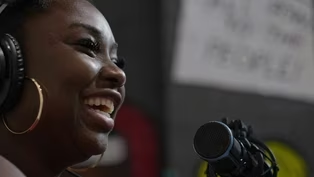
1023: Tampa Bay Breakfast Club Radio
Video has Closed Captions
Clip: S10 Ep23 | 6m 25s | A morning radio show in St. Pete is uplifting the airwaves with their local content. (6m 25s)
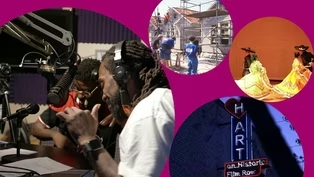
Preview: S10 Ep23 | 29s | Tampa Breakfast Club morning radio, artist Katherine Reynolds, Row Houses and folklore. (29s)
Providing Support for PBS.org
Learn Moreabout PBS online sponsorship

- Arts and Music
The Best of the Joy of Painting with Bob Ross
A pop icon, Bob Ross offers soothing words of wisdom as he paints captivating landscapes.













Support for PBS provided by:
WEDU Arts Plus is a local public television program presented by WEDU
Major funding for WEDU Arts Plus is provided through the generosity of Charles Rosenblum, The State of Florida and Division of Arts and Culture and the National Endowment for the Arts, and the Hillsborough County Board of County Commissioners.