WEDU Arts Plus
Episode 1024
Season 10 Episode 24 | 26m 37sVideo has Closed Captions
Solomon's Castle, Replay Museum, Sponge Docks, Showmen's Museum
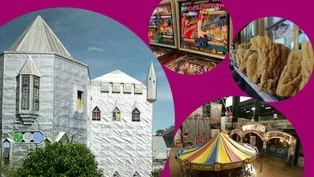
In this local compilation episode of WEDU Arts Plus, tour the 12,000 square foot castle in Ona, built by the late artist, Howard Solomon. The Replay Museum in Tarpon Springs preserves the artistry of retro arcade games. The Tarpon Springs Sponge Docks is a hidden local gem that fuels artistic creativity. The Independent Showmen's Museum preserves the carnival experience in Riverview.
Problems playing video? | Closed Captioning Feedback
Problems playing video? | Closed Captioning Feedback
WEDU Arts Plus is a local public television program presented by WEDU
Major funding for WEDU Arts Plus is provided through the generosity of Charles Rosenblum, The State of Florida and Division of Arts and Culture and the National Endowment for the Arts, and the Hillsborough County Board of County Commissioners.
WEDU Arts Plus
Episode 1024
Season 10 Episode 24 | 26m 37sVideo has Closed Captions
In this local compilation episode of WEDU Arts Plus, tour the 12,000 square foot castle in Ona, built by the late artist, Howard Solomon. The Replay Museum in Tarpon Springs preserves the artistry of retro arcade games. The Tarpon Springs Sponge Docks is a hidden local gem that fuels artistic creativity. The Independent Showmen's Museum preserves the carnival experience in Riverview.
Problems playing video? | Closed Captioning Feedback
How to Watch WEDU Arts Plus
WEDU Arts Plus is available to stream on pbs.org and the free PBS App, available on iPhone, Apple TV, Android TV, Android smartphones, Amazon Fire TV, Amazon Fire Tablet, Roku, Samsung Smart TV, and Vizio.
Providing Support for PBS.org
Learn Moreabout PBS online sponsorship- [Narrator] This is a production of "WEDU PBS," Tampa, St. Petersburg, Sarasota.
Major funding for "WEDU Arts Plus" is provided through The Greater Cincinnati Foundation by an arts loving donor who encourages others to support your PBS station "WEDU," and by the Pinellas Community Foundation.
Giving humanity a hand since 1969.
- [Dalia] In this special edition of "WEDU Arts Plus," featuring a compilation of the quirky, off-beat art stops in West Central Florida.
Tour a castle with galleries fit for a king.
- [Howard] I learned as I went, and I made errors along the way, and some of the errors I have to live with.
I learned whatever I had to learn, and it wound up to be something like 20 or 25 different trades.
- [Dalia] No quarters required for this fun, interactive museum.
- To me, it's gaming therapy, it's very relaxing.
Getting to hit the flippers, just to see how much the game has evolved over the years.
- [Dalia] A peek into the sponge capital of the world.
- We do have a lot of artists that come in here.
If you see a lot of our buildings out on our street, those have been done by a lot of sponge, and they contribute towards the atmosphere in our village.
- [Dalia] And a Riverview Museum that celebrates the art and nostalgia of the traveling show.
- [Man] Everybody comes in here says the same thing.
"I can remember when," "It triggers memories."
Everybody's been to the fair.
Everybody's been to a carnival.
Everybody's ridden a Tilt-A-Whirl.
- It's all coming up next on "WEDU Arts Plus."
(soft classical ambient music) Hello, I'm Dalia Colon, and this is "WEDU Arts Plus."
The late Howard Solomon was an internationally known artist and sculptor who built his own castle near rural Ona, Florida.
This unique building has the facade of a 12,000 square foot medieval castle that is covered with used printing plates, discarded by the local newspaper.
See what lies in store for those willing to get off the beaten path.
(soft acoustic music) - My name is Howard Solomon.
We're in Hardy County, and I've been here for 41 years.
I think of it as my home.
A man's castle is his home.
(gentle ethereal music) My intentions was to build a combination home and studio.
There wasn't enough horizontal land for my plan.
I built the castle because I had to build up instead of out.
And one day reading the local paper, I saw that the paper had an ad to sell printing plates for 10 cents a piece.
And I said, well, that would be a very reflective material, and is rust-proof, and it would make a nice, shiny castle.
I learned as I went, and I made errors along the way, and some of the errors I have to live with.
I learned whatever I had to learn, and it wound up to be something like 20 or 25 different traits.
(ethereal music) When I look at a piece of scrap metal or junk as we call it, it reminds me of something that might look like a nose, or a ear, or hand, (whimsical music) and that's the nucleus of the idea.
Since I have my own junkyard, find pieces to go with it and just weld them together until it looks like something that you don't have to guess what it's supposed to be, it looks like what I intend it to be.
I'd prefer to call my work impressionistic realism.
I've always made wooden pictures, and they're called montage, which means made from one type of material.
I got rather good at it.
I made copies of a modern artists, precise copies to the size and the color, except instead of being on a flat canvas, I made them out of pieces of wood.
(whimsical music) The process of making those animals, actually making the animal twice.
(rousing energetic music) I started out with hoops made out of 1/4" diameter steel, and that creates the basic shapes of the body or the head.
And then, the next stage was to cover the whole sculpture with pieces of metal cut from oil drums.
I could actually stop after the first process and have it what you saw in the animal room with the coat hangers, so it's a wire frame.
In the case of the elephant, and the lion and the eagle hanging from the ceiling, and the fish man, those were frames covered with pieces of oil drum material.
I built this when I lived in the Bahamas in 1968, I think it was.
That's a lampshade with a trumpet valve.
That's a 1910 Ford kerosene lantern.
This is from a Xerox machine with a shock absorber.
The engineer was made out of mattress, thickened in clay.
His eyebrows are almost human hair from 15 different parts of my body, because I don't throw anything away.
(train buzzing) (celestial music) - Growing up out at Solomon's Castle was, I thought everybody's dad was innovative and creative like my dad was.
You really had to keep an eye on your toys, they're able to disappear and be enveloped into a sculpting.
My dad works in the shop every day.
He's almost 80 years old, but I think that's what helps keep him youthful.
He's active.
He'll be in a shop three to four hours a day, sometimes up to six hours.
- [Howard] I started out making little owls, and then from my imagination and looking at different shapes of scrap wood, they turned into pointy head owls, or gnomes.
I cut 'em, I take 'em over to the sander, take off the hard edges.
I take 'em over to the welding table and burn off the fuzz, put some dark color into the torch.
Then I put a little bit of urethane on 'em to cover up the burnt part, so it doesn't come off on your fingers.
And I glue in the eyes and maybe a button nose, and it's all done.
I make hundreds of 'em in a year's time, and then they're inexpensive, and like a souvenir from Solomon's Castle.
- People asking like, how did my dad do?
How could he possibly do so much in a lifetime?
He is very artistic, but I think the difference between my dad and most artists is he also has a great business mind.
- [Howard] I was born an artist and raised in the business atmosphere.
So I have the unusual combination of both.
(ethereal music) My unique situation is, I don't have to sell anything because people are paying me to look at it.
If I sell something, nine times out of 10, I'm gonna have to replace it, because it's foolish to sell something people are paying you to look at.
- My dad pretty much raised me to believe in, if you have a dream, you should go after it, you know, even if other people don't really understand it or accept it, be sure to keep compassion at the front of your brain, and in your heart, and as long as you're not hurting anyone, and even if people don't really accept you or what you're doing, then you should do what where your heart leads you.
- [Howard] I tell people that I retired when I came here, I was 37 years old, and my retirement became a hobby, and then it became a business.
(ethereal music) (ambient music) - [Dalia] To see Solomon's Castle for yourself, visit solomonscastle.com.
The Replay Museum preserves the experience of retro arcade games for generations to enjoy.
Check out this hands-on experience located in Tarpon Springs.
(ambient music) (retro ambient music) - My name is Bobbi.
I work the front desk and help handle our event calendar, try to plan some fun events for people to come out and play for.
I've worked here for four years, I love it.
My husband and I actually had our wedding here, so I love it like it's mine, even though I just work here, Ryan and Becky are just big gamers themselves.
They love amusements.
They love playing games, so I think that they amassed this collection and kind of felt selfish just keeping it all to themselves and wanted to share it with the rest of the world.
- A place like Replay is like a test ground for these games.
We see things break that nobody else sees.
We have problems that nobody else will encounter because of the amount of plays that these games get on them.
You know, longevity is always the goal, wanna make sure each repair is something that's gonna make the game last a lot longer, hopefully, as opposed to like continually going back in and fixing something.
But yeah, there's sort of a checklist as far as like looking for bad connectors, because that can just cause things to overheat if there's not good signal going through.
- [Bobbi] Just cleaning the Pinballs, so that the game will play properly is a big part of it.
- [Stephen] A lot of the older games will switch out to different style of light bulbs and put LEDs inside of them, so just to take away the heat, it draws less power.
So there's certain things like that to keep in mind.
The designers of the game would put notes in the game that a well lit game is gonna be played more, and for that matter, a clean well-lit game.
So it's more like, you know, we got people that come in for the first time, and they kinda just start walking around, and it's kind of hard to say what makes them go up and put their hands on that first game, especially if it's one they haven't seen before, but I think it always comes down to some part of like what they've been through in their life, some part of their history, whether they're into cars or like if it's some kind of movie that they're into.
It could be a band that's highlighted on one of these games.
A lot of it will definitely be like the artwork.
I feel like if you're able to see the game, it's gonna be the art work.
- Who know if it's the colors, if it's the imagination.
I mean, the older pinball machines from the seventies, they definitely pop.
They're trying to be eye-catching, sometimes, maybe slightly suggestive in a sexual manner, but these were back in the days when it was, you know, room full of guys playing pinball, where there weren't really children involved, maybe not women around.
So you can see the kind of development and change of art, kind of moving back from risky art pieces and being more family friendly.
- [Stephen] I mean, you can find out a lot about yourself just by playing games, whether it's just by yourself, you can kind of tell like how competitive of a person you are, and how well you deal with like stressful situations.
- To me, it's gaming therapy.
It's very relaxing, getting hit the slippers.
Just to see how much the game has evolved over the years.
I just love it.
(chuckles) - [Stephen] In a place like Replay with the games that we have here, this style of gaming is something where, even if you're playing by yourself, you still have like a social connection with people, whether you hear somebody yelling out of frustration because they just lost the ball, or somebody is like cheering, because they just got a replay on an insanely high score.
We definitely have people coming in that are trying to set high scores.
Replay is known for having scores that are just like super hard to beat, because of how many people come in and play the games.
- [Ryan] I had a number three, number four for a little bit, and I've been surpassed, so I gotta have to go chase it again.
- [Bobbi] My best high score here is gonna be my GC on Tales of Arabian Nights, it's 44 million.
I got to the wizard mode and rescued the princess.
Part of my like high score chase isn't even technically the score, it's more beating the game and reaching that wizard mode, whatever that final objective is.
- My son is in the Navy now, he's up in South Carolina, I'll send him like a text message real quick, and say, "Look at the score I just put up."
And he'll do the same thing, he goes out in the community, and he's able to play Pinball or any of the video games.
He'll send me a score back.
So it's a way for us to stay in contact with each other and connect, even though we're, you know, hundreds of miles apart.
- Seeing the generations actually come together, enjoy and love these games is why I do what I do.
I know we're doing the right thing.
I know we're here for the right reasons, and we're sharing all this fun with generations to come 'cause we need the younger kids to be interested in this.
If there's any history or future for arcades, we gotta get kids playing.
We gotta get kids playing Pinball.
We gotta get kids playing the retro games 'cause someone's gotta be interested once we're gone.
(melodic music) - [Dalia] For more information, visit replaymuseum.org.
Experience the hidden gem that is the Tarpon Springs Sponge Docks.
From Greek culture, food and natural sponges, these docks are a must sea.
Learn how the sponges fuel the creative work of artists at the docks and beyond.
(classical piano music) - These sponge grows in the Gulf of Mexico because it's most plentiful with plankton in the water, which filters through the sponge and gives it that natural immunity against mold and bacteria.
- There's several types of different grades of sponges that are harvested around the world.
The best quality sponges that we get out here are the best sponges in the world.
There's a lot of processing work that goes into the production of sponges before you buy it at these stores down here in Tarpon Springs.
Conventionally a boat like the one behind me would hold a crew of six men, with two of those men being divers.
So in the early days, it would run through families, and you would see the sons, and the uncles and so forth, really owning the boats and running the boats.
The early settlers department came from the 12 islands of Greece, those are Guinea's islands.
The reason they moved here is a gentleman by the name of John Cheyney came into this area who was an importer/exporter and made an assumption that there were sponges out here in the Gulf of Mexico.
The 12 islands of Greece had already been sponge diving for thousand years, so he contacted an associate of his by the name of John Cocoris who brought the early Greeks here from the 12 islands of Greece.
The name of the main street here is called Dodecanese Boulevard.
(classical ethnic music) Suit is made out of two layers of canvas.
One layer rubber, it's watertight as well as skin tight, but once he puts his suit on, the head deckhand will then start putting on the weights of the suit, starting with the shoes, weighing 12 pounds a piece.
The brass on his shoulders that the helmet can actually weight 22 pounds, and the helmet itself weighing 38 pounds.
Every time this man goes to work in a sponge diving suit, his suit weighs 172 pounds.
(classical ethnic music) - My name is Robin Saenger, and I'm an artist here in Tarpon Springs, Florida.
I've been doing this for a long time, so I have a lot of art on display all around the area, but also around the United States, and actually around the world.
My favorite kind of art is one that is very personal with symbols, creating something really meaningful for people.
(classical ethnic music) Tarpon Springs is a unique energy here.
(classical ethnic music) The culture, the Greek culture of course, but also the arts, the history.
(classical ethnic music) The trees, the shoreline where the oldest community in Pinellas County, we have the most shoreline.
We have tons of parks.
So part of my inspiration, I draw from nature.
From looking at this beautiful area that we live in, and it's absolutely stellar.
It's hard to not live in a place as long as I've lived here and not have it affect you, affect your psyche and your spirit, and your energy.
My studio is actually in a sponge warehouse that was built around the turn of the century.
So when I moved into this studio, I found all kinds of sponge paraphernalia in the attic.
I found the big sponge baskets and bags, and bags of sponges.
So of course, I had to mess around with the sponges.
I had to play with them and paint with them, and also sent them to artists I know who are interested in decorative techniques.
- We do have a lot of artists that come in here, and that's because we are the Sponge Capital of the World.
If you see a lot of our buildings out on our street, those have been done by a lot of sponge, and they contribute towards the atmosphere in our village.
The best to paint with, it depends what texture you want.
A lot of people use these for doing their clouds and their trees and their grasses.
This is four thaw painting, because it's a harder texture than your yellow sponge, or than your wool sponge, because this is the durable, luxurious bathing sponge.
(classical piano music) (ambient music) - [Dalia] To learn more about the area, history and must-see attractions, visit spongedocks.net.
The sights, sounds and smells of carnival life are a unique cultural and artistic experience.
A museum in Riverview attempts to capture that nostalgia by housing, all kinds of carnival memorabilia.
Pieces of Americana on display for future generations.
(gentle chiming music) - [Doc] This is the International Independent Showman's Museum, and it's a $2 million building with $10 million worth of artifacts under the roof.
All the artifacts that you see here are donated by the members of the International Independent Showman's Association, which is the big building across the street over there.
It's a 5,000 member fraternal organization of carnival and circus people who make their living on the road.
Well, I got involved with this when I was about 14 years old, and I'm one of those guys that ran away with a carnival, and I never looked back.
Well, many years ago, several enterprising showman were sitting around having lunch, maybe a cup of coffee.
And they decided that they wanted to preserve the history of this business for future generations who might come behind them, never knowing how fast this business has disappeared and was going to disappear, but they had enough foresight to preserve some of this stuff, instead of hauling the curve as trash.
And we're very fortunate that they did because as you see today, it's priceless, most of these items are one of a kind.
They took 200 acres of what was formerly swamp land, and developed an immense project, which was going to be their world's fair.
And many, many things were exhibited for the first time at the world's fair.
The Midway was coined during that Chicago world's fair.
The first Ferris wheel built by George Washington Ferris was debut at the world's fair.
It stood 241 feet high, weighed 4,000 tons.
And the cars were as big as city buses.
Took 22 minutes to make a revolution.
You have to separate carnivals from circuses.
Circuses are performers with animals.
Carnivals are basically rides, concessions, food.
Now the Royal American Shows was a carnival.
It traveled on 96 railroad cars at its height.
At one time, it employed almost a thousand people.
We were very fortunate to have acquired the Sportland Arcade sign from the Win family in Lebanon, Tennessee.
It was in front of the Sportland Arcade.
It was transported by a wagon in a railroad car, along with other wagons, and it moved every week.
At one time, initially carnivals only had one or two, maybe three rides on their midway, but they might have 15 to 20 shows out there.
One of the premier shows was the "Girl Show."
It was actually a "Vaudeville" show.
It wasn't the hoochie coochie shows that you see today.
The cities and towns of the day didn't allow for that type of undress.
They had a comedian, a singer, several costume dancers.
They put on a "Vaudeville" show and it lasted about an hour, so you really get your quarters worth.
(classical carnival music) The "Minstrel" show actually developed out of the ashes of civil war.
It was one of the first traveling shows in America, and it was an all black affair.
Eventually it spun off in white, the white segment of society took it over, and that's where "Vaudeville" stemmed from.
But the black performers stayed true to their minstrel roots.
The "Minstrel" shows are actually where blues music came from, if it weren't for the venue of the minstrel show, we wouldn't have blues music today.
"Joie Chitwood's Thrill Show" is you see it still around today.
Joey Chitwood comes in every once in a while and talks to us and has donated many, many things.
This model was built by a man named Ray Gentner, and he spent 26 years of his life building this little model, section by section in his basement.
I don't know how many pieces there are, because I've never counted them, But Mr. Gentner had a sense of humor, and he built little pieces with tongue and cheek humor into the model.
And if you look carefully, you'll see what I'm talking about.
I won't give it away, but it's really funny.
Someday, our grandchildren's grandchildren are one-on-one to know what made this business what it is, because soon it will all be gone, and it'll never be again.
And this will be the only repository of all that information for them to come and get a sense of the wonder that we felt when we were out here making this business happen.
Everybody comes in here, says the same thing.
"I can remember when."
"It triggers memories."
Everybody's been to the fair.
Everybody's been to a carnival.
Everybody's ridden a Tilt-A-Whirl, and it has something unique and on an individual basis for every living human being that comes through here.
They take away a certain sense of fond memories, and, you know, the American dream.
(carnival music) (ambient music) - [Dalia] Find out more about the museum and current exhibitions at showmansmuseum.org.
And that wraps it up for this edition of "WEDU Arts Plus."
For more arts and culture, visit wedu.org/artsplus.
Until next time, I'm Dalia Colon, thanks for watching.
(brooding upbeat music) - [Narrator] Major funding for "WEDU Arts Plus" is provided through the Greater Cincinnati Foundation by an arts loving donor who encourages others to support your PBS station "WEDU," and by the Pinellas Community Foundation.
Giving humanity a hand since 1969.
(airy music)
Preview: S10 Ep24 | 29s | Solomon's Castle, Replay Museum, Sponge Docks, Showmen's Museum (29s)
Providing Support for PBS.org
Learn Moreabout PBS online sponsorship

- Arts and Music
The Best of the Joy of Painting with Bob Ross
A pop icon, Bob Ross offers soothing words of wisdom as he paints captivating landscapes.












Support for PBS provided by:
WEDU Arts Plus is a local public television program presented by WEDU
Major funding for WEDU Arts Plus is provided through the generosity of Charles Rosenblum, The State of Florida and Division of Arts and Culture and the National Endowment for the Arts, and the Hillsborough County Board of County Commissioners.