WEDU Arts Plus
Episode 1025
Season 10 Episode 25 | 26m 45sVideo has Closed Captions
Arts Plus 1025
Fine art painter Melvin Gomez shines as a student at Ringling College of Art and Design. Artist Erin Beckloff shares the tradition and history of the letterpress. In Mount Vernon, Ohio, a family has been crafting handmade leather goods for four generations. Dancing Ewe Farm keeps the culinary arts alive through cheese making, cured meats and olive oil.
Problems playing video? | Closed Captioning Feedback
Problems playing video? | Closed Captioning Feedback
WEDU Arts Plus is a local public television program presented by WEDU
Major funding for WEDU Arts Plus is provided through the generosity of Charles Rosenblum, The State of Florida and Division of Arts and Culture and the National Endowment for the Arts, and the Hillsborough County Board of County Commissioners.
WEDU Arts Plus
Episode 1025
Season 10 Episode 25 | 26m 45sVideo has Closed Captions
Fine art painter Melvin Gomez shines as a student at Ringling College of Art and Design. Artist Erin Beckloff shares the tradition and history of the letterpress. In Mount Vernon, Ohio, a family has been crafting handmade leather goods for four generations. Dancing Ewe Farm keeps the culinary arts alive through cheese making, cured meats and olive oil.
Problems playing video? | Closed Captioning Feedback
How to Watch WEDU Arts Plus
WEDU Arts Plus is available to stream on pbs.org and the free PBS App, available on iPhone, Apple TV, Android TV, Android smartphones, Amazon Fire TV, Amazon Fire Tablet, Roku, Samsung Smart TV, and Vizio.
Providing Support for PBS.org
Learn Moreabout PBS online sponsorship- [Announcer] This is a production of WEDU PBS, Tampa, St. Petersburg, Sarasota.
Major funding for WEDU Arts Plus is provided through The Greater Cincinnati Foundation by an arts-loving donor who encourages others to support your PBS station WEDU, and by the Pinellas Community Foundation, giving humanity a hand since 1969.
- [Dalia] In this edition of WEDU Arts Plus, a local art student uses his paintings to help encourage peace.
- I don't want to glorify violence.
At the same time I want also the viewers to find their own interpretation when they confront my painting.
- [Dalia] The art of letter press.
- Letterpress printing, as it became an art form or a craft, it still has that limited constraint of working with the wood and the metal and the wood and metal type and the ornaments.
- [Dalia] Handmade, hand-tooled leather creations.
- Well, it's got this magic aroma that people seem to like.
The fibers are very tough.
You can cut them in almost any direction.
- [Dalia] And the tastes of Tuscany.
- The important thing is using few ingredients, but very good quality.
Don't mess up too much with different flavors.
Just keep it simple.
- It's all coming up next on WEDU Arts Plus.
(bright music) Hello, I'm Dalia Colon, and this is WEDU Arts Plus.
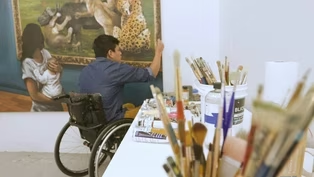
Let's head to Ringling College of Art and Design in Sarasota to meet senior Melvin Gomez.
We visit his studio to learn how he's using his talent to give back to his home country of El Salvador.
(soft music) - Since my childhood, I was supposed to be creative by making my own toys with the material that I found in nature, including wood, clay, rock.
And since then, I have been really interested in art, and one of my neighbors, he's a painter and I always looked at him, he's working.
At some point I asked him if he was willing to teach me because he don't teach, and he said yes, so I start having classes with him, with my neighbor, and that's how I start getting truly into painting and drawing.
(soft music) In 2014, I got the opportunity to study visual art in an international school in Norway, and I met Kimberly White, Associate Director, International Mission from Ringling.
I knew about the fine art program and I say, I want to go there.
- As department head, I look at all the applications, and when Melvin arrived, he came from the school in Norway, so I thought he would be Norwegian.
And then he showed up on campus, and obviously he was not Norwegian.
He's a really gifted painter.
He's expressive, he's got great content that's there.
He's trying to deal with the human condition and bigger issues, but just in the general way of applying paint, I just love his surfaces and a sense of color and composition and form and the brush marks.
- He knows that his hand can make certain marks that no one else's can.
This kind of mark is more appropriate for the horse.
This kind of mark is more appropriate for the figure.
This kind of mark is more appropriate for the landscape or the light source and the clouds.
That ability to grasp that and to organize it and then to adjust it continuously is like, I think everyone who has worked around Melvin knows that his trajectory is superstar level, and we're all glad just to be part of it.
I would say it's incredibly rare, and the level of sophistication that goes into not just great technical skills as far as rendering, but seeing some of the compositions, you start to see right away, oh, there's dynamics of interaction, social, political and historic as well.
- There is really a strong composition to see children shooting a horse, but I grew up in El Salvador around that social context with guns.
I don't want to glorify violence.
At the same time, I want also the viewers to have their own interpretation when they confront my painting.
Because for instance, the painting in the back is a concert of life and death.
- You can talk about philosophy with Melvin.
You can talk about political things.
You can talk about really deep, intellectual associations of subject matter that oftentimes you never get to that point in a conversation with students.
- My art has some classical approach in my artistic process, but at the same time I'm trying to pursue and find my own voice.
- He knows what he's doing, and we're just here to help along with technical advice, conceptual advice, maybe some references or historic context, but the subject matter, the themes, what he's creating, inventing and transferring to the surface, that's entirely his, and it's beautiful.
- That is my main inspiration, to express human condition, emotion, feelings, and desire, and I use my personal experience as an inspiration.
(soft music) In 2009, my life changed forever.
(soft music) I was a victim of gun violence in my country.
(soft music) I saw art, in a way it was, it gave me hope and motivation to move forward in life.
I wake up happy to pursue my passion, and I'm so happy to come to my studio because there is a painting waiting for me.
- There's been times where I've come in here, like there's been a Thursday class and I come back in on Monday and I'm like, how did you even do all this work?
Did you sleep?
- I am gonna graduate in May next year.
My goal at the moment is to teach.
Also I want to go back to my country and share what Ringling taught me.
I went back to my country after I finished my studies in Norway and I opened an art school for children with the mission of breaking the cycle of gun violence and providing the tool to create art three years ago with my neighbor who taught me painting classes.
I told him while I'm not here, you are in charge from the art school, and when I come back, I'll take full responsibility.
My main focus is to keep them busy and spend their time positive.
- It'd be great for Melvin to stay here.
I think he'd be an incredible asset to the community and a great leader, and maybe he'll come back, but I think he could bring all those traits back to his home country and really build something special over there.
- It's truly important.
Painting to me, in some way, I will say saved my life because it truly gave me a new perspective in life and I don't see myself doing something else.
(soft music) - Check out more of Melvin's artwork on Instagram.
just search @melvingomezart.
Artist Erin Beckloff loves the tradition and history of letterpress.
As a professor, Beckloff tries to keep the craft of letterpress alive by educating her students and the public about the art form.
- Letterpress printing is a method of relief printing.
While technology shifted, letterpress printing was the method of printing for over 500 years, and it's no longer economically the fastest way to print, but there's something that people are still connecting to, and I think that's why it's become an art and a craft.
My in-laws gave me a small printing press as a wedding gift, so I got this little printing press and I didn't know how to use it, and so I started reaching out to people in the letterpress community for help, because you can search for it on the internet and there are some videos, but it's so much better to go and meet with someone.
I started to find that there were other people that cared about this, and there were other people that had printing presses in their basements or garages, and it wasn't just people in their twenties and thirties.
It was also people in their eighties.
So it was fantastic to find this community that wanted to help each other.
There aren't really secrets.
It's everyone wants to help letterpress printing survive, and so everyone's willing to help each other out, be it by finding equipment or teaching a technique or learning a new process or talking about how to mix ink.
Everybody helps each other.
Letterpress printing, as it became an art form or a craft, it still has that limited constraint of working with the wood and the metal and the wood and metal type and the ornaments, and your collection tends to influence your aesthetic as a shop.
If you think of someone like Hatch Show Print down in Nashville, Tennessee, they're using blocks that might've been used on a Johnny Cash poster, and now they're being used on a contemporary country music poster.
To think about that that collection is then influencing your aesthetic, when I started to acquire type, I became very interested in wood type.
I love the beauty of the letters.
I love that so many of the wood type fonts were made over 100 years ago and we're still able to use them today.
I like how big and bold they are, and that was just something I really connected with.
My dad actually makes wood type the same way that it was produced for hundreds of years by all the wood type manufacturers.
Hamilton Wood Type and Printing Museum, most people have seen Hamilton on a little drawer pull.
That's that group.
They made type using this pantograph method, which is a dual tracer and router, and so you trace the pattern of the letter or the ornament, decorative ornament, and then it cuts the type out of end grain maple.
A lot of my style and aesthetic came from the fact that my dad, Scott, of Morwood Type, started making type the historic way.
I started really exploring how these ornaments could be used to create form and solids and even letter forms and characters.
I really like to use my dad's ornaments as a main component of my work.
I love the traditional tools of letterpress printing.
The wood and the metal type, the metal type's really small and can get this very crisp line.
Some of the fonts are only available in wood and metal, they never made it to the computer, which is just special.
I just love the history that you know is in every letter that you're setting.
It's been used before, and so being able to give it life by continuing to print with it is just something that I connect to as a tool and as my main driving force of my aesthetic as a printer.
(press clicking) Letterpress printing in a lot of ways is almost meditative.
You become one with the press that you're using, and if it's your own press especially, you start to hear and know the quirks of the press, and they all have their own sound.
Each press has its own rhythm and music to it.
Especially when you're running one of the larger presses like my Chandler and Price CMP with the flywheel, you can feel that motion, and I stand against it, and you're a part of the rhythm of the printing, and so you're feeding it the paper and it continues to run and you hear the cha-chink, cha-chink of the cast iron or you hear the little glitches of the gears and it's a wholly immersive experience and it really makes you slow down, because you can't go faster than the press.
After getting my very first press, I had a business for about a year trying to sell commercial work, and that just really wasn't for me.
I tried to do the craft fairs and the art fairs.
I just really loved making, and I really love people.
And so I came back to my alma mater where I received my undergrad in graphic design, and they had a letterpress shop that was sitting unused.
I had the opportunity to teach a class, to teach students how to be letterpress printers, which quite honestly, I was still learning myself and continue to today.
I started teaching letterpress as an elective.
I had great groups of students for every semester.
So nine years, every semester we've offered letterpress printing, sometimes multiple sections.
It's wonderful to watch my students pull their first print, because they pull that first print off the press and just kind of a light goes on.
Watching them discover how fascinating letterpress printing can be is immensely satisfying and joyful for me.
Pressing On: The Letterpress Film is a documentary about the survival of letterpress printing and specifically the community that have kept it alive.
It is both the older generation that held on to the equipment and the knowledge through a time when letterpress printing was not popular and also the new generation that are continuing to keep it going.
So I would say I'm a member of the new generation.
As I became a part of the community and started to make these connections with these 70 and 80 year old printers, I knew that that knowledge was gonna get lost if we didn't record it in some way.
Through making the film, I got to see the way letterpress had been a part of all of these people's lives since they were young.
So some of the older printers in the community had become apprentices when they were 12 or 15 years old with their families, and so I got to hear the way that letterpress printing had driven their life path and how special it is to them to know that there's a young generation that still cares about this process, this medium, this trade that they love.
The printers that held this knowledge, a lot of it was never recorded in books.
I've taken on this role as educator and filmmaker and created a shop at a university, and they seem to connect to it, and so many of them have gone on to actually buy their own presses, which I never imagined.
I love that it's a part of their lives, but now they have their own presses that they're learning how to use and learning their presses' quirks.
I love to see that engagement and that they want to continue to help be a part of the letterpress community.
Using letterpress printing equipment is what's keeping it alive.
Having a wood type font sit in a drawer or behind glass somewhere isn't gonna keep it going.
When you're continuing to print it, it not only is putting oil back into the wood and keeping those characters in good condition, but by printing it, you're then sharing it with more people, which is keeping letterpress printing alive.
So it's both the use and the people that are continuing to keep letterpress going.
- For more information, visit erinbeckloff.com.
In Mount Vernon, Ohio, four generations of one family have been creating handmade, hand-tooled leather goods.
From carpet bags and purses to belts and key chains, this family has been working in the same building since 1969.
(mellow music) - You're in Down Home Leather.
We manufacture and make and design all the products in this store, and everything is made right here in Mount Vernon.
(mellow music) We started in 1969, so we have been here almost 50 years.
I grew up in a leather shop that my father ran in Mount Vernon, and his father also had a leather shop.
Me and my son produce 90% of it.
My wife cleans up our act.
She's the quality assurance to make sure the things we bring are finished, or she sends them back.
- I'm the one who picks out the leathers because I like what I see, and I also do trim work and zipper work.
We have a lot of different colors.
We have eggplant and a green and gold and yellow, all my favorite colors, we really do, that are fall colors.
(soft music) - Well, it's got this magic aroma that people seem to like, and I do, especially.
The fibers are very tough.
You can cut them in almost any direction.
It's not like material that you have to be so careful of which way the fabric is pulling or stretching.
It's got a tough resiliency and nice to work with.
You look at several things and you say, well, if we made this better or a different color, it's gonna look really nice.
So you have your own inspiration and your own ideas that bring forth these ideas, and hopefully somebody else is gonna agree with you.
We enjoy putting things together and getting it finished.
(hammer tapping) It sometimes does not behave itself and sometimes it's different than it should be, and other times it's not as resilient as it should be, and every hide is completely different.
(soft music) One mistake that people make with leather is when you get leather wet, you do not want to get it near heat.
Don't try to dry it in any kind of heat or put it in the sun.
If you just let it at a cool temperature dry naturally, it will not hurt it at all.
(soft music) - After all these years, I see people that they have bought purses from us 30 years ago, and they're still carrying them and they tell me about it.
Makes me feel fantastic, it really does.
- I mean, it's an enjoyable business at this point.
I hope it can stay this way.
I don't want to increase production to a mind-boggling thing or anything else.
As long as we can keep people happy, that's an enjoyable part of whatever anybody's doing.
- To see more leather goods, visit facebook.com/thewagonersdesigns.
In upstate New York, the culinary arts are thriving.
From farm to table, the art of cheesemaking, cured meats and olive oil are front and center.
(upbeat music) - Dancing Ewe Farm is a sheep farm.
We have 120 ewes.
We have some chickens, a couple of dogs and a couple of cats.
We make sheep's milk cheeses, we make cured meats, of course, Italian style everything, and we import wines from the Maremma and we also make our own olive oil in Tuscany and bring it back.
Everything started with cheese.
My husband Jody came to Italy, to Tuscany, to learn how to make sheep's milk cheeses, specifically Pecorino Tuscano, because after he did some research, he figured out that that one was the best sheep's milk cheese made in the world, and through connections, friends of friends, he landed to La Parrina.
La Parrina is a farm where I was working at the time, and that's how we met.
Something happened, sparkles came through there and we decided to give it a try, and so the next spring, I quit my job at La Parrina and moved here.
(upbeat music) So the milk comes into here.
That's where we make the cheese.
We'll make some fresh or aged cheese, and we also make ricotta.
I feel that the important thing of my style cooking, which is just like every mother's in Italy or in Tuscany actually, I should say, is the important thing is using few ingredients, but very good quality, and don't mess up too much with different flavors.
Just keep it simple.
(upbeat music) Today, as every Wednesday, we are making cured meats and also fresh sausages.
The farm started with the idea of making cheese.
Honestly, with all the sheep, we were going to have like 200 sheep maybe, and that was going to be our only focus of the farm.
Then we quickly realized that we needed other things.
The cheeses were great, but we needed cured meats to go along with it.
As you know, our heart and soul are in Tuscany.
And then the cured meats and cheeses was a great start, but we needed something else, olive oil.
And then the three items were wonderful, but we needed wine, and who knows what the next step would be?
So right now we're just making the cacciatorini, into links, and we do links of six so then we can hang them nicely.
Cacciatorino, singular, cacciatorini, plural, means little hunters, because it's the perfect cured meat as you saw it.
They're aged, so they can be out of the refrigerator for a while, for a few hours, and taste awesome.
The hunters will just put the cacciatorini on their back pocket of their jacket and go hunting with it, and that will make the perfect snack.
So we made the cacciatorini and we made two fresh sausages.
One is with rosemary, which we call rosmarino.
The other one is with beer, and we call it birrata.
The important thing I feel with the cacciatorini and both of the fresh sausages and also the other fresh sausages that we make is to use few ingredients again.
So everything is pork, salt, pepper, wine or beer for the birrata and rosemary for the rosmarino one.
(upbeat music) - [Man] A little bit goes a long way.
- When people come for lunch or dinner, I think the best comments that I hear is one, that they feel like they were invited to our house, and two, that they create connections with other people that they didn't know before coming here.
I want people to feel that they came to our family.
- To learn more, visit dancingewefarm.com.
And that wraps it up for this edition of WEDU Arts Plus.
For more arts and culture, visit WEDU.org/artsplus.
Until next time, I'm Dalia Colon.
Thanks for watching.
(exciting music) - [Announcer] Major funding for WEDU Arts Plus is provided through The Greater Cincinnati Foundation by an arts-loving donor who encourages others to support your PBS station WEDU, and by the Pinellas Community Foundation, giving humanity a hand since 1969.
(soft music)
Video has Closed Captions
Clip: S10 Ep25 | 6m 55s | Melvin Gomez, Fine Art Painter (6m 55s)
Providing Support for PBS.org
Learn Moreabout PBS online sponsorship

- Arts and Music
The Best of the Joy of Painting with Bob Ross
A pop icon, Bob Ross offers soothing words of wisdom as he paints captivating landscapes.













Support for PBS provided by:
WEDU Arts Plus is a local public television program presented by WEDU
Major funding for WEDU Arts Plus is provided through the generosity of Charles Rosenblum, The State of Florida and Division of Arts and Culture and the National Endowment for the Arts, and the Hillsborough County Board of County Commissioners.